Economics 2 Professor Christina Romer Spring 2017 Professor David - - PDF document

economics 2 professor christina romer spring 2017
SMART_READER_LITE
LIVE PREVIEW

Economics 2 Professor Christina Romer Spring 2017 Professor David - - PDF document

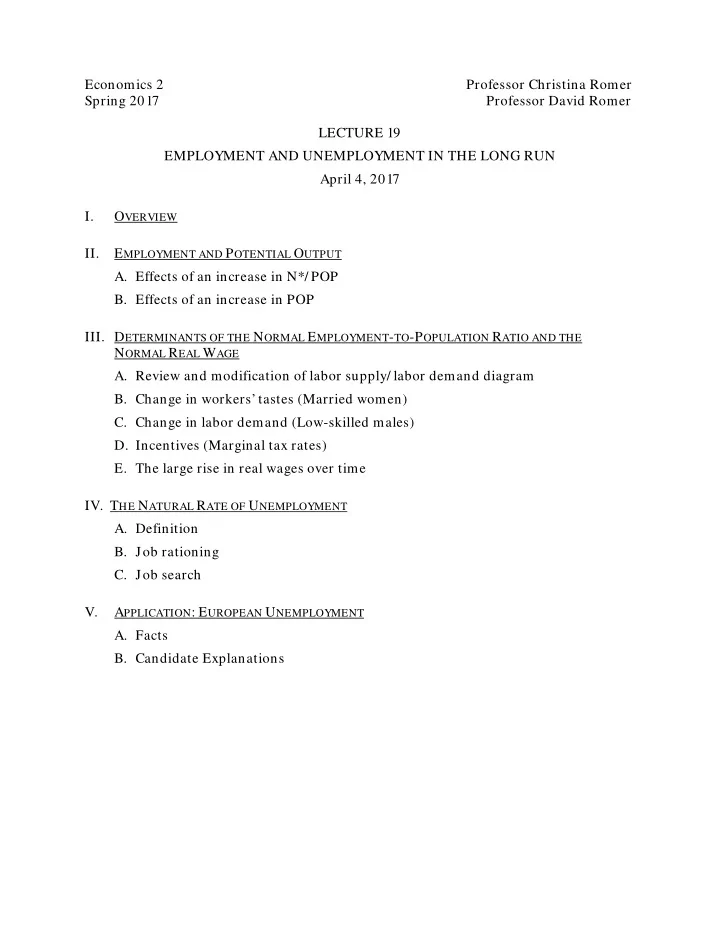
Economics 2 Professor Christina Romer Spring 2017 Professor David Romer LECTURE 19 EMPLOYMENT AND UNEMPLOYMENT IN THE LONG RUN April 4, 2017 I. O VERVIEW II. E MPLOYMENT AND P OTENTIAL O UTPUT A. Effects of an increase in N*/ POP B. Effects


slide-1
SLIDE 1

Economics 2 Professor Christina Romer Spring 2017 Professor David Romer LECTURE 19 EMPLOYMENT AND UNEMPLOYMENT IN THE LONG RUN April 4, 2017 I. OVERVIEW

  • II. EMPLOYMENT AND POTENTIAL OUTPUT
  • A. Effects of an increase in N*/ POP
  • B. Effects of an increase in POP
  • III. DETERMINANTS OF THE NORMAL EMPLOYMENT-TO-POPULATION RATIO AND THE

NORMAL REAL WAGE

  • A. Review and modification of labor supply/ labor demand diagram
  • B. Change in workers’ tastes (Married women)
  • C. Change in labor demand (Low-skilled males)
  • D. Incentives (Marginal tax rates)
  • E. The large rise in real wages over time
  • IV. THE NATURAL RATE OF UNEMPLOYMENT
  • A. Definition
  • B. Job rationing
  • C. Job search

V. APPLICATION: EUROPEAN UNEMPLOYMENT

  • A. Facts
  • B. Candidate Explanations
slide-2
SLIDE 2

LECTURE 19

Employment and Unemployment in the Long Run

April 4, 2017

Economics 2 Christina Romer Spring 2017 David Romer

slide-3
SLIDE 3
  • I. OVERVIEW
slide-4
SLIDE 4

Aggregate Production Function

(1) (2) (3)

slide-5
SLIDE 5
  • II. EMPLOYMENT AND POTENTIAL OUTPUT
slide-6
SLIDE 6

Decomposition of Potential Output per Person

where:

  • Y* is potential output;
  • POP is population;
  • N* is normal employment.
  • is the normal employment-to-population ratio.
  • is normal average labor productivity.
slide-7
SLIDE 7

Employment-to-Population Ratio in the U.S.

Source: Frank, Bernanke, Antonovics, and Heffetz, Principles of Economics.

slide-8
SLIDE 8

Source: Charles Jones and Dietrich Vollrath, Economic Growth.

slide-9
SLIDE 9

Employment and Potential Output

  • Increases in will raise .
  • But, the effect is limited:
  • can’t vary very much.
  • There are countervailing effects on average

labor productivity: An increase in POP for a given lowers because it reduces .

slide-10
SLIDE 10
  • III. DETERMINANTS OF THE NORMAL

EMPLOYMENT-TO-POPULATION RATIO

AND THE NORMAL REAL WAGE

slide-11
SLIDE 11

The Labor Market

S D w N

slide-12
SLIDE 12

Long-Run Labor Market Diagram

S D (MRPL/P) Real Wage, w* w1

N* N1

slide-13
SLIDE 13

Labor Force Participation Rate, Women, U.S., 1962–2017

Source: FRED.

slide-14
SLIDE 14

Source: Claudia Goldin, “Gender Gap,” The Concise Encyclopedia of Economics.

slide-15
SLIDE 15

An Increase in Labor Supply (Women in the U.S.)

S1 D1 (MRPL/P) Real Wage, w* w1

w2

N* N1

∗N2 ∗

S2

slide-16
SLIDE 16

Labor Force Participation Rate, Women, U.S., 1962–2017

Source: FRED.

slide-17
SLIDE 17

Female Labor Force Participation Rate in the U.S., the U.K., and Japan

Source: Organisation for Economic Co-operation and Development (OECD).

50 55 60 65 70 75 1971 1975 1979 1983 1987 1991 1995 1999 2003 2007 2011

U.S. U.K. Japan

slide-18
SLIDE 18

Labor Force Participation Rate – High School Graduates, No College, 25 yrs. & over, Men, 1992–2017

Source: FRED.

slide-19
SLIDE 19

A Fall in Labor Demand (Less Educated Men)

S1 D1 Real Wage, w* N* w1

w2

N2

∗ N1 ∗

D2

slide-20
SLIDE 20

Average versus Marginal Income Tax Rates

  • Average tax rate: Total income tax/total income.
  • Marginal tax rate: The tax paid on an additional

dollar of income.

slide-21
SLIDE 21

Labor Supply When There Are Taxes

  • Think of a household choosing between leisure

and everything else that it likes.

  • Recall: Condition for utility maximization:

MULeisure MUEverything Else PLeisure PEverything Else

  • What is PLeisure? That is, what is the opportunity

cost to the household of consuming 1 more unit of leisure?

  • PLeisure = (1 − t)•wage, where t is the marginal tax

rate. =

slide-22
SLIDE 22

A Reduction in the Marginal Tax Rate

S1 D1 (MRPL/P) Real Wage, w* w1

w2

N* N1

∗N2 ∗

S2

slide-23
SLIDE 23

Real Wages in the U.K. over the Very Long Run

From: Clark, “The Condition of the Working Class in England, 1209-2004”

slide-24
SLIDE 24

Large Increases in Capital and Improvements in Technology

S1 D1 Real Wage, w* w1

N* N1

∗ N2 ∗

D2 w2

slide-25
SLIDE 25
  • IV. THE NATURAL RATE OF UNEMPLOYMENT
slide-26
SLIDE 26

The U.S. Unemployment Rate, 1948–2017

Source: FRED; data from Bureau of Labor Statistics.

slide-27
SLIDE 27

Unemployment in the U.S., Japan, and France

Source: FRED.

slide-28
SLIDE 28

The Natural Rate of Unemployment

  • The economy’s normal or usual unemployment

rate.

slide-29
SLIDE 29

Types and Sources of Unemployment

  • Cyclical unemployment
  • Caused by output being below potential
  • Structural unemployment
  • Caused by job rationing
  • Frictional unemployment
  • Caused by turnover and job search

Normal or natural unemployment consists of structural and frictional unemployment.

slide-30
SLIDE 30

Job Rationing

S D (MRPL/P) Real Wage, w* w1

N* ND

∗ N1 ∗ NS ∗

w

  • Structural

unemployment

slide-31
SLIDE 31

Sources of Job Rationing

  • Minimum wage laws
  • Unions
  • Efficiency wages
slide-32
SLIDE 32

Frictional Unemployment

  • It takes time to match workers and jobs.
  • At the micro level, the economy is constantly

changing.

  • As a result, at any time there are both

unemployed workers and job vacancies.

  • This process is sometimes described as “churn.”
slide-33
SLIDE 33
  • V. APPLICATION OF OUR LONG-RUN LABOR MARKET

FRAMEWORK: EUROPEAN UNEMPLOYMENT

slide-34
SLIDE 34

Unemployment in the Euro Area (blue), Germany (red), and Italy (green), 1993–2016

Source: OECD.

slide-35
SLIDE 35
slide-36
SLIDE 36

Some Candidate Sources of High Natural Rates

  • f Unemployment in Europe
  • Measurement issues
  • High minimum wages and strong unions
  • High payroll taxes
  • High firing costs
  • High marginal tax rates
  • Generous unemployment compensation
slide-37
SLIDE 37
slide-38
SLIDE 38

A Wage Floor

S D Real Wage, w* N* ND

∗ NS ∗

w

  • Unemployment
slide-39
SLIDE 39

Payroll Taxes, Selected Countries

Source: Wall Street Journal.

slide-40
SLIDE 40

High Payroll Taxes in the Presence of Job Rationing

S1 D1 Real Wage, w* N* ND2

∗ ND1 ∗ NS ∗

w

  • Unemployment2

D2

Unemployment1

Tax

slide-41
SLIDE 41

Firing Costs: The Example of Italy

“The laws are so unclear that many dismissals of workers end up in the country’s dysfunctional court system, where if a judge decides a worker was let go unfairly, he will likely rule that the employer has to reinstate him with back pay for the time he was gone. ‘When an investor asks about severance costs, all the

  • ther countries can provide an answer,’ says Pietro

Ichino, an Italian senator and professor of labor law at the University of Milan. ‘Italy can’t.’ Duccio Astaldi, president of Condotte, one of Italy’s largest construction companies, says the difficulty of firing

  • ften prevents him from hiring when times are good.”

Source: “Italy’s Labor Pains,” BusinessWeek, 11/16/2011.

slide-42
SLIDE 42

Firing Costs (in the Presence of Job Rationing)

D1 Real Wage, w* N* ND2

∗ ND1 ∗ NS ∗

w

  • Unemployment2

D2

Unemployment1

S1

slide-43
SLIDE 43

Source: OECD.

slide-44
SLIDE 44

Problems with the High Marginal Tax Rate Explanation of High European Unemployment

  • A better candidate explanation for low

employment than for high unemployment.

  • Marginal tax rates are not dramatically higher in

Europe than in the U.S.

  • The evidence indicates that labor supply responds

to marginal rates, but that the responsiveness is small.

slide-45
SLIDE 45

Maximum Duration of Unemployment Insurance Benefits, 2005

Source: New York Times; data from the OECD.

slide-46
SLIDE 46

Generous Unemployment Compensation

D1 (MRPL/P) Real Wage, w* w1

N* N2

∗ N1 ∗

S1 S2 w2