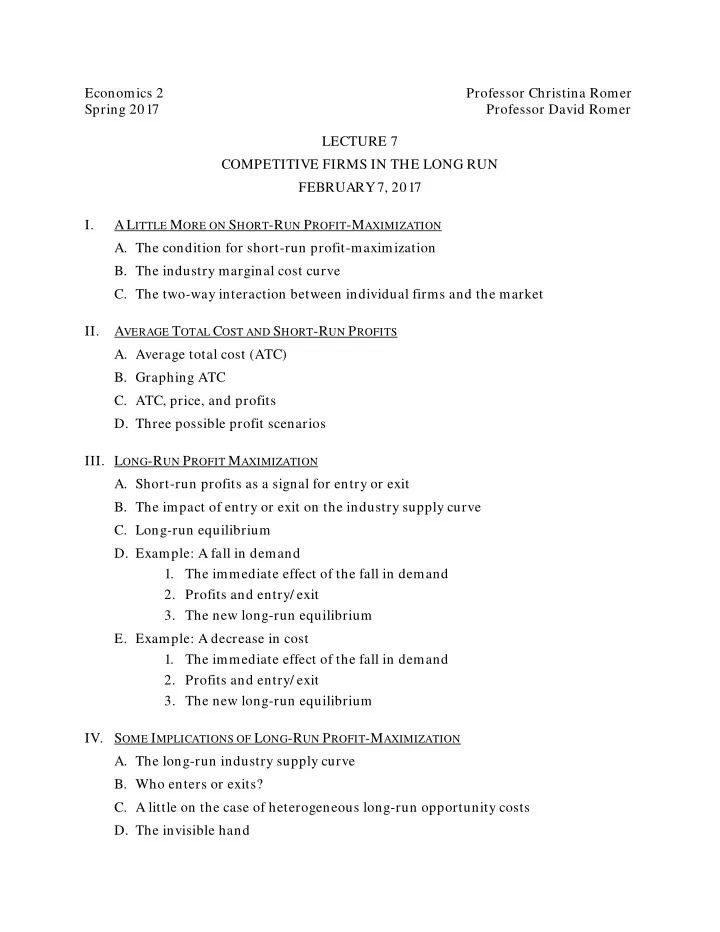
SLIDE 1 Economics 2 Professor Christina Romer Spring 2017 Professor David Romer LECTURE 7 COMPETITIVE FIRMS IN THE LONG RUN FEBRUARY 7, 2017 I. A LITTLE MORE ON SHORT-RUN PROFIT-MAXIMIZATION
- A. The condition for short-run profit-maximization
- B. The industry marginal cost curve
- C. The two-way interaction between individual firms and the market
- II. AVERAGE TOTAL COST AND SHORT-RUN PROFITS
- A. Average total cost (ATC)
- B. Graphing ATC
- C. ATC, price, and profits
- D. Three possible profit scenarios
- III. LONG-RUN PROFIT MAXIMIZATION
- A. Short-run profits as a signal for entry or exit
- B. The impact of entry or exit on the industry supply curve
- C. Long-run equilibrium
- D. Example: A fall in demand
- 1. The immediate effect of the fall in demand
- 2. Profits and entry/ exit
- 3. The new long-run equilibrium
- E. Example: A decrease in cost
- 1. The immediate effect of the fall in demand
- 2. Profits and entry/ exit
- 3. The new long-run equilibrium
- IV. SOME IMPLICATIONS OF LONG-RUN PROFIT-MAXIMIZATION
- A. The long-run industry supply curve
- B. Who enters or exits?
- C. A little on the case of heterogeneous long-run opportunity costs
- D. The invisible hand
SLIDE 2 LECTURE 7 Competitive Firms in the Long Run
February 7, 2017
Economics 2 Christina Romer Spring 2017 David Romer
SLIDE 3 Announcements
- Problem Set 2 is being handed out.
- It is due at the beginning of lecture next
Tuesday (Feb. 14).
- The ground rules are the same as on Problem
Set 1.
- Optional problem set work session: Friday,
4:00–6:00, in 648 Evans.
- Problem Set 1 is being returned in section this
week.
SLIDE 4 Announcements
- Journal article reading for Thursday (by Edward
Glaeser and Erzo Luttmer):
- Read only the assigned pages.
- Don’t stress over every word or parts you
don’t understand.
- Read for approach and findings; think about
relevance for the consequences of not letting prices adjust.
SLIDE 5
I. A LITTLE MORE ON SHORT-RUN PROFIT-MAXIMIZATION
SLIDE 6
q P MC MR (= PMARKET) q1
The Profit-Maximizing Level of Output for a Perfectly Competitive Firm
A competitive firm produces up to the point where P = MC.
SLIDE 7 The Industry Supply Curve Is the Industry Marginal Cost Curve – Example
- Suppose there are 100 firms. Each has MC at 1000 units of
$5, MC at 2000 units of $6, etc.
- Then the MC of the industry at 100,000 units is $5, at
200,000 units is $6, etc. Q $ 1 2 3 4 6 7 5 100K 200K 300K MC (also S) q $ 1 2 3 4 6 7 5 1K 2K 3K MCi (also Si)
SLIDE 8
The Two-Way Interaction of Individual Firms and the Market – Example: A Fall in an Input Price
q Q
Market
D P1 P P
Individual Firm
MR1 MC1 q1 Q1 MC2 MR2 P2 Q2 q2 S1 S2
SLIDE 9
- II. AVERAGE TOTAL COST AND SHORT-RUN PROFITS
SLIDE 10 Average Total Cost
- Recall:
- Costs are measured as opportunity costs.
- Fixed costs: Costs that do not vary with how
much is produced.
- Variable costs: Costs that do vary with how
much is produced.
- Total cost: The sum of fixed and variable costs.
- Average Total Cost = Total Cost
Quantity
SLIDE 11
Marginal Cost and Average Total Cost
Cost (in $) q MC ATC The MC and ATC curves cross at the lowest point of the ATC curve.
SLIDE 12 ATC, Price, and Profits
- Recall:
- Profits = Total Revenue – Total Cost
- Now:
- Total Revenue = P q
- Total Cost = ATC q
- So: Profits = (P q) − (ATC q)
= (P − ATC) q
- So: Profits are positive, negative, or zero depending
- n whether P − ATC is positive, negative, or zero.
SLIDE 13 q P MC MR q1
Revenues, Costs, and Profits
Revenues: Rectangle abef. Costs: abcd. Profits: cdef.
ATC P1 ATC1
b c d e f
SLIDE 14
Negative Economic Profits
q Q
Market
D S P1 P P
Individual Firm
MR MC q1 ATC
P1 < ATC at q1.
ATC1
SLIDE 15
Positive Economic Profits
q Q
Market
D S P1 P P
Individual Firm
MR MC q1 ATC
P1 > ATC at q1.
ATC1
SLIDE 16
Zero Economic Profits
q Q
Market
D S P1 P P
Individual Firm
MR MC q1 ATC
P1 = ATC at q1.
ATC1
SLIDE 17
- III. LONG-RUN PROFIT-MAXIMIZATION
SLIDE 18 The Signals Sent by Profits
- If there are negative profits: Some firms will reduce
the scale of their operations, or exit.
- If there are positive profits: Some firms will expand
the scale of their operations, or new firms will enter.
- Exit moves the industry supply curve to the
left; entry moves it to the right.
- If there are zero profits: There are no forces
tending to cause either contraction or expansion of the industry. In this situation, the industry is in long-run equilibrium.
SLIDE 19
Long-Run Equilibrium
q Q
Market
D S P1 P P
Individual Firm
MR MC q1 ATC
SLIDE 20
Fall in Demand (Starting in Long-Run Equilibrium) – Short-Run Effects
q Q
Market
D1 S1 P1 P P
Individual Firm
q1 ATC1 D2 P2 MR1 MC1 MR2 q2 Q2 Q1
SLIDE 21
Fall in Demand (Starting in Long-Run Equilibrium) – Long-Run Effects
q Q
Market
D1 S1 P1,3 P P
Individual Firm
q1,3 ATC1 D2 P2 MR1,3 MC1 MR2 q2 S3 Q2 Q1 Q3
SLIDE 22
Fall in Marginal Cost (Starting in Long-Run Equilibrium) – Short-Run Effects
q Q
Market
D S1 P1 P P
Individual Firm
MR1 MC1 q1 ATC1 ATC2 MC2 S2 P2 q2 MR2 Q2 Q1
SLIDE 23
Fall in Marginal Cost (Starting in Long-Run Equilibrium) – Long-Run Effects
q Q
Market
D S1 P1 P P
Individual Firm
MR1 MC1 q1,3 ATC1 ATC2 MC2 S2 P2 q2 MR2 P3 S3 MR3 Q2 Q1 Q3
SLIDE 24
- IV. SOME IMPLICATIONS OF LONG-RUN
PROFIT MAXIMIZATION
SLIDE 25
The Long-Run Industry Supply Curve
q Q
Market
PLR P P
Individual Firm
S q1 ATC
The long-run industry supply curve is perfectly elastic at the minimum of ATC.
MC
SLIDE 26 Other Implications of Long-Run Profit Maximization
- Who enters or exits?
- A little about what happens if there is variation in
long-run opportunity cost.