Economically Sustainable Options for Forest Industries in Rural - - PowerPoint PPT Presentation

economically sustainable options for
SMART_READER_LITE
LIVE PREVIEW

Economically Sustainable Options for Forest Industries in Rural - - PowerPoint PPT Presentation

Ecosystem Services: Providing Economically Sustainable Options for Forest Industries in Rural Coastal Communities Priscilla Morris Graduate Research Assistant Sudipta Dasmohapatra (Associate Professor) Department of Forest Biomaterials North


slide-1
SLIDE 1

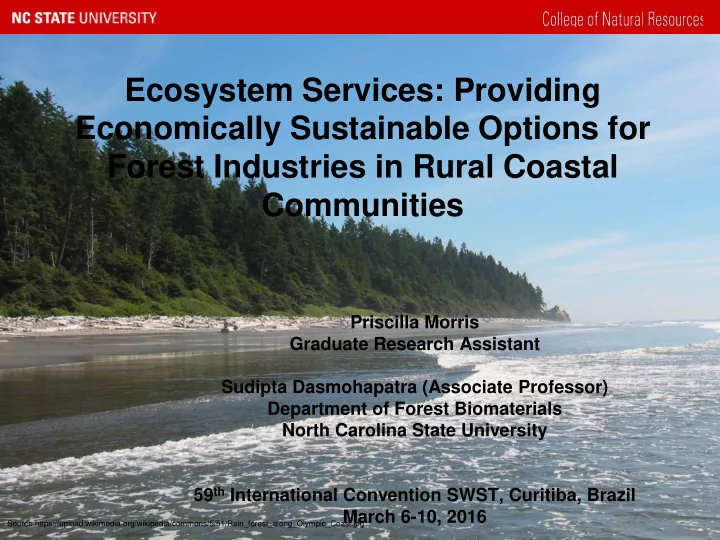
Ecosystem Services: Providing Economically Sustainable Options for Forest Industries in Rural Coastal Communities

Priscilla Morris Graduate Research Assistant Sudipta Dasmohapatra (Associate Professor) Department of Forest Biomaterials North Carolina State University 59th International Convention SWST, Curitiba, Brazil March 6-10, 2016

Source:https://upload.wikimedia.org/wikipedia/commons/5/51/Rain_forest_along_Olympic_Coast.jpg

slide-2
SLIDE 2

Overview

  • Objectives
  • Ecosystem Services Overview
  • Methodology
  • Results
  • Conclusion
slide-3
SLIDE 3

Objectives

  • Assess

–Business owner perceptions of regional

  • Economic viability
  • Potential new markets
  • Opportunities and barriers to grow and sustain
  • Determine

–Strategies to improve local economy utilizing

  • Viable/Sustainable Ecosystem services
  • Market options for Forest Industries in Rural

Coastal Communities

Source: https://encrypted-tbn3.gstatic.com/images?q=tbn:ANd9GcSOgZqVd67aCEPmfOnas9EePxRP-ZN00JBuDDrBm1So7Tr5P1oN5w

slide-4
SLIDE 4

Ecosystem Services Dimensions

  • Definition: Human benefits from ecosystems

– Provisioning – Regulating – Cultural – Supporting

  • Advantages: Crucial to sustaining human societies

– Carbon sequestration – Water purification – Habitat for millions of species

  • Valuation: Payments for Ecosystem

Services

– Incentivize the sustainable use of forested lands

Source: (Payments for Forest Ecosystem Services in the US, (Mercer & Cooley, 2011))

slide-5
SLIDE 5

Methodology

  • Region

–Albemarle-Pamlico Peninsula, North Carolina

  • Data Collection

– Data Collection: In-person interviews (Nov/Dec 2015), 2-3 hours each (using a semi-structured questionnaire) – Sampling Frame: Randomly selected business owners – Study Region: Beaufort, Dare, Hyde, Washington and Tyrrell counties – Demographics: Avg. poverty rate (22%) vs. national avg. (14.5%)

  • Avg. unemployment (9.6%) vs. State average (4%)

– Analysis: Transcription and coding

Source: (US Census Bureau, 2014)

slide-6
SLIDE 6

Albemarle-Pamlico Peninsula

15% 41% 23% 21%

Land Mass Utilized for Industrial Natural Resource Production

Public Timberland Private Timberland Agriculture Land Other 342.80 367.40 1,074.00

200 400 600 800 1,000 1,200

Forestry (2012) Agriculture (2012) Tourism (2013) $ Mil

Albemarle-Pamlico Peninsula's Natural Resources Industry Economic Contribution ($ mil)

5% Of the State 3% Of the State 2% Of the State

Source: US Geospatial Data Gateway (Anonymous, 2014 b) Source: NC State Forestry Extension (Anonymous, 2015) USDA AG STATS (Anonymous, 2014a) & NC Tourism Commerce (Anonymous, 2013)

North Carolina

slide-7
SLIDE 7

Business Owner Perceptions of Region’s Economic Viability

Utilize Natural Resources / Ecosystem Services

Opportunities

Fast food Region cannot support new business

Barriers

Farming Poor Infrastructure

Local Government

Health Care Location Flooding

slide-8
SLIDE 8

Payments for Forest-Based Services by Stakeholders

2005 2006 2007 % of Total Payments in 2007 Government 378,075 380,608 365,619 19.4% Non-government Carbon Offsets 567 1,552 1,692 0.1% Conservation Easements 162,074 195,435 314,999 16.7% Hunting Lease/ Fees 404,517 404,690 410,236 21.7% Wildlife Viewing 30,559 31,569 33,537 1.8% Conservation Banks 34,000 34,000 34,000 1.8% Wetland Mitigation Banks 727,111 727,111 727,111 38.5% Total Non- Government 1,358,828 1,394,358 1,521,575 80.6% Total Payments 1,736,903 1,774,965 1,887,194

Source: Payments for Forest Ecosystem Services in the US (Mercer & Cooley, 2011)

* Note: $ Value in (in 1000s of Constant 2005$)

slide-9
SLIDE 9

Potential Industry and Community Benefits

  • Industry benefits

– Increase alternative market opportunities – Market resiliency to environmental stressors – Partnership creates positive advertisement – Increased leasing opportunities

  • Industry supports communities

– Community leases rights to utilize forested lands

  • Seasonally
  • Provides the landowner the opportunity to double

income from leasing

slide-10
SLIDE 10

Conclusions

  • Ecosystem service markets opportunities for the AP Region

– Bundled Services

  • Partnerships with Government & Non-Government

Organizations – Farm Bill, Conservation Stewardship Program, Environmental Quality Incentives Program – Nature Conservancy, Trust for Public Land, Conservation Fund, Ducks Unlimited – Major Landowners

  • Ecosystem Service Valuation
  • Potential negative impacts of increased Ecosystem utilization
slide-11
SLIDE 11

Questions?

slide-12
SLIDE 12

Resources

  • Anonymous. (2015). Economic Impact Data. NC State University A&T State University

Cooperative Extension. 2013. Available at: http://forestry.ces.ncsu.edu/economic-impact-data/

  • Anonymous. (2014)a. Agricultural Statistics - Summary of Commodities by County. NCDA&CS.

Available at: http://www.ncagr.gov/stats/codata/

  • Anonymous, (2014)b. United States Department of Agriculture National Resources Conservation
  • Service. Geo-spatial Data Gateway. USDA, Available at:

http://www.nrcs.usda.gov/wps/portal/nrcs/main/national/technical/nra/geo/

  • Anonymous, (2013).Tourism, Department of Commerce. NC Tourism Research NC Fast Facts.

Available at: https://www.nccommerce.com/tourism/research/economic-impact

  • Carpenter, Dean E., and Lindsay Dubbs. 2012 Albemarle-Pamlico Ecosystem Assessment.

Raleigh, NC: Albemarle-Pamlico National Estuary Partnership, 2012. Print.

  • Krieger, Douglas J. (2001). The Economic Value of Forest Ecosystem Services: A Review.

Washington, D.C.: Wilderness Society.

  • Mercer, D. Evan., David M. Cooley, and Katherine Hamilton. (2011).Taking Stock: Payments for

Forest Ecosystem Services in the United States. Washington, D.C.: Forest Trends.

  • United States Census Bureau. (2014). Available at:

http://quickfacts.census.gov/qfd/states/37/37013.html

slide-13
SLIDE 13

Estimated Ecosystem Service Market Values U.S. Forests

Source: (Economic Value of Forest Ecosystem Services, (Krieger, 2001))

slide-14
SLIDE 14

Source: (Payments for Forest Ecosystem Services in the US, (Mercer & Cooley, 2011))

Ecosystem Service Payments

slide-15
SLIDE 15

North Carolina

Source: US Geospatial Data Gateway (Anonymous, 2014 b)

slide-16
SLIDE 16

Region’s Natural Resource Base

Source: NC State Forestry Extension (Anonymous, 2015) USDA AG STATS (Anonymous, 2014a) & NC Tourism Commerce (Anonymous, 2013)

342.80 367.40 1,074.00

200 400 600 800 1,000 1,200

Forestry (2012) Agriculture (2012) Tourism (2013) $ Mil

Albemarle-Pamlico Peninsula's Natural Resources Industry Economic Contribution ($ mil)

5% Of the State 3% Of the State 2% Of the State

15% 41% 23% 21%

Land Mass Utilized for Industrial Natural Resource Production

Public Timberland Private Timberland Agriculture Land Other

slide-17
SLIDE 17

*Note: 1982 Data Source US Soil Conservation Service National Resource Inventory, (Carpenter & Dubbs, 2012), 2006 & 2011 Data Source USDA National Land Cover Data: USDA Geospatial Data Gateway (Anonymous, 2013b)

Change in Land Cover Over Time on the AP Peninsula

slide-18
SLIDE 18

Potential Partnerships

  • Government

– Farm Bill – Conservation Stewardship Program – Environmental Quality Incentives Program

  • Non-Government Organizations

– Nature Conservancy – Trusts for Public Land – Conservation Fund – North Carolina Coastal Federation – Ducks Unlimited and Similar Organizations – Major Landowners

slide-19
SLIDE 19

Business Owner Perceptions of Region’s Economic Viability

Interview Viable Business In this Region Advantages of the Location Disadvantages Utilized Marketing Strategies 1 Don't impact the environment, retail such as payless shoes and dollar general, parks, tourist attractions such as nature tours, beaches to access, fast food Ability to accommodate hunters, fishers, outer banks visitors Only one way in and out

  • f the area, storms shut

down the road, Insurance, can't rely on local employment, local government doesn't look

  • ut for residents

Word of mouth and good business 2 No faith in new business success, no people to support it Direct access to the lake and boat ramp, accommodate hunters, fishers, campers Flooding problems from the lake, rural location is sometimes hard to find Word of mouth and social media 3 Fast food Plenty of farm land, good people around, safety Medical care is over 60 miles away, water is under control so far but could become a problem Main grainery in the area, did not need marketing strategies 4 Ecotourism if the infrastructure was there to support it, bird watching, bear tours, refuge visitation, hunting and fishing, quality guide service Close to the lake, the outer banks, and the natural resources in the area Remoteness, lack of infrastructure, cell service, internet, lack of proximal health care Word of mouth 5 No business is profitable in this region Close to water, easy access for boats Daily aggravation No marketing 6 Marina already established. Internet, website with a link to financing, newspaper, radio, word

  • f mouth, welcome bags for boaters traveling

into the area. 7 No infrastucture, very poor, cant support new business Scuppernong river produces good grapes, Winery next to the visitors center Convenience of more urban areas such as fast food and other services Community acceptance, word of mouth 8 Farming Close to the water, easy access for boats, 7-15 boats a week during shrimp season Small community, and it is getting smaller No real marketing strategies Natural Resource Based Terminology, Natural Resource Utilizers, Infrastructure related issues, Risks to their region and business
slide-20
SLIDE 20

Conclusions

  • Difficult to capture the current economic impact of

ecosystem services and ecotourism in the region

  • Business owners believe that the expansion of

ecotourism and utilization of their natural resources is the best sustainable and economic option – Infrastructure and workforce pose problems – Need support and partnership from community and local government

  • Need to assess valuation of the ecosystem services for

the region

slide-21
SLIDE 21

Ecosystem Markets Utilized by Forest Industry in NC

  • In 2007

– Carbon - ? Nation = .09% – Biodiversity- 11-25% – Bundled Services – 76- 99%

  • General conservation activates which provide a range of benefits

including, the provision of multiple ecosystem services

  • Examples of payments: government conservation programs,

wetland and stream mitigation, and purchase of conservation easements by land trusts

slide-22
SLIDE 22

Changes in land cover type over time:

Source: USDA Geospatial Data Gateway (Anonymous, 2013)

Land Cover Type (On the AP) Percent Change (2006 to 2011) Evergreen Forest

  • 5.75%

Cropland

  • 0.80%

Mixed Forest

  • 0.39%

Deciduous Forest

  • 0.16%

Developed, Open Space 0.00% Pasture/ Hay 0.00% Developed, Medium Intensity 0.02% Developed, High Intensity 0.04% Barren Land 0.08% Developed, Low Intensity 0.17% Grassland 0.45% Scrub/ Shrub 1.62% Emergent Herbaceous Wetland 2.03% Woody Wetlands 2.68%

slide-23
SLIDE 23
slide-24
SLIDE 24

Current Utilization of Ecotourism in the AP

  • Private:

– Guide Services:

  • Hunting
  • Fishing
  • Wildlife Tours

– Bird Watching

  • How involved is the Forest Industry?

– Leasing?

slide-25
SLIDE 25

Why Ecotourism?

  • Region heavily relies on its natural resources
  • Large numbers of tourists move through the region to

visit the outer banks

  • Ecotourism is the fastest growing portion of the tourism

industry

  • Community recognizes it as a viable economic option
slide-26
SLIDE 26
  • How Ecosystem based business and Ecotourism can

benefit both the Forest Industry and the Community – Incentives/assistance for community members to

  • perate ecotourism based businesses
  • In turn they lease rights from timber land owners to utilize their

property for their business (Dare to Hyde Adventures is a good example not sure if they lease?)

  • Kayaking, nature tours, bird watching
slide-27
SLIDE 27
slide-28
SLIDE 28

Source: NC State Forestry Extension USDA AG STATS & NC Tourism Commerce

slide-29
SLIDE 29

Perceptions of Business owners in the community

  • Perception of current condition of their area (physically,

economically, viability of new business)

  • Perception of climate change risks

– To the region (physically, economically) – To their business (physically, economically) – What can they do?

slide-30
SLIDE 30

Results

  • Their suggestions for what types of businesses would

thrive in the area – Ecosystem Based businesses: Hunting, Guiding, Bird Watching, Kayaking etc (capture tourist going to the OBX – Fast food, dollar general, payless shoes etc

slide-31
SLIDE 31

Utilize Natural Resources / Ecosystem Services

Opportunities

Fast food Region cannot support new business

Barriers

Farming Poor Infrastructure Local Govt. Health Care Location Flooding