E INITIAL Asbestos Training Section 13 Course L Federal Edition - - PDF document

e
SMART_READER_LITE
LIVE PREVIEW

E INITIAL Asbestos Training Section 13 Course L Federal Edition - - PDF document

raining ervices nternational, Inc Asbestos Management Planner Initial Slideshow MANAGEMENT Qualifications & PLANNER Functions E INITIAL Asbestos Training Section 13 Course L Federal Edition


slide-1
SLIDE 1

raining ervices nternational, Inc Asbestos Management Planner Initial Slideshow 1

MANAGEMENT PLANNER INITIAL

Asbestos Training Course Federal Edition

  • Qualifications &

Functions

Section 13

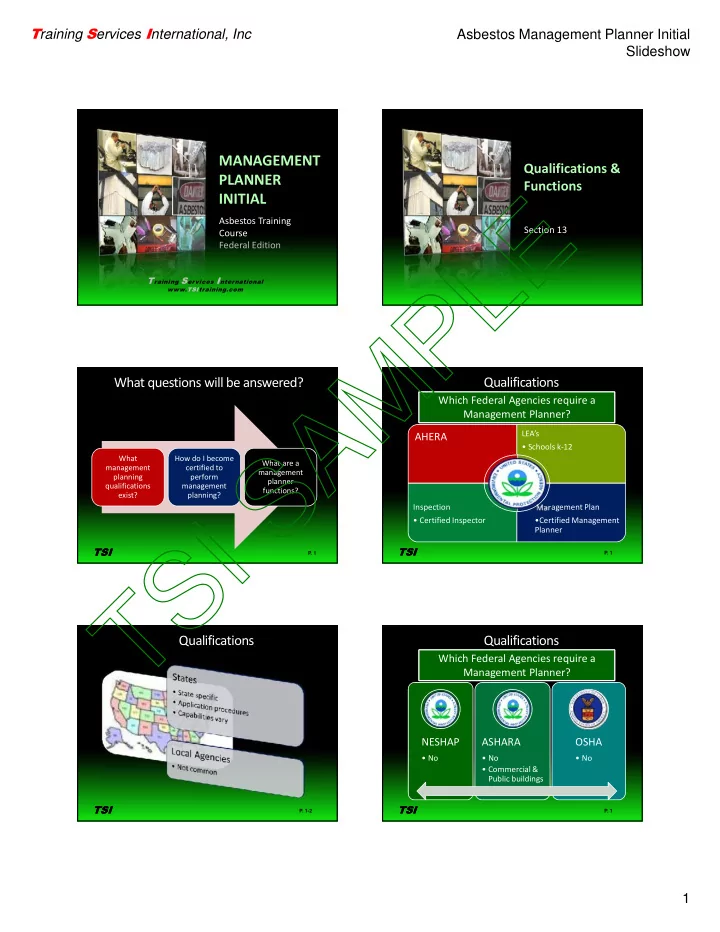
  • What questions will be answered?

What management planning qualifications exist? How do I become certified to perform management planning? What are a management planner functions?

  • P. 1
  • Qualifications

AHERA

LEA’s

  • Schools k-12

Inspection

  • Certified Inspector

Management Plan

  • Certified Management

Planner

Which Federal Agencies require a Management Planner?

  • P. 1
  • Qualifications
  • P. 1-2
  • Qualifications

NESHAP

  • No

ASHARA

  • No
  • Commercial &

Public buildings

OSHA

  • No

Which Federal Agencies require a Management Planner?

  • P. 1

T S I S A M P L E

slide-2
SLIDE 2

raining ervices nternational, Inc Asbestos Management Planner Initial Slideshow 2

  • Certifications
  • P. 3
  • Certification
  • P. 4-5
  • Asbestos Inspector & Management Planner Functions
  • Date, name & signature
  • HA & sample locations
  • Sample procedures,

protocols & dates

  • ACM type
  • Laboratory & HA results
  • Assessment

Inspection

  • Evaluate & Interpret

survey results

  • Hazard assessment
  • Select response

actions

  • O&M plan

Management Plan

  • P. 6-7
  • What should I know now?
  • 1. What are the qualifications required to perform

management planning?

  • 2. What are the Federal regulations that require

asbestos management plans to be performed by a Certified Asbestos Management Planner?

  • 3. What additional licensing do I usually need to

develop management plans?

  • 4. What are the functions of a Management Planner?
  • 1. What are the qualifications required to perform

management planning?

  • 2. What are the Federal regulations that require

asbestos management plans to be performed by a Certified Asbestos Management Planner?

  • 3. What additional licensing do I usually need to

develop management plans?

  • 4. What are the functions of a Management Planner?
  • P. 8

EVALUATING SURVEY RESULTS

Section 14

  • What questions will be answered?

What are keys to evaluating asbestos survey results?

How do asbestos regulations apply to asbestos inspection reports? What is included in an asbestos management plan?

  • P. 9

T S I S A M P L E

slide-3
SLIDE 3

raining ervices nternational, Inc Asbestos Management Planner Initial Slideshow 3

  • Evaluating Survey Results
  • P. 9-11

Does scope support MP development?

  • AHERA minimum

– interior accessible materials

  • Additions based
  • n owner’s needs

Is report accurate & complete?

  • Dates
  • Inspector information
  • ACM information
  • Non-ACM

information

  • Sample information
  • Assessments
  • Regulatory Application
  • P. 11

Regulated Levels

  • f Asbestos

Amount of Asbestos in Homogeneous Area None Detected (0%) Trace up to 1.0% Greater than 1% AHERA 40 CFR Part 763 subpart E No No Yes NESHAPS 40 CFR Part 61 subpart M No No Yes OSHA 29 CFR 1926.1101 No Yes Yes Ohio, Indiana, Illinois, New York, and most other states No No Yes Quantities and type of ACM vary between state regulations

  • Federal Asbestos Regulations

All LEA’s - public or private, not-for – profit school system consisting of grades K-12. Manage/ abate all (ACBM) Response actions include all friable asbestos abatement projects conducted in a school building

P 12

  • Federal Asbestos Regulations
  • All asbestos jobs covered
  • Class I – Removal of TSI & surfacing
  • Class II – Removal of all materials except TSI &

surfacing

  • Class III – any repairs up to 1 glovebag or disposal bag
  • Class IV – cleanup where ACM is contacted but not

disturbed

  • Unclassified operations
  • PACM - Presumed Asbestos-Containing Material.

OSHA (29 CFR 1926.1101)

P 12

  • Federal Asbestos Regulations

NESHAP (40 CFR Part 61 Subpart M)

  • Category I NF (pliable)
  • Category II NF (brittle, rigid)
  • RACM – basically any

currently or will become friable material

  • Notification requirements
  • Emission control procedures
  • Disposal requirements
  • P. 12
  • State Asbestos Regulations

P 13

T S I S A M P L E

slide-4
SLIDE 4

raining ervices nternational, Inc Asbestos Management Planner Initial Slideshow 4

  • Elements of the Management Plan

General building description and a summary of the Inspection Report. Hazard assessments descriptions Recommended preventative measures and/or response actions Response action locations Reasons for selecting the measures and actions

P 13

  • Elements of the Management Plan

Schedule for implementation. Identification of ACBM remaining after response actions Plan for periodically re-inspecting ACBM. Program for informing workers and building occupants Evaluations of resources needed to implement the management plan

P 13

  • What should I know now?
  • P. 14

1. What are two key determinations a management planner should make to decide if an asbestos inspection report can be used to develop an asbestos management plan? 2. What does a reliable asbestos inspection report include? 3. What are the key asbestos regulations that may apply to asbestos materials? 4. What is included in an asbestos management plan?

HAZARD ASSESSMENT

Section 15

  • What questions will be answered?

What is hazard assessment? What factors are used to determine a hazard ranking? What is a common asbestos hazard ranking system?

  • P. 15
  • What questions will be answered?

What are the control

  • ptions available to

manage ACM in a building? What are the benefits and disadvantages to each control option or response action?

  • P. 15

T S I S A M P L E

slide-5
SLIDE 5

raining ervices nternational, Inc Asbestos Management Planner Initial Slideshow 5

  • Hazard Assessment
  • P. 15
  • Assessing ACM – Condition Criteria
  • No damage, very minor if any
  • Good

No Damage

  • Up to 10% overall, 25% localized
  • Fair

Damage

  • Over 10% overall, 25% localized
  • Poor

Significant Damage

  • P. 16
  • Assessing ACM – Condition Criteria

10% Distributed Damage

25% Localized Damage

P 17

  • Potential for Disturbance - Contact
  • Workers in area > 1/week
  • Public area

High

  • Workers in area < 1/week, >

1/ month

  • Occupant/ employee area

Moderate

  • Workers in area < 1/ month
  • Inaccessible

Low

  • P. 17
  • Potential for Disturbance - Vibration
  • Loud motors or engines
  • Intrusive noises

High

  • Motors or engines present,

not obtrusive

  • Occasional loud sounds

Moderate

  • None of the above

Low

  • P. 17
  • Potential for Disturbance – Air Erosion
  • High velocity air

High

  • Noticeable movement of air

Moderate

  • None of the above

Low

  • P. 17

T S I S A M P L E

slide-6
SLIDE 6

raining ervices nternational, Inc Asbestos Management Planner Initial Slideshow 6

  • Potential for Disturbance – Overall
  • Any high

High

  • No high, at least 1 moderate

Moderate

  • No high, no moderate

Low

  • P. 18
  • Hazard Assessment

Significant Damage (Poor) Any 1 Damage (Fair) High 2 Moderate 3 Low 4 No Damage (Good) High 5 Moderate 6 Low 7

  • P. 19
  • Control Options/ Response Actions

Maintaining ACM

Operations & Maintenance (O&M) Program Encapsulation Enclosure Repair

  • P. 20

Goals

  • 1. Protect Human Health & Environment
  • 2. Least Burdensome
  • Maintaining ACM

Advantages

  • ACM remains (performance)
  • Minimal facility disruptions
  • Low initial cost
  • No/ minor waste generated

Disadvantages

  • ACM hazard remains
  • Material may need repaired
  • Future removal costs may be higher
  • P. 21
  • Control Options/ Response Actions

ACM Removal

Required before renovation & demolition Recommended with ACM in poor condition

  • P. 21
  • Controlling Exposure

Removal Advantages

No ACM in facility Life cycle cost may be less

Removal Disadvantages

Areas of facility must be regulated High initial cost Large amount of waste generated Many facility disruptions

  • P. 21

T S I S A M P L E

slide-7
SLIDE 7

raining ervices nternational, Inc Asbestos Management Planner Initial Slideshow 7

  • Hazard Assessment & Control Option

Worksheet

Evaluate

Condition & Potential for Disturbance

Determine

Hazard Ranking

Recommend

Control Options & Area Priority

  • P. 22

LEGAL CONCERNS IN ASBESTOS MANAGEMENT

Section 16

  • What questions will be answered?

What is an

  • wner’s

liability when ACM is in their building? What asbestos regulations address ACM in buildings? What liability issues does an asbestos management planner face? What key legal factors are involved with managing asbestos in buildings?

  • P. 23
  • What questions will be answered?

What legal considerations should be applied when developing an asbestos management plan? What are key issues for when selecting insurance? What insurance coverage is needed for asbestos management ? What are key factors for evaluating an insurance company?

  • P. 23
  • Asbestos Liability – Building Owners
  • AHERA, OSHA, NESHAP, State

Regulatory

  • Knowingly & willfully

Criminal

  • Responsibility to prevent exposure

Civil

  • P. 23
  • What Rules Apply?

What type of facility?

  • School or non-

school

  • AHERA?

What type of activities are conducted?

  • Construction or non-

construction

  • Construction

Standard & NESHAPS or General Industry Standard?

  • P. 24

T S I S A M P L E

slide-8
SLIDE 8

raining ervices nternational, Inc Asbestos Management Planner Initial Slideshow 8

  • What Rules Apply
  • AHERA
  • OSHA

Construction

  • NESHAPS
  • OSHA

Construction

  • NESHAPS
  • AHERA
  • OSHA

General Industry

  • OSHA

General Industry Non-School/ Non- construction School/ Non- construction School/ Construction Non-School/ Construction

  • P. 24
  • Inspections

Normal

  • perations

Renovations/ demolitions

  • P. 25
  • Occupants

Housekeeping Maintenance Asbestos Program Manager

Training

  • P. 25
  • Notifications

ACM Location Presence Quantity Clean-up, repair, & abatements Occupants in adjacent areas Multiple Repairs Over 160 SF/ 260 LF RACM NESHAP Annual Notification

  • P. 26
  • Labeling

Previously installed material Waste containers

DANGER DANGER DANGER DANGER

CONTAINS ASBESTOS FIBERS CONTAINS ASBESTOS FIBERS CONTAINS ASBESTOS FIBERS CONTAINS ASBESTOS FIBERS AVOID CREATING DUST AVOID CREATING DUST AVOID CREATING DUST AVOID CREATING DUST CANCER AND LUNG DISEASE CANCER AND LUNG DISEASE CANCER AND LUNG DISEASE CANCER AND LUNG DISEASE HAZARD HAZARD HAZARD HAZARD

DANGER

  • P. 26

DANGER CONTAINS ASBESTOS FIBERS AVOID CREATING DUST CANCER AND LUNG DISEASE HAZARD

  • Key Personnel

Implementing & managing program Clean-up & repair activities

  • P. 26

T S I S A M P L E

slide-9
SLIDE 9

raining ervices nternational, Inc Asbestos Management Planner Initial Slideshow 9

  • Recordkeeping
  • P. 27
  • Management Planner’s Liability

Regulatory

Licensing & Certifications Criminal

  • P. 28
  • Management Planner’s Liability

Contractual Scope of Work Cost Schedule

  • P. 28
  • Management Planner’s Liability - Civil
  • P. 29
  • Indemnification Clauses

Protection vs.

  • ther’s negligence

Management planner may be named for activities not responsible

  • P. 29
  • Asbestos Management Legal Considerations

Improper identification & remediation Proper planning & execution Development & implementation

  • P. 30

T S I S A M P L E

slide-10
SLIDE 10

raining ervices nternational, Inc Asbestos Management Planner Initial Slideshow 10

  • Abatement design and

Implementation

  • Minimize exposure
  • Proper abatement activities

In-house staff vs. contract labor for O&M Use of previous inspections Recordkeeping

  • P. 30-33
  • Insurance Concerns

Anticipated risks covered by policy Insurance carrier responds to claims fairly Insurance carrier is financially capable Insurer has longevity

  • P. 33
  • Insurance

Coverages

Errors & Omissions Insurance General Liability Insurance

  • Occurrence & Claims Made

Pollution Prevention Insurance

  • Occurance
  • Claims Made
  • P. 33-35
  • Evaluating Insurance Company

Carrier’s quality

  • Coverage
  • Financial stability
  • Management

Commitment

  • Staying in asbestos industry
  • Continue to provide

insurance

  • P. 35-36
  • What should I know now?

P.37

1. What regulations and legal principles affect an

  • wner when ACM is in their building?

2. What are key factors that determine the applicable asbestos regulations in a given situation? 3. What liability issues does an asbestos management planner face? 4. What key legal factors are involved with managing asbestos in buildings? 5. What legal considerations should be applied when developing an asbestos management plan? 6. What are key issues for when selecting insurance? 7. What insurance coverage is needed for asbestos management? 8. What are key factors for evaluating an insurance company?

EVALUATION AND SELECTION OF RESPONSE ACTIONS

Section 17

T S I S A M P L E

slide-11
SLIDE 11

raining ervices nternational, Inc Asbestos Management Planner Initial Slideshow 11

  • What questions will be answered?

What considerations are involved with selecting a response action? What are key factors considered for deciding when to perform response actions?

P 38

  • Operations and Maintenance

(O&M) Program

Required for all friable ACBM Recommended for all ACBM Includes Worker protection Training, Periodic surveillance Initial cleaning

P.38

  • O&M

Advantages

  • ACM remains (performance)
  • Minimal facility disruptions
  • Low initial cost
  • No/ minor waste generated

Disadvantages

  • ACM hazard remains
  • Material may need repaired
  • Future removal costs may be higher
  • P. 39
  • Encapsulation

Limited application Abatement ACM remains Penetrating Bridging Advantages & disadvantages

  • P. 39-41
  • Enclosure

Limited application Abatement ACM remains, difficult to monitor Mechanical systems Spray-applied Advantages & disadvantages

  • P. 41-43
  • Repair

Damaged → Undamaged Abatement & part of O&M Advantages & disadvantages

  • P. 42

T S I S A M P L E

slide-12
SLIDE 12

raining ervices nternational, Inc Asbestos Management Planner Initial Slideshow 12

  • Removal

Permanent solution Required before renovations & demolitions Recommended for poor condition ACM Isolate building area Multiple removal methods No visible debris remains

  • P. 44
  • Removal Examples

Plaster

  • Layers
  • In metal lathe

Sprayed applied

  • Concrete slabs
  • Metal beams & decking

TSI

  • Boiler
  • Pipe line & ftgs

Hazards

  • Electrical, heat, fire, slips
  • P. 45-46
  • Staging and Prioritizing Response Actions

Hazard Rank Efficiency Occupancy Patterns Remaining life of building Planned renovation and maintenance

  • P. 47-48
  • What should I know now?

1. What are the five response actions and one advantage and disadvantage for each? 2. What are key factors considered for deciding when to perform response actions?

  • P. 49

AIR MONITORING

Section 18

  • What questions will be answered?

Why is asbestos air sampling performed? What are the primary asbestos air sampling alternatives? What certifications do air sampling personnel need? What equipment is used for air sampling?

P 50

T S I S A M P L E

slide-13
SLIDE 13

raining ervices nternational, Inc Asbestos Management Planner Initial Slideshow 13

  • What questions will be answered?

What are the types of asbestos air samples? What procedures are required to perform asbestos sampling? What are the asbestos air sampling calibration procedures?

P 50

  • Reasons for Air Sampling

P.50

Determines worker exposures Measures isolation methods, work practices and engineering controls effectiveness Suitability to re-occupy asbestos work area During asbestos activities

  • Reasons for Air Sampling
  • P. 50

Building ambient air levels Regulatory compliance Contractual requirements Reduce liability Determine exposure levels

  • Types of Air Samples

Background Personals Environmental Final Clearance

P.51

  • Air Sampling Alternatives

Procedure OSHA levels USEPA clearance level Identifies fibers NIOSH 7400 Method

  • P. 52-53

PCM

  • Air Sampling Alternatives

Procedure AHERA Method PCME Sample turnaround Costs

  • P. 53-54

TEM

T S I S A M P L E

slide-14
SLIDE 14

raining ervices nternational, Inc Asbestos Management Planner Initial Slideshow 14

  • Air Sampling Certifications
  • P. 54

No Federal requirements Many states have requirements

  • Air Sampling Equipment

Cassettes

How they work Components

P.54-55

  • Air Sampling Equipment

Low volume

0.5-5 liters per minute (l/min) Battery operated, 8-12 hours Used for personals and inside the work area samples

  • P. 56
  • Types of Air Samples
  • Purpose of sample
  • Analytical methods
  • Sampling pumps
  • Key reference levels
  • Sample volume
  • Flow rate
  • Use of results
  • Responsible party, who

takes sample?

  • P. 56-57
  • Types of Air Samples - Personal

Purpose of sample Sampling procedure Analytical methods Sampling pumps Key reference levels Sample volume & flow rate OSHA recommended sampling, use of results Responsible party, who takes sample? 8 Hr. TWA equation

  • P. 58
  • Types of Air Samples - Personals

Required Information (29 CFR 1926.1101 (n)(2))

Date of measurement Operation being monitored Sampling & analytical methods used & evidence of accuracy Number, duration, & results of samples taken Type of protective devices worn

  • P. 59

T S I S A M P L E

slide-15
SLIDE 15

raining ervices nternational, Inc Asbestos Management Planner Initial Slideshow 15

  • Types of Air Samples
  • IWA key sampling factors
  • OWA key sampling factors
  • Purpose of sample
  • Analytical methods
  • Sampling pumps
  • Key reference levels
  • Sample volume
  • Flow rate
  • Use of results
  • Responsible party, who takes sample

Environmental

  • P. 59-60
  • Final Clearance

Visual inspection Final clearance sampling Aggressive sampling Protocols

  • P. 61-62
  • Types of Air Samples
  • P. 63

Number of Samples PCM TEM 5 IWA per AHERA 3 IWA per Ohio Dept. of Health AHERA & ODH (if TEM is selected) Z-test method = 5 IWA, 5 OWA, 2 FB, 1 LB

  • r

5 IWA

Final Air Sampling Alternatives

  • Types of Air Samples

Sampling Cassettes

PCM TEM

25 mm dia. w/ 0.8 µ µ µ µm MCE filter 25 mm dia. w/ 0.45 µ µ µ µm MCE filter Flow Rate 0.5 L / min - 16 L / min Over 1 L / min, less than 10 L / min

Final Air Sampling Alternatives

  • P. 63
  • Types of Air Samples

Volume

PCM TEM

1080 L NIOSH min 3850 L for NIOSH recommended fiber loading Minimum 560 L 1200 L-1800 L recommended Clearance Levels Each sample limit

  • f quantification is

≤ ≤ ≤ ≤ 0.01 f/cc Z-test or average of 5 IWA samples does not exceed filter background level of 70 s/mm2

Final Air Sampling Alternatives

  • P. 63
  • Air Sampling Procedures

Work area readiness Certified personnel Proper protocol Correct pump & cassettes Number of samples & blanks Record sample data Set up & calibrate sample Remove & calibrate sample Package/ prepare samples for analysis

  • P. 64-66

T S I S A M P L E

slide-16
SLIDE 16

raining ervices nternational, Inc Asbestos Management Planner Initial Slideshow 16

  • Calibration
  • P. 66-67
  • What should I know now?
  • 1. What are 3 reasons asbestos air sampling is

performed?

  • 2. What are the 2 primary asbestos air

sampling analytical methods?

  • 3. What are the Federal and state certifications

required to perform asbestos air sampling?

  • 4. What are the primary types of air sampling

cassettes and pumps used for asbestos projects?

  • 5. What types of air samples are taken during

asbestos projects and what is their purpose?

  • P. 68
  • What should I know now?

6. What are key steps when taking an air sample? 7. When should an asbestos air sample be calibrated and what calibration equipment should be used?

  • P. 68

ROLES OF OTHER PROFESSIONALS

Section 19

  • What questions will be answered?

What are some of the key factors involved with asbestos management planning? Who are the key people that can assist the management planner? What contributions can each of these people make?

  • P. 69
  • Team Approach

Input from others improves AMP Others needed to:

  • Provide input
  • Implement
  • P. 69

T S I S A M P L E

slide-17
SLIDE 17

raining ervices nternational, Inc Asbestos Management Planner Initial Slideshow 17

  • Team Approach
  • Industrial

Hygienist

  • Architect/

Engineer

  • Building

Engineer

  • Abatement

Contractor

  • Analytical

Laboratory

  • Building

Owner

P 69-72

  • What should I know now?

1.

What are some of the key factors involved with asbestos management planning?

2.

Who are the key people that can assist the management planner with determining the best asbestos management approach?

3.

What contributions to the management plan can each of these people make?

P 73

ASBESTOS IN-PLACE MANAGEMENT

Section 20

  • What questions will be answered?

What are the asbestos management goals? What are the elements of an asbestos operations and maintenance program? What are the regulatory requirements for

  • wners of buildings

with ACM?

P 74

  • Asbestos Management Goals

O&M Plans

Maintain in – place ACM Protect human health & environment Comply with regulations Reduce liability

Facility Owner requirements

Identify and track ACM location and condition Control access to ACM Clean up existing contamination Maintain ACM until it is removed

  • P. 74
  • Elements of an O&M Program

An ACM inventory Notification Labeling Training Employee protection programs Specialized cleaning procedures Work permit system Special maintenance work practices Specialized cleaning procedures Emergency response procedures Recordkeeping

  • P. 75

T S I S A M P L E

slide-18
SLIDE 18

raining ervices nternational, Inc Asbestos Management Planner Initial Slideshow 18

  • O&M Program Elements

Current ACM Inventory Current ACM Inventory

  • Presence
  • Location
  • Quantity

Activities Activities

  • Initial
  • 3 yr
  • Periodic ACM

Surveillance

  • P. 75-76
  • O&M Program Elements
  • P. 76-77

Reasons

  • Presence &

location of ACM

  • Locations of

asbestos- related activities

  • Avoid the

asbestos hazard Methods

  • Posting signs
  • Distributing

notices

  • Holding

awareness or informational seminars.

  • O&M Program Elements

Final Line of Defense

Material locations Asbestos Activities

Post signs Labeling ACM

  • P. 78
  • Work Practices –

Maintenance

  • AHERA SSSD & OSHA

Class III

  • Response Actions
  • OSHA Class I
  • OSHA Class II

Types of Asbestos Activities

  • Asbestos trained

personnel

  • Work area isolation
  • Wet methods, HEPA vacs,

prompt clean up

  • Worker protection

Performance requirements

  • P. 78
  • Work Practices
  • Reduce fiber release during

cleaning

  • Moist, low abrasion
  • No dry methods
  • No ACM disturbance

Specialized cleaning procedures

  • Response to unplanned,

uncontrolled ACM disturbance

  • Minor & major fiber release

episodes

  • OSHA Class IV

Emergency clean-ups

  • P. 78-79
  • Training

Awareness Work Practices Multiple Levels Initially & Annually

  • P. 79

T S I S A M P L E

slide-19
SLIDE 19

raining ervices nternational, Inc Asbestos Management Planner Initial Slideshow 19

  • Asbestos General Awareness

O&M (OSHA Class III) Material-Specific (OSHA Class II) Designated Person Program Manager AHERA MAP

Training

  • P. 79-18
  • Employee

Protection Programs

  • P. 81
  • Recordkeeping

Notifications Inspections Remediations Repairs Exposure monitoring Medical Fit testing Training

  • P. 83
  • Work Practice Summaries

Piping System Insulation Repair-P. 83 Surfacing Material Repair-P. 84 Boiler and Tank Insulation Repair-P. 85 Drywall/ Joint Compound Repair-P. 86 Gasket Removal-P. 87 Repairs Involving Flooring Material-P. 88 Repairs Involving Transite Siding-P. 89 Repairs Involving Roofing Material-P. 90 Clean-up Procedures/ Fiber Release Episodes-P. 91

  • P. 82-91
  • What should I know now?
  • 1. What are four (4) asbestos management goals?
  • 2. What inspection activities are required by AHERA and

how often do they need to be performed?

  • 3. What are three (3) ways building occupants can be

informed of ACM presence?

  • 4. What areas does AHERA require asbestos warning

signs posted?

  • 5. In a school building with ACM, who is required to be

trained and what courses are required?

  • 6. Who is the person under AHERA responsible for

keeping the LEA in compliance?

  • 7. What in-place programs are an employer required

having who issues respirators to employees?

  • 8. What are three (3) work practices required for

asbestos repairs and cleanup activities?

  • P. 92

ASBESTOS MANAGEMENT PLAN CONTENTS

Section 21

T S I S A M P L E

slide-20
SLIDE 20

raining ervices nternational, Inc Asbestos Management Planner Initial Slideshow 20

  • What questions will be answered?

When is an asbestos management plan required? Does an asbestos management plan have to be available and to whom? What are the asbestos management plan key contents?

P 93

  • Introduction

LEA required to have AMP AMP available:

Central location in each school

building

LEA administration offices

AMP addresses all asbestos activities Working document, continuously updated

P 93

  • Contact Information

P 93-94

App H – P. 1

  • School Building List

Required Information

  • Each school

building name & address

  • ACBM content
  • ACBM removal

dates Suggested Information

  • Original date of

the building construction

  • Addition and

renovation dates

P 96

App H – P. 2

  • AMP Contents

Designated Person Assurances Evaluation of Resources

P 95

App H – P. 3-4

  • AMP Contents

Maintenance & Custodial Training Records

  • Required:
  • Student’s name and

job title

  • Training date
  • Training location
  • Suggested
  • Training agency
  • Course name
  • Training certificate

Inspection and Reinspection Reports

  • Initial inspections
  • All 3 yr re-

inspections

  • All periodic

surveillance

  • Inspector course

covered detailed information

P 95

App H – P. 5-11

T S I S A M P L E

slide-21
SLIDE 21

raining ervices nternational, Inc Asbestos Management Planner Initial Slideshow 21

  • Recommended & Implemented Response Actions

Management Planner Information Recommended preventive measures and response actions information Implemented response action and major fiber release episode information Remaining ACBM After Response Actions

P 96-97

App H – P. 12-14

  • Worker protection

policies

  • Work practices
  • Recordkeeping

O&M Plan

  • SSSD/ Class III

activities

  • Minor Fiber Release

Episode/ Class IV Activity

  • Cleaning Activity

O&M Activity Records

P 97-98

App H – P. 15-18

AMP Contents

  • Name of person performing

each surveillance

  • Date of surveillance
  • Any changes in condition of

material Periodic Surveillance Plan/ Report

  • Steps taken to notify all parties
  • A dated copy of each

notification Plan to Inform

P 98

App H – P. 19-20

AMP Contents

  • AHERA Asbestos Management Plan (AMP)

Requirements

  • Needed by LEA’s for every school building
  • EPA Region 2 has 2 guidance documents

Model Asbestos Management Plan

  • Guide for certified MP’s

Self Audit Checklist

  • Designed for designated persons
  • Used by regulators
  • P. 99-100
  • What should I know now?
  • 1. When is an asbestos management plan

required?

  • 2. Does an asbestos management plan have to

be available and to whom?

  • 3. What individual is responsible for the

implementation of the management plan?

  • 4. What inspection activities have to be

included in the management plan?

  • 5. What is the annual notification

requirements required in the AMP?

P 101

RESPONSE ACTION COST ESTIMATES

Section 22

T S I S A M P L E

slide-22
SLIDE 22

raining ervices nternational, Inc Asbestos Management Planner Initial Slideshow 22

  • What questions will be answered?

What factors affect cost estimates? What is involved with developing a cost estimate? What are some approaches to developing costs estimates?

P 102

  • Introduction

MP required to present least burdensome response action All response actions have costs Costs + effectiveness = response

P 102

  • General Factors Affecting Costs

Size of Project Complexity of the Project Amount and Application of ACM Need for Replacement Materials Quality of Contract Specification

P 102-103

  • Elements of Cost Estimation

ACM Abatement Project Design and Monitoring Services O&M Programs Indirect Costs

P 104-107

  • Approaches to Cost Estimates

Unit Cost Approach Itemized Bid Approach

P 107-108

  • What should I know now?

P 108

1. What factors affect cost estimates? 2. What is involved with developing a cost estimate? 3. What are some approaches to developing costs estimates?

T S I S A M P L E

slide-23
SLIDE 23

raining ervices nternational, Inc Asbestos Management Planner Initial Slideshow 23

  • T

S I S A M P L E