
SLIDE 1
1
Migration-Specific Aspects
- f GeoSentinel
David Hamer, MD Department of Global Health Boston University School of Public Health Section of Infectious Diseases, Dept. of Medicine, Boston Medical Center
Disclosures
Salary and travel support:
- GeoSentinel funding from US CDC,
ISTM, and Public Health Agency of Canada
Talk Outline
- GeoSentinel overview
- Overview of global migrant health
data in GeoSentinel
- Examples of two recent analyses
- Syrian migrants
- Eritrean migrants and P. vivax
- Conclusions and future directions
GeoSentinel Global Surveillance Network
- Established in 1995 by CDC and
International Society for Travel Medicine (ISTM)
- Clinic-based global surveillance system
- De-identified patient information
- International travelers and immigrants
- Central electronic database
- Link time and place of exposure
- Detect new infections and patterns
- Monitor disease burden and distribution
Migrant-Relevant Variables Collected in GeoSentinel
Demographics
- Gender
- Age
- Country
- Birth
- Citizenship
- Residence
before age 10
- Current
residence
Travel History
- Migration
history
- Country or
countries of exposure to current illness
- Seen during
migration or after immigration
Clinical Information
- Inpatient/outpatient
- Main presenting
symptoms
- Underlying
conditions
- Diagnosis
- Diagnostic
method(s)
- Diagnosis status
(C/P)
- Antibiotic
susceptibility data (9 select pathogens)
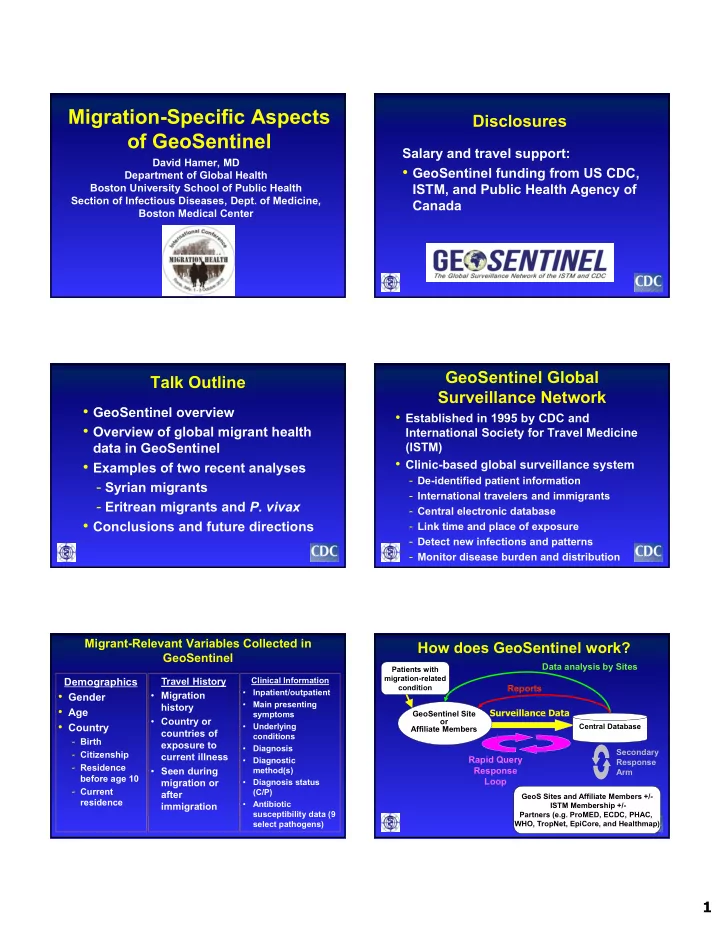
How does GeoSentinel work?
GeoSentinel Site
- r
Affiliate Members
Rapid Query Response Loop
Central Database
Reports Surveillance Data Data analysis by Sites
Secondary Response Arm
GeoS Sites and Affiliate Members +/- ISTM Membership +/- Partners (e.g. ProMED, ECDC, PHAC, WHO, TropNet, EpiCore, and Healthmap) Patients with migration-related condition