State 4-H Hippology Contest State 4-H Hippology Contest - - PowerPoint PPT Presentation

state 4 h hippology contest state 4 h hippology contest
SMART_READER_LITE
LIVE PREVIEW

State 4-H Hippology Contest State 4-H Hippology Contest - - PowerPoint PPT Presentation

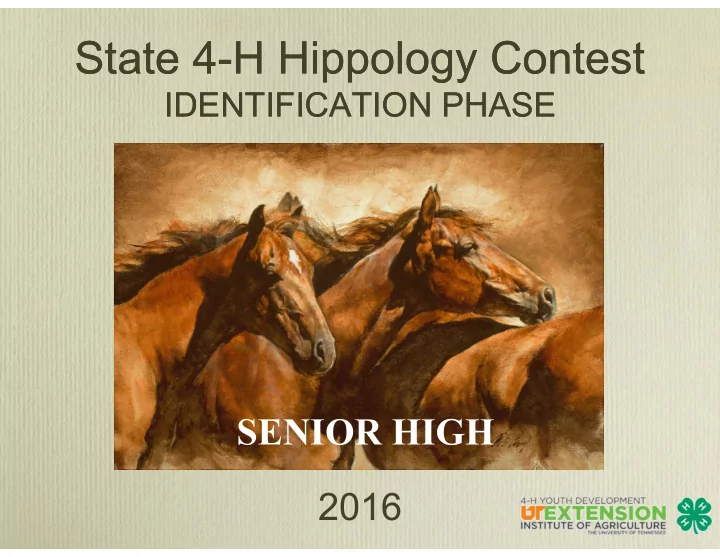
State 4-H Hippology Contest State 4-H Hippology Contest IDENTIFICATION PHASE IDENTIFICATION PHASE SENIOR HIGH 2016 The following questions are multiple choice. The possible answers are on each slide. You will have 20 seconds per slide


slide-1
SLIDE 1

State 4-H Hippology Contest

IDENTIFICATION PHASE

State 4-H Hippology Contest

IDENTIFICATION PHASE

SENIOR HIGH 2016

slide-2
SLIDE 2

The following questions are multiple choice. The possible answers are on each slide.

slide-3
SLIDE 3

You will have 20 seconds per slide this time through. We will also run through the slides a second time giving you an additional 10 seconds to make final answers.

slide-4
SLIDE 4

Identify this color pattern. Identify this color pattern.

  • A. Brindle
  • B. Sorrel
  • C. Perlino
  • D. Palomino

1

slide-5
SLIDE 5

2

Identify the part labeled “E”. Identify the part labeled “E”.

  • A. Cervix
  • B. Vagina
  • C. Uterine horn
  • D. Oviduct
slide-6
SLIDE 6

Identify the use of this piece

  • f equipment.

Identify the use of this piece

  • f equipment.
  • A. Floating teeth
  • B. Grooming mares
  • C. Rasping hooves
  • D. Tooling saddles

3

slide-7
SLIDE 7

Which of these is highest in energy? Which of these is highest in energy?

4

A C B D

slide-8
SLIDE 8

5

Identify this blemish. Identify this blemish.

  • A. Bog Spavin
  • B. Splint
  • C. Side Bone
  • D. Bowed Tendon
slide-9
SLIDE 9

Identify this type of vaccine. Identify this type of vaccine.

  • A. Subcutaneous
  • B. Drench
  • C. Intramuscular
  • D. Intranasal

6

slide-10
SLIDE 10

Identify this procedure. Identify this procedure.

  • A. Endoscopy
  • B. Radiograph
  • C. MRI
  • D. X-ray

7

slide-11
SLIDE 11

Identify this gait. Identify this gait.

  • A. Pace
  • B. Canter
  • C. Running walk
  • D. Rack

8

slide-12
SLIDE 12

Identify the legume. Identify the legume.

9

A B C D

slide-13
SLIDE 13

Identify the part of the horseshoe. Identify the part of the horseshoe.

  • A. Caulk
  • B. Clip
  • C. Fullering
  • D. Web

10

slide-14
SLIDE 14
  • A. Live Cover
  • B. Collecting
  • C. Artificial Insemination
  • D. Teasing
  • A. Live Cover
  • B. Collecting
  • C. Artificial Insemination
  • D. Teasing

Identify this breeding practice. Identify this breeding practice.

11

slide-15
SLIDE 15

Name the disease with these symptoms. Name the disease with these symptoms.

  • A. Encephalomyelitis
  • B. Equine Infectious

Anemia

  • C. Equine Influenza
  • D. Tetanus

12

slide-16
SLIDE 16

What vital sign is being evaluated here. What vital sign is being evaluated here.

  • A. Capillary refill
  • B. Temperature
  • C. Pulse
  • D. Respiration rate

13

slide-17
SLIDE 17

14

Identify the hoof disorder that affects this bone. Identify the hoof disorder that affects this bone.

  • A. Abscess
  • B. Founder
  • C. Thrush
  • D. Navicular
  • A. Abscess
  • B. Founder
  • C. Thrush
  • D. Navicular
slide-18
SLIDE 18

Identify this piece of equipment. Identify this piece of equipment.

  • A. Hoof gauge
  • B. Hoof tester
  • C. Nippers
  • D. Emasculator

15

slide-19
SLIDE 19

B C A D

Identify the body system affected by West Nile Virus. Identify the body system affected by West Nile Virus.

16

slide-20
SLIDE 20

Identify the skin condition with this clinical sign. Identify the skin condition with this clinical sign.

  • A. HYPP
  • B. Rain rot
  • C. HERDA
  • D. Mange

17

slide-21
SLIDE 21

Identify this event. Identify this event.

18

  • A. Cutting
  • B. Team Sorting
  • C. Reined Cow Horse
  • D. Reining
  • A. Cutting
  • B. Team Sorting
  • C. Reined Cow Horse
  • D. Reining
slide-22
SLIDE 22

Identify this piece of tack. Identify this piece of tack.

19

  • A. Breastplate
  • B. Chambon
  • C. Tie Down
  • D. Standing

Martingale

  • A. Breastplate
  • B. Chambon
  • C. Tie Down
  • D. Standing

Martingale

slide-23
SLIDE 23

Identify the bone marked “B”.. Identify the bone marked “B”..

  • A. Metacarpal
  • B. Sesamoid
  • C. Metatarsus
  • D. Phalanx

20

A B C D A G F E A

slide-24
SLIDE 24

Identify this report form. Identify this report form.

  • A. Coggins Test
  • B. Pregnancy Test
  • C. Vaccination Record
  • D. Registration Paper

21

slide-25
SLIDE 25

Identify this process. Identify this process.

  • A. Ensiling
  • B. Fertilizing
  • C. Composting
  • D. Tilling

22

slide-26
SLIDE 26

Identify the hoof structure. Identify the hoof structure.

  • A. Pedal bone
  • B. Navicular bone
  • C. Pastern bone
  • D. Digital Cushion

23

slide-27
SLIDE 27

Which is the best source of protein? Which is the best source of protein?

24

A B C D

slide-28
SLIDE 28

25

Identify the site for internal parasite eggs. Identify the site for internal parasite eggs.

A C B D

slide-29
SLIDE 29

Identify this genetic defect. Identify this genetic defect.

  • A. Umbilical hernia
  • B. HYPP
  • C. Hydrocephalus
  • D. Cryptorchid

26

slide-30
SLIDE 30

27

  • A. Mowing hay
  • B. Tedding hay
  • A. Mowing hay
  • B. Tedding hay
  • C. Raking hay
  • D. Baling hay
  • C. Raking hay
  • D. Baling hay

Identify this process. Identify this process.

slide-31
SLIDE 31

28

  • A. Ground
  • B. Crimped
  • C. Pelleted
  • D. Extruded
  • A. Ground
  • B. Crimped
  • C. Pelleted
  • D. Extruded

Identify this processing method. Identify this processing method.

slide-32
SLIDE 32

Identify the breed affected by Lethal White Foal Syndrome. Identify the breed affected by Lethal White Foal Syndrome.

29

B C D A

slide-33
SLIDE 33

Identify this breed. Identify this breed.

  • A. Jennet
  • B. Hinny
  • C. Mammoth Jack
  • D. Mule

30

slide-34
SLIDE 34

Identify the hoof structure. Identify the hoof structure.

  • A. Bulb
  • B. Bar
  • C. Lamina
  • D. Sulcus

31

slide-35
SLIDE 35

Identify the respiratory disorder that causes this “heave line”. Identify the respiratory disorder that causes this “heave line”.

  • A. Exertional

Rhabdomyolysis

B.

Laminitis

  • C. Chronic Obstructive

Pulmonary Disease

D.

Tetanus

32

slide-36
SLIDE 36

Identify this diagnostic procedure. Identify this diagnostic procedure.

  • A. Thermography
  • B. MRI
  • C. Ultrasound
  • D. X-ray

33

slide-37
SLIDE 37

34

Identify the end of which stage

  • f parturition.

Identify the end of which stage

  • f parturition.
  • A. Stage 1
  • B. Stage 2
  • C. Stage 3
  • D. Stage 4
slide-38
SLIDE 38

Identify. Identify.

  • A. Leg wraps
  • B. Hobbles
  • C. Splint boots
  • D. Over-reach boots

35

slide-39
SLIDE 39

Identify the part marked “C”. Identify the part marked “C”.

  • A. Aorta
  • B. Atrium
  • C. Ventricle
  • D. Vena cava

36

A B D C E

slide-40
SLIDE 40

Identify this farrier tool. Identify this farrier tool.

  • A. Clincher
  • B. Nipper
  • C. Hoof tester
  • D. Pull offs

37

slide-41
SLIDE 41

Identify this forage that should not be fed to all horses. Identify this forage that should not be fed to all horses.

  • A. Byhalia grass
  • B. Tall fescue
  • C. Pokeweed
  • D. Sudan grass

38

slide-42
SLIDE 42

Identify the use of this piece of equipment. Identify the use of this piece of equipment.

  • A. Breeding
  • B. Deworming
  • C. Drenching
  • D. Vaccinating

39

slide-43
SLIDE 43

Identify this conformation fault. Identify this conformation fault.

  • A. Bench-kneed
  • B. Buck-kneed
  • C. Post-legged
  • D. Sickle-hocked

40

slide-44
SLIDE 44

What is the body condition score of this horse according to the Henneke method? What is the body condition score of this horse according to the Henneke method?

  • A. 2
  • B. 4
  • C. 6
  • D. 8

41

slide-45
SLIDE 45

Identify the disease associated with this clinical sign. Identify the disease associated with this clinical sign.

  • A. Influenza
  • B. EIA
  • C. EPM
  • D. Tetanus

42

slide-46
SLIDE 46

Identify. Identify.

  • A. Automatic waterer
  • B. Hay feeder
  • C. Mineral feeder
  • D. Feed bunk

43

slide-47
SLIDE 47

Identify the preferred way to feed hay to stalled horses. Identify the preferred way to feed hay to stalled horses.

44

A B C D

slide-48
SLIDE 48

Identify the color pattern of this Appaloosa. Identify the color pattern of this Appaloosa.

  • A. Blanket
  • B. Snowflake
  • C. Snowcap
  • D. Varnish

45

slide-49
SLIDE 49

Identify this vice. Identify this vice.

  • A. Colic
  • B. Cribbing
  • C. Heaving
  • D. Tooth sharpening

46

slide-50
SLIDE 50

Identify these muscles. Identify these muscles.

47

  • A. Gluteal
  • B. Latissimus
  • C. Pectoral
  • D. Oblique
  • A. Gluteal
  • B. Latissimus
  • C. Pectoral
  • D. Oblique
slide-51
SLIDE 51

Which picture shows the recommended way to tie a horse? Which picture shows the recommended way to tie a horse? 48 B C A D

slide-52
SLIDE 52

Identify this gait. Identify this gait.

  • A. Jog
  • B. Trot
  • C. Canter
  • D. Lope

49

slide-53
SLIDE 53

Identify this genetic defect. Identify this genetic defect.

  • A. CID
  • B. Hydrocephalus
  • C. Inguinal hernia
  • D. Umbilical hernia

50

slide-54
SLIDE 54

You will have 10 seconds per slide this time through. This is your final chance to answer!

slide-55
SLIDE 55

Identify this color pattern. Identify this color pattern.

  • A. Brindle
  • B. Sorrel
  • C. Perlino
  • D. Palomino

1

slide-56
SLIDE 56

2

Identify the part labeled “E”. Identify the part labeled “E”.

  • A. Cervix
  • B. Vagina
  • C. Uterine horn
  • D. Oviduct
slide-57
SLIDE 57

Identify the use of this piece

  • f equipment.

Identify the use of this piece

  • f equipment.
  • A. Floating teeth
  • B. Grooming mares
  • C. Rasping hooves
  • D. Tooling saddles

3

slide-58
SLIDE 58

Which of these is highest in energy? Which of these is highest in energy?

4

A C B D

slide-59
SLIDE 59

5

Identify this blemish. Identify this blemish.

  • A. Bog Spavin
  • B. Splint
  • C. Side Bone
  • D. Bowed Tendon
slide-60
SLIDE 60

Identify this type of vaccine. Identify this type of vaccine.

  • A. Subcutaneous
  • B. Drench
  • C. Intramuscular
  • D. Intranasal

6

slide-61
SLIDE 61

Identify this procedure. Identify this procedure.

  • A. Endoscopy
  • B. Radiograph
  • C. MRI
  • D. X-ray

7

slide-62
SLIDE 62

Identify this gait. Identify this gait.

  • A. Pace
  • B. Canter
  • C. Running walk
  • D. Rack

8

slide-63
SLIDE 63

Identify the legume. Identify the legume.

9

A B C D

slide-64
SLIDE 64

Identify the part of the horseshoe. Identify the part of the horseshoe.

  • A. Caulk
  • B. Clip
  • C. Fullering
  • D. Web

10

slide-65
SLIDE 65
  • A. Live Cover
  • B. Collecting
  • C. Artificial Insemination
  • D. Teasing
  • A. Live Cover
  • B. Collecting
  • C. Artificial Insemination
  • D. Teasing

Identify this breeding practice. Identify this breeding practice.

11

slide-66
SLIDE 66

Name the disease with these symptoms. Name the disease with these symptoms.

  • A. Encephalomyelitis
  • B. Equine Infectious

Anemia

  • C. Equine Influenza
  • D. Tetanus

12

slide-67
SLIDE 67

What vital sign is being evaluated here. What vital sign is being evaluated here.

  • A. Capillary refill
  • B. Temperature
  • C. Pulse
  • D. Respiration rate

13

slide-68
SLIDE 68

14

Identify the hoof disorder that affects this bone. Identify the hoof disorder that affects this bone.

  • A. Abscess
  • B. Founder
  • C. Thrush
  • D. Navicular
  • A. Abscess
  • B. Founder
  • C. Thrush
  • D. Navicular
slide-69
SLIDE 69

Identify this piece of equipment. Identify this piece of equipment.

  • A. Hoof gauge
  • B. Hoof tester
  • C. Nippers
  • D. Emasculator

15

slide-70
SLIDE 70

B C A D

Identify the body system affected by West Nile Virus. Identify the body system affected by West Nile Virus.

16

slide-71
SLIDE 71

Identify the skin condition with this clinical sign. Identify the skin condition with this clinical sign.

  • A. HYPP
  • B. Rain rot
  • C. HERDA
  • D. Mange

17

slide-72
SLIDE 72

Identify this event. Identify this event.

18

  • A. Cutting
  • B. Team Sorting
  • C. Reined Cow Horse
  • D. Reining
  • A. Cutting
  • B. Team Sorting
  • C. Reined Cow Horse
  • D. Reining
slide-73
SLIDE 73

Identify this piece of tack. Identify this piece of tack.

19

  • A. Breastplate
  • B. Chambon
  • C. Tie Down
  • D. Standing

Martingale

  • A. Breastplate
  • B. Chambon
  • C. Tie Down
  • D. Standing

Martingale

slide-74
SLIDE 74

Identify the bone marked “B”.. Identify the bone marked “B”..

  • A. Metacarpal
  • B. Sesamoid
  • C. Metatarsus
  • D. Phalanx

20

A B C D A G F E A

slide-75
SLIDE 75

Identify this report form. Identify this report form.

  • A. Coggins Test
  • B. Pregnancy Test
  • C. Vaccination Record
  • D. Registration Paper

21

slide-76
SLIDE 76

Identify this process. Identify this process.

  • A. Ensiling
  • B. Fertilizing
  • C. Composting
  • D. Tilling

22

slide-77
SLIDE 77

Identify the hoof structure. Identify the hoof structure.

  • A. Pedal bone
  • B. Navicular bone
  • C. Pastern bone
  • D. Digital Cushion

23

slide-78
SLIDE 78

Which is the best source of protein? Which is the best source of protein?

24

A B C D

slide-79
SLIDE 79

25

Identify the site for internal parasite eggs. Identify the site for internal parasite eggs.

A C B D

slide-80
SLIDE 80

Identify this genetic defect. Identify this genetic defect.

  • A. Umbilical hernia
  • B. HYPP
  • C. Hydrocephalus
  • D. Cryptorchid

26

slide-81
SLIDE 81

27

  • A. Mowing hay
  • B. Tedding hay
  • A. Mowing hay
  • B. Tedding hay
  • C. Raking hay
  • D. Baling hay
  • C. Raking hay
  • D. Baling hay

Identify this process. Identify this process.

slide-82
SLIDE 82

28

  • A. Ground
  • B. Crimped
  • C. Pelleted
  • D. Extruded
  • A. Ground
  • B. Crimped
  • C. Pelleted
  • D. Extruded

Identify this processing method. Identify this processing method.

slide-83
SLIDE 83

Identify the breed affected by Lethal White Foal Syndrome. Identify the breed affected by Lethal White Foal Syndrome.

29

B C D A

slide-84
SLIDE 84

Identify this breed. Identify this breed.

  • A. Jennet
  • B. Hinny
  • C. Mammoth Jack
  • D. Mule

30

slide-85
SLIDE 85

Identify the hoof structure. Identify the hoof structure.

  • A. Bulb
  • B. Bar
  • C. Lamina
  • D. Sulcus

31

slide-86
SLIDE 86

Identify the respiratory disorder that causes this “heave line”. Identify the respiratory disorder that causes this “heave line”.

  • A. Exertional

Rhabdomyolysis

B.

Laminitis

  • C. Chronic Obstructive

Pulmonary Disease

D.

Tetanus

32

slide-87
SLIDE 87

Identify this diagnostic procedure. Identify this diagnostic procedure.

  • A. Thermography
  • B. MRI
  • C. Ultrasound
  • D. X-ray

33

slide-88
SLIDE 88

34

Identify the end of which stage

  • f parturition.

Identify the end of which stage

  • f parturition.
  • A. Stage 1
  • B. Stage 2
  • C. Stage 3
  • D. Stage 4
slide-89
SLIDE 89

Identify. Identify.

  • A. Leg wraps
  • B. Hobbles
  • C. Splint boots
  • D. Over-reach boots

35

slide-90
SLIDE 90

Identify the part marked “C”. Identify the part marked “C”.

  • A. Aorta
  • B. Atrium
  • C. Ventricle
  • D. Vena cava

36

A B D C E

slide-91
SLIDE 91

Identify this farrier tool. Identify this farrier tool.

  • A. Clincher
  • B. Nipper
  • C. Hoof tester
  • D. Pull offs

37

slide-92
SLIDE 92

Identify this forage that should not be fed to all horses. Identify this forage that should not be fed to all horses.

  • A. Byhalia grass
  • B. Tall fescue
  • C. Pokeweed
  • D. Sudan grass

38

slide-93
SLIDE 93

Identify the use of this piece of equipment. Identify the use of this piece of equipment.

  • A. Breeding
  • B. Deworming
  • C. Drenching
  • D. Vaccinating

39

slide-94
SLIDE 94

Identify this conformation fault. Identify this conformation fault.

  • A. Bench-kneed
  • B. Buck-kneed
  • C. Post-legged
  • D. Sickle-hocked

40

slide-95
SLIDE 95

What is the body condition score of this horse according to the Henneke method? What is the body condition score of this horse according to the Henneke method?

  • A. 2
  • B. 4
  • C. 6
  • D. 8

41

slide-96
SLIDE 96

Identify the disease associated with this clinical sign. Identify the disease associated with this clinical sign.

  • A. Influenza
  • B. EIA
  • C. EPM
  • D. Tetanus

42

slide-97
SLIDE 97

Identify. Identify.

  • A. Automatic waterer
  • B. Hay feeder
  • C. Mineral feeder
  • D. Feed bunk

43

slide-98
SLIDE 98

Identify the preferred way to feed hay to stalled horses. Identify the preferred way to feed hay to stalled horses.

44

A B C D

slide-99
SLIDE 99

Identify the color pattern of this Appaloosa. Identify the color pattern of this Appaloosa.

  • A. Blanket
  • B. Snowflake
  • C. Snowcap
  • D. Varnish

45

slide-100
SLIDE 100

Identify this vice. Identify this vice.

  • A. Colic
  • B. Cribbing
  • C. Heaving
  • D. Tooth sharpening

46

slide-101
SLIDE 101

Identify these muscles. Identify these muscles.

47

  • A. Gluteal
  • B. Latissimus
  • C. Pectoral
  • D. Oblique
  • A. Gluteal
  • B. Latissimus
  • C. Pectoral
  • D. Oblique
slide-102
SLIDE 102

Which picture shows the recommended way to tie a horse? Which picture shows the recommended way to tie a horse? 48 B C A D

slide-103
SLIDE 103

Identify this gait. Identify this gait.

  • A. Jog
  • B. Trot
  • C. Canter
  • D. Lope

49

slide-104
SLIDE 104

Identify this genetic defect. Identify this genetic defect.

  • A. CID
  • B. Hydrocephalus
  • C. Inguinal hernia
  • D. Umbilical hernia

50

slide-105
SLIDE 105

This completes your ID. Please turn in your score card.