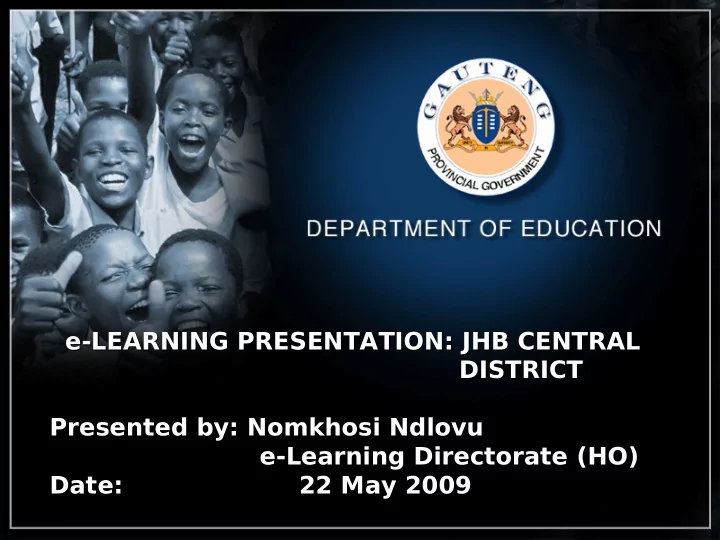
e-LEARNING PRESENTATION: JHB CENTRAL e-LEARNING PRESENTATION: JHB - - PowerPoint PPT Presentation

e learning presentation jhb central e learning
SMART_READER_LITE
LIVE PREVIEW

e-LEARNING PRESENTATION: JHB CENTRAL e-LEARNING PRESENTATION: JHB - - PowerPoint PPT Presentation

e-LEARNING PRESENTATION: JHB CENTRAL e-LEARNING PRESENTATION: JHB CENTRAL DISTRICT DISTRICT Presented by: Nomkhosi Ndlovu Presented by: Nomkhosi Ndlovu e-Learning Directorate (HO) e-Learning Directorate (HO) Date: 22 May 2009 Date: 22 May


slide-1
SLIDE 1

1

e-LEARNING PRESENTATION: JHB CENTRAL e-LEARNING PRESENTATION: JHB CENTRAL DISTRICT DISTRICT Presented by: Nomkhosi Ndlovu Presented by: Nomkhosi Ndlovu e-Learning Directorate (HO) e-Learning Directorate (HO) Date: Date: 22 May 2009 22 May 2009

slide-2
SLIDE 2

2

STRUCTURE OF THE STRUCTURE OF THE PRESENTATION PRESENTATION

  • What e-Learning is all about
  • GDE e-Learning Vision and Mission
  • e-Learning Structures
  • The role of the District
  • The roles of School Managers and

Educators

slide-3
SLIDE 3

3

WHAT e-LEARNING IS ALL ABOUT WHAT e-LEARNING IS ALL ABOUT

  • According to the White Paper on e-

Education (2004:14) e-Learning is about learning and teaching philosophies and methodologies within the context of OBE, using ICTs in the learning environment.

  • The directorate is responsible for

supporting curriculum delivery in both GET and FET through facilitating and promoting the use of ICTs to improve the delivery of teaching and learning.

slide-4
SLIDE 4

4

WHAT e-LEARNING IS ALL ABOUT WHAT e-LEARNING IS ALL ABOUT

  • This involves the development of

policies, strategies and frameworks for the integration of ICTs into the curriculum

  • Creating opportunities for flexible

& collaborative learning; access to information; interaction among teachers, learners & the online environment; this may involve the use of the internet, computer hardware, software and other media.

slide-5
SLIDE 5

5

WHAT WE ARE NOT : WHAT WE ARE NOT :

  • Computers and Software only
  • Learning how to use the

technology

  • Replacing educators with the

technology

slide-6
SLIDE 6

6

WHY……. e-LEARNING? WHY……. e-LEARNING?

  • Self-paced, fast and works anywhere and

at any time

  • Instructional materials are easily updated
  • Permits the use of multimedia which

leads to reinforced learning through the use of video, audio, games and other forms of interaction

  • Supports; assists and enables learning
  • Improves retention, provides immediate

feedback and allows learners to customise learning materials to meet their individual needs

  • Enables learners to learn in a fun way
slide-7
SLIDE 7

7

WHY……. e-LEARNING? WHY……. e-LEARNING?

  • e-Learning will enhance the quality of the

teaching time of educators and it will reduce the time spent on administrative chores.

  • Learning through the use of ICTs is arguably
  • ne of the most powerful means of

supporting learners to achieve the nationally stated curriculum goals: – Learner-centred learning; – Active, exploratory, inquiry based learning; – Collaborative work among learners and teachers; and – Creativity, analytical skills, critical thinking and informed decision-making.

slide-8
SLIDE 8

8

VISION AND MISSION VISION AND MISSION

  • Every South African learner in GET

and FET will be ICT capable by 2014…

  • Together, let’s harness technology

to transform Teaching and Learning!

  • e-Learning for improved learner

attainment!

slide-9
SLIDE 9

9

e-LEARNING STRATEGY e-LEARNING STRATEGY

  • The Directorate has a Strategy

Document in place with an action plan for the next five years

  • The strategy has already been

adopted by Senior Management in the GDE

  • The key thrust of the strategy

articulates our commitment to two key areas: – Enhance curriculum delivery in the classroom – Developing, promoting, supporting & sustaining all schools in the province as e-Schools

slide-10
SLIDE 10

10

e-LEARNING STRATEGIC GOALS e-LEARNING STRATEGIC GOALS

  • Strategic Goal 1:

Improve the teaching and learning through the use of ICTs;

  • Strategic Goal 2:

Develop management and leadership at schools with ICTs;

  • Strategic Goal 3:

Consolidate and strengthen the public schools education system for all learners in the province, especially quintile 1, 2 and 3 schools to quality public education

slide-11
SLIDE 11

11

WHERE ARE WE? WHERE ARE WE?

  • Hosted the Provincial e-Learning

Showcase

  • Hosted the Provincial e-Learning Week
  • Trained District Officials on Software

Evaluation and Selection.

– In the process of compiling a catalogue

  • Trained educators on CAT 1 & 2
  • Conducted the Rubricate Junior Training

for educators

  • Provided bursaries for ACE and BEd

Honours in ICT Education for educators

slide-12
SLIDE 12

12

  • Research the status of e-Learning in our schools
  • Developed guidelines for ICT Governance and

Policy Development

  • Software Evaluation and Selection
  • Capacity building programmes for Officials,

educators and school managers

  • Curriculum support initiatives i.e. Rubricate &

Mathematical Literacy Intervention Programme

  • Procure e-Learning Resource Packs
  • e-Learning advocacy and Information Sharing

sessions

WHERE ARE WE?

slide-13
SLIDE 13

13

e-LEARNING STRUCTURES e-LEARNING STRUCTURES

  • PELT (Provincial e-Learning Teams)
  • DELT (District e-Learning Teams)
  • CELT (Cluster e-Learning Teams)
  • SELT (School e-Learning Teams)
slide-14
SLIDE 14

14

THE ROLE OF THE DISTRICT THE ROLE OF THE DISTRICT

  • Coordinate the Teacher Development

Programmes

  • Monitor the role of School Management Teams

in managing an ICT laden Environment

  • Monitor the integration of ICTs into the

curriculum

  • Support schools in promoting the use of ICTs

for teaching and learning purposes through scheduled School Support Visits

  • Establish e-Learning structures that will

ensure alignment and better coordination of e-

slide-15
SLIDE 15

15

THE ROLE OF SCHOOL THE ROLE OF SCHOOL MANAGERS MANAGERS

  • Manage an ICT Laden Environment
  • Develop the ICT Policy (include all

stakeholders)

  • Ensure ICT Policy implementation
  • Support ICT integration in the

classroom

  • Provide opportunities for

Continuous Professional Teacher Development (CPTD), for all our educators.

slide-16
SLIDE 16

16

THE ROLE OF THE EDUCATOR THE ROLE OF THE EDUCATOR

  • Integrate ICTs into the curriculum

to enhance the delivery of teaching and learning. – Add excitement in the classroom, for learners to see the value of education – Enable our learners to be full participants of the global community.

  • Attend ICT Skills Development

Programmes (workshops,

slide-17
SLIDE 17

17

THE ROLE OF THE TEACHER THE ROLE OF THE TEACHER

  • Select appropriate ICT tools to

achieve learning outcomes. e.g. Use:

– a tape recorder for story telling – a DVD recorder to record learners dramatizing a story – Microsoft Movie Maker for learners to make own films – The internet for research – The email/ cellphones for collaboration – Cellphones to down-load curriculum content/ homework

slide-18
SLIDE 18

18

TO ALL OUR TEACHERS!!! TO ALL OUR TEACHERS!!!

  • As the e-Learning Directorate at Head

Office we salute of all our teachers who have taken great strides in integrating ICTs into the curriculum, to enhance the delivery of teaching and learning. Sometimes with little resources.

  • Your commitment and dedication in

serving our learners and our communities does not go unnoticed.

  • We acknowledge the challenges you are

facing and wish to encourage you to continue with your excellent work. A wise man once said “excellence breeds success”

slide-19
SLIDE 19

19

STRIVE FOR EXCELLENCE STRIVE FOR EXCELLENCE

  • Many centuries ago Aristotle once

said that excellence is not an act but a habit.

  • Excellence is developed by

changing your mindset and approaching every task with care , diligence and rigour.

  • Everything you do in life is a

reflection of who you are – so stamp your work with excellence and success will follow you. Awaken your potential knowing that the power of excellence is

slide-20
SLIDE 20

20

WHICH TYPE ARE YOU? WHICH TYPE ARE YOU?

  • In life there are three types of

people:

  • 1. Those who make things happen.
  • 2. Those who watch things happen.
  • 3. Those who wake up at the end of

their lives and ask “What happened” WHICH TYPE ARE YOU?

slide-21
SLIDE 21

21

LASTLY LASTLY

  • Times are changing. Let us change

with them.

  • Our learners have dreams. Let us

all work together to make their dreams come true. WE CANNOT AFFORD TO FAIL THEM!!!

slide-22
SLIDE 22

22

Thank You!!! Thank You!!!

NB: KINDLY PUT YOUR NB: KINDLY PUT YOUR QUESTIONS/ SUGGESTIONS QUESTIONS/ SUGGESTIONS IN THE IN THE SUGGESTION BOX. SUGGESTION BOX.