Dual-Stage Gas Proportional Scintillation Counter New Developments - - PowerPoint PPT Presentation

dual stage gas proportional scintillation counter new
SMART_READER_LITE
LIVE PREVIEW

Dual-Stage Gas Proportional Scintillation Counter New Developments - - PowerPoint PPT Presentation

Dual-Stage Gas Proportional Scintillation Counter New Developments A.F.V. Cortez, C.A.N. Conde, S.J.C. do Carmo, F.I.G.M. Borges Contact: andre.cortez@coimbra.lip.pt Pisa Meeting on Advanced Detectors 2018, May 27- June 2, 2018 - Isola


slide-1
SLIDE 1

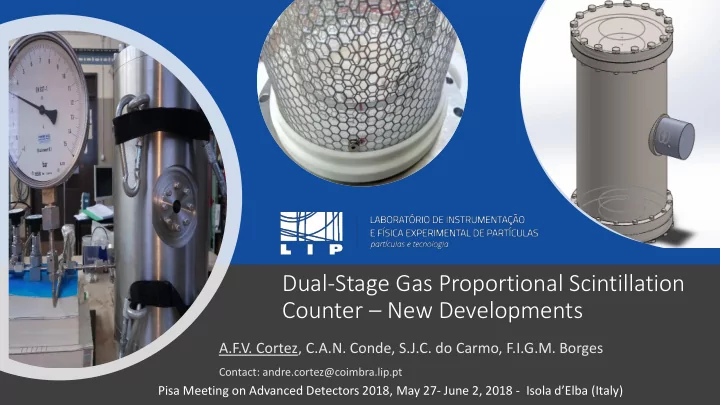
Dual-Stage Gas Proportional Scintillation Counter – New Developments

A.F.V. Cortez, C.A.N. Conde, S.J.C. do Carmo, F.I.G.M. Borges

Contact: andre.cortez@coimbra.lip.pt

Pisa Meeting on Advanced Detectors 2018, May 27- June 2, 2018 - Isola d’Elba (Italy)

slide-2
SLIDE 2
  • Objectives and Motivation
  • Development of a new HPXe-GPSC
  • Working Principle and Experimental Setup
  • Results
  • Conclusions and Future Work

2

Co Contents ntents

André Cortez - Pisa Meeting on Advanced Detectors 2018, May 27- June 2, 2018 - Isola d’Elba (Italy)
  • Simulation
  • Experimental
slide-3
SLIDE 3

Objec jectives tives and nd Moti

  • tivatio

ation

Deve evelop lop a new new hi high gh-pre ressur ssure, e, xenon enon-base ased gase gaseous

  • us radia

radiati tion

  • n det

detec ector tor of

  • f the

the GPS GPSC type ype for for hard X-ray and and gamm mma-ray ay spect ctromet rometry ry.

Here are some reasons why use HPXe GPSC SC?

*Energy resolution; *Operation at room temperature; *Lower cost; *Large detection area; *Flexibility in the geometry definition;

3 André Cortez - Pisa Meeting on Advanced Detectors 2018, May 27- June 2, 2018 - Isola d’Elba (Italy)

slide-4
SLIDE 4

1. 1. Ga Gas s Proportional

  • portional Scinti

ntillation llation Co Counter ter – The e De Detector ector

Pisa Meeting on Advanced Detectors 2018, May 27- June 2, 2018 - Isola d’Elba (Italy)

slide-5
SLIDE 5

The he De Detect tector

  • r – MGHP

GHP GP GPSC

30 cm 17 cm 0.5 cm 5.5 cm 2 cm 0.5 cm 1.5 cm 0.5 cm

5

Anode (tens

  • f keV)

Shielding grid (grounded) Collecting grid (few keV) Photocathode (grounded) Alpha particles support structure (for initial tests)

André Cortez - Pisa Meeting on Advanced Detectors 2018, May 27- June 2, 2018 - Isola d’Elba (Italy)

slide-6
SLIDE 6

D A B D C A B D C

γ

The HPXe detectors of the MGHP-GPSC type consist of four distinct regions:

  • A - Absorption/Drift Region;
  • B - Secondary Scintillation Region;
  • C - Electric Field Barrier Region;
  • D - Photoelectron Collecting Region;

Working king Princi nciple ple

  • Incident energy (Er)
  • w-value
  • Gas

Energy deposition

  • E/p at the anode
  • Pressure
  • Gas

Amplification

  • Solid angle
  • Opt. Transmission
  • Quantum Efficiency
  • Extraction Efficiency

(η)

Collection

Photon Charge VUV photon Region A Region B Region D

Signal Formation

Charge

5

𝐻𝑏𝑗𝑜 = 𝑂

𝑇. 𝑈 𝑝𝑞𝑢 . 𝑅𝐹. η

𝑂𝑇 = 𝐵𝐹𝑇 𝑠 − 𝑞𝐶 2π − 2θ(𝑠) 2π Ω(𝑠, 𝑨) 4π 𝑒𝑠 𝑒𝑨 Photon production Anode shadow Solid angle 𝑈𝑝𝑞𝑢 = 𝑈𝑡ℎ𝑗𝑓𝑚𝑒. 𝑈𝑑𝑝𝑚𝑚𝑓𝑑𝑢. 𝑈𝑝𝑞𝑢 - Grids optical transm. QE- Quantum Efficiency η - Extract. Efficiency

André Cortez - Pisa Meeting on Advanced Detectors 2018, May 27- June 2, 2018 - Isola d’Elba (Italy)

slide-7
SLIDE 7

Plana nar vs Cyli lind ndrica rical l Geometry metry

Cha haracter eristics Cylind ndrical geom eometry (Planar) Pressure Range <20 atm (<10 atm)

  • Detect. Efficiency

(662 keV/15 atm) ~20% (<4%) Solid Angle (Ω/4π) 0,48-0,87 (0,12) Detector Active Volume 3369 cm3 (726 cm3) Detector gain 10 - 30 phe-/e- (~10 phe-/e-) Regions E/p V.cm-1torr-1 Length Cylindrical Length Planar Absorption/Drift 0,03<1 30x5,4 cm 4,0 cm Scintillation 1 – 6 0,5 cm 0,7 cm Optical transmission

  • 1,2 cm

Electric field barrier

  • 2,0 cm

2,4 cm Photoelectron collection <1 0,5 cm 1 cm A B D C A B D C

γ

7

Comparing both geometries, the cylindrical presents:

  • Improved Solid Angle
  • Improved Detect. Efficiency
  • Improved Active Volume of Detection
  • Optical Transmission
  • Lower Biasing Voltage for the same gain

Energy Range: 100 keV – 1 MeV André Cortez - Pisa Meeting on Advanced Detectors 2018, May 27- June 2, 2018 - Isola d’Elba (Italy)

slide-8
SLIDE 8

2. Simu mulation lation and d Expe perimental rimental Re Resu sults lts

Pisa Meeting on Advanced Detectors 2018, May 27- June 2, 2018 - Isola d’Elba (Italy)

slide-9
SLIDE 9

5 10 15 20 25 0,0 1,0 2,0 3,0 4,0 5,0 6,0 5 10 15 20 25 30

R % Eα (MeV) Mylar window width (μm) Energy Alpha particles (after Mylar) Energy Resolution

Tests sts with th Alpha lpha Particle ticles - Simulation mulation

0,00 1,00 2,00 3,00 4,00 5,00 6,00 10 20 30 40 50 60 70 80 90

Energy (MeV) Incidence angle (degrees)

Energy of the Alpha-particles Am 241 - Alpha-particle energy

𝐺𝑋𝐼𝑁𝑁𝑧𝑚𝑏𝑠~0.23% Deterioration due to the Mylar window

Max incidence angle

Combined effect

  • f about 2% in the

energy dispersion

Energy of the Am – 5.486 MeV

241

Energy degradation Alpha particles end up with only 4.486 MeV after crossing the Mylar window + energy dispersion.

9 André Cortez - Pisa Meeting on Advanced Detectors 2018, May 27- June 2, 2018 - Isola d’Elba (Italy)

𝐺𝑋𝐼𝑁𝑁𝑧𝑚𝑏𝑠~2%

slide-10
SLIDE 10

4 8 12 16 20 500 1000 1500 2000 2500 3 6 9 12 15

E/p (V.cm-1.Torr-1) Signal Amplitude (mV) E/p (kV.cm-1.bar-1)

1 2 3 4 5 1 1,5 2 2,5 3

Gain Pressure (bar)

1 V.cm-1.Torr-1

  • Theor. Gain

1.33 V.cm-1.Torr-1 0,3 0,6 0,9 1,2 1,5 1,8 1500 3000 4500 6000 0,3 0,6 0,9 1,2 1,5

E/p (V.cm-1.Torr-1) Signal amplitude (mV) E/p (kV.cm-1.bar-1)

1.05 bar 1.3 bar 2.0 bar 2.5 bar 3.0 bar

Ex Experimen perimental tal Tests sts wi with h Alpha pha Pa Parti ticl cles es

10

Signal

E/p at the anode surface E/p in the collecting region

Signal increases

(more light being produced)

  • Extended scintillation

region (small ionization due to the radial electric field)

  • Positive

feedback in the collect. region

  • Increasing

extraction efficiency

  • Scintillation above

2 V.cm-1.Torr-1 at the anode

  • Positive feedback
  • bserved above

1 V.cm-1.Torr-1

Improves greatly the gain E/p collecting region E/p anode

André Cortez - Pisa Meeting on Advanced Detectors 2018, May 27- June 2, 2018 - Isola d’Elba (Italy)

slide-11
SLIDE 11

Ex Experimen perimental tal Tests sts wi with h Alpha pha Particle ticles

11

Energy Resolution vs E/p

5 7 9 11 13 15 2 4 6 8 10 12

R % E/p (V.cm-1.Torr-1)

1.05 bar 2 bar 3 bar 5 7 9 11 13 15 0,6 0,8 1 1,2 1,4 1,6

R % E/p (V.cm-1.Torr-1)

1.05 bar 2 bar 3 bar E/p at the anode surface E/p in the collecting region 1000 2000 3000 4000 5000 20 40 60 80

Counts MCA Channel E/p Collect. 0.84 1.021.11

1000 2000 3000 4000 5000 20 40 60 80 100

Counts MCA Channel 4.95 5.496.04 E/p anode

  • R% improves with

E/p at the anode surface above ionization threshold

  • R% improves with

E/p in the collect. slightly above scintillation threshold

MCA spectra

André Cortez - Pisa Meeting on Advanced Detectors 2018, May 27- June 2, 2018 - Isola d’Elba (Italy)

slide-12
SLIDE 12

100 200 300 400 500 600 700 60 110 160 210 260 310 360 410 460 510

Counts Channel

P = 1,35 bar (Xe) T = 295 K

R(FWHM) ~10 10%

Ex Experim perimental ntal Tests sts with h Alpha pha Parti ticl cles es

Simulation and First Experimental Measurements Very first result: pure Xe

5 7 9 11 13 15 2 4 6 8 10 12

R % E/p (V.cm-1.Torr-1)

1.05 bar 2 bar 3 bar R = 6.8% (for 4.486 MeV) Best R% for alpha particles (experimental) We can see a trend towards R=5.6% Expected Limit 5.6%

How far are we from the energy resolution (R) limit for the detector with alpha particles?

12 André Cortez - Pisa Meeting on Advanced Detectors 2018, May 27- June 2, 2018 - Isola d’Elba (Italy)

slide-13
SLIDE 13

5 10 15 20 10 20 30

R % Gain

100 200 300 400 500 600 700 60 110 160 210 260 310 360 410 460 510

Counts Channel

P = 1,35 bar (Xe) T = 295 K

R(FWHM) ~10 10%

Ex Experim perimental ntal Tests sts with h Alpha pha Parti ticl cles es

13

Simulation and First Experimental Measurements Very first result: pure Xe R = 6.8% (for 4.486 MeV) Factors contributing for the Energy Resolution limit

𝑆 = 2,355 𝐺 𝑜 + 1 𝑜 × 𝐾 𝑂

𝑇

+ 1 𝑂𝑓 1 + σ𝑟 𝐻𝑟

2

+ 𝐹𝑂𝐷 𝑓 𝑜𝐻 + σ𝑜 𝑜

2

energy electronics photosensor ampl. e- Radiation not monoenergetic Expected Limit R = 2.73% (for 662 keV) R = 4.8% (for 4.486 MeV) Experimental

  • Theor. limits

G=30

5 7 9 11 13 15 2 4 6 8 10 12

R % E/p (V.cm-1.Torr-1)

1.05 bar 2 bar 3 bar Radiation monoenergetic

André Cortez - Pisa Meeting on Advanced Detectors 2018, May 27- June 2, 2018 - Isola d’Elba (Italy)

slide-14
SLIDE 14

3. Co Conclus lusion ion and d Future ture Wo Work

Pisa Meeting on Advanced Detectors 2018, May 27- June 2, 2018 - Isola d’Elba (Italy)

slide-15
SLIDE 15

Conc nclusions lusions and Future ture Work

Homeland Security

Illegal transport of radioactive material

Geological Prospection

Fossil fuel detection

Experimental Physics

X-rays fluorescence analysis

Medical Applications

Neutron detection applications

We believe that the results of this work demonstrate the feasibility

  • f a new detector based on HPXe GPSC. For the present moment an

energy resolution better than R= R=6.8% for Am Am241 241 (al (alph pha-parti rticl cles) was achieved in the first measurements.

Main Advantages of this MGHP-GPSC detector:

  • Improved solid angle,
  • Improved active volume of detection,
  • Improved detection efficiency (20%) and gain (30 phe-/e-) – pressure dependent,
  • Optimized biasing voltage (5x lower than in the previous prototype)

Next step…

  • Improve the performance – starting with the associated electronics and solid angle

corrections (more ruggedized, better energy resolution)

15 André Cortez - Pisa Meeting on Advanced Detectors 2018, May 27- June 2, 2018 - Isola d’Elba (Italy)

slide-16
SLIDE 16

Questions?

16

Pisa Meeting on Advanced Detectors 2018, May 27- June 2, 2018 - Isola d’Elba (Italy)

Thank you!

Associazione Frontier Detector for Frontier Physics Young Researcher Grant

slide-17
SLIDE 17

4. Spare are Slides des

Pisa Meeting on Advanced Detectors 2018, May 27- June 2, 2018 - Isola d’Elba (Italy)

slide-18
SLIDE 18

The he Ex Experi perimental mental System stem

18

Pisa Meeting on Advanced Detectors 2018, May 27- June 2, 2018 - Isola d’Elba (Italy)

slide-19
SLIDE 19

19

𝑂𝑇 = 𝐵𝐹𝑇 𝑠 − 𝑞𝐶 2π − 2θ(𝑠) 2π Ω(𝑠, 𝑨) 4π 𝑒𝑠 𝑒𝑨

Solid Angle Effects

Photon production Anode shadow Solid angle

Ω0 Ω0' Ω1 Ω2

θ1 θ2 L-z z R θ2' θ1' r

Solid angle Ω 𝑠, 𝑨 = Ω0 𝑠, 𝑨 = 4π − Ω1 𝑠, 𝑨 − Ω2 (𝑠, 𝑨) Ω𝑗 𝑨 =

2π θ𝑗

sin θ 𝑒θ 𝑒φ Ω𝑗 𝑨 = 2π 1 − 𝑑𝑝𝑡 θ𝑗 Ω0 𝑨 = 2π 𝑑𝑝𝑡 θ1 + 𝑑𝑝𝑡 θ2

Ω 𝑨 = 2𝜌

(𝑀−𝑨) 𝑀−𝑨 2+𝑆2 + 𝑨 𝑨2+𝑆2

48% - 87% To simplify we assume that all photons are emitted at the detector axis (r=0). This way we obtain.

Pisa Meeting on Advanced Detectors 2018, May 27- June 2, 2018 - Isola d’Elba (Italy)

Ef Effects fects affec fecting ting the he Scinti intillation llation

slide-20
SLIDE 20

20

𝑂𝑇 = 𝐵𝐹𝑇 𝑠 − 𝑞𝐶 2π − 2θ(𝑠) 2π Ω(𝑠, 𝑨) 4π 𝑒𝑠 𝑒𝑨

Anode Shadow

Photon production Anode shadow Solid angle Anode shadow

η𝑏 =

2π−2θ(𝑠) 2π

=

2π−2 sin−1 𝑏

𝑠

a – anode radius r – radial position

  • f the emission

50% - 97%

Pisa Meeting on Advanced Detectors 2018, May 27- June 2, 2018 - Isola d’Elba (Italy)

Ef Effects fects affec fecting ting the he Scinti intillation llation

slide-21
SLIDE 21

Cesium iodide (CsI) photocathodes are widely used as VUV photo-sensors (High QE and Stability) Effective quantum efficiency of the photocathodes is reduced due to photoelectron backscattering at high pressures. What about the Quantum efficiency dependence

  • n the photon incidence angle at pressures

higher than the atmospheric?

Measure the quantum efficiency of a CsI photocathode in gaseous xenon at different pressures and for different photon incidence angles.

Objective

Limited Information

What do we know so far of CsI as a reflective photocathode? Improve solid angle corrections in large volume gas detectors

21

Extraction Efficiency vs Incidence angle

Pisa Meeting on Advanced Detectors 2018, May 27- June 2, 2018 - Isola d’Elba (Italy)

Ef Effects fects affec fecting ting the he Scinti intillation llation

slide-22
SLIDE 22

22

・The collimated photons enter the detector through the quartz window, irradiate the photocathode and the photocurrent induced in the grid is measured using a Keithley 6512 electrometer. ・The photocathode plate is connected to a linear motion feedthrough through a crank, so that the photon incident angle on the photocathode can be varied between 0 and 50 degrees.

Extraction Efficiency vs Incidence angle

Pisa Meeting on Advanced Detectors 2018, May 27- June 2, 2018 - Isola d’Elba (Italy)

Ef Effects fects affec fecting ting the he Scinti intillation llation

slide-23
SLIDE 23

23

・Photon incident angle on the photocathode can be varied by introducing the linear motion feedthrough through a crank in the chamber filled with high pressure gases. ・Relative quantum efficiencies of the CsI photocathode as a function of the photon incident angle from 1 bar and up to 5 bar of xenon was measured.

Conclusions:

Extraction Efficiency vs Incidence angle

Pisa Meeting on Advanced Detectors 2018, May 27- June 2, 2018 - Isola d’Elba (Italy)

Ef Effects fects affec fecting ting the he Scinti intillation llation

slide-24
SLIDE 24

24

Problems blems affec fecti ting ng large rge area ea detec tectors tors

COMPENSATION OF SOLID ANGLE EFFECTS

[dos Santos 2001] X-Ray Spectrom. 2001; 30: 373-381] Electron focusing techniques

  • Brings the electrons close to the detector

axis to maximize the solid angle.

Curved-grid techniques

  • Makes use of two grids, the first curved

and the second planar, for the definition

  • f the scintillation region in such a way

that the electric field increases radially.

Masked-photosensor techniques

  • Photosensor is covered with a mask with

a light transmission that increases radially, that compensate the decrease in the solid angle.

Existing techniques: Curved-technique Masked-photosensor

Examples

So far have only been applied to detectors with planar geometry.

Pisa Meeting on Advanced Detectors 2018, May 27- June 2, 2018 - Isola d’Elba (Italy)

slide-25
SLIDE 25

Detector Predicted Response

25

Solid angle compensation can be achieved by modifying E/p.

Problems blems affec fecti ting ng large rge area ea detec tectors tors

COMPENSATION OF SOLID ANGLE EFFECTS

(Patent to be submitted soon.)

Pisa Meeting on Advanced Detectors 2018, May 27- June 2, 2018 - Isola d’Elba (Italy)

slide-26
SLIDE 26

Pl Plana nar vs Cy s Cylind lindri rica cal l Ge Geom

  • metry

try

26

Considerations on light production 1 𝑞 𝑒𝑂𝑡 𝑒𝑠 = 𝐵 𝐹𝑇 𝑞 − 𝐶 𝑒𝑂𝑡 𝑒𝑠 = 𝐵𝐹𝑇 − 𝑞𝐶 𝑂

𝑇 = 𝑒

𝐵𝐹𝑇 − 𝑞𝐶 𝑒𝑠 𝑂

𝑇 = 𝑒

𝐵 Δ𝑊

𝑞

𝑒 𝐹𝑇 − 𝑞𝐶 𝑒𝑠

𝑂

𝑇 = 𝐵Δ𝑊 𝑞 − 𝑞𝐶d

𝑂𝑇 =

𝑏 𝑠

𝐵𝐹𝑇(𝑠) − 𝑞𝐶 𝑒𝑠 𝑂𝑇 =

𝑒

𝐵 Δ𝑊

𝑑

𝑠 log 𝑐 𝑏 𝐹𝑇 − 𝑞𝐶 𝑒𝑠

𝑂𝑇 = 𝐵

Δ𝑊

𝑑log( 𝑠𝑡 𝑏)

log(

𝑐 𝑏)

− 𝑞𝐶Δr Δ𝑊

𝑞 =

log 𝑠

𝑡 𝑏

log 𝑐 𝑏 Δ𝑊

𝑑

To obtain the same scintillation output

Planar Cylindrical

Considerations on Optical Transmission and Solid angle

Planar Cylindrical

Uses 3 grids 𝑈𝑝𝑞𝑢= 𝑈

𝑕𝑠𝑗𝑒 3

Uses 2 grids 𝑈𝑝𝑞𝑢= 𝑈

𝑕𝑠𝑗𝑒 2

Solid angle Ω𝑞𝑚𝑏𝑜𝑏𝑠=0,14 Ω𝑑𝑧𝑚.=0,7 (𝑣𝑜𝑗𝑔𝑝𝑠𝑛) Solid angle Anode shadow η𝑏=0,50 (𝑛𝑏𝑦𝑗𝑛𝑣𝑛)

𝐻𝑏𝑗𝑜 = 𝑂𝑇. (1−ηa). 𝑈𝑝𝑞𝑢 . 𝑅𝐹. η.Ω

𝐻𝑏𝑗𝑜 𝑑𝑧𝑚𝑗𝑜𝑒. 𝐻𝑏𝑗𝑜 𝑞𝑚𝑏𝑜𝑏𝑠 = Ω𝑑(1 − η𝑏) 𝑈

𝑕𝑠𝑗𝑒. Ω𝑞

~3

η𝑏=0 Anode shadow

Pisa Meeting on Advanced Detectors 2018, May 27- June 2, 2018 - Isola d’Elba (Italy)

slide-27
SLIDE 27

Simula mulati tion

  • n Results

sults

  • Good energy absorption

efficiency up to 1 MeV. Almost independent of..

  • Emission angle
  • Radial emission

position Best results expected for pressures above 15 atm.

27

Pisa Meeting on Advanced Detectors 2018, May 27- June 2, 2018 - Isola d’Elba (Italy)