Dr Daniela Crocetti, Prof Surya Monro, Dr Tray Yeadon-Lee, with - - PowerPoint PPT Presentation

dr daniela crocetti prof surya monro dr tray yeadon lee
SMART_READER_LITE
LIVE PREVIEW

Dr Daniela Crocetti, Prof Surya Monro, Dr Tray Yeadon-Lee, with - - PowerPoint PPT Presentation

Dr Daniela Crocetti, Prof Surya Monro, Dr Tray Yeadon-Lee, with Zwischengeschlecht/StopIGM This project has received funding from the European Unions Horizon 2020 research and innovation programme under the Marie Sklodowska-Curie grant


slide-1
SLIDE 1

This project has received funding from the European Union’s Horizon 2020 research and innovation programme under the Marie Sklodowska-Curie grant agreement No 703352.​

Dr Daniela Crocetti, Prof Surya Monro, Dr Tray Yeadon-Lee, with Zwischengeschlecht/StopIGM

slide-2
SLIDE 2

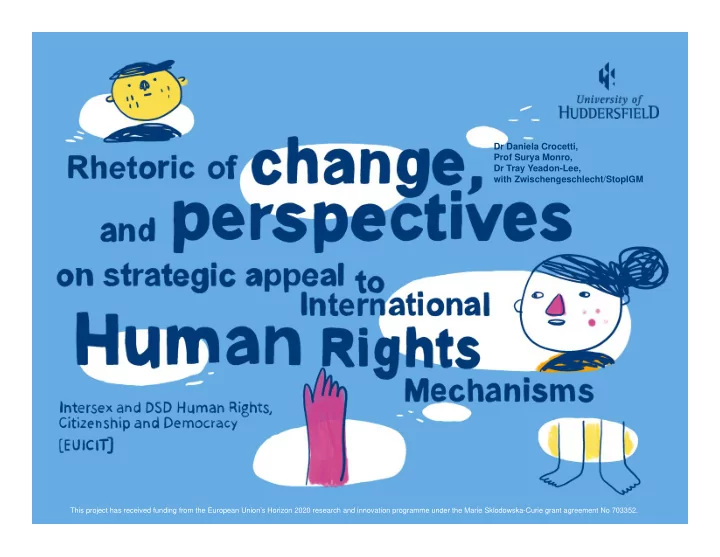
Rhetoric of change and perspectives on strategic appeal to International Human Rights Mechanisms 2

Main Protagonists Overview EUICIT Evolution of Right Claims Rights Claims Human Rights Activism/Advocacy Activism Health Advocate Associations Medical Practioner (MP) positions regarding human rights tactics The Council of Europe Current practice? Shared aims reflected in Human Rights proclamations Contestations Conclusions

slide-3
SLIDE 3

Rhetoric of change and perspectives on strategic appeal to International Human Rights Mechanisms 3

looking at the rights claims put forth by both public facing intersex activists and private facing patient associations trying to sort out what has actually changed in childhood medical practice besides rhetoric, and what remains stagnant seeing how these rights claims are mobilized and translated into human rights framing, or not ...and then piecing together ideas on how policy can act on these seemingly different agendas put forward by intersex activists and patient group advocates alike

Dedicated to Arianna co-founder of AISIA who, thanks to her deep humanity, was a tireless and unforgettable agent of change www.aisia.org

slide-4
SLIDE 4

Rhetoric of change and perspectives on strategic appeal to International Human Rights Mechanisms 4

Activists

Intersex activists use public facing tactics and appeal to human rights frameworks as they generally no longer believe in medical self- reform

Advocates

Varia%on ¡specific ¡‘pa%ent’ ¡ associa%ons ¡o1en ¡use ¡ private-­‑facing ¡tac%cs ¡and ¡ may ¡collaborate ¡directly ¡with ¡ DSD ¡teams ¡

Medical Practitioners (MPs)

¡ DSD ¡teams ¡

slide-5
SLIDE 5

Rhetoric of change and perspectives on strategic appeal to International Human Rights Mechanisms 5

Intersex activists

Tactics

Differences on human rights framing

Patient group associations

MPs may work as allies Request for legislation

slide-6
SLIDE 6

Rhetoric of change and perspectives on strategic appeal to International Human Rights Mechanisms 6

Right Claims

HR framing Intersex activists Health advocate associations Policy Change in childhood medical practice?

We need to focus on practices!

In synthesis: by focusing on the rights claims themselves, as reflected in human rights framing’s focus on practices, policy makers can move forward and address the numerous issues that need changing in childhood medical protocol applied to bodies with variations of sex characteristics

slide-7
SLIDE 7

Rhetoric of change and perspectives on strategic appeal to International Human Rights Mechanisms 7

No unnecessary interventions without consent

Strategy

Framework for quality healthcare services

slide-8
SLIDE 8

Rhetoric of change and perspectives on strategic appeal to International Human Rights Mechanisms 8

This simply means not performing unnecessary interventions on those who cannot consent, but also providing a framework for quality healthcare and services where it is desired.

The differences in tactics are reflections on strategic priorities, such as peer support as opposed to public education, for instance, however, patient group tactics generally stem from similar rights requests to intersex activists framed by specific sex variation experience.

slide-9
SLIDE 9

Rhetoric of change and perspectives on strategic appeal to International Human Rights Mechanisms 9

EUICIT investigated perspectives on Human Rights approaches to Intersex, VSC, DSD and dsd in Europe (specifically focusing on Italy, Switzerland and the UK), mapping the agendas, actions and results of the diverse Intersex activists and health advocates, including the views

  • f clinicians and policy makers working in this area.

Identity/role of interviewee IT 15 SW 6 UK 19 Total number 40 Intersex Activists 6 2 7 15 Patient advocates 3 (included one focus group) 5 8 + IT focus group Policy And related 1 2 6 9 Medics and Healthcare professionals 5 2 1 8

slide-10
SLIDE 10

Rhetoric of change and perspectives on strategic appeal to International Human Rights Mechanisms 10

Intersex rights mobilization began in the form of variations specific support groups ISNA (Intersex Society of North America) is devoted to systemic change to end shame, secrecy, and unwanted genital surgeries International Human Rights Bodies begin to address Intersex

1980s 1990s 2000s

Terms:

Intersex Variations of Sex Characteristics Disorders or differences

  • f Sex

Development FRA definition Variations in a person’s bodily characteristics that do not match strict medical definitions of male or female

slide-11
SLIDE 11

Rhetoric of change and perspectives on strategic appeal to International Human Rights Mechanisms 11

Intersex Genital Mutilation (IGM)

The birth of the Intersex Society of North America (ISNA) in the 1990s inaugurated public facing tactics and initial human rights framing with the introduction of the term ‘Intersex Genital Mutilation’ (IGM). This new form of activism sought to end ‘shame, secrecy and unwanted genital surgeries’, making ‘normalization’ surgical procedures their first line of criticism.

slide-12
SLIDE 12

Rhetoric of change and perspectives on strategic appeal to International Human Rights Mechanisms 12

Intersex activists and health advocates have made numerous rights claims that generally concern medical practices in childhood, there is also concern for the inadequacy of adult care.

  • Normalizing procedures without fully informed consent
  • Stigmatizing, coercive, and/or deceptive medical communication
  • Invasive medical exams and photography
  • Selective termination of intersex foetuses (and infanticide)
  • Gender-normalising prenatal interventions

Lack of:

  • Long term overall health research
  • Adult services
  • Psychological and peer support in medical protocol
slide-13
SLIDE 13

Rhetoric of change and perspectives on strategic appeal to International Human Rights Mechanisms 13

International Human Right Mechanisms increasingly contend that genital surgery is not necessary for gender assignment, and that atypical genitals are not in themselves a health issue.

There are only very few situations where surgery is necessary for medical reasons, such as to create an opening for urine to exit the body. Specific aspects of Intersex medical treatment are increasingly being addressed as serious Human Rights abuses.

slide-14
SLIDE 14

Rhetoric of change and perspectives on strategic appeal to International Human Rights Mechanisms 14

International Human Rights proclamations

Among recent important proclamations are those of:

  • UN Committees and Agencies
  • regional Human Rights bodies
  • Council of Europe
  • European parliament
  • Australian parliament,
  • National ethics committees
  • (Italian, German, and Swiss)
  • Three ex-US Surgeon Generals
  • (Palm Center report)
  • Human Right’s Watch
  • Amnesty International
  • Convention against Torture and Other Cruel, Inhuman or Degrading

Treatment or Punishment (CAT) (2011).

  • Special Rapporteur on Torture (SRT),
  • Juan E. Méndez (2013).
  • UN Interagency statement on involuntary sterilization (2014).
  • Committee on the Rights of the Child (CRC) (2015).
  • EU Fundamental Rights Agency (FRA) (2015).
  • United Nations High Commissioner for Human Rights (2015; 2017).
  • The Yogyakarta Principles +ten (2017)
  • European Parliament resolution (2017; 2019)
  • European Parliament resolution on the rights of intersex people

2018/2878(RSP)

slide-15
SLIDE 15

Rhetoric of change and perspectives on strategic appeal to International Human Rights Mechanisms 15

International Human Rights proclamations

In February of 2019 the European parliament approved a resolution on the rights

  • f intersex people
  • urging member states to address the issue
  • condemning sex normalizing treatments
  • and welcoming laws that prohibit surgery as in Malta and Portugal.

It should be noted that the Portuguese law actually still allows legal guardians to decide for children, and the Maltese law does not criminalize the act of taking children to the UK, for example,for unnecessary cosmetic surgery.

slide-16
SLIDE 16

Rhetoric of change and perspectives on strategic appeal to International Human Rights Mechanisms 16

Human Rights framing

  • 1. Harmful (cultural)

practices

  • 2. Prohibition of

torture and inhuman

  • r degrading

treatment

  • 3. Integrity of the

person

  • 4. Access to justice
  • 5. Involuntary

medical experimentation

  • 6. Violence against

children

  • 7. Right to life
  • 8. Coercive

sterilization

  • 9. Right to health
  • 10. Rights of the

Child

  • 11. Anti-discrimination

laws that include sex characteristics

slide-17
SLIDE 17

Rhetoric of change and perspectives on strategic appeal to International Human Rights Mechanisms 17

Human Rights framing

StopIGM (among other international intersex activists) recognizes Harmful Practices as the most effective human rights framework capable of prohibiting IGM practices. Framing unnecessary Intersex medical practices as harmful cultural practices requires policy bodies to address the central issue of whether these are practices that parents have the right to consent to.

slide-18
SLIDE 18

Rhetoric of change and perspectives on strategic appeal to International Human Rights Mechanisms 18

Stakeholders and styles of activism

International Intersex Activism Health Advocate Associations

  • protests
  • awareness campaigns
  • criminalization of non-consensual,

unnecessary practice

  • peer-support
  • ‘patient expert’
  • better medical care
slide-19
SLIDE 19

Rhetoric of change and perspectives on strategic appeal to International Human Rights Mechanisms 19

Intersex Activism and HR lobbying

International Intersex Activism

UN 2004 - NGO statement (Mauro Cabral) 2008 CEDAW (IMeV and XY-Women Germany)

Appeal to International Human Rights Mechanisms Criminalization of non-consensual, unnecessary practices

slide-20
SLIDE 20

Rhetoric of change and perspectives on strategic appeal to International Human Rights Mechanisms 20

Health advocate associations generally have private facing tactics, and may be founded in direct collaboration with a medical structure. Positions on Human Rights tactics can be very different.

slide-21
SLIDE 21

Rhetoric of change and perspectives on strategic appeal to International Human Rights Mechanisms 21

1980s AIS groups

Variation specific groups

groups led by people with VSCs parent centred groups

slide-22
SLIDE 22

Rhetoric of change and perspectives on strategic appeal to International Human Rights Mechanisms 22

IT, SW, UK groups

In the UK, Italy and Switzerland variation specific patient advocacy groups do not appeal to human rights tactics. Their interview responses ranged from very critical to not-engaged with Human Rights. Some indicated that Human Rights lobbying (or public facing activism in general) did not fall in their mission statement, but that they might support certain issues that Human Rights statements represented.

slide-23
SLIDE 23

Rhetoric of change and perspectives on strategic appeal to International Human Rights Mechanisms 23

2017 AIS-DSD/InterACT/Human Rights Watch Italian AIS association – Not an identity UK AIS association – clinician allies UK CAH association – chronic endocrine care

Primary focus is peer-support

I Want to Be Like Nature Made Me the majority of AISIA’s people don’t identify with an intersex condition I see myself as an advocate for those affected as opposed to an activist, but at the same time have always aimed to challenge clinicians we can’t do that

(be critical of doctors)

slide-24
SLIDE 24

Rhetoric of change and perspectives on strategic appeal to International Human Rights Mechanisms 24

Groups that have the most difficultly with Human Rights framing (in particular claims of torture, and harmful practices) and/or a moratorium

  • n unnecessary genital surgery, generally are led by, or are strongly

focused on parents. Examples of parent led groups: UK parent association want to support all parents (even those who have already chosen surgery). IT CAH association (only parents) - unaware of HR issues US CAH association very critical of Human Rights Watch 2017 report

slide-25
SLIDE 25

Rhetoric of change and perspectives on strategic appeal to International Human Rights Mechanisms 25

Human Rights framing is not well received by MPs. Even interviewed MPs who supported intersex rights claims were wary of HR proclamations and against a moratorium on childhood DSD cosmetic surgery.

Whereas I think the IGM kind of claim, they just go ‘not a chance’ [...] If IGM is abuse and torture and mutilation and the medics absolutely do not see it as that, then where the hell do you go?[…] these surgeons are human beings and they have gone into this practice to, you know, they have sworn to […] then accused that they are butchering, it just cuts to the core of what the hell they’re doing […], its so challenging, and its scary for them, its scary for them. UK MP I think one of the surgeons has said to me this needs to be a law, if someone tells me not to do it, I can’t do it, I won’t do it. That’s interesting […] I went so you just don’t want to have to make the decision, […] you want someone else to say no UK MP

slide-26
SLIDE 26

Rhetoric of change and perspectives on strategic appeal to International Human Rights Mechanisms 26

MPs reluctant to support HR tactics International Best Practice statements refer to International HR proclamations Growing body of medics who condemn unnecessary childhood cosmetic interventions Question the utility of a moratorium on childhood genital surgery Collaborate with patient associations

slide-27
SLIDE 27

Rhetoric of change and perspectives on strategic appeal to International Human Rights Mechanisms 27

A clear example of health advocates being mobilized against human rights tactics can be found in The Response to the Council of Europe Human Rights Commissioner’s Issue Paper on Human Rights and Intersex People, which was co-authored by medical practitioners and health advocates. Claims:

  • 1. Erroneously informed by LGBTIQ activists
  • 2. Was not informed by health advocates or practitioners
  • 3. Misrepresents current practice
  • 4. That the term intersex people is not widely recognised as appropriate

among adults and children having atypical sex development

slide-28
SLIDE 28

Rhetoric of change and perspectives on strategic appeal to International Human Rights Mechanisms 28

Appropriation of intersex issues by LGBT activism is also an area of contention for many intersex activists. Arguments over terminology can also serve to obscure rights claims surrounding the practices themselves. More pressing is the claim that International Human Rights Mechanisms (and indirectly intersex activists) misrepresent medical current practice.

slide-29
SLIDE 29

Rhetoric of change and perspectives on strategic appeal to International Human Rights Mechanisms 29

Most states (except for Malta) permit parents to decide. Interviews with Italian CAH (Congenital Adrenal Hyperplasia) parent advocates indicate a medical bias towards surgery that persists today even in some centres of excellence, while doctors who collaborate with this group continue to claim parents push for surgery

the other thing that parents refuse to do is postpone the operation (IT urologist DSD-Team) we were told it was always better to

  • perate early…the

parent chooses the surgery and the problem is resolved (IT CAH ass.) sometimes I hear about patients [in team meetings] I’ve never seen and never heard of (IT psychologist DSD team)

slide-30
SLIDE 30

Rhetoric of change and perspectives on strategic appeal to International Human Rights Mechanisms 30

Our analysis of UK-NHS data does not support the claim that childhood intersex surgeries have diminished An Italian urologist also stated that they “perform a large number of genitoplasty operations when children are less than a year old… both the clitoral and vaginal plastic surgery in a single operation” For instance AISIA members expressed frustration at being involved in a genetic database project that did not provide the promised research on hormone therapy and total body health, stating “they didn’t provide them [the results] …there is no interest” (Claudia - AISIA) Medical publications such as the 2016 consensus statement update continue to indicate there is a lack of data to base opinions on

There is little data supporting the claim that intersex childhood medical practice has changed. Interviewed MPs and scientific articles indicate that parents are still not receiving emotional support as first-line interventions in most countries.

slide-31
SLIDE 31

Rhetoric of change and perspectives on strategic appeal to International Human Rights Mechanisms 31

  • 1. Medically unnecessary childhood treatments
  • 2. Communication, including access to medical records
  • 3. Life-long health issues
  • 4. Social prejudice

Shared by activists and patient advocates (rights claims) Shared by activists, patient advocates and MPs

  • 5. Data collection
  • 6. National review of practice
  • 7. Patient centred care based on research
  • 8. National guidelines and centres of excellence
slide-32
SLIDE 32

Rhetoric of change and perspectives on strategic appeal to International Human Rights Mechanisms 32

Areas of contestation in Human Rights proclamations Against appeal to International Human Rights Bodies Rights and Best Interests

  • f the child

Contestations

Parent led versus individual led health advocate groups Confusion with LGBT issues, particularly Trans Against moratorium on unnecessary genital surgery Concern regarding criminalization

  • f medical

procedures Opposed to legislation of medical protocol Best interests

  • f the child?
slide-33
SLIDE 33

Rhetoric of change and perspectives on strategic appeal to International Human Rights Mechanisms 33

Policy and Intersex Human Rights Rights of the child versus rights of the parent Perceived stakeholder conflict around HR Concerns around regulating medical practice Awareness of Human Rights Condemnations Address rights claims National inquiry into practice Harmful (cultural) practices

slide-34
SLIDE 34

EUICIT University of Huddersfield

https://research.hud.ac.uk/institutes-centres/ccid/projects/current_projects/intersex-dsd_human_rights/ design housatonic.eu