Suffering at the end of life -an orthodox perspective Assoc Prof - - PDF document

suffering at the end of life an orthodox perspective
SMART_READER_LITE
LIVE PREVIEW

Suffering at the end of life -an orthodox perspective Assoc Prof - - PDF document

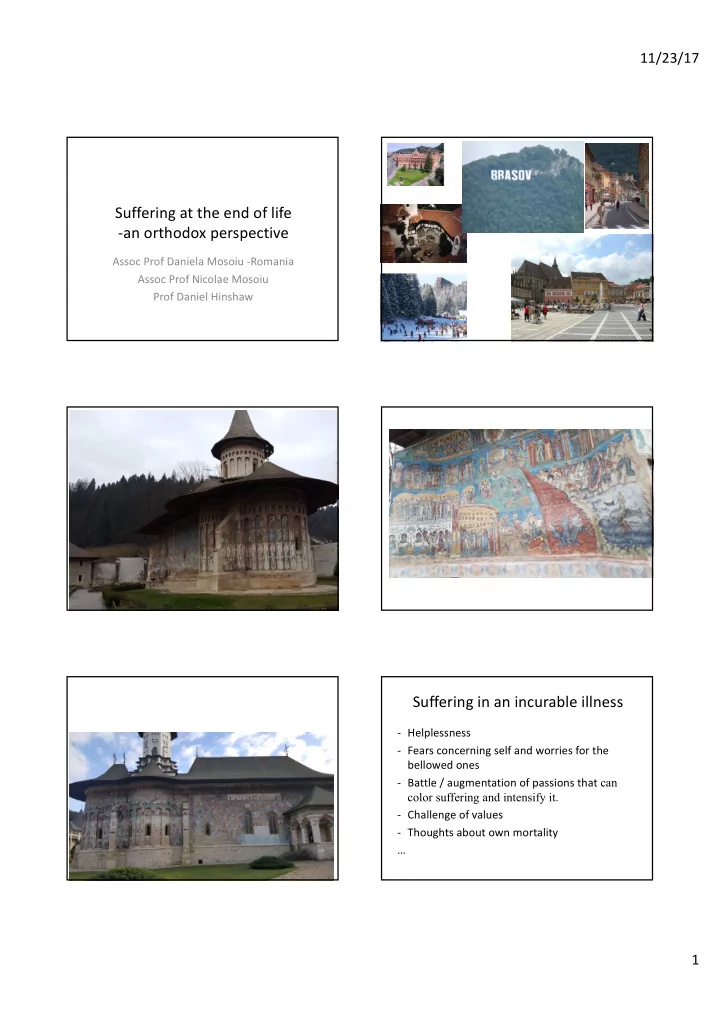
11/23/17 Suffering at the end of life -an orthodox perspective Assoc Prof Daniela Mosoiu -Romania Assoc Prof Nicolae Mosoiu Prof Daniel Hinshaw Suffering in an incurable illness - Helplessness - Fears concerning self and worries for the


slide-1
SLIDE 1

11/23/17 1

Suffering at the end of life

  • an orthodox perspective

Assoc Prof Daniela Mosoiu -Romania Assoc Prof Nicolae Mosoiu Prof Daniel Hinshaw

Suffering in an incurable illness

  • Helplessness
  • Fears concerning self and worries for the

bellowed ones

  • Battle / augmentation of passions that can

color suffering and intensify it.

  • Challenge of values
  • Thoughts about own mortality

slide-2
SLIDE 2

11/23/17 2

Remember Your Death

An Orthodox Christian Medical Directive

In everything you do, remember your end, and you will never

  • sin. Sirach 7:36

…No one who has acquired the remembrance of death will ever be able to sin.

Hesychius the Horebite as quoted by St John Climacus in The Ladder of Divine Ascent

Death today A Problem To Be Solved

  • The biomedical healthcare model

emphatically denies the reality of death.

  • Its approach is wedded to the modern

notion of progress: Its just a matter of time before we conquer aging, etc!

Death as transition

  • Suffering is an inherent component of our

mortal condition, as is dying.

  • In the Nicene Creed, …He was crucified

under Pontius Pilate, suffered, and was buried and resurrected …

Paschal Troparion

Christ has risen from the dead, Trampling down death by death, And upon those in the tombs bestowing life!

  • „The Son of God makes use even of the death

in order to defeat it. He overturns the sense of death and it is used by Him as means of defeating it and of entering as man in the eternal life”.

  • Pr.Prof.Dumitru Stăniloae, Chipul nemuritor al lui

Dumnezeu, Craiova, 1986, p.186

Petre’s Story

  • 11 years, part of large family
  • All family members are deaf

and mute

  • Family living in poor conditions
  • Renal cancer with bone secondary's unresponsive

to chemotherapy

  • Because of severe pain he has to be admitted in

the hospice although he would like to stay at home

Iunie 2010

slide-3
SLIDE 3

11/23/17 3

Who is suffering

  • The patient
  • The family and community around him/her
  • The professionals who witness the suffering

and offer care

Suffering occurs in persons

  • Human body -“temple of the Holy Spirit” (1Co.6:19)
  • The human body is animated and the soul is embodied,”
  • Olivier Clement, 1996, Trupul morţii şi al slavei, Scurtă introducere la o

teopoetică a trupului, Bucureşti, Editura Christiana, p.8

  • The body must be understood not for a single moment, not

even theoretically, apart from its deep relationship with the soul, and this natural solidarity manifests itself in various

  • ways. The human being fundamentally belongs both to the

earthly and to the heavenly world, but the person must undergo an endless movement of ascent

  • Marius Lazurca, Invenţia trupului, Ed. Anastasia, Bucureşti, f.a., p. 97.

Pain control should be used not only to comfort the patient but to aid the patient in preparing for death…opportunity for repentance.

HT Engelhardt The Foundations of Christian Bioethics pp. 326, 331

Curing and healing

  • curing refers to the physiological

reconstruction of the physical body,

  • healing has many meanings

– inner peace, – forgiveness, – removing the stigma (disease associated with sin) – eliminating social barriers -the man with leprosy, told in the Gospel of Saint Mark (1:40-45

Essential Elements of Healing

  • Transformation of suffering
  • Reconciliation
  • Acquaintance with ones death
  • Silence
  • Gratitude and Worship
  • Communion

Transformation of Suffering

.

  • Relief of pain and other forms of physical distress

(i.e., symptoms) do not end suffering. However, good symptom relief makes it easier to fully explore and address the deeper spiritual issues that underlie ones suffering.
slide-4
SLIDE 4

11/23/17 4

Reconciliation

Repentance

It is necessary to prepare for death through a stern and liberating process of coming to terms with life, making ones peace with everyone, with

  • neself, with ones conscience,

with ones circumstances, with the present and the past, with events and with people – and indeed with the future, the coming of death itself…. One cannot enter into eternity tied and fettered by hatred.

Metropolitan Anthony Bloom

Acquaintance with Ones Death

  • For the patient to know the diagnosis is
  • critical. Although the diagnosis may be terrible

(e.g., metastatic cancer), not knowing it robs patients of the ability to directly confront the evil facing them and may add to their suffering.

Acceptance versus Denial

The sick one who is familiar with his illness is easily cured, and the one who acknowledges his pain is close to healing.

  • St. Isaac of Syria

Silence

Hesychia and Kenosis

  • A life-threatening illness can focus ones

attention like nothing else; becoming aware of

  • ur mortal nature, but as a realistic perception

grounded in the hope of the Resurrection.

  • living this, can then be our kenosis, a stripping

away of the noise so that real silence - hesychia can be experienced.

  • Then we can really begin to listen.

Gratitude and Worship

nAs Orthodox Christians, healing also includes giving glory and thanks to God - it is doxological and eucharistic. nChrist cured ten lepers of their leprosy in Luke 17:11-19 and one (the Samaritan) who glorified God and gave thanks was healed. nOur worship is a source of healing, if it gives glory and thanksgiving to God regardless of

  • ur condition and the apparent outcome.

Communion

  • Ultimately, healing is all

about communion (Greek: koinonia) or fellowship – a deep, intimate relationship with God and our neighbor. Love one another as I have loved you. (John 15:12)

  • Communion in the Christian

sense, is an intimacy between persons modeled on and enervated by the continuous love flowing between the persons of the Holy Trinity.

slide-5
SLIDE 5

11/23/17 5

…When we have reached love, we have reached God and our journey is

  • complete. We have

crossed over to the island which lies beyond the world…

St Isaac of Syria

Holy sacraments collective experiences

The Holy Sacrament of Unction

  • provides a deep sense of solidarity due to Bible

readings, prayers and anointing itselfall those present are anointed with holy oil: the sick, the healthy, the priests and all others and creates a special bond between the patient and others. Deepest sense of communion is given by celebration of the Holy Liturgy followed by the reception of Holy Communion, the Body and Blood of Christ, by which we acquire consanguinity with both mystical Christ and with other participants

Is suffering the ultimate evil for a human being ?

  • If Yes - everything is permitted to end it

included killing the person who suffers

  • If NO – we believe suffering can bring human

growth and healing of the sick person and those around them

God whispers to us in our pleasures, speaks in our conscience, but shouts in

  • ur pains: it is His megaphone to rouse a

deaf world.

C.S. Lewis The Problem of Pain

“Suffering, therefore, can become an effective means for creating a deep and intimate communion with Christ and with the afflicted members of his Body.

Breck, J, The Sacred Gift of Life, p. 221; SVS Press

Evolving definition of palliative care

Palliative care is the about relieve of suffering for patients with a chronic progressive illnesses, quality of life for them and their families, support

  • f families in the bereavement period

“A Christian ending to our life, painless, blameless, peaceful, and a good defense before the dread judgment seat of Christ, let us ask” Holy Liturgy

slide-6
SLIDE 6

11/23/17 6