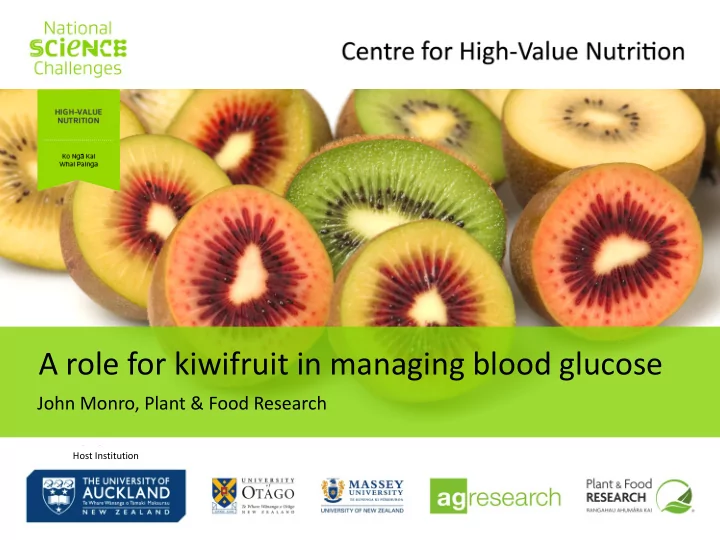
SLIDE 1 Host Institution
A role for kiwifruit in managing blood glucose
John Monro, Plant & Food Research
SLIDE 2 Plan of talk
» Measuring the properties of kiwifruit that could be beneficial » Testing the role of kiwifruit properties in clinical trials » Measuring the glycaemic potency
» Exchanging kiwifruit for other carbohydrate foods – glycaemic and nutritional consequences » Next steps – the HVN/Zespri phase
SLIDE 3
Aim
» Help Zespri to sell kiwifruit in an increasingly diabetic, sugar averse market, by showing that they are safe and healthy Project funding » HVN $1 million over 3 years » Zespri $100,000 over 3 years
SLIDE 4 Problems and possibilities for kiwifruit
» Market is becoming fearful of sugars » Kiwifruit are sugar-rich » Kiwifruit sugars are about 50% fructose (fruit sugar)
» Kiwifruit are a rich source
» Kiwifruit may aid digestion » Kiwifruit appear to stimulate laxation » Used the right way, kiwifruit may reduce glycaemia and protect against its effects
SLIDE 5 » A “tsunami of diabetes” in the major markets for kiwifruit
> 400 million diabetic by 2030 Best quality kiwifruit
A problem and opportunity facing the kiwifruit industry
SLIDE 6
Challenges
» Showing that kiwifruit, even in the diets of consumers at risk for diabetes, are nutritionally beneficial – Short term (postprandial) – Long term (metabolic and diverse diabetic complications) » Incorporating kiwifruit into the diet in ways that lead to a net health benefit to consumers
SLIDE 7 Kiwifruit have favourable properties
2 kiwifruit ↓ 900 ml disperse hydrated solids volume Stomach is distensible 50 (empty)-1500 ml Therefore dietary fibre dispersion from
- ne or two kiwifruit, easily fills gastric
space surrounding and interacting with
Residues occupied a large volume after digestion Kiwifruit settled bed volume increased about 4x after digestion
Post-digestion volume per unit of pulp digested and settled overnight
SLIDE 8 Reduced rate of glucose absorption in vivo?
Luminal mixing Luminal diffusion Digestion
Altered postprandial blood glucose response?
Disperse kiwifruit cell wall remnants retarded processes involved in glycaemic response
SLIDE 9 Wheat biscuit + 2 kiwifruit (WB+KF), compared with Wheat biscuit + 2 kiwifruit’s sugars (WB+Sug) (n = 20)
» Reduced amplitude » Sustained availability » No hypoglycaemia
Means ± sem
Conclusion: Non-carbohydrate components of kiwifruit may improve glucose homeostasis
Non-carbohydrate components of kiwifruit moderated glycaemic response in vivo
SLIDE 10 Mean blood glucose responses to equal (40 g) available carbohydrate meals: Glucose Wheat biscuit (WB), WB + ‘Hayward’ kiwifruit (WB+GR) WB + SunGold kiwifruit (WB+SG)
Incorporating KF into a diet without increasing carbohydrate
- r energy intake – the dietetic approach
Benefits confirmed
Recommended limit
Equal carbohydrate partial substitution of kiwifruit for starchy food reduced glycaemic response
SLIDE 11 0-180 min: (full period) LSD 26.8, p = 0.012, 0-120 min: LSD = 22.7, p <.001 120-180 min LSD = 11.5, p < 0.001
SunGold and Hayward improved glycaemic response over 3 h.
Areas within measurement periods showed improved glucose homeostasis
SLIDE 12
Relative glycaemic potency (RGP)
Allows the glycaemic potency of a food to be expressed as grams of glucose equivalents (GGE) per 100 g food. The glycaemic effects of SunGold and Hayward were measured relative to a 40 g glucose reference. IAUCfood/IAUCgluc x WtGluc/Wtfood x 100 = RGP (g glucose equivts./100 g) = GGE/100 g
SLIDE 13 (Means ± sem) (LSD = 4.9, p < 0.001)
GGE per 100 g food
One kiwifruit had the same effect on blood glucose as 6.6 g glucose
Kiwifruit has a low relative glycaemic potency (GGE/100 g)
SLIDE 14
GGE per serving
Relative glycaemic impact can be expressed in gram units, so behaves like a nutrient. Because it is expressed as if it were a nutrient, but represents an effect, it has been termed a virtual food component.
Relative glycaemic impact expressed as a virtual food component (GGE (g) /given quantity)
SLIDE 15 Kiwifruit Serving size – 100 g (Approx) Per serving PER 100 g Energy-kJ Protein (g) Fat (g) Carbohydrate
Dietary fibre (g) Sodium (mg) Potassium (mg) Vitamin C (mg) Β-carotene equiv. (µg) Glycaemic impact (glucose equiv.) (g) 202 0.9 0.6 11 10 2.3 4 236 120 18 6 202 0.9 0.6 11 10 2.3 4 236 120 18 6
Relative glycaemic impact: LOW
Potential role of GGE in showing relative glycaemic impact in food labels
SLIDE 16 Effect of equi-carbohydrate substitution by kiwifruit on estimated GGE dose
Kiwifruit exchanges Serve GI CHOAVL GGE Exchange 1 KF Exchange 2 KF (g) (%) (g/serve) (g) New GGE % Decr New GGE % Decr Bread white 60 75 30 22.5 18.9 16 15.3 32 Cornflakes 30 80 25 20.0 15.8 21 11.5 43 Rice Bubbles 30 88 26 22.9 17.6 23 12.4 46 Rice, white (China) 150 83 36 29.9 25.3 15 20.6 31 Rice, Jasmine (Japan) 150 109 42 45.8 37.9 17 30.0 34 Rice, Japonica (Japan) 150 75 46 34.5 30.9 11 27.3 21 Mashed potato (China) 150 73 20 14.6 11.2 23 7.9 46 Sweet potato (China) 150 77 21 16.2 12.3 24 8.4 48 1 Kiwifruit 100 46 12.5 5.8 5.8 5.8 2 Kiwifruit 200 46 25 11.5 11.5 11.5
Difference between high and low GI is 15 %
SLIDE 17
Effect of partially replacing the available carbohydrate in starchy staple foods by the amount of available carbohydrate in one whole kiwifruit.
Equal carbohydrate, partial exchange of whole kiwifruit for starchy staple improves nutrient intake
SLIDE 18 Timing of kiwifruit ingestion relative to carbohydrate food may be important
SunGold kiwifruit consumed 30 min before wheat biscuit (WB) decapitated the blood glucose spike
WB alone WB + SG together WB 30m post SG
(40% less than WB)
Equi-carbohydrate comparison
SLIDE 19
Kiwifruit-substituted Wheat Biscuit was as satiating as Wheat Biscuit alone at the same CHO intake
Kiwifruit has a role in appetite control during glycaemia management
SLIDE 20
The HVN-Zespri phase (2016-2019) » With an emphasis on health claims the research will attend to MPI and EFSA criteria: » Consumer safety » Relevance to customary food consumption patterns » Plausible mechanisms » Relevant endpoints » Relevant biomarkers
SLIDE 21 Next steps: The HVN-Zespri phase
» Consumer safety: Insulin response, fructose effects » Customary food consumption: Realistic meals, customary diets » Plausable mechanisms: Metabolic, hormonal, pancreatic, physiological-metabolic syndrome » Relevant endpoints: CVD, circulatory, β-cell function » Relevant biomarkers: Plasma lipids, glycation, oxidative stress, inflammation, endothelial dysfunction
When to eat kiwifruit: clinical Kiwifruit exchanges in realistic European and Asian meals (postprandial) (2016) Kiwifruit exchange tables (2016) Metabolic effects of long-term KF consumption (KRIP pilot study) (2016) Long-term consumption metabolic effects (healthy) (2017) Long-term consumption metabolic and risk factor effects (prediabetic) (2018) Intake patterns for
HVN
SLIDE 22
Acknowledgements
» Zespri » Carbohydrate Digestion and Metabolism Team, Plant & Food Research:
» Kerry Bently-Hewitt » Sue Middlemiss-Krak » Suman Mishra
» Jinny Willis, Don Bevan Centre, Christchurch » All participants in the clinical trials