Continuous Glucose Monitors What is CGM? Continuous Glucose - - PowerPoint PPT Presentation

continuous glucose monitors what is cgm
SMART_READER_LITE
LIVE PREVIEW

Continuous Glucose Monitors What is CGM? Continuous Glucose - - PowerPoint PPT Presentation

Continuous Glucose Monitors What is CGM? Continuous Glucose Monitoring systems use a tiny sensor inserted under the skin to check glucose levels in tissue fluid. Sensor replaced every 7-10 days A reusable transmitter sends information


slide-1
SLIDE 1

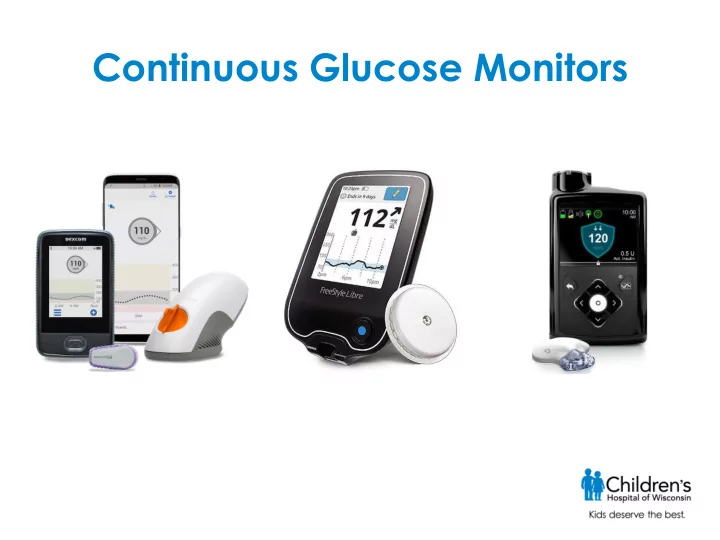
Continuous Glucose Monitors

slide-2
SLIDE 2

What is CGM?

  • Continuous Glucose Monitoring systems

use a tiny sensor inserted under the skin to check glucose levels in tissue fluid.

  • Sensor replaced every 7-10 days
  • A reusable transmitter sends information

about glucose levels via radio waves from the sensor to a wireless device

  • The information may go to a phone,

receiver or insulin pump

slide-3
SLIDE 3

How CGM works

  • A tiny electrode (sensor) is inserted just under the

skin

– Sensor is replaced every 7-10 days

  • A reusable transmitter is attached to the sensor

– Transmitter is reused and replaced when needed

  • Sensor continually measures glucose levels in the

interstitial fluid (IF)

– There is a lag time between when glucose hits blood and the fluid

  • Transmitter locks into the sensor

– Sends data via blue tooth to a receiver or smart device – Sensor glucose reading is shown on a screen

  • Includes directional arrows and a graph
slide-4
SLIDE 4

Parts of CGM

  • 1. Sensor
  • 2. Transmitter
  • 3. Receiver
slide-5
SLIDE 5

Advantages

  • Can provide real time glucose information every 5 minutes

– Up to 288 readings in a 24 hour period

  • Shows where glucose is

– Current number on machine

  • Shows where glucose was

– Trend graph

  • Predicts where glucose is going

– Rate of change arrows

  • Certain devices are FDA approved to use for dosing
  • Remote monitoring
  • Multiple alarm settings
  • Reduced or eliminates finger-sticks
slide-6
SLIDE 6

Blood Glucose Data Vs. CGM Data

slide-7
SLIDE 7

Dexcom

Available Models: G5, G6 Similarities:

  • Remote Monitoring-If the student has a blue-

tooth enabled device near them, the results can be remotely monitored.

  • Set high and low alarms
  • Shows glucose trending arrows
  • Updates glucose reading every five minutes
  • May be covered by state health insurance
slide-8
SLIDE 8

Dexcom Comparison

Dexcom G5 Dexcom G6

  • CAN NOT be used to dose from unless

you are sure it is being calibrated twice per day.

  • Requires Calibrations
  • Can NOT be used with acetaminophen
  • Larger size
  • Set high and low alarm
  • 7-day wear
  • CAN be used to determine insulin dose
  • Does not require calibrations
  • CAN be used with acetaminophen
  • Smaller size
  • Predictive low alarm in addition to high

and low alarms

  • 10-day wear
slide-9
SLIDE 9

Libre Flash

  • Quarter-sized sensor that will give glucose

value when the reader is swiped over the top.

  • Shows trending arrows
  • CAN be used to determine

dosing

  • Not covered by state health insurance
  • Can be used with phone app for sensor

glucose readings

slide-10
SLIDE 10

Medtronic Pump

  • Enlite or Guarian 3 Sensors used with

Medtronic pumps

  • NOT used for dosing
  • Shows trending arrows
  • Set high and low alarms
slide-11
SLIDE 11
slide-12
SLIDE 12

CGM Accuracy

MARD: Mean Absolute Relative Difference between the blood glucose monitoring system value and the lab reference value. (The lower the better)

  • The glucometer and CGM can have different values and still fall within a range

that is considered accurate

Most Glucometers are around 15%

CGMs MARD Dexcom 9% Libre 11.4%

slide-13
SLIDE 13

CHW Recommendations for Use in School Setting

  • The student may need to have cell phone with them or

use school Wi-Fi to transmit data to remote receivers during the school day.

  • Constant monitoring by school personnel is not

expected, priority should be given to low and high alerts.

  • High alerts may occur after eating and will not always

need to be treated. There must be two hours between insulin doses.

  • Blood glucose should be checked with finger poke if

symptoms don’t match the sensor glucose reading or if the trending arrows are double arrows up.