Document Content 7. Text editing, DTP and Word Meaning, grammar, - - PDF document

document
SMART_READER_LITE
LIVE PREVIEW

Document Content 7. Text editing, DTP and Word Meaning, grammar, - - PDF document

Document Content 7. Text editing, DTP and Word Meaning, grammar, spelling, emphasis Processing Footnotes, illustrations, diagrams, references Structure Title, abstract, chapters, appendices, sections, sub()sections,


slide-1
SLIDE 1

CL1 2002/3-7 1

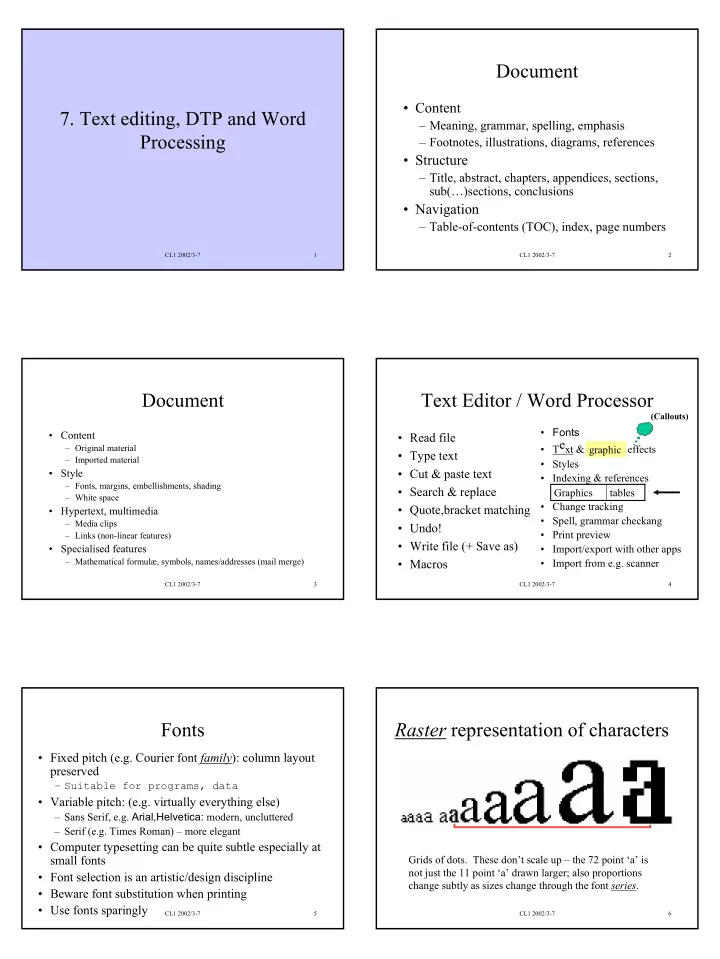
  • 7. Text editing, DTP and Word

Processing

CL1 2002/3-7 2

Document

  • Content

– Meaning, grammar, spelling, emphasis – Footnotes, illustrations, diagrams, references

  • Structure

– Title, abstract, chapters, appendices, sections, sub(…)sections, conclusions

  • Navigation

– Table-of-contents (TOC), index, page numbers

CL1 2002/3-7 3

Document

  • Content

– Original material – Imported material

  • Style

– Fonts, margins, embellishments, shading – White space

  • Hypertext, multimedia

– Media clips – Links (non-linear features)

  • Specialised features

– Mathematical formulæ, symbols, names/addresses (mail merge)

CL1 2002/3-7 4

  • Fonts
  • Text & graphic effects
  • Styles
  • Indexing & references
  • Change tracking
  • Spell, grammar checkang
  • Print preview
  • Import/export with other apps
  • Import from e.g. scanner

Text Editor / Word Processor

  • Read file
  • Type text
  • Cut & paste text
  • Search & replace
  • Quote,bracket matching
  • Undo!
  • Write file (+ Save as)
  • Macros

tables Graphics graphic

(Callouts)

CL1 2002/3-7 5

Fonts

  • Fixed pitch (e.g. Courier font family): column layout

preserved

– Suitable for programs, data

  • Variable pitch: (e.g. virtually everything else)

– Sans Serif, e.g. Arial,Helvetica: modern, uncluttered – Serif (e.g. Times Roman) – more elegant

  • Computer typesetting can be quite subtle especially at

small fonts

  • Font selection is an artistic/design discipline
  • Beware font substitution when printing
  • Use fonts sparingly

CL1 2002/3-7 6

Raster representation of characters

Grids of dots. These don’t scale up – the 72 point ‘a’ is not just the 11 point ‘a’ drawn larger; also proportions change subtly as sizes change through the font series.

slide-2
SLIDE 2

CL1 2002/3-7 7

Font metrics:vector representation

  • If characters are stored as

descriptions of line segments then it is possible to scale the character over a wide range of sizes; hinting may still be required to cope with special cases, especially at very small sizes where the pixel is a significant fraction of the character size. Francesco Torniello ‘S’, 1517

CL1 2002/3-7 8

Antialiasing

  • Blends foreground and background colour at edge
  • f graphical object
  • Gives smoother appearance but ties graphical
  • bject to background colour

CL1 2002/3-7 9

Stages to writing

  • A word processor makes it too easy to write

without organised thinking; It all looks great but has no substance. An organised approach helps.

  • Gather material & establish structure
  • Free writing (just content)
  • Rewrite/Restructure; don’t be afraid to discard junk

– You can always make it shorter and simpler

  • Check details (proofread, spell check)
  • Adjust layout, apply style, preview, print
  • Check again!

CL1 2002/3-7 10

Blaise Pascal, 1623-1662

Je n’ai fait cell-ci plus longue que parce que je n’ai pas eu le loisir de la faire plus courte. (I have made this letter longer than usual, only because I have not had the time to make it shorter.)

  • Lettres Provincales (1657)
  • r …
  • K.I.S.S. - Keep It Small and Simple

CL1 2002/3-7 11

Writing Tools

  • Indexing, cross-referencing
  • Bibliography
  • ‘FOG’ and equivalent indices
  • Thesaurus
  • Spelling & grammar checker, word count
  • Layout tools (styles)
  • MS Word document auto-trasher

CL1 2002/3-7 12

Task support

  • Import of material from Web or databases
  • ‘pro forma’ documents merged with address

lists

  • Cross-application support e.g. Excel table or

maps in document

  • Support for collaborative writing

– Change tracking

  • Support for PDAs – handwriting and speech
slide-3
SLIDE 3

CL1 2002/3-7 13

FOG (readability) Index

  • Choose a sample of at least 100 words and calculate the Fog Index as
  • utlined below. The "ideal" Fog Index level is 7 or 8. A level above

12 indicates the writing sample is too hard for most people to read. 1. Consider big words to be 3 or more syllables. 2. average sentence length = (number of words / number of sentences) 3. percentage of big words = (number of big words / total number of words) * 100 4. Add the average sentence length to the percentage of big words 5. Multiply the result by .4 = Fog Index

CL1 2002/3-7 14

FOG example - 1

“The last three or four years have seen an explosion in the range and scope of electronic business activity. It is the belief of all major commentators in the field and of most business leaders that this will continue and that as soon as the current technologies reach a critical point it will be accompanied by a vast increase in the volume of business carried out over e-business technology. A certain amount of hype accompanies all pronouncements but the underlying picture is that the next few years will see a major transformation in the way the majority of business transactions are carried out.“ Words = 103; sentences = 3; >=3 syllables = 15; sentence length = 103/3 = 34; big words = 15/103 = 14%; av sentence + % big words = 48; * .4 FOG = 19.2 (author = JHB; oops). Splitting the long sentence reduces it to

CL1 2002/3-7 15

FOG example - 2

“The last three or four years have seen a huge increase in the range and scope of electronic business. It is the belief of all major writers in the field and of most business leaders that this will carry on. They believe that as soon as current technology reaches a certain point the result will be a vast increase in the volume of business carried out electronically. A certain amount of hype has to be assumed but the picture is that the next few years will see major changes in the way most business is carried out.” Words = 97; sentences = 4; >=3 syllables = 6; sentence length = 97/4 = 24; big words = 3/97 = 3%; avg. sentence + % big words = 27; * .4 FOG = 10.8

CL1 2002/3-7 16

A few notes on writing

  • Read any instructions you have been given
  • Observe conventions on style
  • Your document should have structure (if not, why

not?). Express that structure in layout

– What goes in the beginning? middle? end? – Use paragraphs; long stretches of unbroken text are hard to read and may indicate muddled thought – What are your conclusions? If none, why? – Use sectioning and lists, though don’t go overboard

  • Consider your audience

CL1 2002/3-7 17

Application categories

  • Text editor

– Wordpad, notepad, emacs(Unix); implicit in mailers etc. – For plain text, e.g. programs, data files etc. – Little or no style

  • Word Processor

– Word, Lotus […] … – Richer style, indexing aids; support for large documents – Support for collaboration, standard tasks

CL1 2002/3-7 18

Application categories

  • Desktop Publishing system

– Pagemaker, Quark Xpress – Style is paramount; may want to edit text elsewhere – Aimed at specialist users

  • Web editor

– HoTMetaL, Dreamweaver

  • Full control of structure and style

– Frontpage, Word(etc.) extensions

  • More aimed at putting paper document on Web

– Acrobat and related products (produce PDF files)

  • Good Web rendition of documents but large with limitations
slide-4
SLIDE 4

CL1 2002/3-7 19

Document Preparation

  • Visual Formatting

– a.k.a. WYSIWYG

  • What You See Is What You Get

– [YWIYGI: You Wanted It, You Got It …] – Document is prepared graphically – Use GUI tools to adjust format on screen – e.g. MS Word, Quark Xpress, Pagemaker

CL1 2002/3-7 20

Document Preparation

  • Logical Formatting

– uses textual commands embedded in the document text – a.k.a markup language – Use subsequent processing to lay out document – E.g. SGML family (including HTML) , LaTeX – Often generated from WYSIWYG editor – Set of instructions for laying out document

CL1 2002/3-7 21

Logical formatting

Can create and define new commands Layout is automated and “expert” Layout adjusts automatically to page/screen size Visible record of layout Source is plain text

can be generated by program Can be mailed easily

Output has to be run through formatter

CL1 2002/3-7 22

HTML example (Web)

  • This HTML seen as raw
  • r plain ASCII text:
  • Becomes this
  • .. When viewed

through a web browser <html><head></head> <body bgcolor=“blue”><ul> <li>Plain <li><b>Bold</b> <li><I>Italics</I> </ul></body></html>

  • Plain
  • Bold
  • Italics

CL1 2002/3-7 23

Visual Formatting

What you see is (sort-of) what you get

  • Screen and printer have different aspects & resolution
  • Fonts may differ

Can end up mixing style and content Mailed as attachments and requires same software

  • Allows possibility of ’active’ documents

(more like Web pages) But can harbour viruses

Both have their place

CL1 2002/3-7 24

Key Points

  • Functions of:

– text editor, word processor – DTP system, Web page editor

  • Content vs. style
  • Fonts, sizing, anti-aliasing
  • Visual and logical formatting

– mark-up languages vs. WYSIWYG