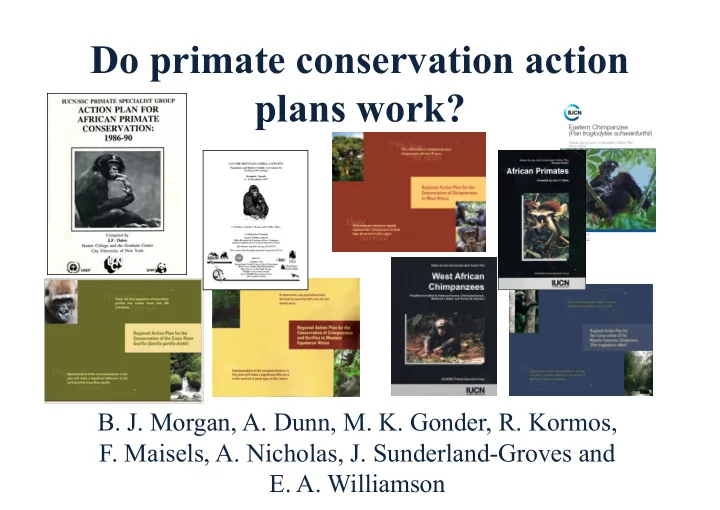
Do primate conservation action plans work? B. J. Morgan, A. Dunn, - - PowerPoint PPT Presentation

do primate conservation action plans work
SMART_READER_LITE
LIVE PREVIEW

Do primate conservation action plans work? B. J. Morgan, A. Dunn, - - PowerPoint PPT Presentation

Do primate conservation action plans work? B. J. Morgan, A. Dunn, M. K. Gonder, R. Kormos, F. Maisels, A. Nicholas, J. Sunderland-Groves and E. A. Williamson What are conservation action plans ? A consensual list of activities that, if


slide-1
SLIDE 1

Do primate conservation action plans work?

  • B. J. Morgan, A. Dunn, M. K. Gonder, R. Kormos,
  • F. Maisels, A. Nicholas, J. Sunderland-Groves and
  • E. A. Williamson
slide-2
SLIDE 2

What are conservation action plans?

A consensual list of activities that, if implemented in specific,

  • ften priority sites, should stem the decline in the numbers

and/or distribution of the taxon in question

  • Brief history of conservation action plans
  • Development of action plans
  • Structure of action plans
  • How do we evaluate effectiveness ?
  • Moving forward – suggestions and

recommendations for future action plans

slide-3
SLIDE 3

Gorilla gorilla diehli Cross River gorilla Pan troglodytes troglodytes central chimpanzee Pan troglodytes schweinfurthii eastern chimpanzee Pan troglodytes ellioti Nigeria-Cameroon chimpanzee Pan troglodytes verus western chimpanzee Pan paniscus bonobo Gorilla gorilla gorilla western lowland gorilla Gorilla beringei graueri Grauers gorilla Gorilla beringei beringei mountain gorilla

slide-4
SLIDE 4

History of ape conservation action plans (1)

A Global Strategy for Primate Conservation (1977)

slide-5
SLIDE 5

History of ape conservation action plans (2)

slide-6
SLIDE 6

Regional, taxon-specific plans (1993 →)

slide-7
SLIDE 7

How are action plans developed?

  • Consensus that it is necessary and will be used
  • Grant writing
  • Workshops
  • Drafts
  • Publication!
  • Distribution….
  • (Monitoring/evaluation)
  • Repeat the process, updating as necessary
slide-8
SLIDE 8

What do action plans contain?

  • Definition and identification of priority sites
  • Priority actions at specific sites (e.g. anti-poaching, habitat protection)
  • Identification of sites needing (more) surveys
  • Non-site specific priority actions (e.g. research/health/tourism)
  • Population and Habitat Viability Assessment (PHVA)
  • Financial needs – 4 of 7 plans:

– West African chimpanzees $9 million – Western Equatorial African chimpanzees and gorillas $30 million – Cross River gorillas $4.6 million – Nigeria-Cameroon chimpanzees $14.7 million

slide-9
SLIDE 9

How might we evaluate the effectiveness of the action planning process?

  • The degree and quality of information provision
  • The extent of implementation of priority actions
  • The success in raising funds from new sources and

increasing overall funding levels

  • Evidence of policy changes and threat mitigation
  • Measure improvements related to increased collaboration

and efficiency between stakeholders

slide-10
SLIDE 10

Evaluations of regional action plans

  • Pan troglodytes verus (Kormos 2008, unpublished report to

SSC/PSG and Critical Ecosystems Partnership Fund) 35 questionnaires analysed from 75 workshop participants

  • Western Equatorial Africa - Gorilla gorilla gorilla and Pan

troglodytes troglodytes (Maisels 2011, unpublished report to WCS, IUCN & CMS) 27 people commented on progress with priority

  • actions. No action had been taken at some sites. No evaluation of

fundraising success.

  • Gorilla gorilla diehli (Dunn, Nicholas, Sunderland-Groves,

unpublished excel spreadsheet) Workshop participants commented

  • n specific actions. No evaluation of fundraising success. No review

for several actions.

slide-11
SLIDE 11

Do action plans work?

Are action plans worth the time and effort of their development...?

slide-12
SLIDE 12

Are action plans worth the time and effort of writing? – Yes

  • Action Plans consolidate often disparate and unpublished

information

  • Action Plans may contribute to improvement in

collaboration and information sharing between stakeholders, stemming from the workshop process

  • They lead to implementation of priority actions
  • Funding agencies use IUCN-endorsed plans for assurance

that their funds are being directed to tackle the highest priority conservation issues, which should then receive highest chances of being funded

slide-13
SLIDE 13

Are action plans worth the time and effort of writing - No?

  • They are expensive to develop and write
  • They may contribute towards a culture of feigned action
  • Unless they are updated frequently, stakeholders may be

liable to overlook commitments

  • If costs of actions are stressed, some stakeholders may not

feel capable or motivated to implement actions

  • If those who use an action plans are unconvinced of its

efficacy, alternative methods should be sought to bring solutions

slide-14
SLIDE 14

Recommendations for future plans

  • Ensure that conservation decision-makers are fully engaged and officially

endorse the action-planning process

  • Priority actions need to be, as far as possible, very specific
  • Reconsider the wisdom of estimating the costs of priority actions
  • Find a way to remind conservation decision-makers of the action plan
  • Develop ‘living’ action plans, through updating information online
  • Build in some degree of action-based evaluation of progress from the start
  • Consider audiences who have the power to mitigate damaging activities
  • Consider the overlaps with other conservation priority sites
  • Declare ‘no-go’ zones
  • Prioritise professional development of early career in-country

conservationists

  • Consider adopting a champion/coordinator for each region or ape subspecies
  • Consider establishing a seed fund for each region/subspecies
slide-15
SLIDE 15

John, the flagship ape, for encouragement, and for improving the ape conservation action plans in Central and West Africa through critical thinking and unwavering attention to detail

IPS Congress Cancun, Mexico 11-18 August 2012

T H A N K Y O U

Everyone who has contributed to the development or/and implementation of an action plan

Anthony Rylands and Russ Mittermeier for supporting the process and publications