Division of Waste Management Solid Waste Section Composting and - - PowerPoint PPT Presentation

division of waste management
SMART_READER_LITE
LIVE PREVIEW

Division of Waste Management Solid Waste Section Composting and - - PowerPoint PPT Presentation

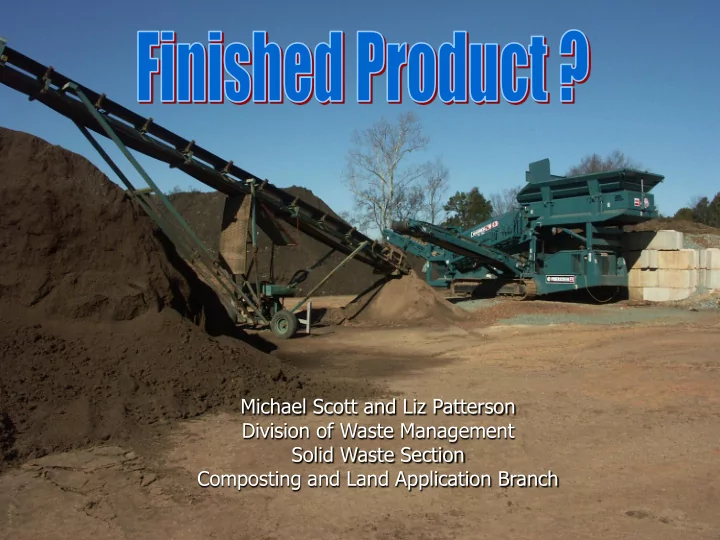
Michael Scott and Liz Patterson Division of Waste Management Solid Waste Section Composting and Land Application Branch How should we define finished product? What impact does that have on the process? The current solid waste


slide-1
SLIDE 1

Michael Scott and Liz Patterson Division of Waste Management Solid Waste Section Composting and Land Application Branch

slide-2
SLIDE 2

►How should we define finished product? ►What impact does that have on the

process?

slide-3
SLIDE 3

The current solid waste regulations classify finished product based on the Federal standards for: pathogens, heavy metals, foreign matter and total N. APS sites? Type I facilities?

slide-4
SLIDE 4

► Is a finished product that satisfies the State and

Federal requirements suitable for all end uses?

► How do we further define finished product? ► 15 days at or above 131 F ?

slide-5
SLIDE 5

►Stability: Degree of stabilization of the

  • rganic substances in compost (inversely

related to the microbial activity and the bioavailability of organic matter).

slide-6
SLIDE 6

►Maturity: Degree of decomposition of

phytotoxic substances and the adequacy of compost for plant growth (includes the absence of other toxic components like excessive metal concentrations or high salinity).

slide-7
SLIDE 7

► Stability measured by:

Biological indicators of microbial activity (respiration)

slide-8
SLIDE 8

► Maturity evaluated by:

Plant assays

slide-9
SLIDE 9

► Defining finished

product: What impact does that have on the process? Stormwater or wastewater?

slide-10
SLIDE 10

How do other states address finished product?

slide-11
SLIDE 11

Compost maturity tests can be used for:

►Evaluating compost progress and using the

information to make improvements to the composting process

►Determining the level of maturity of any

compost product intended for use or marketing and using the information to make informed recommendations about its best use

slide-12
SLIDE 12

Solvita CO2 Test

slide-13
SLIDE 13

SOLIVITA TEST RESULTS APPROXIMATE STAGE OF THE COMPOSTING PROCESS MAJOR CLASS

8

Highly matured compost ; well aged; possibly over-aged; Like soil; ready for most uses FINISHED COMPOST

7

Well-matured, aged composts; cured; Ready for most uses FINISHED COMPOST

6

Aeration needs are reduced; curing; Significantly reduced management requirement ACTIVE COMPOST

5

Compost is moving past the active phase of decomposition; Ready for curing; reduced need for intensive management ACTIVE COMPOST

4

Compost in medium or moderately active stage of Decomposition; may be ready for curing ACTIVE COMPOST

3

Active compost; young materials, high respiration rate; Still needs intensive oversight and management ACTIVE COMPOST

2

Very active, moderately fresh compost; very high Respiration rate; needs very intensive aeration And/or turning RAW COMPOST

1

Fresh, raw compost; typical of new mixes; extremely high Rate of decomposition; very putrescible or odorous materials; high in volatile organic acids RAW COMPOST

INTERPRETING SOLVITA CO2 TEST RESULTS

slide-14
SLIDE 14

Solvita Ammonia Test