Discrete Holomorphicity in the Chiral Potts Model Robert Weston - - PowerPoint PPT Presentation

discrete holomorphicity in the chiral potts model
SMART_READER_LITE
LIVE PREVIEW

Discrete Holomorphicity in the Chiral Potts Model Robert Weston - - PowerPoint PPT Presentation

1 slide DH QG Currents The CP model CP via rep th pert CFT Conclusions Discrete Holomorphicity in the Chiral Potts Model Robert Weston Heriot-Watt University, Edinburgh GGI, 19/05/15 Robert Weston (Heriot-Watt) DH in the CP model GGI,


slide-1
SLIDE 1

1 slide DH QG Currents The CP model CP via rep th pert CFT Conclusions

Discrete Holomorphicity in the Chiral Potts Model

Robert Weston

Heriot-Watt University, Edinburgh

GGI, 19/05/15

Robert Weston (Heriot-Watt) DH in the CP model GGI, 19/05/15 1 / 28

slide-2
SLIDE 2

1 slide DH QG Currents The CP model CP via rep th pert CFT Conclusions

Plan

1

The Talk in 1 Slide

2

Discrete Holomorphicity

3

Non-Local Quantum Group Currents

4

The Z(N) Chiral Potts Model

5

The CP Model via Representation Theory

6

DH relations and perturbed CFT

7

Conclusions

[Ref: Y. Ikhlef, RW, M. Wheeler and P. Zinn-Justin, J. Phys.A 46 (2013) 265205, arxiv:1302.4649; Y. Ikhlef and RW, (2015) arxiv:1502.04944]

Robert Weston (Heriot-Watt) DH in the CP model GGI, 19/05/15 2 / 28

slide-3
SLIDE 3

1 slide DH QG Currents The CP model CP via rep th pert CFT Conclusions

The Talk in 1 Slide

DH means a lattice analog of Cauchy-Riemann relations We use underlying quantum group to construct DH operators for stat-mech models DH follows from fact that lattice model weights are QG R-matrices DH relns in massless case are discrete version of ∂¯

zΨ(z, ¯

z) = 0 DH relns in massive case are of form ∂¯

zΨ(z, ¯

z) =

i

χi(z, ¯ z) where in CFT Ψ(z)Φpert

i

(w, ¯ w) = · · · + χi(w, ¯ w) z − w + · · · Can thus identify the CFT perturbing fields DH operators hopefully useful in rigorous proof of scaling to CFT

Robert Weston (Heriot-Watt) DH in the CP model GGI, 19/05/15 3 / 28

slide-4
SLIDE 4

1 slide DH QG Currents The CP model CP via rep th pert CFT Conclusions

Discrete Holomorphicity

Λ a planar graph in R2, embedded in complex plane. Let f be a complex-valued fn defined at midpoint of edges

Robert Weston (Heriot-Watt) DH in the CP model GGI, 19/05/15 4 / 28

slide-5
SLIDE 5

1 slide DH QG Currents The CP model CP via rep th pert CFT Conclusions

Discrete Holomorphicity

Λ a planar graph in R2, embedded in complex plane. Let f be a complex-valued fn defined at midpoint of edges f said to be DH if it obeys lattice version of

  • f (z)dz = 0 around any

cycle. Around elementary plaquette, we use: f (z01)(z1 −z0)+f (z12)(z2 −z1)+f (z23)(z3 −z2)+f (z30)(z0 −z3) = 0 z0 z1 z2 z3 zij = (zi + zj)/2

Robert Weston (Heriot-Watt) DH in the CP model GGI, 19/05/15 4 / 28

slide-6
SLIDE 6

1 slide DH QG Currents The CP model CP via rep th pert CFT Conclusions

Discrete Holomorphicity

Λ a planar graph in R2, embedded in complex plane. Let f be a complex-valued fn defined at midpoint of edges f said to be DH if it obeys lattice version of

  • f (z)dz = 0 around any

cycle. Around elementary plaquette, we use: f (z01)(z1 −z0)+f (z12)(z2 −z1)+f (z23)(z3 −z2)+f (z30)(z0 −z3) = 0 z0 z1 z2 z3 zij = (zi + zj)/2 Can be written for this cycle as f (z23) − f (z01) z2 − z1 = f (z12) − f (z30) z1 − z0 , a discrete C-R reln ¯ ∂f = 0

Robert Weston (Heriot-Watt) DH in the CP model GGI, 19/05/15 4 / 28

slide-7
SLIDE 7

1 slide DH QG Currents The CP model CP via rep th pert CFT Conclusions

What is use of DH in SM/CFT?

For review see [S. Smirnov, Proc. ICM 2006, 2010] DH of observables has been as a key tool in rigorous proof of existence and uniqueness of scaling limit to particular conformal field theories, e.g.,

planar Ising model [S. Smirnov, C. Hongler D. Chelkak . . . , 2001-] - convergence of interfaces to SLE(3) site percolation on triangular lattice - Cardy’s crossing formula and reln to SLE(6) [S. Smirnov: 2001]

We find DH condition also useful in identifying the particular integrable CFT perturbation to which SM lattice model corresponds

Robert Weston (Heriot-Watt) DH in the CP model GGI, 19/05/15 5 / 28

slide-8
SLIDE 8

1 slide DH QG Currents The CP model CP via rep th pert CFT Conclusions

DH and Integrability

Observed by [Ikhlef, Cardy (09); de Gier, Lee, Rasmussen (09); Alam, Batchelor (12,14)] that candidate operators in various lattice models

  • bey DH in the case when R-matrix obeys Yang-Baxter

Our construction explains this by showing how DH operators arise naturally from Quantum Groups

Robert Weston (Heriot-Watt) DH in the CP model GGI, 19/05/15 6 / 28

slide-9
SLIDE 9

1 slide DH QG Currents The CP model CP via rep th pert CFT Conclusions

Non-local quantum group currents in vertex models

Following Bernard and Felder [1991] we consider a set of elements {Ja, Θab, Θab}, a, b = 1, 2, . . . , n, of a Hopf algebra U. Properties: Θab Θcb = δa,c and

  • ΘbaΘbc = δa,c

Co-product ∆ and antipode S are (with summation convention): ∆(Ja) = Ja ⊗ 1 + Θab ⊗ Jb S(Ja) = − ΘbaJb ∆(Θab) = Θac ⊗ Θcb S(Θab) = Θba ∆( Θab) = Θac ⊗ Θcb S( Θab) = Θba. Acting on rep of U, we represent as Ja = a , Θab = a b ,

  • Θab =

b a

Robert Weston (Heriot-Watt) DH in the CP model GGI, 19/05/15 7 / 28

slide-10
SLIDE 10

1 slide DH QG Currents The CP model CP via rep th pert CFT Conclusions

Coproducts pictures are: ∆(Ja) = Ja ⊗ 1 a + Θab ⊗ Jb a ∆(Θab) = Θac ⊗ Θcb a b , ∆( Θab) =

  • Θac ⊗

Θcb b a with obvious extensions to ∆(N)(x): ∆(N)(Ja) =

  • i

a i

Robert Weston (Heriot-Watt) DH in the CP model GGI, 19/05/15 8 / 28

slide-11
SLIDE 11

1 slide DH QG Currents The CP model CP via rep th pert CFT Conclusions

With ˇ R : V1 ⊗ V2 → V2 ⊗ V1 2 1 , ˇ R∆(x) = ∆(x) ˇ R is ˇ R(Ja ⊗ 1) + a + ˇ R(Θab ⊗ Jb) = a = (Ja ⊗ 1) ˇ R + a + (Θab ⊗ Jb) ˇ R a ˇ R(Θac ⊗ Θcb) = a b = (Θac ⊗ Θcb) ˇ R a b , ˇ R( Θbc ⊗ Θca) = a b = ( Θbc ⊗ Θca) ˇ R a b

Robert Weston (Heriot-Watt) DH in the CP model GGI, 19/05/15 9 / 28

slide-12
SLIDE 12

1 slide DH QG Currents The CP model CP via rep th pert CFT Conclusions

So we have non-local currents a + a = a + a

Robert Weston (Heriot-Watt) DH in the CP model GGI, 19/05/15 10 / 28

slide-13
SLIDE 13

1 slide DH QG Currents The CP model CP via rep th pert CFT Conclusions

So we have non-local currents a + a = a + a Gives ja(x − 1 2, t) − ja(x + 1 2, t) + ja(x, t − 1 2) − ja(x, t + 1 2) = 0 when inserted into a correlation function

Robert Weston (Heriot-Watt) DH in the CP model GGI, 19/05/15 10 / 28

slide-14
SLIDE 14

1 slide DH QG Currents The CP model CP via rep th pert CFT Conclusions

So we have non-local currents a + a = a + a Gives ja(x − 1 2, t) − ja(x + 1 2, t) + ja(x, t − 1 2) − ja(x, t + 1 2) = 0 when inserted into a correlation function Idea: Construct DH operators in terms of such currents:

  • Dense (Uq(

sl2) ) and dilute loop models (Uq(A(2)

2 )):

[Ikhlef, RW, Wheeler, Zinn-Justin (13)]

  • Chiral Potts (Uq(

sl2) ) : [Iklef, RW (15)]

Robert Weston (Heriot-Watt) DH in the CP model GGI, 19/05/15 10 / 28

slide-15
SLIDE 15

1 slide DH QG Currents The CP model CP via rep th pert CFT Conclusions

The Integrable Z(N) Chiral Potts Model

Introduced by [Howes, Kadonoff, den Nijs (83); Au-Yang, Perk, McCoy, Tang, Yan, Sah (87); Baxter, Perk, Au-Yang (88)]. See [B. McCoy, Advanced Statistical Mech, OUP, 2010]

Robert Weston (Heriot-Watt) DH in the CP model GGI, 19/05/15 11 / 28

slide-16
SLIDE 16

1 slide DH QG Currents The CP model CP via rep th pert CFT Conclusions

The Integrable Z(N) Chiral Potts Model

Introduced by [Howes, Kadonoff, den Nijs (83); Au-Yang, Perk, McCoy, Tang, Yan, Sah (87); Baxter, Perk, Au-Yang (88)]. See [B. McCoy, Advanced Statistical Mech, OUP, 2010] Heights a ∈ {0, 1, · · · , N − 1} on vertices: s s s r r r r s

Robert Weston (Heriot-Watt) DH in the CP model GGI, 19/05/15 11 / 28

slide-17
SLIDE 17

1 slide DH QG Currents The CP model CP via rep th pert CFT Conclusions

The Integrable Z(N) Chiral Potts Model

Introduced by [Howes, Kadonoff, den Nijs (83); Au-Yang, Perk, McCoy, Tang, Yan, Sah (87); Baxter, Perk, Au-Yang (88)]. See [B. McCoy, Advanced Statistical Mech, OUP, 2010] Heights a ∈ {0, 1, · · · , N − 1} on vertices: s s s r r r r s Boltzmann weights are Wrs(a − b) = r s a b , W rs(a − b) = r s a b .

Robert Weston (Heriot-Watt) DH in the CP model GGI, 19/05/15 11 / 28

slide-18
SLIDE 18

1 slide DH QG Currents The CP model CP via rep th pert CFT Conclusions

The Integrable Z(N) Chiral Potts Model . . .

Rapidities r, s in Wrs(a − b) are points on algebraic curve Ck

Robert Weston (Heriot-Watt) DH in the CP model GGI, 19/05/15 12 / 28

slide-19
SLIDE 19

1 slide DH QG Currents The CP model CP via rep th pert CFT Conclusions

The Integrable Z(N) Chiral Potts Model . . .

Rapidities r, s in Wrs(a − b) are points on algebraic curve Ck Ck given by (x, y, µ) with xN + yN = k(1 + xNyN), µN = k′ 1 − kxN = 1 − kyN k′ , genus (N − 1)2

Robert Weston (Heriot-Watt) DH in the CP model GGI, 19/05/15 12 / 28

slide-20
SLIDE 20

1 slide DH QG Currents The CP model CP via rep th pert CFT Conclusions

The Integrable Z(N) Chiral Potts Model . . .

Rapidities r, s in Wrs(a − b) are points on algebraic curve Ck Ck given by (x, y, µ) with xN + yN = k(1 + xNyN), µN = k′ 1 − kxN = 1 − kyN k′ , genus (N − 1)2 Obeys star-triangle

N−1

  • d=0

W rs(a − d)Wrt(d − b)W st(d − c) = ρrst × Wrs(c − b)W rt(a − c)Wst(a − b) but no difference property

Robert Weston (Heriot-Watt) DH in the CP model GGI, 19/05/15 12 / 28

slide-21
SLIDE 21

1 slide DH QG Currents The CP model CP via rep th pert CFT Conclusions

The Integrable Z(N) Chiral Potts Model . . .

Explicitly (with ω = exp(2πi/N)) Wrs(a) = µr µs a ×

a

  • ℓ=1

ys − xrωℓ yr − xsωℓ W rs(a) = (µrµs)a ×

a

  • ℓ=1

xrω − xsωℓ ys − yrωℓ

Robert Weston (Heriot-Watt) DH in the CP model GGI, 19/05/15 13 / 28

slide-22
SLIDE 22

1 slide DH QG Currents The CP model CP via rep th pert CFT Conclusions

The Integrable Z(N) Chiral Potts Model . . .

Explicitly (with ω = exp(2πi/N)) Wrs(a) = µr µs a ×

a

  • ℓ=1

ys − xrωℓ yr − xsωℓ W rs(a) = (µrµs)a ×

a

  • ℓ=1

xrω − xsωℓ ys − yrωℓ When k = 0, model reduces to critical Fateev-Zamolodchikov Z(N) model: known lattice realisation of parafermionic CFT [F-Z (82,85)]

Robert Weston (Heriot-Watt) DH in the CP model GGI, 19/05/15 13 / 28

slide-23
SLIDE 23

1 slide DH QG Currents The CP model CP via rep th pert CFT Conclusions

The Integrable Z(N) Chiral Potts Model . . .

Explicitly (with ω = exp(2πi/N)) Wrs(a) = µr µs a ×

a

  • ℓ=1

ys − xrωℓ yr − xsωℓ W rs(a) = (µrµs)a ×

a

  • ℓ=1

xrω − xsωℓ ys − yrωℓ When k = 0, model reduces to critical Fateev-Zamolodchikov Z(N) model: known lattice realisation of parafermionic CFT [F-Z (82,85)] When N = 2, model is just Ising model

Robert Weston (Heriot-Watt) DH in the CP model GGI, 19/05/15 13 / 28

slide-24
SLIDE 24

1 slide DH QG Currents The CP model CP via rep th pert CFT Conclusions

The Integrable Z(N) Chiral Potts Model . . .

Explicitly (with ω = exp(2πi/N)) Wrs(a) = µr µs a ×

a

  • ℓ=1

ys − xrωℓ yr − xsωℓ W rs(a) = (µrµs)a ×

a

  • ℓ=1

xrω − xsωℓ ys − yrωℓ When k = 0, model reduces to critical Fateev-Zamolodchikov Z(N) model: known lattice realisation of parafermionic CFT [F-Z (82,85)] When N = 2, model is just Ising model For general N, k = 0 the phase diagram still little understood

Robert Weston (Heriot-Watt) DH in the CP model GGI, 19/05/15 13 / 28

slide-25
SLIDE 25

1 slide DH QG Currents The CP model CP via rep th pert CFT Conclusions

CP Representation Theory

The CP models can be understood in terms of N dim. cyclic representations Vrs of Uq( sl2) at q = −eiπ/N, where r, s ∈ Ck [Bazhanov and Stroganov (90)]

Robert Weston (Heriot-Watt) DH in the CP model GGI, 19/05/15 14 / 28

slide-26
SLIDE 26

1 slide DH QG Currents The CP model CP via rep th pert CFT Conclusions

CP Representation Theory

The CP models can be understood in terms of N dim. cyclic representations Vrs of Uq( sl2) at q = −eiπ/N, where r, s ∈ Ck [Bazhanov and Stroganov (90)]

  • Uq(

sl2) has generators ei, fi, t±1

i

, zi, (i = 0, 1) with ∆(ei) = ei ⊗ 1 + tizi ⊗ 1, ∆(fi) = fi ⊗ t−1

i

+ z−1

i

⊗ fi, ∆(ti) = ti ⊗ ti, ∆(zi) = zi ⊗ zi, Useful to consider ¯ ei := tifi with ∆(¯ ei) = ¯ ei ⊗ 1 + tiz−1

i

⊗ ¯ ei.

Robert Weston (Heriot-Watt) DH in the CP model GGI, 19/05/15 14 / 28

slide-27
SLIDE 27

1 slide DH QG Currents The CP model CP via rep th pert CFT Conclusions

CP Representation Theory. . .

Write action on Vrs in terms of N × N matrices X, Y : X =        1 · · · w · · · w2 · · · . . . . . . . . . . . . . . . . . . · · · wN−1        , Z =        1 · · · 1 · · · . . . . . . . . . . . . . . . . . . · · · 1 1 · · ·       

Robert Weston (Heriot-Watt) DH in the CP model GGI, 19/05/15 15 / 28

slide-28
SLIDE 28

1 slide DH QG Currents The CP model CP via rep th pert CFT Conclusions

CP Representation Theory. . .

Write action on Vrs in terms of N × N matrices X, Y : X =        1 · · · w · · · w2 · · · . . . . . . . . . . . . . . . . . . · · · wN−1        , Z =        1 · · · 1 · · · . . . . . . . . . . . . . . . . . . · · · 1 1 · · ·        e.g. πrs(e1) = κ1 q − q−1 (xrµrµsZ − ys)X. where r = (xr, yr, µr) ∈ Ck.

Robert Weston (Heriot-Watt) DH in the CP model GGI, 19/05/15 15 / 28

slide-29
SLIDE 29

1 slide DH QG Currents The CP model CP via rep th pert CFT Conclusions

CP Representation Theory. . .

Suppose R-matrix ˇ R(rr′, ss′) : Vrr′ ⊗ Vss′ → Vss′ ⊗ Vrr′ is of form: ˇ R(rr′, ss′) = Sr′s(Tr′s′ ⊗ Trs)Srs′ Srs′ : Vrr′ ⊗ Vss′ → Vs′r′ ⊗ Vsr, Trs : Vsr → Vrs Srs(vε1 ⊗ vε2) = Wrs(ε1 − ε2)(vε2 ⊗ vε1), Trsvε =

N−1

  • a=0

W rs(a)vε−a.

Robert Weston (Heriot-Watt) DH in the CP model GGI, 19/05/15 16 / 28

slide-30
SLIDE 30

1 slide DH QG Currents The CP model CP via rep th pert CFT Conclusions

CP Representation Theory. . .

Suppose R-matrix ˇ R(rr′, ss′) : Vrr′ ⊗ Vss′ → Vss′ ⊗ Vrr′ is of form: ˇ R(rr′, ss′) = Sr′s(Tr′s′ ⊗ Trs)Srs′ Srs′ : Vrr′ ⊗ Vss′ → Vs′r′ ⊗ Vsr, Trs : Vsr → Vrs Srs(vε1 ⊗ vε2) = Wrs(ε1 − ε2)(vε2 ⊗ vε1), Trsvε =

N−1

  • a=0

W rs(a)vε−a. Then ˇ R(rr′, ss′)[πrr′ ⊗ πss′(∆(x))] = [πss′ ⊗ πrr′(∆(x))] ˇ R(rr′, ss′) is ensured by stronger ‘sufficiency conditions’: Srs′[πrr′ ⊗ πss′(∆(x))] = [πs′r′ ⊗ πsr(∆(x))]Srs′ (1 ⊗ Trs)[πs′r′ ⊗ πsr(∆(x))] = [πs′r′ ⊗ πrs(∆(x))](1 ⊗ Trs) (Tr′s′ ⊗ 1)[πs′r′ ⊗ πrs(∆(x))] = [πr′s′ ⊗ πrs(∆(x))](Tr′s′ ⊗ 1) Sr′s[πr′s′ ⊗ πrs(∆(x))] = [πss′ ⊗ πrr′(∆(x))]Sr′s

Robert Weston (Heriot-Watt) DH in the CP model GGI, 19/05/15 16 / 28

slide-31
SLIDE 31

1 slide DH QG Currents The CP model CP via rep th pert CFT Conclusions

CP Representation Theory. . .

Defining ˇ R(rr′, ss′)ab

cd by

ˇ R(rr′, ss′)(va ⊗ vb) =

c,d

ˇ R(rr′, ss′)ab

cd(vd ⊗ vc), we have

ˇ R(rr′, ss′)ab

cd = Wr′s(d − c)W r′s′(a − d)W rs(b − c)Wrs′(a − b).

Robert Weston (Heriot-Watt) DH in the CP model GGI, 19/05/15 17 / 28

slide-32
SLIDE 32

1 slide DH QG Currents The CP model CP via rep th pert CFT Conclusions

CP Representation Theory. . .

Defining ˇ R(rr′, ss′)ab

cd by

ˇ R(rr′, ss′)(va ⊗ vb) =

c,d

ˇ R(rr′, ss′)ab

cd(vd ⊗ vc), we have

ˇ R(rr′, ss′)ab

cd = Wr′s(d − c)W r′s′(a − d)W rs(b − c)Wrs′(a − b).

Associating Vrr′ with r′ r , we can represent ˇ R(rr′, ss′)ab

cd by

s s′ r r′ d c a b where the CP weights are represented by Wrs(a − b) = r s a b , W rs(a − b) = r s a b

Robert Weston (Heriot-Watt) DH in the CP model GGI, 19/05/15 17 / 28

slide-33
SLIDE 33

1 slide DH QG Currents The CP model CP via rep th pert CFT Conclusions

Non-local QG currents

Consider ¯ e0 := t0f0 with ∆(¯ e0) = ¯ e0 ⊗ 1 + t0z−1 ⊗ ¯ e0 and πrr′(¯ e0) = αX

  • x−1

r′

− y−1

r

πrr′(t0z−1

0 )

  • , πrr′(t0z−1

0 ) =

yryr′ q2xrxr′µrµr′ Z −1

Robert Weston (Heriot-Watt) DH in the CP model GGI, 19/05/15 18 / 28

slide-34
SLIDE 34

1 slide DH QG Currents The CP model CP via rep th pert CFT Conclusions

Non-local QG currents

Consider ¯ e0 := t0f0 with ∆(¯ e0) = ¯ e0 ⊗ 1 + t0z−1 ⊗ ¯ e0 and πrr′(¯ e0) = αX

  • x−1

r′

− y−1

r

πrr′(t0z−1

0 )

  • , πrr′(t0z−1

0 ) =

yryr′ q2xrxr′µrµr′ Z −1 Modifying the previous graphical notation, introduce X ∼ r′ r spin σ , π(rr′)(t0z−1

0 ) ∼

r′ r disorder µ

Robert Weston (Heriot-Watt) DH in the CP model GGI, 19/05/15 18 / 28

slide-35
SLIDE 35

1 slide DH QG Currents The CP model CP via rep th pert CFT Conclusions

Non-local QG currents

Consider ¯ e0 := t0f0 with ∆(¯ e0) = ¯ e0 ⊗ 1 + t0z−1 ⊗ ¯ e0 and πrr′(¯ e0) = αX

  • x−1

r′

− y−1

r

πrr′(t0z−1

0 )

  • , πrr′(t0z−1

0 ) =

yryr′ q2xrxr′µrµr′ Z −1 Modifying the previous graphical notation, introduce X ∼ r′ r spin σ , π(rr′)(t0z−1

0 ) ∼

r′ r disorder µ Current ¯ e0(x, t) splits into two ‘half-currents’ thus: ¯ e0(x, t) = r′ r · · · x−1

r′

r′ r · · · −y−1

r

Robert Weston (Heriot-Watt) DH in the CP model GGI, 19/05/15 18 / 28

slide-36
SLIDE 36

1 slide DH QG Currents The CP model CP via rep th pert CFT Conclusions

Consider the sufficiency condition Srs′[πrr′ ⊗ πs,s′(∆(x))] = [πs′,r′ ⊗ πs,r(∆(x))]Srs′ For x = ¯ e0 (with r′ = r, s′ = s), this becomes: x−1

r

s s r r − y−1

r

+ x−1

s

− y−1

s

= x−1

r

− y−1

s

+ x−1

r

− y−1

s

Note:

1

The line lives on the dual CP lattice

2

There is cancellation

Robert Weston (Heriot-Watt) DH in the CP model GGI, 19/05/15 19 / 28

slide-37
SLIDE 37

1 slide DH QG Currents The CP model CP via rep th pert CFT Conclusions

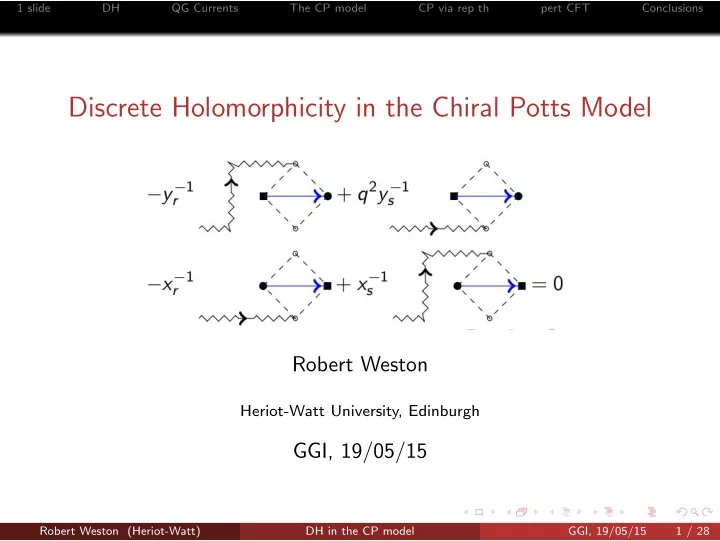
Four terms cancel. Expressed in terms of CP weights: −y−1

r

+ q2y−1

s

−x−1

r

+ x−1

s

= 0

Robert Weston (Heriot-Watt) DH in the CP model GGI, 19/05/15 20 / 28

slide-38
SLIDE 38

1 slide DH QG Currents The CP model CP via rep th pert CFT Conclusions

The effect of the ‘disorder’ operator expressed purely in terms of CP Boltzmann weights is: fs fr Wrs(a − b − 1) = a b , fr fs Wrs(a − b + 1) = a b 1 frfs W rs(a − b − 1) = a b , frfsW rs(a − b + 1) = a b , fr = yr −qxrµr .

Robert Weston (Heriot-Watt) DH in the CP model GGI, 19/05/15 21 / 28

slide-39
SLIDE 39

1 slide DH QG Currents The CP model CP via rep th pert CFT Conclusions

Embedding into the complex plane

Define u, φ by x = ei(u+φ)/N and y = ei(u−φ+π)/N and embed with angle ϑ = us − ur: Wrs = ϑ , W rs = ϑ ,

Robert Weston (Heriot-Watt) DH in the CP model GGI, 19/05/15 22 / 28

slide-40
SLIDE 40

1 slide DH QG Currents The CP model CP via rep th pert CFT Conclusions

Embedding into the complex plane

Define u, φ by x = ei(u+φ)/N and y = ei(u−φ+π)/N and embed with angle ϑ = us − ur: Wrs = ϑ , W rs = ϑ , Above relation becomes − exp(i(ϑ + φr − π)/N) + exp(i(φs + π)/N) − exp(i(ϑ − φr)/N) + exp(−iφs/N) = 0

Robert Weston (Heriot-Watt) DH in the CP model GGI, 19/05/15 22 / 28

slide-41
SLIDE 41

1 slide DH QG Currents The CP model CP via rep th pert CFT Conclusions

Now define O(z) to be the half current O((z1 + z2)/2)) = exp(−is Arg(z1 − z2))T(µ(z2)σ(z1)) where

  • σ(z1) is X = at CP site z1
  • µ(z2) is disorder operator ending at dual CP site z2
  • T is time ordering (largest Im(zi) to right)
  • Arg(z) is principal argument of z
  • ‘spin’ s = (1 − 1/N)

Robert Weston (Heriot-Watt) DH in the CP model GGI, 19/05/15 23 / 28

slide-42
SLIDE 42

1 slide DH QG Currents The CP model CP via rep th pert CFT Conclusions

Now define O(z) to be the half current O((z1 + z2)/2)) = exp(−is Arg(z1 − z2))T(µ(z2)σ(z1)) where

  • σ(z1) is X = at CP site z1
  • µ(z2) is disorder operator ending at dual CP site z2
  • T is time ordering (largest Im(zi) to right)
  • Arg(z) is principal argument of z
  • ‘spin’ s = (1 − 1/N)

We get ∗ ∗ ∗ ∗ z1 z2 z3 z4 eiφr/Nδz1O(z1) + eiφs/Nδz2O(z2) +e−iφr/Nδz3O(z3) + e−iφs/Nδz4O(z4) = 0

Robert Weston (Heriot-Watt) DH in the CP model GGI, 19/05/15 23 / 28

slide-43
SLIDE 43

1 slide DH QG Currents The CP model CP via rep th pert CFT Conclusions

Now define O(z) to be the half current O((z1 + z2)/2)) = exp(−is Arg(z1 − z2))T(µ(z2)σ(z1)) where

  • σ(z1) is X = at CP site z1
  • µ(z2) is disorder operator ending at dual CP site z2
  • T is time ordering (largest Im(zi) to right)
  • Arg(z) is principal argument of z
  • ‘spin’ s = (1 − 1/N)

We get ∗ ∗ ∗ ∗ z1 z2 z3 z4 eiφr/Nδz1O(z1) + eiφs/Nδz2O(z2) +e−iφr/Nδz3O(z3) + e−iφs/Nδz4O(z4) = 0 Get similar condition for vertical W plaquette.

Robert Weston (Heriot-Watt) DH in the CP model GGI, 19/05/15 23 / 28

slide-44
SLIDE 44

1 slide DH QG Currents The CP model CP via rep th pert CFT Conclusions

CFT interpretation

Want to interprete the ‘twisted’ DH cond eiφr/Nδz1O(z1) + eiφs/Nδz2O(z2) + e−iφr/Nδz3O(z3) + e−iφs/Nδz4O(z4) = 0 around ∗ ∗ ∗ ∗ z1 z2 z3 z4

Robert Weston (Heriot-Watt) DH in the CP model GGI, 19/05/15 24 / 28

slide-45
SLIDE 45

1 slide DH QG Currents The CP model CP via rep th pert CFT Conclusions

CFT interpretation

Want to interprete the ‘twisted’ DH cond eiφr/Nδz1O(z1) + eiφs/Nδz2O(z2) + e−iφr/Nδz3O(z3) + e−iφs/Nδz4O(z4) = 0 around ∗ ∗ ∗ ∗ z1 z2 z3 z4

  • 1. Critical Fateev-Zamolodchikov case

We have φr = φs = k = 0 and O(z) is known Z(N) F-Z lattice model parafermion with DH condition [Rajabpour & Cardy 07] δz1O1 + δz2O2 + δz3O3 + δz4O4 = 0 which is discrete version of ¯ ∂O = 0 Described by CFT: c = 2(N − 1)/(N + 2), O = fund. spin s = 1 − 1/N parafermion.

Robert Weston (Heriot-Watt) DH in the CP model GGI, 19/05/15 24 / 28

slide-46
SLIDE 46

1 slide DH QG Currents The CP model CP via rep th pert CFT Conclusions

CFT Interpretation . . .

  • 2. General N > 2 Case

Cardy (93), Watts (98) predict integrable CP identifiable as S = SFZ +

  • d2r [δ+Φ+(z, ¯

z) + δ−Φ−(z, ¯ z) + τε(z, ¯ z)]

  • spin 0 energy operator ε has conf. dim. (hε, hε) with hε = 2/(N + 2)
  • spin ±1 Φ± have conf. dim (hε + 1, hε) and (hε, hε + 1)

Robert Weston (Heriot-Watt) DH in the CP model GGI, 19/05/15 25 / 28

slide-47
SLIDE 47

1 slide DH QG Currents The CP model CP via rep th pert CFT Conclusions

CFT Interpretation . . .

  • 2. General N > 2 Case

Cardy (93), Watts (98) predict integrable CP identifiable as S = SFZ +

  • d2r [δ+Φ+(z, ¯

z) + δ−Φ−(z, ¯ z) + τε(z, ¯ z)]

  • spin 0 energy operator ε has conf. dim. (hε, hε) with hε = 2/(N + 2)
  • spin ±1 Φ± have conf. dim (hε + 1, hε) and (hε, hε + 1)

CFT argument then implies ¯ ∂O(z, ¯ z) = π

  • δ+ χ+(z, ¯

z) + δ− χ−(z, ¯ z) + τ χ0(z, ¯ z)

  • where

O(z)Φ±(w, ¯ w) = + · · · χ±(w, ¯ w) z − w + · · · ; spin(χ±) = s + 1 ∓ 1 O(z)ε(w, ¯ w) = + · · · χ0(w, ¯ w) z − w + · · · ; spin(χ0) = s − 1

Robert Weston (Heriot-Watt) DH in the CP model GGI, 19/05/15 25 / 28

slide-48
SLIDE 48

1 slide DH QG Currents The CP model CP via rep th pert CFT Conclusions

CFT Interpretation . . .

By expanding around FZ point our DH condition eiφr/Nδz1O(z1) + eiφs/Nδz2O(z2) + e−iφr/Nδz3O(z3) + e−iφs/Nδz4O(z4) = 0 can be described precisely in this way as discrete version of ¯ ∂O(z, ¯ z) = π

  • δ+ χ+(z, ¯

z) + δ− χ−(z, ¯ z) + τ χ0(z, ¯ z)

  • with χ± and χ0 identified in terms of correct-spin lattice operators

and parameters (δ+, δ−, τ) given in terms of (r, s).

Robert Weston (Heriot-Watt) DH in the CP model GGI, 19/05/15 26 / 28

slide-49
SLIDE 49

1 slide DH QG Currents The CP model CP via rep th pert CFT Conclusions

CFT Interpretation . . .

3.The Ising Case In general case, we find parafermions associated with ¯ e1 also gives DH condition Those associated with e0 and e1 give parafermionic currents with are discretely antiholomorphic

Robert Weston (Heriot-Watt) DH in the CP model GGI, 19/05/15 27 / 28

slide-50
SLIDE 50

1 slide DH QG Currents The CP model CP via rep th pert CFT Conclusions

CFT Interpretation . . .

3.The Ising Case In general case, we find parafermions associated with ¯ e1 also gives DH condition Those associated with e0 and e1 give parafermionic currents with are discretely antiholomorphic Combining DH relations for ¯ e0 and ¯ e1 in Ising case gives a discrete version of ¯ ∂Ψ = −im ¯ Ψ where Ψ and ¯ Ψ are two spin ±1/2 components of Ising fermions

Robert Weston (Heriot-Watt) DH in the CP model GGI, 19/05/15 27 / 28

slide-51
SLIDE 51

1 slide DH QG Currents The CP model CP via rep th pert CFT Conclusions

CFT Interpretation . . .

3.The Ising Case In general case, we find parafermions associated with ¯ e1 also gives DH condition Those associated with e0 and e1 give parafermionic currents with are discretely antiholomorphic Combining DH relations for ¯ e0 and ¯ e1 in Ising case gives a discrete version of ¯ ∂Ψ = −im ¯ Ψ where Ψ and ¯ Ψ are two spin ±1/2 components of Ising fermions Combing DAH relations for e0 and e1 gives discrete version of ∂ ¯ Ψ = imΨ Together = Dirac eqn - seen in Ising by [Riva & Cardy (06)]

Robert Weston (Heriot-Watt) DH in the CP model GGI, 19/05/15 27 / 28

slide-52
SLIDE 52

1 slide DH QG Currents The CP model CP via rep th pert CFT Conclusions

Conclusions

Quantum group currents give operators with DH or DAH relations Works for a range of models: dilute and dense loop models [IWWZ (13)] and CP [IW (15)] DH conditions tell us about underlying CFT and the perturbations of CFT our lattice model corresponds to Hopefully useful in establishing rigourous scaling limits to CFT (i.e., the Smirnov programme)

Robert Weston (Heriot-Watt) DH in the CP model GGI, 19/05/15 28 / 28