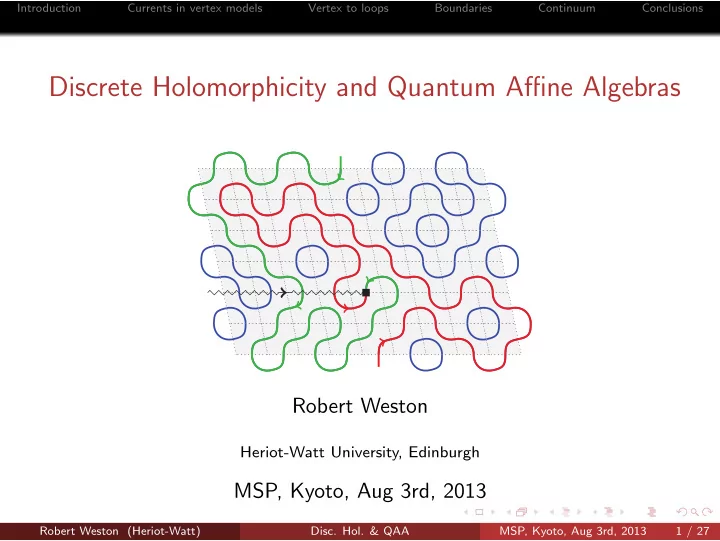
Discrete Holomorphicity and Quantum Affine Algebras Robert Weston - - PowerPoint PPT Presentation

discrete holomorphicity and quantum affine algebras
SMART_READER_LITE
LIVE PREVIEW

Discrete Holomorphicity and Quantum Affine Algebras Robert Weston - - PowerPoint PPT Presentation

Introduction Currents in vertex models Vertex to loops Boundaries Continuum Conclusions Discrete Holomorphicity and Quantum Affine Algebras Robert Weston Heriot-Watt University, Edinburgh MSP, Kyoto, Aug 3rd, 2013 Robert Weston


slide-1
SLIDE 1

Introduction Currents in vertex models Vertex to loops Boundaries Continuum Conclusions

Discrete Holomorphicity and Quantum Affine Algebras

Robert Weston

Heriot-Watt University, Edinburgh

MSP, Kyoto, Aug 3rd, 2013

Robert Weston (Heriot-Watt)

  • Disc. Hol. & QAA

MSP, Kyoto, Aug 3rd, 2013 1 / 27

slide-2
SLIDE 2

Introduction Currents in vertex models Vertex to loops Boundaries Continuum Conclusions

Plan

1

Introduction

2

Non-local quantum group currents in vertex models

3

From vertex models to loop models

4

Interacting boundaries

5

The continuum limit

6

Conclusions & Comments

Ref: Y. Ikhlef, R.W., M. Wheeler, P. Zinn-Justin: Discrete Holomorphicity and Quantized Affine Algebras, J. Phys.A 46 (2013) 265205, arxiv:1302.4649

Robert Weston (Heriot-Watt)

  • Disc. Hol. & QAA

MSP, Kyoto, Aug 3rd, 2013 2 / 27

slide-3
SLIDE 3

Introduction Currents in vertex models Vertex to loops Boundaries Continuum Conclusions

What is Discrete Holomorphicity?

Λ a planar graph in R2, embedded in complex plane. Let f be a complex-valued fn defined at midpoint of edges f said to be DH if it obeys lattice version of

  • f (z)dz = 0 around any

cycle. Around elementary plaquette, we use: f (z01)(z1 −z0)+f (z12)(z2 −z1)+f (z23)(z3 −z2)+f (z30)(z0 −z3) = 0 z0 z1 z2 z3 zij = (zi + zj)/2 Can be written for this cycle as f (z23) − f (z01) z2 − z1 = f (z12) − f (z30) z1 − z0 , a discrete Cauchy-Riemann reln

Robert Weston (Heriot-Watt)

  • Disc. Hol. & QAA

MSP, Kyoto, Aug 3rd, 2013 3 / 27

slide-4
SLIDE 4

Introduction Currents in vertex models Vertex to loops Boundaries Continuum Conclusions

What is use of DH in SM/CFT?

For review see [S. Smirnov, Proc. ICM 2006, 2010] DH observables used in proof of long-standing conjectures on conformal invariance of scaling limit, e.g.,

planar Ising model [S. Smirnov, C. Hongler, D. Chelkak . . . , 2001-] percolation on honeycomb lattice - Cardy’s crossing formula and reln to SLE(6) [S. Smirnov: 2001]

Robert Weston (Heriot-Watt)

  • Disc. Hol. & QAA

MSP, Kyoto, Aug 3rd, 2013 4 / 27

slide-5
SLIDE 5

Introduction Currents in vertex models Vertex to loops Boundaries Continuum Conclusions

Relation to Integrability

DH seems also to be related to integrability [Riva & Cardy 07, Cardy & Ikhlef 09, Ikhlef 12, Alam & Batchelor 12, de Gier et al13] e.g. parafermions of dilute O(n) loop model are DH precisely in the case when loop weights obey a linear relation whose solution corresponds to a solution of Yang-Baxter relation. How to interprete linear relation for R implying YB? Natural to assume that R∆(x) = ∆(x)R for a quantum group is behind this. i.e. DH observables should be understood in terms of quantum group generators [Bernard & Fendley have publicly made this point].

Robert Weston (Heriot-Watt)

  • Disc. Hol. & QAA

MSP, Kyoto, Aug 3rd, 2013 5 / 27

slide-6
SLIDE 6

Introduction Currents in vertex models Vertex to loops Boundaries Continuum Conclusions

Our Key Results

Dense/dilute 0(n) PFs are essentially non-local quantum group currents for Uq(A(1)

1 )/Uq(A(2) 2 )

DH of these currents just comes from R∆(x) = ∆(x)R Currents of boundary (co-ideal) subalgebra gives rise to observables that have discrete boundary conditions of form Re

  • Ψ(z01)(z1 − z0) + Ψ(z12)(z2 − z1)
  • = 0

z0 z1 z2

Robert Weston (Heriot-Watt)

  • Disc. Hol. & QAA

MSP, Kyoto, Aug 3rd, 2013 6 / 27

slide-7
SLIDE 7

Introduction Currents in vertex models Vertex to loops Boundaries Continuum Conclusions

Non-local quantum group currents in vertex models

Following Bernard and Felder [1991] we consider a set of elements {Ja, Θab, Θab}, a, b = 1, 2, . . . , n, of a Hopf algebra U. Properties: Θab Θcb = δa,c and

  • ΘbaΘbc = δa,c

Co-product ∆ and antipode S are (with summation convention): ∆(Ja) = Ja ⊗ 1 + Θab ⊗ Jb S(Ja) = − ΘbaJb ∆(Θab) = Θac ⊗ Θcb S(Θab) = Θba ∆( Θab) = Θac ⊗ Θcb S( Θab) = Θba. Acting on rep of U, we represent as Ja = a , Θab = a b ,

  • Θab =

b a

Robert Weston (Heriot-Watt)

  • Disc. Hol. & QAA

MSP, Kyoto, Aug 3rd, 2013 7 / 27

slide-8
SLIDE 8

Introduction Currents in vertex models Vertex to loops Boundaries Continuum Conclusions

Coproducts pictures are: ∆(Ja) = Ja ⊗ 1 a + Θab ⊗ Jb a ∆(Θab) = Θac ⊗ Θcb a b , ∆( Θab) =

  • Θac ⊗

Θcb b a and obvious extensions to ∆(N)(x). With R : V1 ⊗ V2 → V2 ⊗ V1 2 1

Robert Weston (Heriot-Watt)

  • Disc. Hol. & QAA

MSP, Kyoto, Aug 3rd, 2013 8 / 27

slide-9
SLIDE 9

Introduction Currents in vertex models Vertex to loops Boundaries Continuum Conclusions

R∆(x) = ∆(x)R becomes: R(Ja ⊗ 1) + a + R(Θab ⊗ Jb) = a = (Ja ⊗ 1)R + a + (Θab ⊗ Jb)R a R(Θac ⊗ Θcb) = a b = (Θac ⊗ Θcb)R, a b , R( Θbc ⊗ Θca) = a b = ( Θbc ⊗ Θca)R a b

Robert Weston (Heriot-Watt)

  • Disc. Hol. & QAA

MSP, Kyoto, Aug 3rd, 2013 9 / 27

slide-10
SLIDE 10

Introduction Currents in vertex models Vertex to loops Boundaries Continuum Conclusions

For monodromy matrix, we have non-local currents a + a = a + a Gives ja(x − 1 2, t) − ja(x + 1 2, t) + ja(x, t − 1 2) − ja(x, t + 1 2) = 0 when inserted into a correlation function.

Robert Weston (Heriot-Watt)

  • Disc. Hol. & QAA

MSP, Kyoto, Aug 3rd, 2013 10 / 27

slide-11
SLIDE 11

Introduction Currents in vertex models Vertex to loops Boundaries Continuum Conclusions

Quantum Affine Algebras

Consider algebra U gen. by ei, fi, t±1

i

with standard relns and ∆(ei) = ei ⊗ 1 + ti ⊗ ei, ∆(ti) = ti ⊗ ti Hence can consider currents: ei(x, t + 1 2) ∼ i ei(x + 1 2, t) ∼ i

Robert Weston (Heriot-Watt)

  • Disc. Hol. & QAA

MSP, Kyoto, Aug 3rd, 2013 11 / 27

slide-12
SLIDE 12

Introduction Currents in vertex models Vertex to loops Boundaries Continuum Conclusions

We consider two cases with i ∈ {0, 1} with irreps: Uq(A(1)

1 ): 6-Vertex Model

e0 = z 1

  • , t0 =

q−1 q

  • Uq(A(2)

2 ): 19-Vertex Izergin-Korepin Model

e0 = z1−ℓ   1 q   , t0 =   q−2 1 q2  

Robert Weston (Heriot-Watt)

  • Disc. Hol. & QAA

MSP, Kyoto, Aug 3rd, 2013 12 / 27

slide-13
SLIDE 13

Introduction Currents in vertex models Vertex to loops Boundaries Continuum Conclusions

From vertex models to loop models - the A(1)

1

dense case

6-vertex model R(z = zh/zv) =     A(z) B(z) C(z) C(z) B(z) A(z)     can be written in dressed-loop picture as A(z) = , B(z) = , C(z) = + plus reversed arrow cases.

Robert Weston (Heriot-Watt)

  • Disc. Hol. & QAA

MSP, Kyoto, Aug 3rd, 2013 13 / 27

slide-14
SLIDE 14

Introduction Currents in vertex models Vertex to loops Boundaries Continuum Conclusions

These can be rewriiten as appropriate loop weights a(z) = qz − q−1z−1, b(z) = z − z−1: a(z) b(z) times additional factor (−q)

δ 2π from directed line turning through

angle δ. Acute angle α given by z = (−q)− α

π .

Thus A(z) = a(z), B(z) = b(z), C(z) = a(z)(−q)

α π + b(z)(−q) α π −1 = q − q−1.

Partition fn becomes: Z = aNabNb(−q − q−1)Nloops

Robert Weston (Heriot-Watt)

  • Disc. Hol. & QAA

MSP, Kyoto, Aug 3rd, 2013 14 / 27

slide-15
SLIDE 15

Introduction Currents in vertex models Vertex to loops Boundaries Continuum Conclusions

e0(x, t) in the loop picture - the A(1)

1

dense case

For Uq(A(1)

1 ), we have e0 = z

1

  • , so sends up arrow to down, or

right arrow to left: Simple boundary conditions consistent with e0(a, b) = 0 are below, with a free line passing through (a, b) and attached to boundaries as shown: e0(x, t + 1

2) = 1 Z

  • The tail

can be moved through loops on boundary.

Robert Weston (Heriot-Watt)

  • Disc. Hol. & QAA

MSP, Kyoto, Aug 3rd, 2013 15 / 27

slide-16
SLIDE 16

Introduction Currents in vertex models Vertex to loops Boundaries Continuum Conclusions

To express purely in terms of loop configuration C, consider angle turns of and and effects of Both and have same angle turn θ(C) = πk(C), where k(C) ∈ Z, equals 2 in example. Weight = (−q)k(C).

  • No. down - no. up crossing of

also k(C). Weight =qk(C). Hence e0(x, t + 1

2) = zv Z

  • C|(x+ 1

2 ,t)∈γ

W (C)(−q2)θ(C)/π.

Robert Weston (Heriot-Watt)

  • Disc. Hol. & QAA

MSP, Kyoto, Aug 3rd, 2013 16 / 27

slide-17
SLIDE 17

Introduction Currents in vertex models Vertex to loops Boundaries Continuum Conclusions

Similarly e0(x + 1 2, t) = 1 Z

  • = zh

Z qα/π

C|(x,t+ 1

2 )∈γ

W (C)(−q2)θ(C)/π = zv Z e−iα

C|(x,t+ 1

2 )∈γ

W (C)(−q2)θ(C)

Robert Weston (Heriot-Watt)

  • Disc. Hol. & QAA

MSP, Kyoto, Aug 3rd, 2013 17 / 27

slide-18
SLIDE 18

Introduction Currents in vertex models Vertex to loops Boundaries Continuum Conclusions

Defining non-local operator φ0 on edges, by φ0(x, t + 1 2) = z−1

v e0(x, t + 1

2), φ0(x + 1 2, t) = z−1

v eiαe0(x + 1

2, t). we have φ0(a, b) = 1

Z

  • C|(a,b)∈γ

W (C)(−q2)θ(C)/π and e0(x − 1/2, t) + e0(x, t − 1/2) − e0(x + 1/2, t) − e0(x, t + 1/2) = 0 . becomes φ0(x, t−1/2)+ei(π−α)φ0(x+1/2, t)−φ0(x, t+1/2)−ei(π−α)φ0(x−1/2, t) = 0 φ0 is the known parafermionic operator with DH around plaquette [Riva &Cardy 06, Smirnov 06]: π − α α

(x,t−1/2) (x+1/2,t) (x,t+1/2) (x−1/2,t)

(x, t) ∈ Z2 .

Robert Weston (Heriot-Watt)

  • Disc. Hol. & QAA

MSP, Kyoto, Aug 3rd, 2013 18 / 27

slide-19
SLIDE 19

Introduction Currents in vertex models Vertex to loops Boundaries Continuum Conclusions

e1(x, t) in the loop picture - dense case

A similar argument works for e1(x, t), but leads to a simpler DH

  • variable. Defining a non-local operator φ1 on edges, by

φ1(x + 1 2, t) = z−1

v e1(x + 1

2, t), φ1(x, t + 1 2) = z−1

v eiαe1(x, t + 1

2). we have φ1(a, b) = 1

Z

  • C|(a,b)∈γ

W (C)e−iθ(C) which is DH as above. Note, if we define ¯ ei = tifi, then we have ∆(¯ ei) = ¯ ei ⊗ 1 + ti ⊗ ¯ ei and the above argument can be repeated. We find corresponding anti-holomorphic observables.

Robert Weston (Heriot-Watt)

  • Disc. Hol. & QAA

MSP, Kyoto, Aug 3rd, 2013 19 / 27

slide-20
SLIDE 20

Introduction Currents in vertex models Vertex to loops Boundaries Continuum Conclusions

Interacting Boundaries

To obtain integrable interacting boundary conditions, identify co-ideal subalgebra B ⊂ U, ∆(B) = B ⊗ U, and use Sklyanin formalism. For our V (z) reps earlier, we have KL(z) : V (z−1) → V (z) and KL(z) x = x KL(x), x ∈ B. If Ja, Θab ∈ B, we have z−1 z a = z−1 z a z−1 z a b = z−1 z a b

Robert Weston (Heriot-Watt)

  • Disc. Hol. & QAA

MSP, Kyoto, Aug 3rd, 2013 20 / 27

slide-21
SLIDE 21

Introduction Currents in vertex models Vertex to loops Boundaries Continuum Conclusions

Towards the loop picture

To make the change to the loop picture, we start from double row transfer matrix on diagonal (light-cone) lattice: Then consider loop picture on dual lattice: R = z z−1 = α K = z−1 z = α etc

Robert Weston (Heriot-Watt)

  • Disc. Hol. & QAA

MSP, Kyoto, Aug 3rd, 2013 21 / 27

slide-22
SLIDE 22

Introduction Currents in vertex models Vertex to loops Boundaries Continuum Conclusions

The A(1)

1

case

Co-ideal sub-algebra B generated by {T0 , T1 , Q := e1 + r ¯ e0 , ¯ Q := ¯ e1 + re0} , where r is a real parameter. KL(z)x = xKL(z) gives: KL(z) = z + rz−1 z−1 + rz

  • In loop picture, becomes:

∼ (−q)∓(α−β)/2π where β is a deficit angle - given by (−q)−(α−β)/π = z+rz−1

z−1+rz .

Robert Weston (Heriot-Watt)

  • Disc. Hol. & QAA

MSP, Kyoto, Aug 3rd, 2013 22 / 27

slide-23
SLIDE 23

Introduction Currents in vertex models Vertex to loops Boundaries Continuum Conclusions

For boundary conditions compatible with e0(x, t) = 0, can use: Then find (with x + t = 0 mod(2)): e0(x + 1, t) = z−1(−q)− 1

2

Z

  • C|(x+1,t)∈γ

W (C)(−q2)θ(C)/π(−q)nβ/2π e0(x, t) = z−1(−q)− 1

2 e−iα

Z

  • C|(x,t)∈γ

W (C)(−q2)θ(C)/π(−q)nβ/2π n = no. times left path touches boundary minus no. times right path touches boundary

Robert Weston (Heriot-Watt)

  • Disc. Hol. & QAA

MSP, Kyoto, Aug 3rd, 2013 23 / 27

slide-24
SLIDE 24

Introduction Currents in vertex models Vertex to loops Boundaries Continuum Conclusions

Bulk comm relns for modified: φ0(a, b) = 1 Z

  • C|(a,b)∈γ

W (C)(−q2)θ(C)/π(−q)nβ/2π are φ0(x, t) + eiαφ0(x + 1, t) − φ0(x + 1, t + 1) − eiαφ0(x, t + 1) = 0 This is DH on light-cone lattice α

(x+1,t) (x+1,t+1) (x,t) (x,t+1)

Robert Weston (Heriot-Watt)

  • Disc. Hol. & QAA

MSP, Kyoto, Aug 3rd, 2013 24 / 27

slide-25
SLIDE 25

Introduction Currents in vertex models Vertex to loops Boundaries Continuum Conclusions

Relation at the left boundary

Q = e1 + r ¯ e0 is conserved at left boundary: e1(1, t) + r ¯ e0(1, t) = e1(1, t + 1) + r ¯ e0(1, t + 1) , t = 0 (mod 2) which can be translated into z−1φ1(1, t) + rz ¯ φ0(1, t) = e−iαz−1φ1(1, t + 1) + eiαrz ¯ φ0(1, t + 1) plus conjugate relns from ¯ Q. Defining ψ := z−1(φ1 + rφ0), we find Re

  • ψ(1, t) + ei(π−α)ψ(1, t + 1)
  • = 0,

α

(1,t) (1,t+1)

which is BC around plaquette linked to integrability by [Ikhlef 12; de Gier, Lee, Rasmussen 13].

Robert Weston (Heriot-Watt)

  • Disc. Hol. & QAA

MSP, Kyoto, Aug 3rd, 2013 25 / 27

slide-26
SLIDE 26

Introduction Currents in vertex models Vertex to loops Boundaries Continuum Conclusions

The Continuum Limit

When |q| = 1, theories have CFT continuum limits. Non-rigorous identification of fields obtained by Coulomb gas approach of Nienhuis [84] with c = 1 − 6(1−g2)

g

, hr,s = (r−gs)2−(1−g)2

4g

, g = 1 − 2ν. We find: Dense case: φ0 ∼ (h13, 0), φ1 ∼ (1, 0); q = −e2πiν. Dilute case: φ0 ∼ (h12, 0), φ1 ∼ (1, 0); q4 = −e2πiν.

Robert Weston (Heriot-Watt)

  • Disc. Hol. & QAA

MSP, Kyoto, Aug 3rd, 2013 26 / 27

slide-27
SLIDE 27

Introduction Currents in vertex models Vertex to loops Boundaries Continuum Conclusions

Conclusions & Comments

Parafermions come directly from quantum group currents Quantum group invariance leads to DH property Discrete integral boundary conditions understood similarly from boundary quantum groups Why is underlying connection between quasitriangular Hopf algebras and discrete calculus? All our results with exception of CFT limit seem to be true for generic q, including −1 < q < 0 massive regimes.

Robert Weston (Heriot-Watt)

  • Disc. Hol. & QAA

MSP, Kyoto, Aug 3rd, 2013 27 / 27

slide-28
SLIDE 28

Introduction Currents in vertex models Vertex to loops Boundaries Continuum Conclusions

Appendix: Non-local operators in lattice models

Consider 1D Ising model in terms of transfer matrix: V = C2, T : V → V , with Z = TrV (T N). Could also write for lattice Λ with positions x ∈ {1, 2, · · · , N}: V (x) ∼ = V , VΛ = ⊗x∈ΛV (x), T(x) : V (x) → V (x + 1), B : VΛ → VΛ with B = ⊗x∈ΛT(x), with Z = TrVΛ(B) Schematically: A local operator σz(x) : V (x) → V (x) is then well defined and σz(n)σy(m) = 1 Z TrVΛ(σz(n)σz(m)B). Can just be written as σz(n)σy(m) = 1

Z TrV (σzT m−nσzT N−m+n).

Robert Weston (Heriot-Watt)

  • Disc. Hol. & QAA

MSP, Kyoto, Aug 3rd, 2013 28 / 27

slide-29
SLIDE 29

Introduction Currents in vertex models Vertex to loops Boundaries Continuum Conclusions

  • Gen. formalism is useful for quasi-local operators in 2D [B&F 91]

If edge mid-points p ∈ Λ, points p∗ ∈ Λ∗: VΛ = ⊗p∈ΛV (p), R(x, t) : V (x − 1 2, t) ⊗ V (x, t − 1 2) → V (x, t + 1 2) ⊗ V (x + 1 2, t) B = ⊗p∗∈Λ∗R(p∗) : VΛ → VΛ, Z = TrVΛ(B) Any operator acts as O : VΛ → VΛ and O = 1

Z TrVΛ(OB)

Local operator O(p) acts as identity on every edge except the one p. Quasi-local operator O(p) acts as identity except along a string of edges terminating in p.

Robert Weston (Heriot-Watt)

  • Disc. Hol. & QAA

MSP, Kyoto, Aug 3rd, 2013 29 / 27

slide-30
SLIDE 30

Introduction Currents in vertex models Vertex to loops Boundaries Continuum Conclusions

Thus we consider a quasi-local operator ja(p) associated with a node attached to the edge p and a tail labelled by a terminating at a fixed point on the left boundary. The operator relations a + a = a + a become ja(x − 1

2, t) − ja(x + 1 2, t) + ja(x, t − 1 2) − ja(x, t + 1 2) when

inserted into a correlation function.

Robert Weston (Heriot-Watt)

  • Disc. Hol. & QAA

MSP, Kyoto, Aug 3rd, 2013 30 / 27