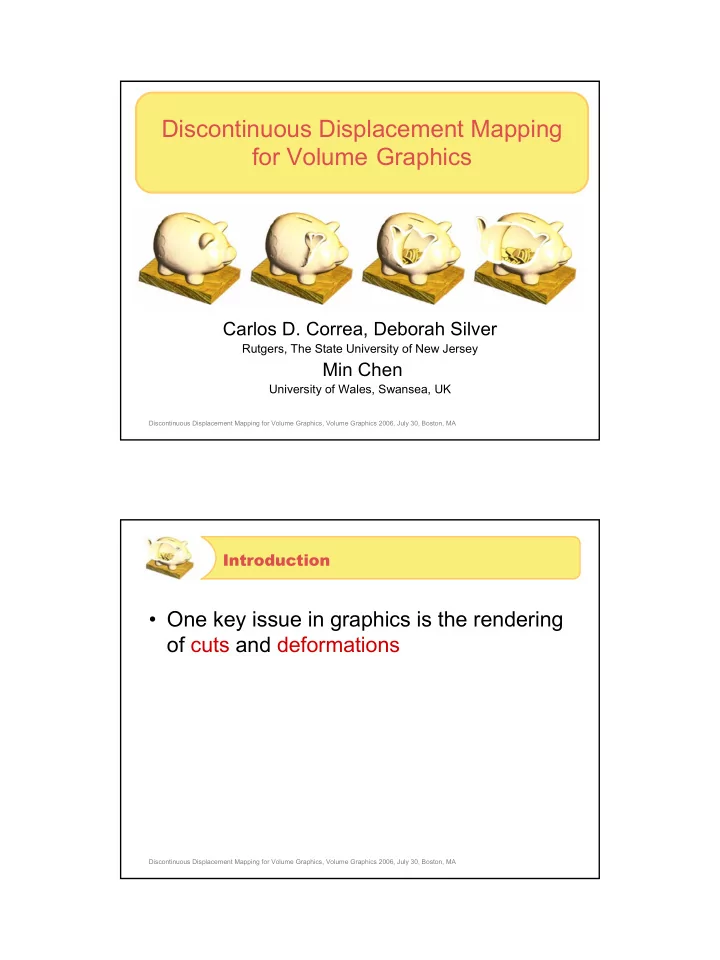
Discontinuous Displacement Mapping for Volume Graphics Carlos D. - - PDF document

discontinuous displacement mapping for volume graphics
SMART_READER_LITE
LIVE PREVIEW

Discontinuous Displacement Mapping for Volume Graphics Carlos D. - - PDF document

Discontinuous Displacement Mapping for Volume Graphics Carlos D. Correa, Deborah Silver Rutgers, The State University of New Jersey Min Chen University of Wales, Swansea, UK Discontinuous Displacement Mapping for Volume Graphics, Volume


slide-1
SLIDE 1

1

Discontinuous Displacement Mapping for Volume Graphics, Volume Graphics 2006, July 30, Boston, MA

Discontinuous Displacement Mapping for Volume Graphics

Carlos D. Correa, Deborah Silver

Rutgers, The State University of New Jersey

Min Chen

University of Wales, Swansea, UK

Discontinuous Displacement Mapping for Volume Graphics, Volume Graphics 2006, July 30, Boston, MA

Introduction

  • One key issue in graphics is the rendering
  • f cuts and deformations
slide-2
SLIDE 2

2

Discontinuous Displacement Mapping for Volume Graphics, Volume Graphics 2006, July 30, Boston, MA

Previous Approaches

  • Physically based, e.g., finite elements, mass-

spring models, meshless methods

Nealen et al. 2005 Volumes typically via a proxy mesh

  • Non-physically based

– Surface free-form , procedural, displacement- based – Volume free-form (Westermann, 2000) Ray deflectors (Kurzion & Yagel, 1997) Spatial TFs (Chen et al, 2003) Volume Browsing (McGuffin, 2003)

Discontinuous Displacement Mapping for Volume Graphics, Volume Graphics 2006, July 30, Boston, MA

Our Approach

Illustration/Image Physics Computer Generated Image Illustration/Image Computer Generated Image

Concept, abstraction Gross specification

Time integration Combination refinement

Physics-Based Deformation Illustrative Deformation

Simplification

slide-3
SLIDE 3

3

Discontinuous Displacement Mapping for Volume Graphics, Volume Graphics 2006, July 30, Boston, MA

Goal

  • To start with an illustration of what we

want and put it in the object

  • Similar to displacement maps

Discontinuous Displacement Mapping for Volume Graphics, Volume Graphics 2006, July 30, Boston, MA

Traditional Displacement Mapping

  • Commonly used to add details

to a base surface

  • Applied along normal
  • Usually continuous

V-ray rendering system http://www.spot3d.com/vray

slide-4
SLIDE 4

4

Discontinuous Displacement Mapping for Volume Graphics, Volume Graphics 2006, July 30, Boston, MA

Traditional Displacement Mapping (cont.)

  • Surface subdivision

– Limitations of surface representation can be solved using a tetrahedral mesh: further complicates the problem of tessellation

  • Ray tracing

Lee et al. Displaced Subdivision Surfaces Wang et al. Generalized Displacement Maps Discontinuous Displacement Mapping for Volume Graphics, Volume Graphics 2006, July 30, Boston, MA

Cuts

  • Difficult to model cuts and large deformations
  • Surface Subdivision Needs re-meshing
  • Ray Tracing Handle intersection with new

surface, can’t model large unorthogonal deformations

  • Ray Deflectors Difficult to model surface of

cut as rays get deflected

  • For ray tracing/warping, is easier to render cuts

and deformations with inverse mapping

slide-5
SLIDE 5

5

Discontinuous Displacement Mapping for Volume Graphics, Volume Graphics 2006, July 30, Boston, MA

Solution

  • 3D Displacements: model large

deformations and cuts (no re-meshing)

  • Inverse Mapping: High resolution

rendering of cuts

  • Directly on volumes: need an “inside” to

properly model cuts

Discontinuous Displacement Mapping for Volume Graphics, Volume Graphics 2006, July 30, Boston, MA

Discontinuous Displacement Mapping

  • Given a common reference coordinate frame
  • A position function P and a displacement D
  • Since we use inverse mapping
  • We use
slide-6
SLIDE 6

6

Discontinuous Displacement Mapping for Volume Graphics, Volume Graphics 2006, July 30, Boston, MA

Displacement Setup

  • Specify forward displacement
  • Sample its inverse at discrete

positions

  • What about empty space (due

to cuts)?

– Define displacement there too (to maintain C0 continuity – correct tri-linear interpolation) – Define alpha map (represent cut geometry)

Discontinuous Displacement Mapping for Volume Graphics, Volume Graphics 2006, July 30, Boston, MA

Displacements

  • Define desired detail and “add” to scene
  • Like displacement maps, we “add” the displacement to

the volume. We then render this new volume

Original volume Displaced volume Displacements

slide-7
SLIDE 7

7

Discontinuous Displacement Mapping for Volume Graphics, Volume Graphics 2006, July 30, Boston, MA

Rendering Pipeline

  • Sample scene bounding box (resulting scene)

then find opacity and color attributes of each point using inverse transformation

Discontinuous Displacement Mapping for Volume Graphics, Volume Graphics 2006, July 30, Boston, MA

Problem: add lighting

  • Displaced volume

with no lighting

slide-8
SLIDE 8

8

Discontinuous Displacement Mapping for Volume Graphics, Volume Graphics 2006, July 30, Boston, MA

Using Original Normals

  • Using the original

normals result in incorrect lighting

Discontinuous Displacement Mapping for Volume Graphics, Volume Graphics 2006, July 30, Boston, MA

Transformed Normals

  • Barr [1984] derived

transformation of normals for forward mapping. We derive for inverse displacements:

  • Normals on the rim of cut

are still incorrect since a new surface has been created

slide-9
SLIDE 9

9

Discontinuous Displacement Mapping for Volume Graphics, Volume Graphics 2006, July 30, Boston, MA

  • Blend with normal of

alpha map to handle normals at discontinuities Adjusted Normals near Cuts

Discontinuous Displacement Mapping for Volume Graphics, Volume Graphics 2006, July 30, Boston, MA

Discussion I: Interactive Manipulation

  • Displacements can be placed and rotated within the
  • volume. This is done via linear transformations,

represented as 4x4 matrices.

translation rotation scaling

slide-10
SLIDE 10

10

Discontinuous Displacement Mapping for Volume Graphics, Volume Graphics 2006, July 30, Boston, MA

Discussion II: Multiple Displacements

  • Multiple Displacements can be placed,

e.g., through addition of displacements

p = p' + D1(p') + D2(p')

Discontinuous Displacement Mapping for Volume Graphics, Volume Graphics 2006, July 30, Boston, MA

Discussion III: Composition

  • One of the advantages of Displacement Maps is the ability to operate

algebraically, e.g., through composition.

  • Composition is, in general, not commutative

p1 = p' + D1(p') p = p1 + D2(p1)

D1: ripples D2: peel

slide-11
SLIDE 11

11

Discontinuous Displacement Mapping for Volume Graphics, Volume Graphics 2006, July 30, Boston, MA

Volume Datasets

256x256x128 Engine 256x256x162 Tomato 256x256x256 Bunny 190x190x134 Piggy Bank 256x256x224 Teddy bear

Discontinuous Displacement Mapping for Volume Graphics, Volume Graphics 2006, July 30, Boston, MA

Results

slide-12
SLIDE 12

12

Discontinuous Displacement Mapping for Volume Graphics, Volume Graphics 2006, July 30, Boston, MA

Results

Discontinuous Displacement Mapping for Volume Graphics, Volume Graphics 2006, July 30, Boston, MA

Discussion IV: GPU

  • GPU texture memory size

– Current displacements occupy 320 KB - 6 MB. Still much smaller than the volume – Complex 3D displacements might require larger sizes

slide-13
SLIDE 13

13

Discontinuous Displacement Mapping for Volume Graphics, Volume Graphics 2006, July 30, Boston, MA

Semantics

  • Displacement is specified with no regards
  • f semantics of data (planar cuts)
  • Need a mechanism to preserve/constrain

to features in the dataset (to appear, IEEE Visualization 2006)

Discontinuous Displacement Mapping for Volume Graphics, Volume Graphics 2006, July 30, Boston, MA

Conclusions

  • Illustrative Deformation is a powerful technique

to simulate effects in volume graphics, such as fracturing, slicing, deforming and cutting.

  • Can be efficiently implemented via

Discontinuous Displacement Maps

  • We devised a collection of techniques for

implementing this method in real-time in contemporary GPUs

  • Applications: Special effects, VR, Illustration,

Surgical Planning, Games.

slide-14
SLIDE 14

14

Discontinuous Displacement Mapping for Volume Graphics, Volume Graphics 2006, July 30, Boston, MA

Thanks! More info

http://www.caip.rutgers.edu/~cdcorrea/displacement