Sub-/Seismic Structure and Deformation Quantification on different - - PowerPoint PPT Presentation

sub seismic structure and deformation quantification on
SMART_READER_LITE
LIVE PREVIEW

Sub-/Seismic Structure and Deformation Quantification on different - - PowerPoint PPT Presentation

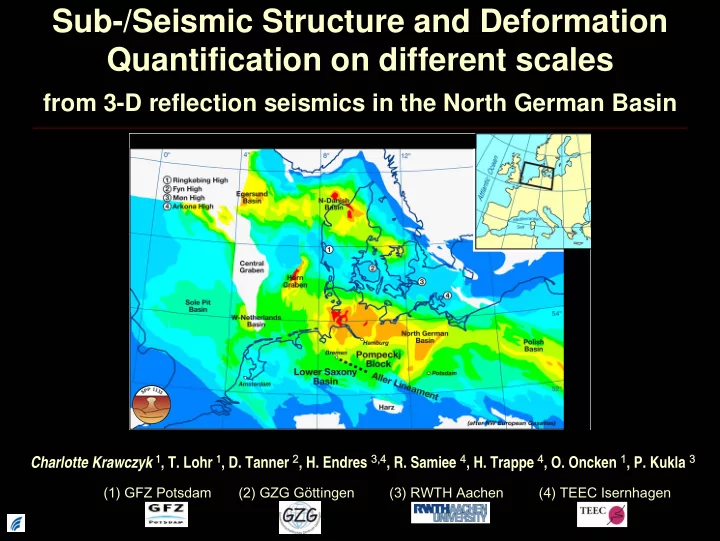
Sub-/Seismic Structure and Deformation Quantification on different scales from 3-D reflection seismics in the North German Basin Charlotte Krawczyk 1 , T. Lohr 1 , D. Tanner 2 , H. Endres 3,4 , R. Samiee 4 , H. Trappe 4 , O. Oncken 1 , P. Kukla 3


slide-1
SLIDE 1

Sub-/Seismic Structure and Deformation Quantification on different scales

from 3-D reflection seismics in the North German Basin

Charlotte Krawczyk 1, T. Lohr 1, D. Tanner 2, H. Endres 3,4, R. Samiee 4, H. Trappe 4, O. Oncken 1, P. Kukla 3

(1) GFZ Potsdam (2) GZG Göttingen (3) RWTH Aachen (4) TEEC Isernhagen

slide-2
SLIDE 2

Basin evolution depends on

(a) magnitude of deformation, (b) strain accumulation in space and time, (c) processes controlling (a) and (b) under varying kinematic constraints. study seismic and sub-seismic deformation in 3-D quantify distribution, magnitude and accumulation of strain over variety of scales

sub-seismic scale 12 x 5 cm 0.5 x 0.2 km seismic scale

slide-3
SLIDE 3

Workflow ‘sub-/seismic deformation analysis’

predict hydrocarbon pathways and storage

(1) (1) Seismic interpretation structural architecture and tectonic evolution (2) (2) Kinematic 3-D retro-deformation quantify strain magnitude and distribution (3) (3) Geostatistic tools quantitative fracture prediction (4) (4) Analogue deformation experiments evolution of strain over time (5) (5) Validation of results

slide-4
SLIDE 4

Seismic data, processing results and modelling examples cannot be shown here for confidentially reasons of industry data. Results to date are:

  • hanging-wall deformation is strongly controlled

by 3-D fault morphology

  • areas of high and low deformation are imaged
  • deformation affects area up to 1.3 km away from fault
  • e1 magnitude: 15% after 100 m displacement,

25-30% after 200 m displacement

  • location of strain concentration does not change
  • deformation evolves from localized zones to

areas of more distributed strain

Strain distribution and quantification