Seismic Design Seismic Design Seismic Design Seismic Design - - PowerPoint PPT Presentation

seismic design seismic design seismic design seismic
SMART_READER_LITE
LIVE PREVIEW

Seismic Design Seismic Design Seismic Design Seismic Design - - PowerPoint PPT Presentation

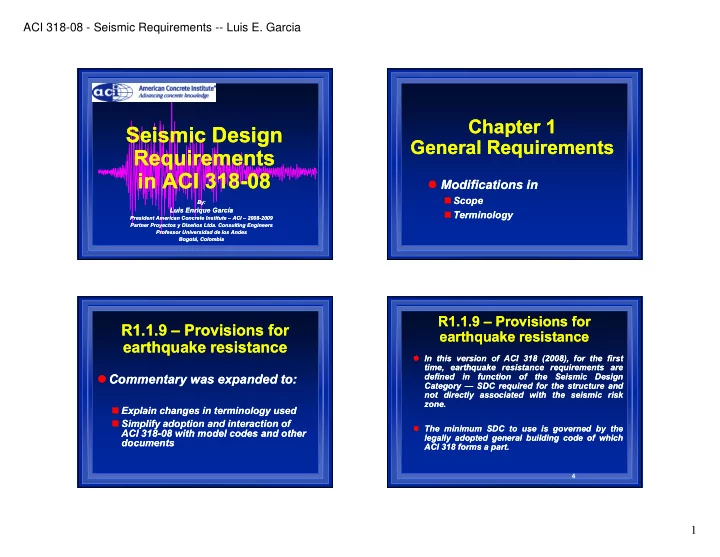
ACI 318-08 - Seismic Requirements -- Luis E. Garcia Chapter 1 Chapter 1 Chapter 1 Chapter 1 Seismic Design Seismic Design Seismic Design Seismic Design General Requirements General Requirements Requirements Requirements in ACI 318-08


slide-1
SLIDE 1

ACI 318-08 - Seismic Requirements -- Luis E. Garcia 1

Seismic Design Seismic Design Seismic Design Requirements in ACI 318-08 Seismic Design Requirements in ACI 318-08

By:

Luis Enrique García

President American Concrete Institute – ACI – 2008-2009 Partner Proyectos y Diseños Ltda. Consulting Engineers Professor Universidad de los Andes Bogotá, Colombia By:

Luis Enrique García

President American Concrete Institute – ACI – 2008-2009 Partner Proyectos y Diseños Ltda. Consulting Engineers Professor Universidad de los Andes Bogotá, Colombia

Chapter 1 Chapter 1 Chapter 1 General Requirements Chapter 1 General Requirements

Modifications in Modifications in

Scope Terminology Scope Terminology

R1.1.9 – Provisions for earthquake resistance R1.1.9 – Provisions for earthquake resistance

Commentary was expanded to:

Explain changes in terminology used Simplify adoption and interaction of

Commentary was expanded to:

Explain changes in terminology used Simplify adoption and interaction of Simplify adoption and interaction of ACI 318-08 with model codes and other documents Simplify adoption and interaction of ACI 318-08 with model codes and other documents

R1.1.9 – Provisions for earthquake resistance R1.1.9 – Provisions for earthquake resistance

In this version of ACI 318 (2008), for the first In this version of ACI 318 (2008), for the first In this version of ACI 318 (2008), for the first time, earthquake resistance requirements are defined in function

  • f

the Seismic Design Category — SDC required for the structure and not directly associated with the seismic risk zone. In this version of ACI 318 (2008), for the first time, earthquake resistance requirements are defined in function

  • f

the Seismic Design Category — SDC required for the structure and not directly associated with the seismic risk zone.

4

The minimum SDC to use is governed by the legally adopted general building code of which ACI 318 forms a part. The minimum SDC to use is governed by the legally adopted general building code of which ACI 318 forms a part.

slide-2
SLIDE 2

ACI 318-08 - Seismic Requirements -- Luis E. Garcia 2

TABLE R1.1.9.1 — CORRELATION BETWEEN SEISMIC-RELATED TERMINOLOGY IN MODEL CODES

Code, standard, or resource document and edition Level of seismic risk or assigned seismic performance or design categories as defined in the Code defined in the Code ACI 318-08; IBC 2000, 2003; 2006; NFPA 5000, 2003, 2006; ASCE 7- 98, 7-02, 7-05; NEHRP 1997, 2000, 2003 SCD* A, B SCS C SCD D, E, F BOCA National Building Code 1993, 1996, 1999; Standard Building Code 1994, 1997, 1999; ASCE 7-93, 7-95; NEHRP 1991, SPC† A, B SPC C SPC D; E

5

ASCE 7 93, 7 95; NEHRP 1991, 1994 Uniform Building Code 1991, 1994, 1997 Seismic Zone 0, 1 Seismic Zone 2 Seismic Zone 3, 4

*SDC = Seismic Design Category as defined in code, standard, or resource document. †SPC = Seismic Performance Category as defined in code, standard, or resource document

Chapter 2 Notation and Definitions Chapter 2 Notation and Definitions

There were important changes in notation of the whole document and all individual Chapter notation was moved to Chapter 2. There are a few new definitions related There were important changes in notation of the whole document and all individual Chapter notation was moved to Chapter 2. There are a few new definitions related There are a few new definitions related to Chapter 21. All definitions, old and new, were moved to Chapter 2. There are a few new definitions related to Chapter 21. All definitions, old and new, were moved to Chapter 2.

Chapter 21 Earthquake-resistant structures Chapter 21 Earthquake-resistant structures structures structures

Chapter 21 was reorganized in function of Seismic Design Categories (SDC) A, B, C, and D, E, and F in incremental order from

  • rdinary to special:

Chapter 21 was reorganized in function of Seismic Design Categories (SDC) A, B, C, and D, E, and F in incremental order from

  • rdinary to special:

A → B → C → D, E, F A → B → C → D, E, F

Seismic Design Category and Energy Dissipation Capacity Seismic Design Category and Energy Dissipation Capacity

SDC S i i D i Denomination (E di i ti Must comply with in Seismic Design Category (Energy dissipation capacity) Must comply with in ACI 318-08

A

Ordinary

Chapters 1 to 19 and 22

B

Chapters 1 to 19, 22, and 21.2

C

Intermediate

Chapters 1 to 19, 22, and 21.3 y 21.4

D, E, F

Special

Chapters 1 to 19, 22, And 21.5 to 21.13

slide-3
SLIDE 3

ACI 318-08 - Seismic Requirements -- Luis E. Garcia 3

ACI 318-08 – Chapter 21 Earthquake-resistant structures ACI 318-08 – Chapter 21 Earthquake-resistant structures

Content 21.1 – General requirements 21 2 Ordinary moment frames Content 21.1 – General requirements 21 2 Ordinary moment frames B 21.2 – Ordinary moment frames 21.3 – Intermediate moment frames 21.4 – Intermediate precast structural walls 21.5 – Flexural members of special moment frames 21.6 – Special moment frame members subjected to bending and axial load 21.7 – Joints of special moment frames 21.8 – Special moment frames constructed using precast concrete 21.9 – Special structural walls and coupling beams 21.2 – Ordinary moment frames 21.3 – Intermediate moment frames 21.4 – Intermediate precast structural walls 21.5 – Flexural members of special moment frames 21.6 – Special moment frame members subjected to bending and axial load 21.7 – Joints of special moment frames 21.8 – Special moment frames constructed using precast concrete 21.9 – Special structural walls and coupling beams B C D E 21.10 – Special structural walls constructed using precast concrete 21.11 – Structural diaphragms and trusses 21.12 – Foundations 21.13 – Members not designated as part of the seismic-force- resisting system 21.10 – Special structural walls constructed using precast concrete 21.11 – Structural diaphragms and trusses 21.12 – Foundations 21.13 – Members not designated as part of the seismic-force- resisting system E F

21.1 – General requirements 21.1 – General requirements

Scope Scope

Chapter 21 contains provisions considered to be the minimum requirements for a cast-in-place or precast concrete structure capable of sustaining a series of

  • scillations into the inelastic range of

response without critical deterioration in strength. Chapter 21 contains provisions considered to be the minimum requirements for a cast-in-place or precast concrete structure capable of sustaining a series of

  • scillations into the inelastic range of

response without critical deterioration in strength. g Therefore, the objective is to provide energy dissipation capacity in the nonlinear range of response. g Therefore, the objective is to provide energy dissipation capacity in the nonlinear range of response.

TABLE R21.1.1 — SECTIONS OF CHAPTER 21 TO BE SATISFIED IN TYPICAL APPLICATIONS

Component resisting earthquake effect, unless

  • therwise noted

Seismic Design Category (SDC) A

(none)

B

(21.1.1.4)

C

(21.1.1.5)

D

(21.1.1.6) Analysis and design requirements 21.1.2 21.1.2 21.1.2, 21.1.3 requirements None Materials None None 21.1.4 21.1.7 Frame members 21.2 21.3 21.5, 21.6, 21.7, 21.8 Structural walls and coupling beams None None 21.9 Precast structural walls None 21.4 21.4,† 21.10 Structural diaphragms and trusses None None 21.11 trusses Foundations None None 21.12 Frame members not proportioned to resist forces induced by earthquake motions None None 21.13 Anclajes None 21.1.8 21.1.8

Global Energy Dissipation Capacity Global Energy Dissipation Capacity

Force Force elastic elastic

Fe Fe

maximum elastic displacement demand maximum elastic displacement demand Maximum elastic force demand Maximum elastic force demand Displacement Displacement

Fy Fy u u u

nonlinear nonlinear Maximum nonlinear displacement demand Maximum nonlinear displacement demand Yield strength Yield strength Displacement Displacement

uy uy um um ue ue In several earthquake resistance regulations this is defined through parameter R In several earthquake resistance regulations this is defined through parameter R

e e y y

F u R F u = =

slide-4
SLIDE 4

ACI 318-08 - Seismic Requirements -- Luis E. Garcia 4

Elastic vs. Nonlinear Demand Elastic vs. Nonlinear Demand

10 10 20 20

u

linear elastic linear elastic nonlinear nonlinear

  • 20
  • 20
  • 10
  • 10

1 1 2 2 3 3 4 4 5 5 6 6 7 7 8 8 9 9 10 10 11 11 12 12 13 13 14 14 15 15

time (s) time (s) u (cm) (cm) linear elastic linear elastic nonlinear nonlinear 0 2 0 2 0.4 0.4 0.6 0.6 0.8 0.8 force force

  • 0.8
  • 0.8
  • 0.6
  • 0.6
  • 0.4
  • 0.4
  • 0.2
  • 0.2

0.2 0.2 1 1 2 2 3 3 4 4 5 5 6 6 7 7 8 8 9 9 10 10 11 11 12 12 13 13 14 14 15 15 time (s) time (s) force force (1/W) (1/W)

Current seismic design strategy Current seismic design strategy

Given an energy dissipation capacity for the structural

material and structural system, defined through an R value depending of the detailing scheme the design

Given an energy dissipation capacity for the structural

material and structural system, defined through an R value depending of the detailing scheme the design value depending of the detailing scheme the design horizontal seismic force is obtained from:

and the maximum elastic force demand is in turn

value depending of the detailing scheme the design horizontal seismic force is obtained from:

and the maximum elastic force demand is in turn e y

F F R =

and the maximum elastic force demand is in turn

  • btained using Newton’s 2nd Law:

and the maximum elastic force demand is in turn

  • btained using Newton’s 2nd Law:

= ×

e a

F m ass S T ( , ) ξ

Acceleration response spectrum from the general building code Acceleration response spectrum from the general building code

What would happen if What would happen if What would happen if energy dissipation capacity is not available? What would happen if energy dissipation capacity is not available? available? available?

slide-5
SLIDE 5

ACI 318-08 - Seismic Requirements -- Luis E. Garcia 5

Nonstructural wall panel in contact with the structure column

ACI 318-08 requires (21.1.2) that interaction between structural and nonstructural elements that may affect the response during the earthquake

h Nonstructural wall panel separated from the structure

  • st uctu a e e

e ts t at ay a ect t e espo se du g t e ea t qua e Must be taken into account. Rigid members assumed not to be a part of the seismic-force-resisting system are permitted provided their effect on the response of the system is considered and accommodated in the structural design. Consequences of failure of structural and nonstructural members that are not a part of the seismic-force-resisting system shall be considered.

C.21.1 – General Requirements C.21.1 – General Requirements

Compressive strength of concrete 21 MPa Specified compressi e strength of light eight Compressive strength of concrete 21 MPa Specified compressi e strength of light eight

c

f ′ ≥

Specified compressive strength of lightweight concrete ≤ 35 MPa For computing the amount of confinement reinforcement fyt ≤ 700 MPa (= 100,000 psi = 7000 kgf/cm2) Reinforcing steel must meet ASTM A706. If ASTM A615 is used, it must meet: Specified compressive strength of lightweight concrete ≤ 35 MPa For computing the amount of confinement reinforcement fyt ≤ 700 MPa (= 100,000 psi = 7000 kgf/cm2) Reinforcing steel must meet ASTM A706. If ASTM A615 is used, it must meet:

The actual yield strength based on mill tests does not exceed fy by more than 125 MPa. The ratio of the actual tensile strength to the actual yield strength is not less than1.25 The actual yield strength based on mill tests does not exceed fy by more than 125 MPa. The ratio of the actual tensile strength to the actual yield strength is not less than1.25

slide-6
SLIDE 6

ACI 318-08 - Seismic Requirements -- Luis E. Garcia 6

Reinforcing steel Reinforcing steel

stress MPa stress MPa

σ

actual tensile strength actual tensile strength

σ

failure failure

σy σ u

actual yield strength actual yield strength strain strain E 1 O max max maximum elongation maximum elongation y yield elongation yield elongation

ε ε ε

21.2 – Ordinary moment frames 21.2 – Ordinary moment frames

Corresponds to SDC B Beams must have at least two continuous Corresponds to SDC B Beams must have at least two continuous Beams must have at least two continuous longitudinal bars along both top and bottom

  • faces. These bars shall be developed at the

face of support. Columns having clear height less than or equal to Beams must have at least two continuous longitudinal bars along both top and bottom

  • faces. These bars shall be developed at the

face of support. Columns having clear height less than or equal to

c1 c2

five times the dimension c1 must be designed for shear in accordance with 21.3.3.

(shear requirements for intermediate SDC C)

five times the dimension c1 must be designed for shear in accordance with 21.3.3.

(shear requirements for intermediate SDC C)

21.3 - Intermediate moment frames 21.3 - Intermediate moment frames

Requirements for this Section are equivalent to the rest of Chapter 21, but are less strict and have a lesser scope. Requirements for this Section are equivalent to the rest of Chapter 21, but are less strict and have a lesser scope. p Two alternatives are presented for shear design of beams and columns:

Obtain design shear forces as function of nominal end moments as done for special elements, or use twice the shear from analysis This is

p Two alternatives are presented for shear design of beams and columns:

Obtain design shear forces as function of nominal end moments as done for special elements, or use twice the shear from analysis This is use twice the shear from analysis. This is equivalent to using the following load combinations: U = 1.2D + 1.0L + (1.0E)x2.0 U = 0.9D + (1.0E)x2.0 use twice the shear from analysis. This is equivalent to using the following load combinations: U = 1.2D + 1.0L + (1.0E)x2.0 U = 0.9D + (1.0E)x2.0

21.3 - Intermediate moment frames 21.3 - Intermediate moment frames

Reinforcement details in a frame member shall satisfy beam requirements if the f d i l i l d P d Reinforcement details in a frame member shall satisfy beam requirements if the f d i l i l d P d y q factored axial compressive load, Pu , does not exceed . When Pu is greater reinforcing details must meet column requirements. y q factored axial compressive load, Pu , does not exceed . When Pu is greater reinforcing details must meet column requirements.

g c

A f 10 ′

When a slab-column system without beams is part of the seismic-force-resisting system, reinforcement details in any span resisting moments caused by E must satisfy 21.3.6. When a slab-column system without beams is part of the seismic-force-resisting system, reinforcement details in any span resisting moments caused by E must satisfy 21.3.6.

slide-7
SLIDE 7

ACI 318-08 - Seismic Requirements -- Luis E. Garcia 7

21.3 - Intermediate moment frames 21.3 - Intermediate moment frames

For beams: Moment strength must comply with: For beams: Moment strength must comply with: g p y g p y ( )

≥ ⋅

n n face

M M

max .

1 5

n

M −

n

M −

n n

M M 1 3

+ −

21.3 - Intermediate moment frames 21.3 - Intermediate moment frames

For beams: At both ends of the beam, hoops shall be provided over For beams: At both ends of the beam, hoops shall be provided over lengths not less than 2h measured from the face of the supporting member toward midspan. The first hoop shall be located not more than 50 mm from the face of the supporting member. Spacing of hoops shall not exceed the smallest of d/4, 8db of the smaller longitudinal bar, 24db

  • f hoop, or 300 mm. Stirrups shall be spaced not more

than d/2 throughout the length of the beam. lengths not less than 2h measured from the face of the supporting member toward midspan. The first hoop shall be located not more than 50 mm from the face of the supporting member. Spacing of hoops shall not exceed the smallest of d/4, 8db of the smaller longitudinal bar, 24db

  • f hoop, or 300 mm. Stirrups shall be spaced not more

than d/2 throughout the length of the beam.

2h 2h @d/2

21.3 - Intermediate moment frames 21.3 - Intermediate moment frames

For columns At both ends of the column, hoops shall be provided at spacing so over a length measured from the joint For columns At both ends of the column, hoops shall be provided at spacing so over a length measured from the joint a length0 measured from the joint

  • face. Spacing so shall not exceed the

smallest of 1/2 of the smallest cross-sectional dimension of the column, 8db of the smallest longitudinal bar enclosed, 24db of the hoop bar, or 300 mm. Outside this length spacing must be the one defined in Chapters 7 and 11 a length0 measured from the joint

  • face. Spacing so shall not exceed the

smallest of 1/2 of the smallest cross-sectional dimension of the column, 8db of the smallest longitudinal bar enclosed, 24db of the hoop bar, or 300 mm. Outside this length spacing must be the one defined in Chapters 7 and 11 defined in Chapters 7 and 11. Length 0 shall not be less than the largest of the maximum cross- sectional dimension of the column;,

1/6 of the clear span of the column,

  • r 450 mm.

defined in Chapters 7 and 11. Length 0 shall not be less than the largest of the maximum cross- sectional dimension of the column;,

1/6 of the clear span of the column,

  • r 450 mm.

21.3 - Intermediate moment frames 21.3 - Intermediate moment frames

Two-way slabs without beams (slab-column frames)

  • Reinforcement provided to resist Mslab shall be placed

ithi th l t i Two-way slabs without beams (slab-column frames)

  • Reinforcement provided to resist Mslab shall be placed

ithi th l t i

slab

within the column strip.

  • Not less than 50% of the reinforcement in the column

strip at supports shall be placed within the effective slab width defined by lines drawn parallel to the span at 1.5 slab depths from the column face .

  • Continuous bottom reinforcement in the column strip

shall be not less than 33% of the top reinforcement at th t i th l t i

slab

within the column strip.

  • Not less than 50% of the reinforcement in the column

strip at supports shall be placed within the effective slab width defined by lines drawn parallel to the span at 1.5 slab depths from the column face .

  • Continuous bottom reinforcement in the column strip

shall be not less than 33% of the top reinforcement at th t i th l t i the support in the column strip.

  • Not less than 25% of the top reinforcement at the

support in the column strip shall be continuous throughout the span. the support in the column strip.

  • Not less than 25% of the top reinforcement at the

support in the column strip shall be continuous throughout the span.

slide-8
SLIDE 8

ACI 318-08 - Seismic Requirements -- Luis E. Garcia 8

21.3 - Intermediate moment frames 21.3 - Intermediate moment frames 21.3 - Intermediate moment frames 21.3 - Intermediate moment frames

Two-way slabs without beams (slab-column frames) Two-way slabs without beams (slab-column frames) At the critical sections for punching shear, shear caused by factored gravity loads shall not exceed, where must be calculated as defined in Chapter 11 for prestressed and non prestressed slabs. At the critical sections for punching shear, shear caused by factored gravity loads shall not exceed, where must be calculated as defined in Chapter 11 for prestressed and non prestressed slabs.

c

V 0.4φ

c

V

This requirement may be waived if the slab complies with 21.13.6 This requirement may be waived if the slab complies with 21.13.6

21.4 — Intermediate precast structural walls 21.4 — Intermediate precast structural walls

Requirements of 21.4 apply to intermediate t t t l ll f i t f th Requirements of 21.4 apply to intermediate t t t l ll f i t f th precast structural walls forming part of the seismic-force resisting systems. In connections between wall panels, or between wall panels and the foundation, yielding must be restricted to steel elements

  • r reinforcement..

precast structural walls forming part of the seismic-force resisting systems. In connections between wall panels, or between wall panels and the foundation, yielding must be restricted to steel elements

  • r reinforcement..

Elements of the connection that are not designed to yield must develop at least 1.5Sy. Elements of the connection that are not designed to yield must develop at least 1.5Sy.

21.5 — Flexural members of special moment frames 21.5 — Flexural members of special moment frames

A i l f P t t d A i l f P t t d

f A 0 10 ′

Axial force Pu must not exceed Clear span of element n must be larger than 4d Ratio bw/h > 0.3 Width b must comply with: Axial force Pu must not exceed Clear span of element n must be larger than 4d Ratio bw/h > 0.3 Width b must comply with:

c g

f A 0.10 ′

Width bw must comply with:

bw > 250 mm

larger than the width of the supporting element plus 3h/4 at each side

Width bw must comply with:

bw > 250 mm

larger than the width of the supporting element plus 3h/4 at each side

slide-9
SLIDE 9

ACI 318-08 - Seismic Requirements -- Luis E. Garcia 9

21.5 — Flexural members of special moment frames 21.5 — Flexural members of special moment frames

21.5 — Flexural members of special moment frames 21.5 — Flexural members of special moment frames

Longitudinal reinforcement Longitudinal reinforcement Longitudinal reinforcement

Steel ratio for negative and positive reinforcement must not be less than:

Longitudinal reinforcement

Steel ratio for negative and positive reinforcement must not be less than:

c y y

f f f 1.4 4 ρ ′ ≥ ≥ ⋅

but: At least two bars continuous top and bottom. but: At least two bars continuous top and bottom.

y y

f f 4 0.025 ρ ≤

21.5 — Flexural members of special moment frames 21.5 — Flexural members of special moment frames

Longitudinal reinforcement

Moment strength at each section must be at least:

Longitudinal reinforcement

Moment strength at each section must be at least: Moment strength at each section must be at least: Moment strength at each section must be at least:

( )

≥ ⋅

n n face

M M

max .

0.25

n

M −

n

M −

n n

M M 0.5

+ −

21.5 — Flexural members of special moment frames 21.5 — Flexural members of special moment frames

Longitudinal reinforcement Longitudinal reinforcement

Lap splices are permitted if hoops are provided throughout the splice length. Maximum hoop spacing must not exceed d/4 or 100 mm. No lap splices are permitted in joints or within 2h

  • f column face or where inelastic action is

t d Lap splices are permitted if hoops are provided throughout the splice length. Maximum hoop spacing must not exceed d/4 or 100 mm. No lap splices are permitted in joints or within 2h

  • f column face or where inelastic action is

t d expected. expected.

slide-10
SLIDE 10

ACI 318-08 - Seismic Requirements -- Luis E. Garcia 10

21.5 — Flexural members of special moment frames 21.5 — Flexural members of special moment frames

Hoops must be provided: Hoops must be provided:

50 mm 50 mm 50 mm 50 mm s ≤d/2 s ≤d/2 2h 2h 2h 2h confinement zones confinement zones

21.5 — Flexural members of special moment frames 21.5 — Flexural members of special moment frames

Shear design: Shear design:

Δ n n ΔVe ΔVe

pr

M −

pr

M +

( ) ( )

M M

+

( ) ( )

M M +

( ) ( )

pr pr izq der e n

M M V

. . + −

+ Δ =

  • (

) ( )

pr pr izq der e n

M M V

. . − +

+ Δ =

  • Mpr computed using fypr = 1.25 fy

and φ = 1.0

Mpr computed using fypr = 1.25 fy

and φ = 1.0

21.5 — Flexural members of special moment frames 21.5 — Flexural members of special moment frames

Pu1 Pu1 Pu2 Pu2 Wu Wu

(Vu)ver. right (Vu)ver. right (Vu)vert. left (Vu)vert. left

1 x

Vu(x) Vu(x)

( ) ( )

u u u ver.izq. ver.der. n

1 V V P ⎡ ⎤ + − ∑ ⎢ ⎥ ⎣ ⎦ (Vu)ver. left + ΔVe (Vu)ver. left + ΔVe (Vu)ver. left- ΔVe (Vu)ver. left- ΔVe (V ) ΔV (V ) ΔV

shear envelope shear envelope

(Vu)ver. right+ ΔVe (Vu)ver. right+ ΔVe (Vu)vert. right - ΔVe (Vu)vert. right - ΔVe

For design, Vc = 0 if ΔVe is more than 50%

  • f required shear strength, or axial force is less than 0.05f’cAg

For design, Vc = 0 if ΔVe is more than 50%

  • f required shear strength, or axial force is less than 0.05f’cAg

21.6 — Special moment frame members subjected to bending and axial load 21.6 — Special moment frame members subjected to bending and axial load General

Axial force greater than The least section dimension that passes th h th t id t b t th

General

Axial force greater than The least section dimension that passes th h th t id t b t th

0.10 ′ ⋅ ⋅

c g

f A

through the centroid must be greater than

300 mm.

Ratio b/h > 0.4 through the centroid must be greater than

300 mm.

Ratio b/h > 0.4

slide-11
SLIDE 11

ACI 318-08 - Seismic Requirements -- Luis E. Garcia 11

21.6 — Special moment frame members subjected to bending and axial load 21.6 — Special moment frame members subjected to bending and axial load

Column flexural strength must comply with: Column flexural strength must comply with: 1.2 ≥

∑ ∑

nc nb

M M

Mnc M Mnc M Mnb Mnb Mnc Mnb Mnb Mnc

nc

Mnb Mnc Mnc Mnb Mnc Mnc Mnb Mnc Mnb Mnc

(a) (c) (b)

21.6 — Special moment frame members subjected to bending and axial load 21.6 — Special moment frame members subjected to bending and axial load

Transverse reinforcement in confining zones must comply Transverse reinforcement in confining zones must comply g p y with:

  • Spiral columns:
  • Columns with hoops:

g p y with:

  • Spiral columns:
  • Columns with hoops:

0.3 1 ⎡ ⎤ ′ ⎛ ⎞ ⋅ ⋅ ⋅ ⎢ ⎥ ⎜ ⎟

g c c

A s b f A 0.12 ′ = ⋅

c s yt

f f ρ 1 = ⋅ − ⎢ ⎥ ⎜ ⎟ ⎢ ⎥ ⎝ ⎠ ⎣ ⎦

g c c sh yt ch

A f A 0.09 ′ ⋅ ⋅ ⋅ =

c c sh yt

s b f A f

21.6 — Special moment frame members subjected to bending and axial load 21.6 — Special moment frame members subjected to bending and axial load

hx hx hx

x

h mm 350 ≤

joint transverse i f t joint transverse i f t x x x

hx b hc

b

b s d long. s0 / 4 6 ⎧ ⎪ ≤ ⎨ ⎪ ⎩

confinement zones confinement zones

50 mm 50 mm

lap splices in central zone lap splices in central zone reinforcement as required by 21.7 reinforcement as required by 21.7

n

h h 6 ⎧ ⎪ ≤ ⎨ ⎪

  • 350 h

⎧ ⎛ ⎞

⎧ ≤ ⎨

b long

6d . s 50 mm 50 mm

joint transverse reinforcement as required by 21.7 joint transverse reinforcement as required by 21.7

450 mm ⎪ ⎩

x

350-h 100 s mm mm 3 150 100 ⎧ ⎛ ⎞ + ⎪ ⎜ ⎟ ⎪ ⎝ ⎠ = ⎨≤ ⎪ ⎪≥ ⎩

≤ ⎨ ⎩ s 150 mm

21.6 — Special moment frame members subjected to bending and axial load 21.6 — Special moment frame members subjected to bending and axial load

  • Shear design
  • Shear design

Mpr Mpr

( ) ( )

Mpr corresponds to the maximum moment strength for the axial load range on the element (1.25fy and φ=1). Ve cannot be less than the one obtained from analysis. Mpr corresponds to the maximum moment strength for the axial load range on the element (1.25fy and φ=1). Ve cannot be less than the one obtained from analysis.

hn hn Ve Ve

( ) ( )

pr pr arriba abajo e n

M M V h + =

less than the one obtained from analysis. For design Vc = 0 if Ve is more than 50%

  • f the required shear or the axial force

is less than 0.05f’cAg less than the one obtained from analysis. For design Vc = 0 if Ve is more than 50%

  • f the required shear or the axial force

is less than 0.05f’cAg

Mpr Mpr

slide-12
SLIDE 12

ACI 318-08 - Seismic Requirements -- Luis E. Garcia 12

21.7 — Joints of special moment frames 21.7 — Joints of special moment frames

General requirements General requirements

When computing shear strength within the joint in special frames all longitudinal reinforcement must be presumed to be stressed at 1.25fy. Longitudinal reinforcement terminating at a joint must be extended to the far face of the column confined core and anchored in tension. Wh th b l it di l i f t When computing shear strength within the joint in special frames all longitudinal reinforcement must be presumed to be stressed at 1.25fy. Longitudinal reinforcement terminating at a joint must be extended to the far face of the column confined core and anchored in tension. Wh th b l it di l i f t When the beam longitudinal reinforcement passes through the joint , the column dimension parallel to the reinforcement cannot be less than 20db largest longitudinal bar, for normal weight concrete and 26db for lightweight concrete. When the beam longitudinal reinforcement passes through the joint , the column dimension parallel to the reinforcement cannot be less than 20db largest longitudinal bar, for normal weight concrete and 26db for lightweight concrete.

21.7 — Joints of special moment frames 21.7 — Joints of special moment frames

  • Computation of the shear demand on the joint:
  • Computation of the shear demand on the joint:

Mpr-c Mpr-c Ve-col Ve-col

plane to evaluate shear Vu plane to evaluate shear Vu column column

M M

u u

beam beam

s y s

T f A 1.25 =

c s y s

C T f A 1.25 = =

c s y s

C T f A 1.25 ′ ′ ′ = =

s y s

T f A 1.25 ′ ′ =

Ve-col Ve-col Mpr-c Mpr-c ( ) ( )

u y s s e viga col

V f A A V 1.25 ′ = + −

( ) ( ) ( ) ( )

y s e viga col u y s e viga col

f A V V f A V 1.25 1.25 ⎧ − ⎪ ⎪ ≥ ⎨ ⎪ ′ − ⎪ ⎩ Beam in both sides: Beam in both sides: Beam in one side: Beam in one side:

21.7 — Joints of special moment frames 21.7 — Joints of special moment frames

Shear strength Shear strength

  • Joints confined in all four faces
  • Joints confined in three faces or in opposite faces
  • Joints confined in all four faces
  • Joints confined in three faces or in opposite faces

n c j

V f A 1.70 φ φ ′ ⋅ = ⋅ ⋅ ⋅

n c j

V f A 1.25 φ φ ′ ⋅ = ⋅ ⋅ ⋅

  • Other joints
  • Other joints

n c j

V f A 1.00 φ φ ′ ⋅ = ⋅ ⋅ ⋅

21.7 — Joints of special moment frames 21.7 — Joints of special moment frames

Definition of Aj Definition of Aj

Aj bw bw bw bw h

w

Aj bw bw h x

w w

b x b h 2 + ⎧ ≤ ⎨ + ⎩

slide-13
SLIDE 13

ACI 318-08 - Seismic Requirements -- Luis E. Garcia 13

21.7 — Joints of special moment frames 21.7 — Joints of special moment frames

Development for hooks embedded in the Development for hooks embedded in the confined core confined core

db dh

critical section

y b dh

f d ⋅ = dh

c

f 5.4 ′

  • 21.8 — Special moment frames

constructed using precast concrete 21.8 — Special moment frames constructed using precast concrete

The requirements of 21.8 apply for special The requirements of 21.8 apply for special q pp y p moment frames built using precast concrete forming part of the seismic-force- resistant system. The detailing provisions in 21.8.2 and 21.8.3 are intended to produce frames that respond to design displacements essentially like monolithic special moment q pp y p moment frames built using precast concrete forming part of the seismic-force- resistant system. The detailing provisions in 21.8.2 and 21.8.3 are intended to produce frames that respond to design displacements essentially like monolithic special moment esse t a y e

  • o t

c spec a

  • e t

frames. The provisions of 21.8.4 indicate that when not satisfying 21.8.2 or 21.8.3 they must satisfy the requirements of ACI 374.1 esse t a y e

  • o t

c spec a

  • e t

frames. The provisions of 21.8.4 indicate that when not satisfying 21.8.2 or 21.8.3 they must satisfy the requirements of ACI 374.1

21.8 — Special moment frames constructed using precast concrete 21.8 — Special moment frames constructed using precast concrete

Special precast moment frames with ductile ti t l ith ll Special precast moment frames with ductile ti t l ith ll connections must comply with all requirements for special cast-in-place frames and Vn should not be less than 2Ve. Special precast moment frames with strong connections are intended to experience flexural yielding outside the connections connections must comply with all requirements for special cast-in-place frames and Vn should not be less than 2Ve. Special precast moment frames with strong connections are intended to experience flexural yielding outside the connections flexural yielding outside the connections. These requirements are applicable independently of any of these two situations. flexural yielding outside the connections. These requirements are applicable independently of any of these two situations.

21.9 — Special structural walls and coupling beams 21.9 — Special structural walls and coupling beams

Terminology Terminology h Vu Vu w w hw hw

slide-14
SLIDE 14

ACI 318-08 - Seismic Requirements -- Luis E. Garcia 14

21.9 — Special structural walls and coupling beams – General requirements 21.9 — Special structural walls and coupling beams – General requirements

Cover Cover

20 mm

Maximum

reinforcement spacing

Maximum

reinforcement spacing

h s s s s

s ≤ 3h s ≤ 450 mm

s s

21.9 — Special structural walls and coupling beams 21.9 — Special structural walls and coupling beams

Flexure design Flexure design

Design for flexure and flexure and axial load for structural walls must be performed using the requirements of Chapter 10. Concrete and developed longitudinal reinforcement within effective flange widths boundary elements Design for flexure and flexure and axial load for structural walls must be performed using the requirements of Chapter 10. Concrete and developed longitudinal reinforcement within effective flange widths boundary elements within effective flange widths, boundary elements, and the wall web shall be considered effective. The effects of openings shall be considered. within effective flange widths, boundary elements, and the wall web shall be considered effective. The effects of openings shall be considered.

21.9 - Special structural walls and coupling beams 21.9 - Special structural walls and coupling beams

Flexure design Flexure design Flexure design

Unless a more detailed analysis is performed, effective flange widths of flanged sections ( I, L, C

  • r T) may be supposed to extend from the face of

the web a distance equal to the smaller of:

Flexure design

Unless a more detailed analysis is performed, effective flange widths of flanged sections ( I, L, C

  • r T) may be supposed to extend from the face of

the web a distance equal to the smaller of: (a) 1/2 the distance to an adjacent wall web, and (b) 25 percent of the total wall height. (a) 1/2 the distance to an adjacent wall web, and (b) 25 percent of the total wall height.

21.9 - Special structural walls and coupling beams 21.9 - Special structural walls and coupling beams

21 9 2 Reinforcement 21 9 2 Reinforcement 21.9.2 – Reinforcement The distributed web reinforcement ratios, ρt and ρ, for structural walls shall not be less than 0.0025, except that if Vu does not exceed (MPa) = (kgf/cm2), ρt and ρ, may be reduced to the values given 21.9.2 – Reinforcement The distributed web reinforcement ratios, ρt and ρ, for structural walls shall not be less than 0.0025, except that if Vu does not exceed (MPa) = (kgf/cm2), ρt and ρ, may be reduced to the values given

cv c

0.083A f′ λ

cv c

0.27A f′ λ

in14.3. Separation of reinforcement must not exceed 450 mm in14.3. Separation of reinforcement must not exceed 450 mm

slide-15
SLIDE 15

ACI 318-08 - Seismic Requirements -- Luis E. Garcia 15

Minimum steel ratio Minimum steel ratio

  • 14.3.2 – Minimum steel ratio of vertical reinforcement ρ

computed over gross section is:

0 0012 f

f º ( / ) ó

  • 14.3.2 – Minimum steel ratio of vertical reinforcement ρ

computed over gross section is:

0 0012 f

f º ( / ) ó

0.0012 for deformed bars not larger than Nº 5 (5/8”) ó 16M

(16 mm), with fy not less than 420 MPa.

0.0015 for other deformed bars. 0.0012 for welded wire reinforcement with diameter not

larger than16 mm.

  • 14.3.3 - Minimum ratio of horizontal reinforcement area to

gross concrete area, ρt:

0.0012 for deformed bars not larger than Nº 5 (5/8”) ó 16M

(16 mm), with fy not less than 420 MPa.

0.0015 for other deformed bars. 0.0012 for welded wire reinforcement with diameter not

larger than16 mm.

  • 14.3.3 - Minimum ratio of horizontal reinforcement area to

gross concrete area, ρt:

0.0020 for deformed bars not larger than Nº 5 (5/8”) ó 16M

(16 mm), with fy not less than 420 MPa.

0.0025 for other deformed bars. 0.0020 for welded wire reinforcement with diameter not

larger than16 mm.

0.0020 for deformed bars not larger than Nº 5 (5/8”) ó 16M

(16 mm), with fy not less than 420 MPa.

0.0025 for other deformed bars. 0.0020 for welded wire reinforcement with diameter not

larger than16 mm.

Difference between wall and column Difference between wall and column

14.3.6 — Vertical reinforcement

need not be enclosed by lateral ties if vertical reinforcement area is not greater than 0.01 times gross concrete area, or where vertical

14.3.6 — Vertical reinforcement

need not be enclosed by lateral ties if vertical reinforcement area is not greater than 0.01 times gross concrete area, or where vertical reinforcement is not required as compression reinforcement. reinforcement is not required as compression reinforcement.

21.9 - Special structural walls and coupling beams 21.9 - Special structural walls and coupling beams At l t t t i f i f t At l t t t i f i f t At least two curtains of reinforcement must be used in a wall if Vu exceeds (MPa) = At least two curtains of reinforcement must be used in a wall if Vu exceeds (MPa) =

cv c

0.17 A f′ λ

cv c

0.53 A f′ λ (kgf/cm2) (kgf/cm2) 21.9 - Special structural walls and coupling beams 21.9 - Special structural walls and coupling beams

Nominal shear strength must not exceed: Nominal shear strength must not exceed:

  • a s ea st e gt

ust

  • t e ceed

where αc is:

  • a s ea st e gt

ust

  • t e ceed

where αc is:

n cv c c n y

V A f f α λ ρ ⎡ ⎤ ′ = + ⎣ ⎦

αc αc

0.25 0.25 w w

h

  • 0.17

0.17 2.0 2.0 1.5 1.5 0.5 0.5 1.0 1.0 2.5 2.5

slide-16
SLIDE 16

ACI 318-08 - Seismic Requirements -- Luis E. Garcia 16

Wall boundary elements Wall boundary elements

  • Boundary elements must be placed at edges and

around openings when inelastic response is expected ACI 318-08 gives two alternatives to

  • Boundary elements must be placed at edges and

around openings when inelastic response is expected ACI 318-08 gives two alternatives to

  • expected. ACI 318-08 gives two alternatives to

define if boundary elements are needed: 1) Section 21.9.6.2 presents a displacement- based procedure. Boundary elements are needed or not depending on the compressive strain at the edge of wall caused by the seismic lateral deflection, or

  • expected. ACI 318-08 gives two alternatives to

define if boundary elements are needed: 1) Section 21.9.6.2 presents a displacement- based procedure. Boundary elements are needed or not depending on the compressive strain at the edge of wall caused by the seismic lateral deflection, or 2) Section 21.9.6.3 requires boundary elements when the compressive stress at the edge of wall caused by the seismic forces exceeds a threshold value. 2) Section 21.9.6.3 requires boundary elements when the compressive stress at the edge of wall caused by the seismic forces exceeds a threshold value.

Displacement-based boundary element procedure in ACI 318 (21.9.6.2) Displacement-based boundary element procedure in ACI 318 (21.9.6.2)

This procedure is based on the compressive strain demand at edges of wall when the wall is This procedure is based on the compressive strain demand at edges of wall when the wall is strain demand at edges of wall when the wall is deformed under the maximum expected lateral displacement caused by the design earthquake ground motion. Section 21.9.6.2 is based on the assumption that inelastic response of the wall is dominated by flexural action at a critical, yielding section. strain demand at edges of wall when the wall is deformed under the maximum expected lateral displacement caused by the design earthquake ground motion. Section 21.9.6.2 is based on the assumption that inelastic response of the wall is dominated by flexural action at a critical, yielding section. The wall should be proportioned so that the critical section occurs at the base of the wall and is applicable only to walls continuous from base to top of the structure. The wall should be proportioned so that the critical section occurs at the base of the wall and is applicable only to walls continuous from base to top of the structure.

Displacement-based boundary element procedure in ACI 318 (21.9.6.2) Displacement-based boundary element procedure in ACI 318 (21.9.6.2) The wall should have a single critical section under flexure and axial load at the The wall should have a single critical section under flexure and axial load at the base of the wall. The zones of the wall in compression must be provided with specially reinforced boundary elements when the depth of the neutral axis at nominal strength, c, is greater than: base of the wall. The zones of the wall in compression must be provided with specially reinforced boundary elements when the depth of the neutral axis at nominal strength, c, is greater than: and and

w u w

c 600 h ≥ ⎛ ⎞ δ ⋅⎜ ⎟ ⎝ ⎠

  • u

w

0.007 h δ ≥

Nonlinear response of a wall Nonlinear response of a wall

δ

P

θ p Wall section Wall section p

Mu Mu My My Mcr Mcr

φ u

φcr

cr φ y Moment Moment Curvature Curvature

Plastification length Plastification length

slide-17
SLIDE 17

ACI 318-08 - Seismic Requirements -- Luis E. Garcia 17

Nonlinear response of wall Nonlinear response of wall

Using Moment-area theorems it is possible to show that the lateral deflection caused by curvature up to yield (green zone) is: Using Moment-area theorems it is possible to show that the lateral deflection caused by curvature up to yield (green zone) is: b and the additional deflection caused by nonlinear rotation (orange zone) is: and the additional deflection caused by nonlinear rotation (orange zone) is:

  • Total lateral deflection is then:

Total lateral deflection is then: φy φy (φu− φy) (φu− φy) p p φu φu φ a

Nonlinear wall deflection Nonlinear wall deflection

w w

Curvature at yield Deflection at yield Nonlinear deflection Nonlinear curvature

δy δy (δu−δy) (δu−δy) hw hw φ (φ φ ) (φ φ ) p p θp θp The total deflection is: We can solve for the ultimate curvature demand and obtain: The total deflection is: We can solve for the ultimate curvature demand and obtain: φy φy (φu − φy) (φu − φy)

Moment-curvature diagram for wall section Moment-curvature diagram for wall section

M Mn Mn Ultimate curvature demand Ultimate curvature demand φ Mcr Mcr φcr φcr φy φy φu φu φn φn

What happens at section? What happens at section?

εcu εcu At level of displacement At level of displacement φ c εs > εy εs > εy At level of At level of At level of nominal strength At level of nominal strength demand demand Strain Strain εc = 0.003 εc = 0.003 c εs = εy εs = εy εc < 0.003 εc < 0.003 φu φu φn φn φy φy w w h At level of yield in tension of extreme reinforcement At level of yield in tension of extreme reinforcement cy cy

slide-18
SLIDE 18

ACI 318-08 - Seismic Requirements -- Luis E. Garcia 18

Equation (21-8) deduction Equation (21-8) deduction

The rotation at the plastic hinge when the displacement demand (δu) takes place is: The rotation at the plastic hinge when the displacement demand (δu) takes place is: With a plastic hinge length equal to half the wall horizontal length: With a plastic hinge length equal to half the wall horizontal length: Then the curvature at the wall base when the displacement demand occurs is: Then the curvature at the wall base when the displacement demand occurs is:

Equation (21-8) deduction Equation (21-8) deduction

The concrete strain at the extreme fiber in compression at ultimate is: The concrete strain at the extreme fiber in compression at ultimate is: We can then obtain the strain at ultimate for the displacement demand: and We can then obtain the strain at ultimate for the displacement demand: and The value of c for a ultimate strain of εcu = 0.003 is: The value of c for a ultimate strain of εcu = 0.003 is:

Equation (21-8) deduction Equation (21-8) deduction

If a 600 value parameter is used instead of 666 in last equation and it is solved for εcu a value of εcu = 0.0033 is obtained, which in turn leads to the following equation: If a 600 value parameter is used instead of 666 in last equation and it is solved for εcu a value of εcu = 0.0033 is obtained, which in turn leads to the following equation: If the maximum strain at the extreme compression fiber exceeds

εcu = 0.0033 then the value of c obtained from last equation

would be exceeded Thus the form ACI 318 presents it: If the maximum strain at the extreme compression fiber exceeds

εcu = 0.0033 then the value of c obtained from last equation

would be exceeded Thus the form ACI 318 presents it: would be exceeded. Thus the form ACI 318 presents it: If c is greater than the value obtained boundary elements must be placed along the length where it is exceeded and a little more. would be exceeded. Thus the form ACI 318 presents it: If c is greater than the value obtained boundary elements must be placed along the length where it is exceeded and a little more.

Need for boundary elements in displacement-based procedure Need for boundary elements in displacement-based procedure

If equation (21-8) indicates that the value

  • f c is exceeded this is a symptom that

If equation (21-8) indicates that the value

  • f c is exceeded this is a symptom that
  • f c is exceeded, this is a symptom that

strains greater than εcu = 0.0033 must be expected and the need to confine the edge of the wall is warranted in order to prevent spalling of the concrete there.

  • f c is exceeded, this is a symptom that

strains greater than εcu = 0.0033 must be expected and the need to confine the edge of the wall is warranted in order to prevent spalling of the concrete there. In that case ACI 318 prescribes the same type and amount of confining transverse reinforcement that for columns. In that case ACI 318 prescribes the same type and amount of confining transverse reinforcement that for columns.

slide-19
SLIDE 19

ACI 318-08 - Seismic Requirements -- Luis E. Garcia 19

Boundary elements displacement-base procedure Boundary elements displacement-base procedure

M

εs εs εcu εcu c

0.003 0.003

Region where Region where

Mn Mn

Region where boundary elements must be provided Region where boundary elements must be provided

Displacement-based boundary element procedure in ACI 318 (21.9.6.32 Displacement-based boundary element procedure in ACI 318 (21.9.6.32 Boundary elements must be placed from the critical section up for a Boundary elements must be placed from the critical section up for a from the critical section up for a distance not less than the larger of w o Mu/(4Vu). The evaluation is performed for the wall when subjected to the nonlinear horizontal design displacements from the critical section up for a distance not less than the larger of w o Mu/(4Vu). The evaluation is performed for the wall when subjected to the nonlinear horizontal design displacements corresponding to the design earthquake. The value of δu corresponds to the nonlinear roof horizontal displacement. corresponding to the design earthquake. The value of δu corresponds to the nonlinear roof horizontal displacement. Stress-based boundary element procedure in ACI 318 (21.9.6.3) Stress-based boundary element procedure in ACI 318 (21.9.6.3)

Boundary elements must be provided at edges and around openings of walls when the maximum Boundary elements must be provided at edges and around openings of walls when the maximum

c

0.2 f′ p g stress at the extreme fiber in compression caused by factored loads that include seismic effects exceeds unless that whole wall is confined as a column. p g stress at the extreme fiber in compression caused by factored loads that include seismic effects exceeds unless that whole wall is confined as a column.

u u w cu c g w

P M f 0.2 f A I 2 ⋅ ′ = + > ⋅ ⋅

  • The boundary elements can be discontinued

when the compression stress is less than The boundary elements can be discontinued when the compression stress is less than

c

0.15 f′

g w Pu

Stress-based boundary element procedure in ACI 318 (21 9 6 3) Stress-based boundary element procedure in ACI 318 (21 9 6 3)

( )

u u cu w

P M P 2 300 mm = + −

  • Mu

( )

u u tu g w

P M P A 300 mm = − ≤ −

  • ACI 318 (21.9.6.3)

ACI 318 (21.9.6.3)

This procedure had been part of ACI 318 since the 1971 version This procedure had been part of ACI 318 since the 1971 version the 1971 version. In the 1999 version of 318 a modification was introduced in which the need to resist all flexural forces from seismic effects with just the boundary elements was suppressed. the 1971 version. In the 1999 version of 318 a modification was introduced in which the need to resist all flexural forces from seismic effects with just the boundary elements was suppressed.

slide-20
SLIDE 20

ACI 318-08 - Seismic Requirements -- Luis E. Garcia 20

Old (pre-1999) procedure Old (pre-1999) procedure

Boundary elements i ti ll fl l Boundary elements i ti ll fl l w resisting all flexural effect that include seismic forces resisting all flexural effect that include seismic forces

P M

Pu Mu heb

( )

u u cu w eb

P M P 2 h = + −

  • (

)

u u tu g w eb

P M P A h = − ≤ −

  • 0n

c g st st y

P [0.85 f (A A ) A f ] ′ φ⋅ = φ⋅ ⋅ ⋅ − + ⋅

n(max) 0n

P 0.80 P φ⋅ ≤ ⋅ φ⋅

tn st y

P A f φ⋅ = φ⋅ ⋅

21.9 - Special structural walls and coupling beams 21.9 - Special structural walls and coupling beams

Boundary elements – Both procedures

When boundary elements are needed (under any of the two

Boundary elements – Both procedures

When boundary elements are needed (under any of the two When boundary elements are needed (under any of the two procedures) these boundary elements must extend horizontally from the maximum compression fiber a distance equal to the greater of : c-0.1w or c/2. In section with flanges the boundary element must include the effective flange width and must extend at least 300 mm into the web. Transverse reinforcement must be that required for column, but there is no need to comply with equation 21-3. When boundary elements are needed (under any of the two procedures) these boundary elements must extend horizontally from the maximum compression fiber a distance equal to the greater of : c-0.1w or c/2. In section with flanges the boundary element must include the effective flange width and must extend at least 300 mm into the web. Transverse reinforcement must be that required for column, but there is no need to comply with equation 21-3. p y q Special transverse reinforcement in the boundary element must extend into the foundation element supporting the wall. Wall horizontal transverse reinforcement must be anchored into the confined boundary element core. p y q Special transverse reinforcement in the boundary element must extend into the foundation element supporting the wall. Wall horizontal transverse reinforcement must be anchored into the confined boundary element core.

21.9 - Special structural walls and coupling beams 21.9 - Special structural walls and coupling beams

In ACI 318-08, there are modifications in the requirements for coupling beams in In ACI 318-08, there are modifications in the requirements for coupling beams in the requirements for coupling beams in walls. the requirements for coupling beams in walls.

Coupling beams Coupling beams

slide-21
SLIDE 21

ACI 318-08 - Seismic Requirements -- Luis E. Garcia 21

21.10 — Special structural walls constructed using precast concrete 21.10 — Special structural walls constructed using precast concrete

Scope— These requirements apply to special t t l ll t t d i t Scope— These requirements apply to special t t l ll t t d i t structural walls constructed using precast concrete forming part of the seismic-force- resisting system. Special structural walls constructed using precast concrete shall satisfy all requirements

  • f special cast-in-place structural walls plus

those of section 21.10. structural walls constructed using precast concrete forming part of the seismic-force- resisting system. Special structural walls constructed using precast concrete shall satisfy all requirements

  • f special cast-in-place structural walls plus

those of section 21.10. Special structural walls constructed using precast concrete and unbonded post- tensioning tendons and not satisfying the requirements of 21.10.2 are permitted provided they satisfy the requirements of ACI ITG-5.1. Special structural walls constructed using precast concrete and unbonded post- tensioning tendons and not satisfying the requirements of 21.10.2 are permitted provided they satisfy the requirements of ACI ITG-5.1.

21.11 — Structural diaphragms and trusses 21.11 — Structural diaphragms and trusses

floor diaphragm floor diaphragm prescribed horizontal forces prescribed horizontal forces

21.11 — Structural diaphragms and trusses 21.11 — Structural diaphragms and trusses

This section contains: This section contains:

  • Requirements for slabs-on-grade , floor and roof slabs

when they are part of the seismic-force-resisting system must comply with this section.

  • Minimum thickness for diaphragms are given.
  • Gives minimum reinforcement for diaphragms.
  • Indicates shear strength for these elements
  • Defines when boundary elements must be used in
  • Requirements for slabs-on-grade , floor and roof slabs

when they are part of the seismic-force-resisting system must comply with this section.

  • Minimum thickness for diaphragms are given.
  • Gives minimum reinforcement for diaphragms.
  • Indicates shear strength for these elements
  • Defines when boundary elements must be used in
  • Defines when boundary elements must be used in

diaphragms.

  • Includes requirements for construction joints within the

diaphragm.

  • Defines when boundary elements must be used in

diaphragms.

  • Includes requirements for construction joints within the

diaphragm.

slide-22
SLIDE 22

ACI 318-08 - Seismic Requirements -- Luis E. Garcia 22

21.12 — Foundations 21.12 — Foundations

This section contains:

  • 21.12.1 — Scope - Foundations resisting earthquake

i d d f f i h k i d d

This section contains:

  • 21.12.1 — Scope - Foundations resisting earthquake

i d d f f i h k i d d induced forces or transferring earthquake-induced forces between structure and ground.

  • 21.12.2 — Footings, foundation mats, and pile caps –

Gives requirements for the anchoring of reinforcement in vertical elements of the seismic-force-resisting system to these foundation elements.

  • 21.12.3 — Grade beams and slabs-on-ground – Sets

minimum dimension s and minimum reinforcement for induced forces or transferring earthquake-induced forces between structure and ground.

  • 21.12.2 — Footings, foundation mats, and pile caps –

Gives requirements for the anchoring of reinforcement in vertical elements of the seismic-force-resisting system to these foundation elements.

  • 21.12.3 — Grade beams and slabs-on-ground – Sets

minimum dimension s and minimum reinforcement for u d e s o s a d u e

  • ce

e t o these elements,

  • 21.12.4 — Piles, piers, and caissons – Indicates the type
  • f effects to take into account in design and the

minimum reinforcement allowable for these elements. u d e s o s a d u e

  • ce

e t o these elements,

  • 21.12.4 — Piles, piers, and caissons – Indicates the type
  • f effects to take into account in design and the

minimum reinforcement allowable for these elements.

21.13 — Members not designated as part of the seismic-force-resisting system 21.13 — Members not designated as part of the seismic-force-resisting system

This section is a response to the extended practice by structural designers of designating arbitrarily some of the This section is a response to the extended practice by structural designers of designating arbitrarily some of the structural designers of designating arbitrarily some of the structural elements as being parte of the seismic-force- resisting system and part not. Northridge Earthquake affecting the City of Los Angeles in 1994 pointed out great deficiencies in this practice. In ACI 318-95 this section was totally revised and it was updated in 1999, 2002, 2005 , and now in 2008. In essence it is a call to the designer to check the structural designers of designating arbitrarily some of the structural elements as being parte of the seismic-force- resisting system and part not. Northridge Earthquake affecting the City of Los Angeles in 1994 pointed out great deficiencies in this practice. In ACI 318-95 this section was totally revised and it was updated in 1999, 2002, 2005 , and now in 2008. In essence it is a call to the designer to check the In essence it is a call to the designer to check the deformation levels that so called “non participating” elements are subjected and the minimum reinforcement they should comply with. In essence it is a call to the designer to check the deformation levels that so called “non participating” elements are subjected and the minimum reinforcement they should comply with.

21.13 — Members not designated as part of the seismic-force-resisting system 21.13 — Members not designated as part of the seismic-force-resisting system

This Section contains two procedures to check non- This Section contains two procedures to check non- p participating elements that are not part of the seismic- force-resisting system:

  • When the forces induced by the design displacement

combined with the gravity forces do not exceed the design strength of the elements, this section indicates the minimum reinforcement to use. p participating elements that are not part of the seismic- force-resisting system:

  • When the forces induced by the design displacement

combined with the gravity forces do not exceed the design strength of the elements, this section indicates the minimum reinforcement to use.

  • If the strength is exceeded the sections of Chapter 21

that are mandatory for these elements are indicated.

  • If the strength is exceeded the sections of Chapter 21

that are mandatory for these elements are indicated.

21.13 — Members not designated as part of the seismic-force-resisting system 21.13 — Members not designated as part of the seismic-force-resisting system

This section includes new requirements for slab- This section includes new requirements for slab- This section includes new requirements for slab- column frames that are not part of the seismic- force-resisting system. Slab-column frames have shown repeatedly their vulnerability under seismic demands. This vulnerability is specially associated with the punching shear strength of the slab-column joint. This section includes new requirements for slab- column frames that are not part of the seismic- force-resisting system. Slab-column frames have shown repeatedly their vulnerability under seismic demands. This vulnerability is specially associated with the punching shear strength of the slab-column joint. The new procedure in ACI 318-08 (Section 21.13.6) indicates when shear reinforcement must be provided in the slab-column joint as a function of the story drift. The new procedure in ACI 318-08 (Section 21.13.6) indicates when shear reinforcement must be provided in the slab-column joint as a function of the story drift.

slide-23
SLIDE 23

ACI 318-08 - Seismic Requirements -- Luis E. Garcia 23

21.13 — Members not designated as part of the seismic-force-resisting system 21.13 — Members not designated as part of the seismic-force-resisting system Story drift cannot exceed the larger of: Story drift cannot exceed the larger of:

⎛ ⎞ − ⎜ ⎟ ⎝ ⎠

ug c

  • r

V V 0.005 0.035 0.05φ

where Vug is the factored gravity punching shear demand and Vc is the punching shear strength. where Vug is the factored gravity punching shear demand and Vc is the punching shear strength.

⎝ ⎠

21.13 — Members not designated as part of the seismic-force-resisting system 21.13 — Members not designated as part of the seismic-force-resisting system

The End The End