Disclosures United Therapeutics, Speakers Bureau Daniela Brady, RN - - PowerPoint PPT Presentation

disclosures
SMART_READER_LITE
LIVE PREVIEW

Disclosures United Therapeutics, Speakers Bureau Daniela Brady, RN - - PowerPoint PPT Presentation

6/21/2013 Disclosures United Therapeutics, Speakers Bureau Daniela Brady, RN Research Nurse Clinician Pulmonary Hypertension Center Columbia University Medical Center PGI2: Mechanism of Action Prostacyclin pathway Prostacyclin (PGI2)


slide-1
SLIDE 1

6/21/2013 1

Daniela Brady, RN

Research Nurse Clinician Pulmonary Hypertension Center Columbia University Medical Center

Disclosures

United Therapeutics, Speaker’s Bureau

Prostacyclin (PGI2)

Naturally occuring prostaglandin metabolite of arachidonic

acid (PGI2)

Continuously produced by the vascular endothelium by

prostacyclin synthase

A relative deficiency of prostacyclin may contribute to the

pathogenesis of PAH

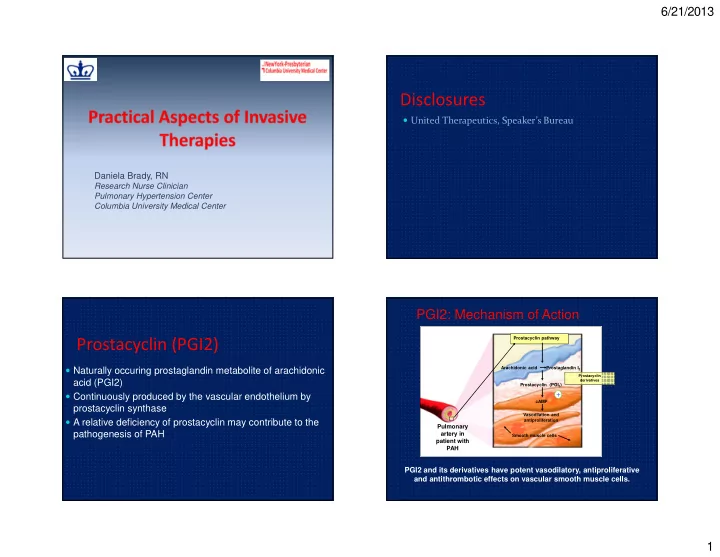
Prostacyclin pathway Arachidonic acid Prostaglandin I2 Prostacyclin (PGI2) cAMP Vasodilation and antiproliferation Smooth muscle cells

Prostacyclin derivatives

+

Pulmonary artery in patient with PAH

PGI2 and its derivatives have potent vasodilatory, antiproliferative and antithrombotic effects on vascular smooth muscle cells.

PGI2: Mechanism of Action

slide-2
SLIDE 2

6/21/2013 2

Main Properties of Prostacyclin

Systemic and pulmonary vasodilation via relaxation of vascular smooth muscle cells Inhibition of platelet aggregation Inhibition of vascular cell migration and proliferation Cytoprotective effect: prevention of ischemic cell injury Improvement in pulmonary clearance of endothelin-1 Possible inotropic effect

Prostanoids

Developed to mimic the favorable characteristics of

prostacyclin (PGI2) but offer alternate modes of delivery

Longer half-life or other features (e.g.

thermostability) to improve risk-benefit ratio and/or quality of life issues associated with epoprostenol delivery

Intravenous Epoprostenol (PGI2)

Rapidly hydrolyzed in circulation (t1/2 = 3 min) Unstable at room temperature – requires ice packs

thermo-stable formulation FDA approved; not tested in children

Many potential side effects Requires continuous IV infusion for sustained effect

PGI2 was first used as an acute vasodilator in 1980 in

a child with IPAH

FDA approved 1995; FC III/IV PAH

Epoprostenol vs. Conventional Therapy Change from Baseline in 6-Minute Walk Test

Epoprostenol (11; 41) Conventional Therapy (14; 40)

  • 60
  • 40
  • 20

20 40 60 80 Meters Week 1 Weeks 8 and 12 (Mean)

Rubin, et al. Ann Intern Med, 1990; Barst, et al. NEJM, 1996

slide-3
SLIDE 3

6/21/2013 3

Barst, RJ. et al. Circulation 1999 K-M survival curves comparing survival of nonresponders (n=24) treated with long-term PGI2 with survival of nonresponders (n=22) for whom PGI2 was indicated but unavailable

Epoprostenol and Survival in Children

Yung, D. et al. Circulation 2004;110:660-665 Kaplan-Meier curves for survival and treatment success in patients in more recent medical era (n=44)

Pediatric PAH Survival and Treatment success in “Epo Era”

Epoprostenol (Flolan) Epoprostenol –thermostable (Veletri)

Epoprostenol delivery system (CADD pump)

IV/SQ Prostanoid Side Effects

Flushing Headache Diarrhea Nausea/emesis Jaw pain Leg pain Hypotension Dizziness Syncope Delivery complications Site pain Site reaction

Vary according to drug and route of delivery

slide-4
SLIDE 4

6/21/2013 4

Epoprostenol Delivery System Complications

Local site infection Catheter related bloodstream infections CADD pump malfunction

bolus effect cessation phenomenon – due to short half life

  • f epoprostenol

Epoprostenol

Prostacyclin is effective in treating group 1 PAH

improve pulmonary hemodynamics prolong survival improve symptoms extend exercise tolerance

Caution

numerous side effects inconvenience and risks with continuous infusion

Pediatric PAH Indications for IV epoprostenol: general guidelines

WHO FC III or IV patient (presence of right heart

failure)

Non-responsive to AVT Very young patients (<7yrs); maximize benefit

during rapid lung development

Syncope (particularly if already on oral tx) Failed oral trial (how long do you wait?) Consider a lower threshold knowing the natural

history in children is worse than adults, untreated

Treprostinil (remodulin)

Longer acting prostacyclin analogue

(t ½= 4 hours)

Stable at room temperature

No ice packs or refrigeration required Mixed cassettes last 48 hours

SQ or IV form

slide-5
SLIDE 5

6/21/2013 5

Treprostinil Delivery Systems

CADD Legacy Chrono 5 Minimed 407 C (IV/SQ)

IV/SC Bioequivalence Study

Laliberte et al. J Cardiovasc Pharmacol. 2004.

Hour

12 24 36 48 60 72 84 96 10-3 10-2 10-1 100

Treprostinil concentration, ng/mL

IV SC

Steady state

  • IV Remodulin

▲SC Remodulin

Treatment considerations: IV vs SQ

Provider/patient preferences Financial considerations PAH center experience Family/care-giver support Body image concerns Low pain threshholds

SQ Treprostinil Site Pain Considerations

slide-6
SLIDE 6

6/21/2013 6

Site Pain Management Approaches: Local/Topical options

First line remedies

Ice Warm bath with Epsom salts Aloe vera gel, arnica oil, capsaicin cream

Anesthetic Agents

Lidocaine 5% patches/lidocaine cream Caladryl lotion

Vasoconstrictive agents

Hemorrhoid ointment

PLO Gel compounds

Pain Management Approaches: Systemic options

Histamine H1 receptor antagonists

Loratadine, fexofenadine HCL, cetirizine HCL

Histamine H2 receptor antagonists

Ranitidine, famotidine

Non-opioid analgesics

Ibuprofen, acetaminophen

GABA analogs

Gabapentin, pregabalin

Opioid analgesics (for severe pain)

Tramadol, fentanyl patch, hydrocodone with acetaminophen

Antidepressants

Amitriptyline

IV Epoprostenol to IV Treprostinil transition

Successful transition of 13 pediatric PAH pts

from IV epo to IV treprostinil

2 deaths, 2 transitions to other therapies Transitioned in hospital over 24 hours (rapid or slow) Patients maintained their exercise capacity Higher dose, fewer side effects Several central line infections however, reported

before current recommendations for treprostinil line care were implemented

Ivy DD, et al. Am J Cardiol, 2007

IV Prostanoids: Minimizing risk for Catheter Related- Blood Stream Infections (CR-BSI)

Single center experience using closed-hub system and waterproofing precautions during showering with IV prostanoids in children to minimize CR-BSI 50 patients receiving prostanoids Closed-hub system and maintenance of dry catheter hub connections significantly reduced the incidence of CR-BSI (particularly infections caused by gram-negative pathogens) in patients receiving intravenous treprostinil.

Ivy DD, et al. Infection Control and Hospital Epidemiology, 2009.
slide-7
SLIDE 7

6/21/2013 7 Rates of CR-BSI pre and post implementation of Closed-Hub system with protected connections

Ivy DD, et al. Infection Control and Hospital Epidemiology, 2009.

SQ Treprostinil for PH associated with CLD of infancy

Case series of 5 infants successfully treated (off-label)

with SQ treprostinil at Columbia University Medical Center

General characteristics

CLD Former premature infants (born at 23-26 weeks) Birth weight range 470-635 grams 4/5 patients were under 1 year of age at the time of

initiation of therapy

SQ Treprostinil for PH associated with CLD of infancy: Results

All patients had improvement in their respiratory and

inotrope support after treprostinil initiation

There were no local reactions at SC infusion site No evidence of pain or tenderness at infusion site 4/5 patients are alive at present (one baby died from

suspected septic shock 2 weeks after initiation of therapy)

Transition of Pediatric PAH Patients from IV Epoprostenol to oral/inhaled agents

Retrospective review of all pediatric IPAH/FPAH

treated at Columbia (1987-2008) who transitioned off IV epo to oral/inhaled drugs

General criteria for transition off included:

FC I/II Age > 6yrs PAPm <35mmHg Normal cardiac index

Hemodynamics and clinical data were assessed on

peak epoprostenol dose vs. off epoprostenol

Melnick L, et al., AJCardiol, 2010

slide-8
SLIDE 8

6/21/2013 8

Transition of Pediatric PAH Patients from IV Epoprostenol to oral/inhaled agents: Results

14/104 pediatric patients who met general criteria were transitioned off IV epoprostenol (over several months to years; 4/03-7/08) 13/14 remained off IV epo on oral/inhaled medications Hemodynamics, exercise capacity (if able) and WHO functional class remained stable off epo compared to peak epoprostenol dose. (f/u 7+6 mos); Further improvement in WHO FC was seen post epoprostenol (p<0.005) All 13 patients are alive at present; (77% ERA, 69% PDE-5 inhibitor, 38% CCB, 8% iloprost)

Melnick L, et al., AJCardiol, 2010

Summary: Prostanoids in Pediatric PAH

IV epoprostenol still remains the “gold standard” for the treatment of advanced pediatric PAH Newer agents have enabled initiation or transition to other prostanoids and even to oral/inhaled agents in carefully selected patients Close monitoring of side effects and diligent management are important for patient compliance and treatment success Caution should be applied to delay in the institution of prostanoid therapy when using novel oral agents As novel agents are developed so are new challenges in decision making