Disclosures University of Utah and Primary Childrens Hospital I - - PowerPoint PPT Presentation

disclosures
SMART_READER_LITE
LIVE PREVIEW

Disclosures University of Utah and Primary Childrens Hospital I - - PowerPoint PPT Presentation

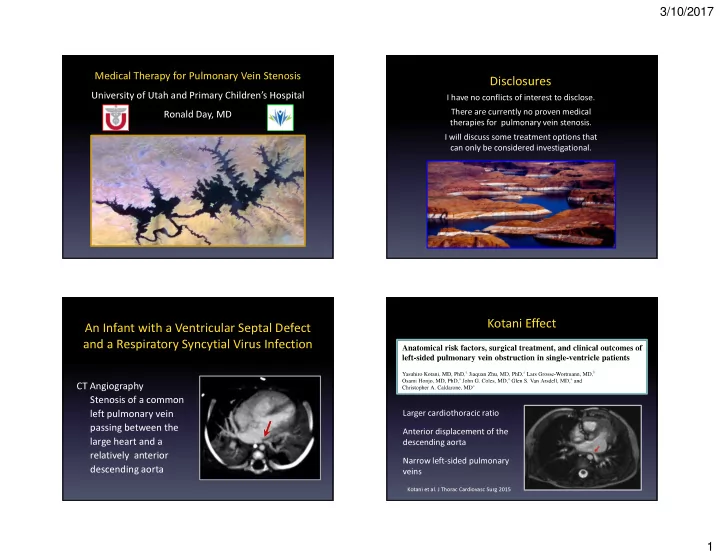
3/10/2017 Medical Therapy for Pulmonary Vein Stenosis Disclosures University of Utah and Primary Childrens Hospital I have no conflicts of interest to disclose. There are currently no proven medical Ronald Day, MD therapies for pulmonary


slide-1
SLIDE 1

3/10/2017 1

Medical Therapy for Pulmonary Vein Stenosis

University of Utah and Primary Children’s Hospital Ronald Day, MD

Disclosures

I have no conflicts of interest to disclose. There are currently no proven medical therapies for pulmonary vein stenosis. I will discuss some treatment options that can only be considered investigational.

An Infant with a Ventricular Septal Defect and a Respiratory Syncytial Virus Infection

CT Angiography Stenosis of a common left pulmonary vein passing between the large heart and a relatively anterior descending aorta

Kotani Effect

Larger cardiothoracic ratio Anterior displacement of the descending aorta Narrow left-sided pulmonary veins

Kotani et al. J Thorac Cardiovasc Surg 2015

slide-2
SLIDE 2

3/10/2017 2

Pathogenesis of Pulmonary Vein Stenosis

So could heart size be a potential factor Stenosis is more common in the left pulmonary veins Conditions associated with cardiomegaly Prematurity (patent ductus arteriosus) Congenital heart defects Heart transplantation Additional factors that stimulate intraluminal changes at the left atrial connection and in the upstream vessels Necrotizing enterocolitis (Heching HJ et al) Inflammation Respiratory infections Genetic tendancy for microvascular disease (MTHFR) Mechanical injury: interventions with good intentions

Prevention of Pulmonary Vein Stenosis Observation and Challenge Pathogenesis of Pulmonary Vein Stenosis

Increased muscular thickness of pulmonary veins Extensive growth of cells in the intima with features consistent with myofibroblasts

Pogoriler et al. Pediatr Dev Pathol 2016

Treatment of Pulmonary Vein Stenosis

Vinblastine and Methotrexate

Rationale: Chemotherapy to suppress proliferation March 2000 to October 2006 29 patients were offered therapy 15 patients were treated without withdrawal 6 patients survived more than one year Vinblastine and Methotrexate could potentially alter the progression of pulmonary vein stenosis in some

  • patients. However, there was enough toxicity that

treatment was often interrupted or delayed.

Rehman et al. Congenit Heart Dis 2011

slide-3
SLIDE 3

3/10/2017 3

Pathogenesis of Pulmonary Vein Stenosis

Pulmonary Vein Banding

Similar cellular changes in the wall of upstream vessels as veins in human pulmonary vein stenosis Endothelial to Mesenchymal Cell Transformation: Myofibroblasts

Sham Banded CD31 α-SMA Merged Kato et al. J Thorac Cardiovasc Surg 2014

Pathogenesis of Pulmonary Vein Stenosis

Pulmonary Vein Banding

Banded pulmonary veins demonstrated an increase in the expression of TGF-β1

Sham Banded TGFβ1 TGFβ1/GAPDH

Kato et al. J Thorac Cardiovasc Surg 2014

Potential Therapy for Pulmonary Vein Stenosis

Evaluated the effects of Losartan in neonatal pigs who underwent banding of their pulmonary veins Losartan decreased intimal hyperplasia in the upstream vessels, at least short-term

Banded Losartan Unbanded Sham

Zhu et al. J Thorac Cardiovasc Surg 2014

Pathogenesis of Pulmonary Vein Stenosis

Histology of Seven Patients

Bilateral disease involving 2 vessels Immunoreactivity for several tyrosine kinase receptors Intensity of staining: Grades (0 negative to 4 marked) Previous Treatment Angioplasty (5), surgery (4), chemotherapy (1), brachytherapy (1) Cells in the lesions of pulmonary vein stenosis stained mildly to markedly with tyrosine kinase receptors Platelet-derived growth factor receptors (PDGFR), α and β Vascular endothelial growth factor receptor (VEGFR), 2

Reidlinger et al. Cardiovasc Pathol 2006

slide-4
SLIDE 4

3/10/2017 4

Treatment of Pulmonary Vein Stenosis

Imatinib (Gleevec) and Bevacizumab (Avastin)

Single arm, prospective, open-label trial FDA approved Industry sponsored Aims Describe the feasibility of administering Gleevec, with or without Avastin, to mitigate the progression of multi- vessel disease for intraluminal pulmonary vein stenosis Safety: incidence of serious adverse events Efficacy: disease status and survival

Callahan et al. AAP Abstract 2016

Treatment of Pulmonary Vein Stenosis

Imatinib (Gleevec) and Bevacizumab (Avastin)

Callahan et al. AAP Abstract 2016 0 weeks Patient Enrollment 24 weeks 48 weeks Primary Endpoint 72 weeks Final Endpoint Best Anatomic Palliation Assess Disease Status Assess Disease Status Assess Disease Status

Interventional Catheterization, Surgery, Lung Transplant Drug Therapy

Treatment of Pulmonary Vein Stenosis

Imatinib (Gleevec) and Bevacizumab (Avastin)

Callahan et al. AAP Abstract 2016

Patient Population n = 48 Premature birth n = 18 (38%) Genetic syndrome n = 13 (27%) Congenital heart disease n = 38 (79%) Anomalous pulmonary venous connections n = 17 (35%) Single ventricle physiology n = 6 (13%) Bilateral PVS n = 39 (81%) Median vessels involved 4 (range 2- 5) Mean gradient ≥4 mmHg Relatively high risk patients

Treatment of Pulmonary Vein Stenosis

Imatinib (Gleevec) and Bevacizumab (Avastin)

Callahan et al. AAP Abstract 2016

Interventions before drug therapy Catheter-mediated n = 48 (100%) median 2 (1 - 6)/patient Surgical n = 47 (98%) median 1 (1 - 3)/patient “sutureless” repair n = 40 (85%) Interventions during or after drug therapy Catheter-mediated n = 42 (88%) median 3 (1 - 12)/patient Surgical n = 2 (4%)

slide-5
SLIDE 5

3/10/2017 5

Treatment of Pulmonary Vein Stenosis

Imatinib (Gleevec) and Bevacizumab (Avastin)

Callahan et al. AAP Abstract 2016

Local recurrence with or without stabilization Re-stenosis in previously affected veins Progression with or without stabilization New or worsening disease in ≥ 2 veins New obstruction in previously unaffected vein Proximal disease extending distally (upstream) New vein atresia Stabilization ≥ 6 months without recurrence or progression

Treatment of Pulmonary Vein Stenosis

Imatinib (Gleevec) and Bevacizumab (Avastin)

Callahan et al. AAP Abstract 2016

Stabilization was associated with Absence of lung disease (p = 0.03) Higher percentage of eligible drug doses received (90% vs. 83%; p = 0.03) All Patients N = 48 Alive 37 (77%) Recurred 36 (75%) Progressed 6 (13%) Stabilized 16 (33%)

Therapy for Pulmonary Vein Stenosis Observation and Challenge Therapy for Pulmonary Vein Stenosis Observation and Challenge

slide-6
SLIDE 6

3/10/2017 6

Therapy for Pulmonary Vein Stenosis Observation and Challenge

Treatment of Pulmonary Hypertension Associated with Pulmonary Vein Stenosis

What is an acceptable pulmonary arterial pressure? Parallel Circulation

1/Rp (Total) = 1/Rp (R) + 1/Rp (L) 1/3 = 1/6 + 1/6 Single Lung (2 vessel disease) Rp = 6 units-m2 CI = 3 L/min-m2 Mean PAP = 25 mmHg RPAWP = 7 mmHg LPAWP = 23 mmHg

Domingo et al. (preparing for submission)

Treatment of Pulmonary Hypertension Associated with Pulmonary Vein Stenosis

Number of Patients, 13 Mean Duration (years) Nighttime Oxygen

11 9.7 (1.3-17.6)

Calcium Channel Blocker

7 8.5 (2.2-12.3)

Phosphodiesterase V Inhibitor

9 5.6 (1.1-10.9)

Endothelin Receptor Antagonist

4 5.1 (0.3-14.1)

Prostacyclin Analog

2 0.8 (0.6-1.0)

Domingo et al. (preparing for submission)

slide-7
SLIDE 7

3/10/2017 7

Treatment of Pulmonary Hypertension Associated with Pulmonary Vein Stenosis

Pulmonary Vein Stenosis Challenges

Limited understanding Factors that cause stenosis Factors that result in the progression of disease Failure to collaborate and improve the quality of care Diversity in care Strategies to screen for and monitor stenosis No proven methods to treat inoperable stenoses Optimal timing of treatment is unknown

Pulmonary Vein Stenosis Hope

Opportunity to improve collaboration A network of individuals who care

  • Congenital heart surgeons
  • Interventional cardiologists
  • Providers committed to research and basic care

Multiple disciplines

  • Scientists with expertise in vascular biology
  • Families

Thank You!

University of Utah and Primary Children’s Hospital

Final Disclosure Ronald Day has no compelling desire to harm beavers.