Disclosures Tumor Budding in I have nothing to disclose Colorectal - - PowerPoint PPT Presentation

disclosures
SMART_READER_LITE
LIVE PREVIEW

Disclosures Tumor Budding in I have nothing to disclose Colorectal - - PowerPoint PPT Presentation

5/26/2017 Disclosures Tumor Budding in I have nothing to disclose Colorectal Carcinoma: What, Why, and How Soo-Jin Cho, MD, PhD Assistant Professor UCSF Dept of Pathology Current Issues in Anatomic Pathology 2017 Outline Background


slide-1
SLIDE 1

5/26/2017 1

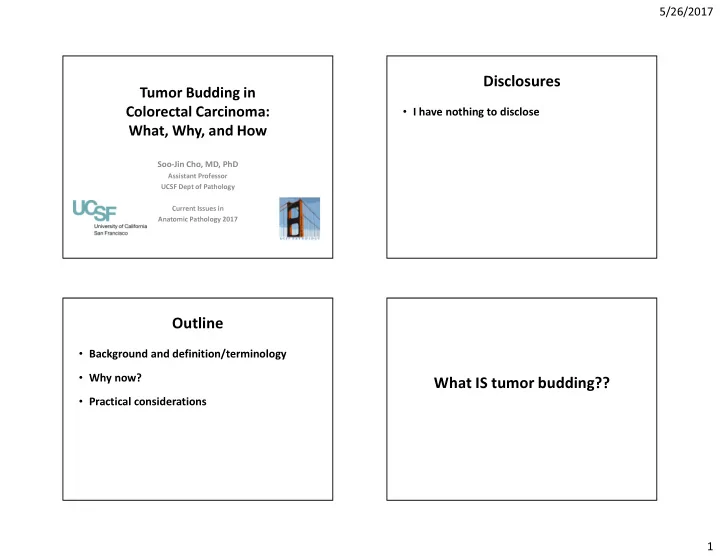
Tumor Budding in Colorectal Carcinoma: What, Why, and How

Soo-Jin Cho, MD, PhD

Assistant Professor UCSF Dept of Pathology Current Issues in Anatomic Pathology 2017

Disclosures

  • I have nothing to disclose

Outline

  • Background and definition/terminology
  • Why now?
  • Practical considerations

What IS tumor budding??

slide-2
SLIDE 2

5/26/2017 2

What is tumor budding?

Definitions

  • Tumor bud

– Most studies define as single tumor cells and and tumor cell clusters composed of ≤4 cells – Peritumoral vs. Intratumoral

vs.

  • Poorly differentiated clusters (PDC)

– Tumor clusters (composed of ≥5 cells) and lacking glandular lumens – vs. Poorly differentiated carcinoma

  • Tumor grade ≠ Tumor budding

Peritumoral vs. Intratumoral budding

PTB ITB

Why is this a hot topic NOW??

slide-3
SLIDE 3

5/26/2017 3

Why is this a hot topic now?

AJCC Cancer Staging Manual, 7th ed.

FIGURE 14.4. Observed survival rates for 28,491 cases with adenocarcinoma of the

  • colon. Data from the SEER

1973–2005 Public Use File diagnosed in years 1998–2000.

IIIA IIA IIB IIC

Why is this a hot topic now?

  • “Factors important to consider in making

decisions about treatment” per AJCC guidelines (8th ed.)

– Serum CEA levels – Tumor regression score in rectal carcinoma – Circumferential resection margin – Lymphovascular invasion (LVI) – small vessel versus venous – Perineural invasion – Microsatellite instability (MSI) – KRAS and NRAS mutation status – BRAF mutation

No tumor budding… YET

Why is this a hot topic now?

  • In the U.S., tumor budding is currently not a required element in the CAP

cancer protocol for CRC (current as of January 2016)

  • Other organs where tumor budding is showing prognostic impact:

– Esophagus – Breast – Pancreas – Lung

  • Importance recognized by:

– Union for International Cancer Control (UICC) – Association of Directors of Anatomic and Surgical Pathology – Included in guidelines for CRC screening, diagnosis, and treatment in Europe and Japan

Coming soon to a synoptic near you!

Tumor budding in colorectal carcinoma

  • Early reports:

– Imai, 1954: Postulated “sprouting” at invasive edge of carcinomas reflect a more rapid tumor growth rate – Hase et al., 1993: Prognostic value of tumor budding in colorectal cancer – “More severe budding was associated with worse outcome” (5-year and 10-year survival rates) – Ueno et al., 2002: “Because of its value as a prognostic indicator and its reproducibility, tumour ‘budding’ would be a good index to estimate the aggressiveness of rectal cancer.”

slide-4
SLIDE 4

5/26/2017 4

Tumor budding in biopsies

  • Associated with:

– Nodal and distant metastasis at time of resection – Non-response to neoadjuvant chemoradiotherapy – Poor survival outcome in rectal cancer patients

  • INTRATUMORAL budding

– Proposed cutoff of 6 tumor buds/HPF (400x)…

Reviewed in Koelzer VH, et al. Hum Pathol. 2016;47:4-19.

Tumor budding as a prognostic factor in resection specimens

  • Stage I CRC (pT1/2 pN0 M0)

– High-grade tumor budding is significantly associated with nodal metastasis

  • Stage II CRC (pT3/4 pN0 M0)

– Heterogeneous group; risk stratification needed high-grade tumor budding as a “high risk feature”

  • High-grade tumor budding associated with poor overall and

disease-free survival in resected patients with stage II disease

  • Tumor budding associated with other aggressive

clinicopathologic features (i.e., LVI, higher tumor grade, infiltrative tumor margin)

Reviewed in Koelzer VH, et al. Hum Pathol. 2016;47:4-19.

Tumor budding: What to do with the information??

  • Malignant polyps

– Tumor budding as a predictor of lymph node metastasis – Tx/management: Surgical resection

  • Stage II CRC

– Tumor budding as an adverse prognostic factor – Tx/management: Risk-adapted follow-up and adjuvant therapy

  • Pre-operative biopsies of CRC

– Tumor budding as an adverse prognostic factor and predictor of lymph node and distant metastasis – Tx/management: Neo-adjuvant therapy and risk-adapted surgery

Reviewed in Koelzer VH, et al. Hum Pathol. 2016;47:4-19.

So HOW do you count tumor buds??

Multitude of methods…

slide-5
SLIDE 5

5/26/2017 5

Just a few published methods…

Lugli A, et al. Br J Cancer. 2012;106:1713-1717.

Meta analyses

  • Despite multitude of methods, tumor

budding in CRC is strongly predictive of:

– Lymph node metastases – Recurrence – Cancer-related death at 5 years

Rogers AC, et al. Br J Cancer. 2016;115:831-40.

2016 Consensus Statements

  • DEFINITION of Tumor Budding:

– Single tumor cells or clusters of up to 4 tumor cells at the invasive margin

  • Tumor Budding ≠ Tumor Grade
  • Tumor Budding should be counted on H&E (not

cytokeratin), using hotspot method

– Scan the entire invasive front in all tumor sections and choose a “hotspot” – Count # tumor buds in a 20x field – Apply appropriate correction factor for your microscope to get count in 0.785 mm2 (Ueno method) – Provide tumor budding score (low/intermediate/high)

slide-6
SLIDE 6

5/26/2017 6

Method: Ueno et al.

  • Tumor bud definition: <5 cancer cells, observed in the invasive frontal

region

  • Method: Clusters were counted under the 20x objective lens in a field

where budding was observed most intensively.

  • Grading tumor budding:
  • G1: <5
  • G2: 5 to 9
  • G3: ≥10

Ueno H, et al. Histopathology. 2002;40:127-32.

Why use the Ueno method?

Ueno H, et al. Histopathology. 2002;40:127-32.

G1 G2 G3

Method: Consensus 2016

slide-7
SLIDE 7

5/26/2017 7

Tumor budding score

BX40/50 (20x) 0.785 mm2 0-3 0-3 4 3 5 4 6 5 7 6 8 7 9 7 10 8 11 9 12 10 For UCSF Microscopes (BX40/50): Low: 5 and below Intermed: 6-11 High: 12 and higher For tumor budding scores >12, multiply by 0.8

So we actually tried it… The UCSF Experiment (Round 1)

  • 10 total faculty who sign out GI cases (primary
  • r secondary area)
  • Tumor budding previously discussed at

departmental subspecialty meetings

  • Brief Powerpoint with background and recent

consensus methodology

  • Whole slide image scanning (Aperio) utilized

– 10 cases of colorectal carcinoma selected (random) – Two circled areas corresponding to 20x field diameter

  • n UCSF microscopes

Representative case

slide-8
SLIDE 8

5/26/2017 8

1-1 1-2 2-1 2-2 3-1 3-2 4-1 4-2 5-1 5-2 6-1 6-2 7-1 7-2 8-1 8-2 9-1 9-2 10-1 10-2 1 4 4 0-3 0-3 0-3 0-3 0-3 4 0-3 7 0-3 0-3 5 0-3 4 0-3 0-3 0-3 0-3 6 2 7 6 8 12 3 2 5 5 1 4 4 4 2 9 13 15 7 6 4 4 3 13 13 12 12 7 10 6 10 5 8 5 4 2 8 13 13 8 4 4 9 4 12 10 15 10 12 11 10 13 3 10 6 5 4 10 17 20 8 3 3 4 5 14 16 14 12 12 8 14 16 3 15 3 4 3 11 17 17 8 5 5 7 6 14 14 16 13 9 6 13 20 7 10 4 4 4 13 28 26 2 1 5 5 7 15 15 18 17 8 7 15 28 4 11 5 6 17 14 33 47 8 7 9 16 8 11 33 13 15 9 10 18 30 10 18 9 10 11 17 50 45 15 11 12 16 10 12 12 9 7 4 7 3 13 3 5 4 5 1 13 12 12 2 8 8 Cons High (8/10) High (7/10) Int (5/10) High (7/10) Int (5/10) Low (7/10) NONE High (9/10) Int (6/10) NONE

The UCSF Experiment (Round 1)

Comments and Points for Discussion

  • “How close…??” – distance between clusters, distance of cluster to

larger gland

  • “Where to count?? Does it have to exactly be at the "leading edge"
  • nly or can it be a little more superficial??” – peritumoral versus

intratumoral budding

  • “What to do with very poorly differentiated tumors??”
  • “Glandular fragmentation vs. true budding”
  • “Retraction may make some clusters appear like separate clusters?

Crushed cells? Degenerating cells?”

  • “I probably undercounted as I tried to ignore fibroblasts but some of

them may have been tumor cells.”

Challenges

  • Technical

– H&E versus Cytokeratin Cytokeratin staining results in tumor bud counts that are 3-4x counts obtained on H&E

  • Interpretive

– Gland fragmentation – Inflammation obscuring tumor buds – Tumor bud versus stromal cells

Mitrovic B, et al. Mod Pathol. 2012;25:1315-25.

Infiltrative border but no tumor budding

slide-9
SLIDE 9

5/26/2017 9

Mitrovic B, et al. Mod Pathol. 2012;25:1315-25.

Tumor budding in a malignant polyp (arrows)

Mitrovic B, et al. Mod Pathol. 2012;25:1315-25.

Blurring of tumor-stroma interface

Mitrovic B, et al. Mod Pathol. 2012;25:1315-25.

Blurring of tumor-stroma interface Higher magnification reveals tumor budding

Peritumoral inflammatory infiltrate Tumor vs. stromal cells

Mitrovic B, et al. Mod Pathol. 2012;25:1315-25.

Challenging scenarios

H&E Keratin

slide-10
SLIDE 10

5/26/2017 10

Keratin Neoplastic glandular fragmentation (arrow, not tumor bud)

Mitrovic B, et al. Mod Pathol. 2012;25:1315-25.

Challenging scenarios

H&E

Recommendations by Mitrovic et al.

  • Report tumor budding in all malignant polyps and CRC resection

specimens

  • Ueno methodology

– “We report tumor budding as present if ≥10 groups of <5 cells are counted in a 20x objective field (ie, Ueno’s so-called ‘high-grade budding’).”

  • In “borderline” cases Cytokeratin

– “If this confirm the impression of additional tumor cells, bringing the count to ≥10 buds, we report as positive for tumor budding.” – “However, we caution against the routine use of cytokeratin stains in cases where bud counts on H&E do not approach 10/20x objective. In

  • ur experience, counts by cytokeratin immunohistochemistry are

substantially higher than those on H&E and the limited data suggest that much higher cutoffs are needed to reach prognostic significance.”

Lessons Learned / Future Directions

  • Easy concept, difficult to put into everyday

practice

– “Tutorial” may be helpful

  • What to do what when you really can’t

count??

– Cytokeratin Go back to H&E and count… (UCSF Round 2?)

  • Consensus = “Correct” method??

– Additional studies necessary…

Rieger G, et al. Histopathology. 2017. DOI: 10.1111/his.131

Method: Rieger et al. (2017)
slide-11
SLIDE 11

5/26/2017 11

“Special variants” NOT tumor buds

  • Micropapillary

– Per WHO 2010, “small clusters of tumor cells within stromal spaces mimicking vascular channels” – Same as poorly differentiated cell clusters (PDCs)??

  • Mucinous

– Cell clusters lie in mucin pools and are not surrounded by tumor stroma Do NOT qualify as bona fide tumor buds – Excluded from assessment of tumor budding

  • MSI-H

– Tumor budding virtually absent

Micropapillary variant

Kim M-J, et al. Hum Pathol. 2006;37:809-15.

Mucinous variant

“Special variants” High grade buds

  • Signet ring cell

– Suggested to classify as high-grade tumor budding by definition (Prall F. Histopathology. 2007;50:151-62.)

slide-12
SLIDE 12

5/26/2017 12

Take-home messages

  • Tumor budding is an emerging important

independent prognostic factor in colorectal carcinoma

  • Methodology is undergoing refinement

– H&E vs. Cytokeratin – What to report

  • Watch for future updates in reporting

Case 1 Case 2 Case 3 Case 4 Case 5 Case 6 Case 7 Case 8 Case 9 Case 10 1 Low Low Low Low Int Low Low Low Low Int 2 Int High Low Low Low Low Int High Int Low 3 High High Int Int Int Low Int High Int Int 4 High High High High Int Int Int High Int Low 5 High High High High High Low Int High Int Int 6 High High Int High Int Low High High Low Low 7 High High Int High Int Int High High Int High 8 High High Int High High Int High High High High 9 High Low High High Low Low Low High Low Low 10 High Int Int High Low Low High High Int Int Cons High (8/10) High (7/10) Int (5/10) High (7/10) Int (5/10) Low (7/10) NONE High (9/10) Int (6/10) NONE

The UCSF Experiment (Round 1)

Infiltrative border but no budding Tumor budding in a malignant polyp (arrows) Resection specimen – blurring of tumor-stroma interface Higher mag of (c) – tumor budding seen

Mitrovic B, et al. Mod Pathol. 2012;25:1315-25.