Disclosures Diabetes in Pregnancy I have nothing to disclose - - PowerPoint PPT Presentation

disclosures
SMART_READER_LITE
LIVE PREVIEW

Disclosures Diabetes in Pregnancy I have nothing to disclose - - PowerPoint PPT Presentation

10/23/2014 Diagnosis and Management of Disclosures Diabetes in Pregnancy I have nothing to disclose Kirsten Salmeen, MD Assistant Professor Department of Obstetrics, Gynecology & Reproductive Sciences Maternal-Fetal Medicine Overview


slide-1
SLIDE 1

10/23/2014 1

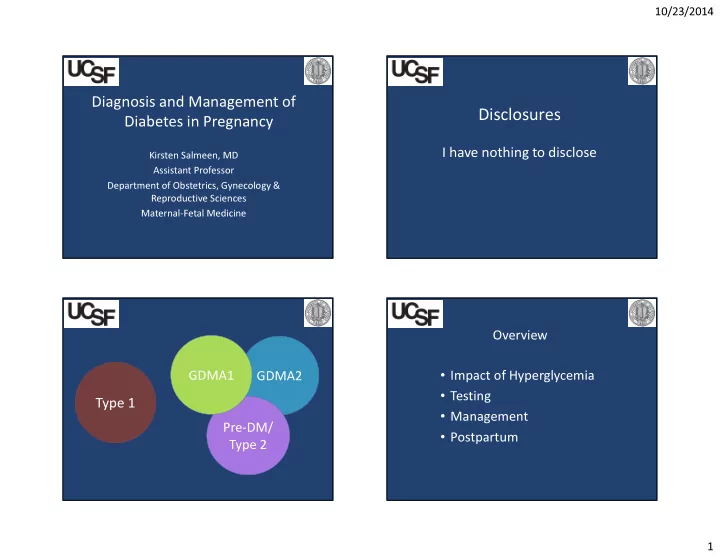
Diagnosis and Management of Diabetes in Pregnancy

Kirsten Salmeen, MD Assistant Professor Department of Obstetrics, Gynecology & Reproductive Sciences Maternal-Fetal Medicine

Disclosures

I have nothing to disclose Type 1

GDMA2 Pre-DM/ Type 2 GDMA1 Overview

  • Impact of Hyperglycemia
  • Testing
  • Management
  • Postpartum
slide-2
SLIDE 2

10/23/2014 2

Glucose & Insulin

Cunningham et al. Williams Obstetrics, 23rd Edition

GLUCOSE INSULIN

PREGNANT NON-PREGNANT PREGNANT NON-PREGNANT

Normal Pregnancy:

  • Fasting HYPO glycemia
  • Postprandial HYPER glycemia
  • HYPER insulinemia

Normal Glucose In Pregnancy: Non Diabetics

Hernandez Diabetes Care 2011

Glucose & Insulin – Pregnancy

  • Pregnancy = “Pancreatic Stress Test”
  • Human placental lactogen blocks peripheral

uptake and use of glucose in the mother

  • Insulin sensitivity is > 50% lower

Glucose & Insulin – The Fetus

  • Transfer of glucose across placenta is by

facilitated diffusion via glucose transport proteins

  • Glucose is the primary substrate for fetal growth
  • The fetus makes its own insulin
  • Hyperinsulinemia likely drives excess fetal growth
slide-3
SLIDE 3

10/23/2014 3

Overview

  • Impact of Hyperglycemia
  • Testing
  • Management
  • Postpartum

Pregnancy Outcomes in GDM

Approximate Overall % Relative Risk/Odds Ratio Macrosomia 20 RR ~1.4 Pre-Eclampsia 15 RR ~1.7 Cesarean Section Varies RR ~ 1.2 Shoulder Dystocia 3-5 OR ~ 1.2 IUFD ~ 0.05 RR ~ 2

HAPO Study Cooperative Research Group N Engl J Med 2008 Schmidt M Diabetes Care 2001 Wendland E BMC Pregnancy Childbirth 2012

Hyperglycemia & Pregnancy Outcomes

Preeclampsia (%) Macrosomia (%) Cesarean Section (%) 50 gram, 1-hour < 100 mg/dL 3.0 12.2 17.5 100 – 114 mg/dL 6.3 12.5 20.8 116 – 134 mg/dL 5.6 15.4 23.0 > 134 mg/dL 5.9 17.2 23.4 P-value for trend 0.01 0.001 0.001

Sermer et al AJOG 1995

Fasting Glucose Macrosomia (%) < 72 mg/dL 9.7 74-76 mg/dL 14.4 78-82 mg/dL 14.1 > 82 mg/dL 20.5

Hyperglycemia & Pregnancy Outcomes

Sermer et al AJOG 1995

slide-4
SLIDE 4

10/23/2014 4

Outcome (%) Fasting < 74 Fasting 74-77 Fasting 79-81 Fasting ≥ 83 Odds Ratio 95% CI Birth weight ≥ 4000 g 23.4 27.9 28.5 31.7 1.14 1.06-1.22 Birth weight ≥ 4500 g 4.3 6.3 6.8 8.1 1.23 1.08-1.40 LGA 17.2 18.9 22.7 25.6 1.19 1.10-1.29 PIH/PreE 5.8 6.6 7.1 7.9 1.12 0.99-1.26 Shoulder Dystocia 1.4 0.8 1.7 2.2 1.21 0.92-1.62

Hyperglycemia & Pregnancy Outcomes

Jensen AJOG 2001 Jensen AJOG 2001

Outcome (%) 2 hour < 102 2 hour 102-114 2 hour 115-128 2 hour ≥ 130 Odds Ratio 95% CI Birthweight ≥ 4000 g 22.9 27.4 28.8 32.3 1.16 1.01-1.34 Birthweight > 4500 g 5.2 5.3 5.6 8.6 1.16 1.01-1.34 LGA 16.0 20.7 21.1 27.2 1.23 1.13-1.33 PIH/PreE 4.8 6.9 8.4 7.2 1.16 1.02-1.31 Shoulder Dystocia 0.4 1.2 1.8 2.9 1.78 1.32-2.40

Hyperglycemia & Pregnancy Outcomes

  • Does hyperglycemia without overt diabetes during pregnancy

increase risk of adverse pregnancy outcomes?

  • Blinded study of ~25,000 women at 15 centers in 9 countries
  • Primary outcomes: birthweight > 90%ile for GA, primary CD,

neonatal hypoglycemia, cord-blood C-peptide level > 90%ile

  • Primary predictor: Levels of hyperglycemia

HAPO Study Cooperative Research Group N Engl J Med 2008

HAPO Glucose Levels

Level Fast (mg/dL) 1 hr (mg/dL) 2 hr (mg/dL) 1 < 75 ≤ 100 ≤ 90 2 75-79 106-132 91-108 3 80-84 133-155 109-125 4 85-89 156-171 126-139 5 90-94 172-193 140-157 6 95-99 194-211 158-177 7 ≥ 100 ≥ 212 ≥ 178

HAPO Study Cooperative Research Group N Engl J Med 2008

slide-5
SLIDE 5

10/23/2014 5

HAPO Results

HAPO Study Cooperative Research Group N Engl J Med 2008

Weight Prolonged Labor (%) Excess Bleeding (%) CD (%) 3000 – 3999 g 0.9% 0.5 18 4000 – 4499 g 1.2 0.7 25.5 4500 – 4999 g 1.3 0.9 35.6 > 5000 g 1.5 1.1 50.6

Boulet SL et al. Am J Obstet Gynecol. 2003;188(5):1372-8; Acker et al. Obstet Gynecol. 1985;66:762; Nesbitt et al. Am J Obstet Gynecol. 1998;179:476; Sandmire et al. Int J Gynaecol Obstet. 1988;26:65; Overland E et al. Am J Obstet Gynecol. 2009;200(5):506

Impacts of Macrosomia – Maternal

Boulet AJOG 2003

Impacts of Macrosomia – Fetal

3000 – 3999 g 4,000 – 4,499 g 4,500 – 4,999 g ≥ 5,000 g Outcome % % OR CI % OR CI % OR CI 5 min Apgar ≤ 3 0.1 0.1 1.3 1.2-1.4 0.2 2.0 1.8-2.3 0.5 5.2 4.1-6.6 Assisted ventilation ≥ 30 min 0.3 0.3 1.2 1.1-1.2 0.5 1.9 1.7-2.0 1.3 4.0 3.5-4.6 Birth injury 0.3 0.5 2 1.9-2.1 0.8 3.1 3.0-3.3 1.3 4.5 4.0-5.2 Neonatal Mortality Rate* 0.7 0.6 0.87 0.8-1 0.7 1.0 0.8-1.2 1.9 2.7 1.9-3.8

* Per 1,000, < 28 days

Gillman Pediatrics 2003

Cumulative hazard (risk) function for development of metabolic syndrome according to birth weight.

P = 0.56 P = 0.004 LGA LGA AGA AGA

Impacts of Macrosomia - Childhood

slide-6
SLIDE 6

10/23/2014 6

  • Increasing blood glucose (even without overt

diabetes) is associated with worsening pregnancy outcomes including macrosomia, pre-eclampsia and cesarean section in an approximately linear fashion.

Overview

  • Impact of Hyperglycemia
  • Testing
  • Treatment
  • Postpartum

When to test?

Initial Visit:

  • Overweight/obese
  • History of gestational diabetes or glucose intolerance
  • Prior LGA infant
  • Family history of type 2 DM
  • Maternal age > 35
  • High-risk ethnic groups (non-Caucasian)
  • PCOS

24 – 28 Weeks:

  • Everyone else
  • High-risk patients who screened negative earlier

How are average-risk patients screened for GDM in your practice?

T w

  • s

t e p t e s t . . . O n e s t e p t e s t . . . F a s t i n g b l

  • d

. . . A a n d C B a n d C

57% 13% 7% 21% 2%

  • A. Two step testing (1-hour, 50 gram glucose

loading test followed by fasting 3-hour, 100 gram loading test if needed) at 24-28 weeks

  • B. One step testing (fasting 2-hour, 75 gram loading

test at 24-28 weeks

  • C. Fasting blood sugar and/or hemoglobin A1c in

the first trimester

  • D. A and C
  • E. B and C
slide-7
SLIDE 7

10/23/2014 7

GDM Testing Controversy

What defines disease?

HAPO Study Cooperative Research Group. N Engl J Med. 2008.

F 75-79 1 hr 106-132 2 hr 91-108 F 90-94 1 hr 172-193 2 hr 140-157

In your opinion, what primary cesarean section rate defines disease?

> 1 5 % > 2 % > 2 5 % > 3 %

12% 24% 35% 30%

  • A. > 15%
  • B. > 20%
  • C. > 25%
  • D. > 30%

More Sensitive, Less Specific LESS women WITHOUT disease test positive MORE women WITHOUT disease test positive

Sensitivity v Specificity

Less Sensitive, More Specific One-Step Two-Step Carpenter Coustan National Diabetes Data Group Universal Screening Risk-Based Screening Early Screening 24-28 Week Screening Hemoglobin A1c No Hemoglobin A1c Testing for 1 abnormal value No f/u for 1 abnormal value

slide-8
SLIDE 8

10/23/2014 8 One-Step vs. Two-Step Testing Two-Step

Step 1: Non-Fasting, 50 g, 1 hr serum glucose measurement ≥ 130/140 mg/dL Step 2 Step 2: Fasting, 100 g, 3 hr glucose test 2+ abnormal values GDM GDM prevalence ~ 5-10%

One-Step

Fasting, 75 g, 1 & 2 hr serum glucose measurement 1+ abnormal value GDM GDM prevalence ~ 20%

Control CC

IAD- PSG

GDM by CC (%) GDM by IADPSG (%) Normal Glucose Tolerance (%) *Primary Cesarean 19.5 17.8 14.8 *Shoulder Dystocia 1.2 0.71 0.91 *PPH 1.5 1.4 1.3

Ethridge Obstet Gynecol 2014

Prenatal Outcomes and Screening Strategies

* Not statistically significant

Prenatal Outcomes and Screening Strategies

Pregnancy outcomes among 1,750 women diagnosed with GDM by Carpenter- Coustan criteria and 1,526 women diagnosed by IADPSG criteria. GDM Rate by CC = 10.6% GDM rate by IADPSG = 35.5% 2-Step CC Criteria IADPSG Criteria GDM % NGT % P: GDM vs NGT GDM % NGT % P: GDM vs NGT Gest HTN 4.9 4.0 0.047 5.7 2.2 0.009 Delivery 0.049 0.026 Vaginal 57.9 58.4 69.7 73.2 CD 27.6 25.7 22.1 18.5 Forceps 14.5 15.9 8.2 8.3 LGA 4.9 4.6 0.9 4.8 3.2 0.04

Duran Diabetes Care 2014 Mayo AJOG 2014

Prenatal Outcomes and Screening Strategies

Outcome OGTT Negative (N=526) IADPSG (N=155) CDA (N=358) * Composite 0.9 (0.8-1.2) 1.4 (1.1 – 1.9) 1.4 (1.1-1.8) PIH/Pre-E 0.9 (0.6-1.7) 3.0 (1.7-5.6) 1.2 (0.7-2.1) CD 1.1 (0.9-1.4) 1.4 (1.01-1.2) 1.3 (1.05-1.7) LGA (> 90%ile) 1.2 (0.9-1.6) 1.8 (1.1-2.9) 1.5 (1.1-2.2)

* Composite of: hypertensive disorders, shoulder dystocia, 3rd or 4th degree laceration, LGA, NICU admission, neonatal: respiratory complication, hypoglycemia, jaundice CDA Guidelines: 1 hr, 50 g > 140 2 hr, 75 g < 95/191/160

Odds of Outcome compared to 1 hr, 50 g < 140 mg/dL
slide-9
SLIDE 9

10/23/2014 9

One-Step vs. Two-Step

  • IADPSG criteria increases rates of GDM
  • IADPSG GDM is associated with pregnancy
  • utcomes similar to CC GDM
  • If treating CC GDM improves outcomes (it

does), diagnosing and treating IADPSG- defined GDM seems clinically appropriate

Alternative Testing Strategies

Trujillo Diab Res Clin Prac 2014

Performance Measures Cut-off for fasting plasma glucose (mg/dL) 80 85 90 92 Positive Test (%) 54.3 34.3 19.8 15.6 Sensitivity (%) 96.9 92.5 88.3 86.8 Specificity (%) 55.0 78.4 95.1 100 Positive Predictive Value (%) 32.0 48.3 79.8 100 Negative Predictive Value (%) 98.8 97.9 97.4 97.2 Fasting plasma glucose as a predictor for GDM (by IADPSG criteria)

Alternative Testing Strategies

O’Connor Clin Chem Lab Med 2012

A1c ≥ 6.5 DM2 A1c 5.7-6.4 Pre-Diabetes A1c < 5.7 Normal

Non- Pregnant 1st Trimester 2nd Trimester 3rd Trimester HbA1c % 4.8 – 5.5 (5.2) 4.3 – 5.4 (5.0) 4.4 – 5.4 (4.9) 4.7 – 5.7 (5.1) Average HbA1c Values Non-Diabetic Women

4.4% 5.4% 5.6% 4.7% 5.1% 4.9% Non-Preg 2nd Tri 3rd Tri 1st Tri

Jelly Beans

Lamar AJOG 1999

  • Brach jelly beans, mixed assortment
  • 28 jellybeans = 50 g simple sugar

50 g Glucose Beverage Jelly Beans Calculated Value 95% CI Calculated Value 95% CI Sensitivity 80% 28-99% 40% 5-85% Specificity 82% 75-88% 85% 77-90% Positive Predictive Value 15% 4-34% 9% 1-29% Negative Predictive Value 99% 95-100% 97% 93-99%

slide-10
SLIDE 10

10/23/2014 10

Overview

  • Impact of Hyperglycemia
  • Testing
  • Treatment
  • Postpartum
  • Hyperglycemia is associated with

worse pregnancy outcomes.

  • Does intervention help?

Treatment of GDM

  • Crowther et al:

– RCT of treatment for gestational diabetes – 958 women with OGT: fasting < 140 & 2 hr 140-198 – 485 received dietary intervention, glucose monitoring, and insulin therapy if indicated – 473 received routine care

Treatment of GDM

Crowther et al. N Engl J Med 2005

Intervention Group N= 490 (%) Routine Care N= 510 (%) Adjusted RR or Treatment Effect Adjusted p-value *Any serious perinatal complication 1 4 0.33 (0.14 – 0.75) 0.01 Admission to NICU 71 61 1.13 (1.03 – 1.23) 0.04 Macrosomia 10 21 0.47 (0.34 – 0.64) < 0.001 Neonatal hypoglycemia 7 5 1.42 (0.87 – 2.32) 0.16 Preeclampsia 12 18 0.7 (0.51 – 0.95) 0.02 Cesarean Delivery 31 32 0.97 (0.81 – 1.16) 0.73 * One or more of: death, shoulder dystocia, bone fracture, nerve palsy

slide-11
SLIDE 11

10/23/2014 11

Anxiety & GDM

Crowther NEJM 2005

* * * * * ** ‡ Scores for the SF-36 can range from 0 (worst) to 100 (best).

  • Landon et al:

– RCT of treatment of mild GDM – 958 patients with fasting glucose < 95, but 2 or more abnormal values on 3 hour (1 hr > 180, 2 hr > 155, 3 hr > 140) – 485 were treated (37 required insulin) – 473 had usual care (2 required insulin)

Treatment of GDM

Intervention Group N = 485 (%) Control Group N = 473 (%) Relative Risk p-value NICU Admission 9 11.6 0.77 (0.51 – 1.18) 0.19 Macrosomia 5.9 14.3 0.41 (0.26 – 0.66) < 0.001 Neonatal Hypoglycemia 5.3 6.8 0.77 (0.44 – 1.36) 0.32 Shoulder Dystocia 1.5 4.0 0.37 (0.14 – 0.97) 0.02 Cesarean Delivery 26.9 33.8 0.79 (0.64 – 0.99) 0.02 Preeclampsia or GHTN 8.6 13.6 0.63 (0.42 – 0.96) 0.01

Treatment of GDM

Landon et al. N Eng J Med. 2009

  • Blood Sugar Monitoring (biofeedback)
  • Choices for Treatment:

– Dietary modification & exercise – Oral agents – Insulin therapy

Treatment of GDM

slide-12
SLIDE 12

10/23/2014 12

Hawkins Obstet Gynecol 2009

Blood Sugar Monitoring

Weekly (N=675) Daily (N=315) p Vaginal Delivery 67.1% 63.2% 0.22 Shoulder Dystocia 1.9% 1.6% 0.71 Birth Weight 3,690 g 3,536 g < 0.001 LGA 34.4% 23.1% < 0.001

Treatment of GDM

  • No evidence to-date to support a

specific diet.

  • Carb-restriction (< 40%) seems to

improve outcomes

  • Usual advice: 25-30 kcal/kg/day, limit

carbs to < 40% of total calories, 20% protein, 40% fat.

Treatment of GDM – Diet

Han et al. Cochrane Database of Systematic Reviews 2013, Issue 3. Major et al. Obstet Gynecol 1998;91:600-4.

Exercise data is lacking with regards to pregnancy outcomes

Avoiding Ketosis

  • Severe carb restriction can result in ketosis – resulting

from breakdown of fatty acids in absence of sufficient carbohydrates

  • Ketosis may be associated with behavioral and

intellectual abnormalities in offspring

  • Rizzo et al: Children’s developmental scores correlated

inversely with 3rd trimester beta-hydroxybutyrate levels

  • Onyeije et al: Maternal ketonuria associated with

increased risk of oligohydramnios, nonreactive NST, fetal heart rate decelerations

Rizzo et al. N Engl J Med 1991;325:911-6. Onyeije et al. Am J Obstet Gynecol. 2001;184(4):713-8.

In your practice, for patients who fail diet/exercise management of diabetes, what is your preferred first-line agent?

M e t f

  • r

m i n G l y b u r i d e I n s u l i n

19% 22% 59%

  • A. Metformin
  • B. Glyburide
  • C. Insulin
slide-13
SLIDE 13

10/23/2014 13

  • Glyburide (sulfonylurea) – Increases insulin

release from beta cells in pancreas

  • Metformin (biguanide) – Increases insulin

sensitivity, decreases gluconeogenesis

Treatment of GDM – Oral Agents

400 women, GDM requiring medication, randomized to Glybruide or insulin.

Treatment of GDM – Glyburide

Langer et al. N Engl J Med 2000;343:1134-8.

Treatment of GDM – Glyburide

Langer et al. N Engl J Med 2000

Outcome Glyburide (N=201) Insulin (N=203) P Value Neonatal LGA 12% 13% 0.76 Birth Weight 3256 g 3194 g 0.28 Hypoglycemia 9% 6% 0.25 Maternal Blood Glucose < 40 mg/dL 2% 20% 0.03 Preeclampsia 6% 6% 1 Cesarean Section 23% 24% NS

Langer: Secondary data analysis of RCT

  • Glyburide and insulin are equally efficient for treatment of

GDM in all levels of disease severity.

Langer et al. Am J Obstet Gynecol. 2005

Treatment of GDM – Glyburide

Fasting plasma glucose on oral GTT < 95 mg/dL > 95 mg/dL Insulin Glyburide Insulin Glyburide LGA 7.7% 8.8% 17.8% 18.4% Macrosomia 2.0% 6.3% 8.0% 9.2% Composite Outcome* 25.3% 27.5% 30.7% 29.1%

* At least one of: metabolic complications, LGA/macrosomia, neonatal ICU admission > 24 hrs, need for respiratory support.

slide-14
SLIDE 14

10/23/2014 14

Glyburide should be administered 30-60 minutes before a meal

Caritis et al. Obstet Gynecol. 2013;121:1309-12.

Glyburide – Timing of Administration

Glyburide crosses the placenta Rochon et al: Retrospective cohort study of 235 women

  • Odds of Glyburide failure were 2.84 (1.01 – 7.98) times higher among

patients with glucose challenge test ≥ 200 mg/dL

  • Neonates born to successfully Glyburide-treated mothers were more

likely to go to the ICN as compared to women with Glyburide-failures (33% vs 10%, p = 0.037). Jacobson et al: Retrospective study comparing outcomes between 236 Glyburide-treated patients and 268 insulin-treated patients

  • Patients treated with Glyburide had higher incidence of pre-

eclampsia (12% vs 6%, p = 0.02, aOR 2.32)

  • Neonates more likely to receive phototherapy (9% vs 5%, p < 0.05)

Schwartz et al. Abstract SMFM. Am J Obstet Gynecol 2003;S25. Rochon et al. Am J Obstet Gynecol. 2006;195:1090-4. Jacobson et al. Am J Obstet Gynecol. 2005;193:118-24.

Downsides of Glyburide

Trends in Glyburide Use

Castillo Obstet Gynecol 2014

Proportion of Patients on Glyburide 0.4 0.8 0.2 0.0 0.6 1.0

Glyburide use increased from 7.4% to 64.5% from 2000 to 2011

2001 2011

Metformin

  • Rowan et al: RCT of 751 women to compare Metformin &

insulin in the treatment of GDM. – Primary outcome was composite of neonatal complications – Rate of primary outcome was equal in both groups – 46% required supplemental insulin. – More women in the metformin group than in the insulin group would choose to receive their assigned treatment again (76.6% vs 27.2%, p < 0.001).

Rowan et al. N Engl J Med. 2008;358:2003-15. Moore et al. Obstet Gynecol. 2010;115:55-9.

slide-15
SLIDE 15

10/23/2014 15 Treatment of GDM - Metformin

Rowan et al. N Engl J Med. 2008;358:2003-15.

Treatment of GDM - Metformin

  • Moore: RCT of 149 women comparing

Metformin to Glyburide. – Generally similar outcomes – Failure rate for metformin was 2.1 x higher than Glyburide.

Moore Obstet Gynecol 2010

Insulin

Type Onset Peak (hours) Duration (hours) Insulin Lispro/Aspart 1-15 min 1-2 hrs 4-5 hrs NPH 1-3 hrs 5-7 hrs 13-18 hrs Insulin Glargine (Lantus) 1 hr None 24 hrs Insulin Detemir (Levemir) 1-2 hrs None 24 hrs

Oral Agents vs. Insulin

Dhulkotia AJOG 2010

Meta-analysis of oral hypoglycemics vs insulin: No difference in birthweight

FAVORS ORAL AGENTS FAVORS INSULIN Pooled Weighted Mean Difference

slide-16
SLIDE 16

10/23/2014 16

Oral Agents vs Insulin

Dhulkotia AJOG 2010

Meta-analysis of oral hypoglycemics vs insulin: No difference in CS Rates

FAVORS ORAL AGENTS FAVORS INSULIN

Induction of Labor

  • Rosenstein: Infant mortality rates at 39 weeks are lower than
  • verall mortality risk of expectant management.

Rosenstein et al. Am J Obstet Gynecol. 2012;206:309.e1-7.

Overview

  • Impact of Hyperglycemia
  • Testing
  • Treatment
  • Postpartum

Postpartum – Impact of Activity

Bao JAMA Intern Med 2014

Each 100 min/wk increase in moderate-intensity physical activity reduced the risk of DM2 by 9%.

slide-17
SLIDE 17

10/23/2014 17 Postpartum – Impact of Activity

RR for Type 2 DM associated with TV watching: 0-5 hrs = 1 6-10 hrs = 1.28 11-20 hrs = 1.41 > 20 hrs = 1.77

Bao JAMA Intern Med 2014

Effect of Life Style on Risk of DM

Ratner J Clin Endocrinol Metab 2008

Conclusions

  • The goal of blood sugar testing is to identify

women at increased risk for poor perinatal

  • utcomes and provide intervention where

possible

  • Given the low risk of intervention and the

high-potential for gain, the most sensitive testing strategy should be considered

  • Testing strategy must be tailored to

patients/population

Conclusions

  • Dietary intervention is often adequate

treatment

  • Oral antihyperglycemics are an appropriate

alternative to insulin

  • Careful attention to diet and exercise in the

postpartum period reduces the long term risk

  • f type 2 diabetes
slide-18
SLIDE 18

10/23/2014 18

Thank You!