Disclosures Nothing to declare --- or --- Clinical Approach to - - PowerPoint PPT Presentation

disclosures
SMART_READER_LITE
LIVE PREVIEW

Disclosures Nothing to declare --- or --- Clinical Approach to - - PowerPoint PPT Presentation

Back Pain John W. Engstrom, MD December 15, 2011 Disclosures Nothing to declare --- or --- Clinical Approach to the Evaluation Significant ownership interests and Management of Low Back Pain Consulting, speaker bureaus,


slide-1
SLIDE 1

Back Pain John W. Engstrom, MD

December 15, 2011 1

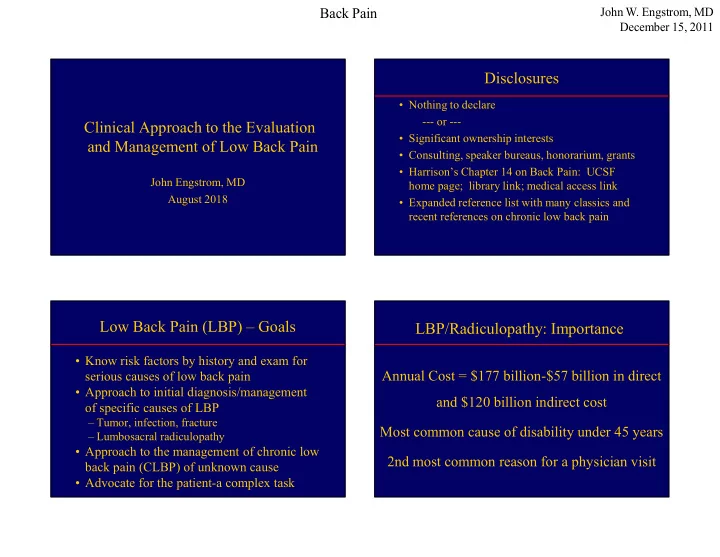
Clinical Approach to the Evaluation and Management of Low Back Pain

John Engstrom, MD August 2018

Disclosures

  • Nothing to declare
  • -- or ---
  • Significant ownership interests
  • Consulting, speaker bureaus, honorarium, grants
  • Harrison’s Chapter 14 on Back Pain: UCSF

home page; library link; medical access link

  • Expanded reference list with many classics and

recent references on chronic low back pain

Low Back Pain (LBP) – Goals

  • Know risk factors by history and exam for

serious causes of low back pain

  • Approach to initial diagnosis/management
  • f specific causes of LBP

– Tumor, infection, fracture – Lumbosacral radiculopathy

  • Approach to the management of chronic low

back pain (CLBP) of unknown cause

  • Advocate for the patient-a complex task

LBP/Radiculopathy: Importance

Annual Cost = $177 billion-$57 billion in direct and $120 billion indirect cost Most common cause of disability under 45 years 2nd most common reason for a physician visit

slide-2
SLIDE 2

Back Pain John W. Engstrom, MD

December 15, 2011 2

Acute LBP: Risk Factors for Serious Cause - History

Prior history of cancer Pain at rest or at night-most common risk missed History of chronic infection History of trauma Intravenous drug use Corticosteroid use History of rapidly progressive neurologic deficit Age > 70 years

Acute LBP: Risk Factors for Serious Cause - Examination

Unexplained, documented fever Unexplained, documented weight loss Palpation tenderness over spinous processes-C/T/L Abdominal, rectal, or pelvic mass Patrick’s sign or heel percussion sign Straight-leg or reverse straight-leg raising signs Rapidly progressive focal neurologic deficit

ALBP-Natural History/Treatment

  • 85-90% back to functional baseline in 12 weeks
  • Treat symptoms

– NSAIDs or acetaminophen for pain – Limited bed rest-2 days max; progressive ambulation – Muscle relaxants if back pain interferes with sleep – Muscle relaxants often not tolerable during a work day – Opioids are not a first choice! – Reassurance

LBP – General Examination

Abdomen-pulsatile mass in 50-75% with AAA Spine-palpate spinous processes; use paraspinal muscles as a control for non- specific pain Hips-Internal/external rotation with leg flexed Pelvis and Rectum-rare, but don’t forget

slide-3
SLIDE 3

Back Pain John W. Engstrom, MD

December 15, 2011 3

Examination Signs

Signs that reproduce usual pain symptoms Patrick’s Sign - Hip or buttock pain elicited by internal rotation of the hip with flexion of the leg at the knee Straight-leg raising – Traction on L5 or S1 roots or sciatic nerve (all posterior to hip) Reverse straight-leg raising – Traction on L2- L4 roots or femoral nerve (all ant to hip)

Initial Approach to Acute Back or Neck Pain

Acute LBP 1

Risks for Serious Source? Consider infection, tumor, fracture Symptomatic Rx x 3 months No Diagnostic Tests Yes No

1 Pain < 3 months duration

Algorithm 2 -ALBP Suspected Serious Etiology

Risk factors present Infection Cancer Rapidly progressive neurologic deficit Fracture Plain X-ray/CT ESR, CBC, consider consultation,

imaging, other lab

Immediate consultation

Lumbosacral Radiculopathy - Neurologic Findings

Root Motor Reflex Sensory Pain Distribution L4 Quads (knee ext) Knee Medial calf Medial calf Leg adduct L5 EHL/EDB/Peronei None Lateral calf, Posterolateral thigh; (foot eversion) dorsal foot Lat calf, dorsal foot S1 FDL (toe flexors) Ankle Sole foot Posterior thigh/calf Sole foot

slide-4
SLIDE 4

Back Pain John W. Engstrom, MD

December 15, 2011 4

Exam for L/S Radiculopathy-Motor

  • Use smallest bulk muscle avail-most sensitive
  • L4-If quad weak, check leg adductors (obturator nerve)
  • L5 -Dorsiflex toes (EDB)/great toe (EHL)
  • Evert foot (peronei); dorsiflex foot-TA
  • S1-Toe Flexors-tibial nerve, sciatic nerve
  • Overcome flexion of toes with fingers-do not screen with

big toe or foot plantar flexion

L/S Radiculopathy-Sensory

  • Decreased sensation (negative sensory symptoms)

indicates a decrease in sensory function;

  • Paresthesias/pain (positive sensory symptoms)

reflect alive nerve cells firing inappropriately

  • Elicit either a decrease in quantity or quality of

sensation (decrease = loss of sensory axons)

  • Compare light touch from side-to-side
  • Sensation scale (0 to 10; 0=None, 10 = normal)

L/S Radiculopathy-Sensory

  • L4-Medial calf
  • L5-Lateral calf or dorsal foot
  • S1-Sole foot
  • Sens loss from root/nerve injury occurs in a patch
  • Circumferential loss below the knees suggests

spinal cord/brain lesion or polyneuropathy

L/S Radiculopathy-Reflexes

  • Symmetry of the reflex is more important than

absolute value (3+ throughout vs. right 3/left 2)

  • Limbs in analagous positions to compare sides
  • If you can’t get a reflex, add stretch to the tendon
  • r reinforcement
  • L4-sitting or supine, knees bent if supine
  • L5-No associated reliable reflex
  • S1-strike Achilles or ball of dorsiflexed foot
slide-5
SLIDE 5

Back Pain John W. Engstrom, MD

December 15, 2011 5

Lumbar Radiculopathy-Anatomic Diagnosis

  • Paracentral disk herniation (root in lateral recess)
  • r lateral disk herniation (root in neural foramen)
  • Bony foraminal stenosis
  • Tumor, infection, fracture
  • Scarring from prior injury
  • Anatomy helps determine etiology of a lumbar

radiculopathy and consideration for surgery

Natural History of Acute Disk-Related Radiculopathy

  • Weber (1983)- If deficit and pain tolerable while waiting,

spontaneous recovery common

  • Saal (1989)-Focal motor deficits improve with rehab;

pain improves over time-not as fast as with surgery

  • Bottom Line: If patient can function with the pain, then

the long term outcome is about the same with and without surgery

Acute Disk Herniation and Nerve Root Injury: Compression or Inflammation?

Usually Not Compression

  • Mobile nerve roots
  • Nerve roots move during lumbar puncture
  • Gelatinous nucleus pulposus does not compress
  • Favorable response to steroids

Evidence for Inflammation: Extrusion of nucleus pulposis  inflammation  demyelination

slide-6
SLIDE 6

Back Pain John W. Engstrom, MD

December 15, 2011 6

Radiculopathy is not a Radiologic Diagnosis

  • MR Imaging did not replace the neurologist;

instead, the imaging findings doubled our work

  • “Is the anatomic change clinically significant?”
  • Imaging establishes anatomic plausibility
  • Disk abutment to nerve roots often asymptomatic
  • Does the history, exam, and ancillary testing (as

measures of nerve root function) support the anatomic abnormality

Pros of Spine Imaging

  • May find specific and treatable cause for

symptoms

  • Outstanding anatomic definition
  • Non-invasive
  • MRI preferred for anatomy of soft tissues
  • CT is helpful for detection of fractures
  • CT myelography can define the extent to which

abnormalities seen on MRI are bony (e.g.- foraminal narrowing from bone vs disk) helpful

Cons of Spine Imaging

  • Expensive in the U.S.

– $143 for spine MRI in Taiwan in 2010! – Radiology a profit center vs. a cost center

  • Non-specific findings that do not explain the

patient’s symptoms are very common

– May lead to unnecessary additional testing – May alarm patients and clinicians unnecessarily – Set patient expectations when testing ordered

Role of Exam and EMG studies

  • Neurologic exam is a qualitative measure of how

the nervous system functions (physiology)

  • MRI assesses anatomy of the nervous system
  • EMG gives a semi-quantitative measure of nerve

tissue function (physiology)

  • When the anatomy and physiology point to the

same cause, the probability of a correct diagnosis increases dramatically

slide-7
SLIDE 7

Back Pain John W. Engstrom, MD

December 15, 2011 7

  • History suggests a nerve root injury
  • Exam shows focal abnormalities suggesting nerve

root injury

  • Radiology (MRI) shows anatomic nerve root

injury or compression

  • EMG, when necessary, establishes nerve root

injury and excludes peripheral nerve injury

Radiculopathy Diagnostic Stool and the 4 legs: Hx, Exam, Radiol, EMG Disk Herniation: Surgical Indications

  • Cauda equina syndrome (CES)
  • Spinal cord compression (C/T-spine)
  • Progressive motor weakness by exam

Severe Radicular Pain - Controversial

CES Symptoms and Signs

  • Patient describes perineal or perianal numbness
  • New nocturia or bowel/bladder incontinence
  • Unable to feel or reduced feeling for toilet paper after

urination or bowel movement

  • Weakness and numbness in the legs in the distribution of

multiple bilateral nerve roots

  • Acute, subacute, chronic

CES Diagnosis and Management

  • Common etiologies-Herniated disk, tumor, abscess,

traumatic displacement of spine,

  • Almost never due to chronic spondylotic spinal stenosis
  • Consensus opinion-earlier surgery (within 1-2 days)

better than later-partial syndrome better than complete

  • Send to ER for lumbar spine MRI or CT
  • Request emergent spine surgery consultation
slide-8
SLIDE 8

Back Pain John W. Engstrom, MD

December 15, 2011 8

Progressive Motor Weakness

  • Progressive weakness is defined by a neurologic

exam that reveals true weakness

– True weakness-patient provides constant effort – Breakaway weakness with variable effort (with or without pain) does not count!

  • Upper motor neuron weakness in the arms or legs
  • Early intervention if weakness intereferes

significantly with occupation or ADLs

Intractable Pain and Surgery

  • Radicular pain interferes with occupation /ADLs

– Surgery leads to faster resolution of pain – Nerve root pain source is clear and intractable

  • Radicular pain pattern concurs with spine imaging
  • r EMG results (e.g.-correct side and level)
  • Patient needs to understand that finding the pain

source is needed to “fix” the pain-set realistic expectations before surgery

  • Spondylolysis-multiple microfractures in the

pedicles of either L4 or L5

– Congenital predisposition – Common in teenage athletes-back pain in a teenager is a “different” entity

  • Spondylolisthesis-Slippage of one vert body on

another; max with flexion/extension; often painful

Spondylolysis and Spondylolisthesis

Normal Lumbar Spine MRI-Sagittal T2

slide-9
SLIDE 9

Back Pain John W. Engstrom, MD

December 15, 2011 9

FLEX EXT

Extension

Who is at Risk for Lumbar Spine “Dynamic Instability”?

  • Extensive literature on acute/severe spine trauma

and metastatic disease, but scant otherwise

  • Developmental spondylolisthesis and lysis
  • Prior major traumatic injuries that include trunk
  • Axial back pain reproduced by flexed (sitting,

bending forward) or extended (standing, supine) postures

  • Degenerative spine disease-frequency unclear

Chronic Low Back Pian

  • Defn-LBP lasting more than 12 weeks without an

identifiable specific etiology

  • Risk factors-obesity, women > men, old age, prior

back pain, restricted spinal mobility, high psychological distress, poor self-rated health, low physical activity, smoking, job dissatisfaction, and widespread pain

slide-10
SLIDE 10

Back Pain John W. Engstrom, MD

December 15, 2011 10

Lack of good evidence for efficacy and safety in randomized controlled trials for chronic pain

  • “Enriched enrollment” exclu unresponsive

to meds or with unacc side effects

  • Exclude subjects with mental disorders of

hx substance abuse (most likely to become habituated-“adverse selection”)

  • Compare with placebo, not usual care (e.g.-

use of acetaminophen or NSAIDs)

  • Lack of parallel focus on return to function

Is Chronic Opiate Use Effective?

  • Lack of clinical trial evidence beyond 4 mo
  • Among 25 short term controlled trials, quality of

evidence poor in 21

  • Opioid tolerance begins at 1 month
  • Hyperalgesia (sensitization to pain) occurs during
  • pioid therapy
  • Pre-op management in ortho no longer use opoids

Is Chronic Opiate Use a Problem?

  • 87% of morphine for pain goes for long

term use

  • Industry conflicts of interest with company

profits-downplaying the risks (Oxycontin)

  • Frequent cause of prescription-related

deaths: 16,651/yr-2010

  • Most common cause of death in first three

years after lumbar fusion surgery

slide-11
SLIDE 11

Back Pain John W. Engstrom, MD

December 15, 2011 11

Local Pain Generators in the Spine

  • Capsules of facet and sacroiliac joints
  • Ligaments: posterior longitudinal,

interspinous

  • Periosteum: vertebral bodies and arches
  • Dura mater and epidural fibroadipose tissue
  • Spinal arterioles (especially to joints and

vertebral bodies)

  • Veins: epidural and paravertebral

Referred Pain is a Common Source of Back and Limb Pain

  • Back or leg pain, without nerve or nerve root

compression, is often referred from pain-sensitive structures of the spine

  • Many instances in which the anatomic generator

for the spine cannot be identified despite detailed investigation

Chronic LBP without Radiculopathy

  • Search for structural etiology for the pain
  • Validate the patient’s symptoms
  • Share the frustration of both doctor and patient

when unable to localize a specific anatomic pain generator

  • Involve multidisciplinary pain management,

especially with behavioral options, when possible

“Cascade” of Excessive Resource Use

  • Population-based functional outcomes in patients

with back pain are worse in recent years despite dramatic increases in imaging frequency

  • Non-specific imaging findings often lead to more

unnecessary diagnostic tests

  • ACP and NASS partnered in “Choosing Wisely”

campaign to reduce unnecessary spine care- MD education, audit and feedback re imaging rates, rapid access to alternative management

slide-12
SLIDE 12

Back Pain John W. Engstrom, MD

December 15, 2011 12

Reasons NOT to Choose Dx Testing

  • No spine MRI in at least first 6-12 weeks of LBP
  • nset in the absence of red flags
  • Don’t use EMG to investigate axial cervical,

thoracic, or lumbar back pain

  • Don’t use bone morphogenetic protein for routine

cervical spinal fusion surgery

  • Don’t recommend bed rest for > 48 hours
  • Don’t use spine injections without imaging

guidance

LBP-Patient Education

  • Goal: Validate the impact of the patient’s pain on their

life, especially intrusion to meaningful functions

  • Not all back or leg pain is due to nerve tissue injury (e.g.-

the sprained ankle analogy); referred pain is common

  • Unless the source of the pain can be identified reliably,

surgery doesn’t help

  • Reduced physical activity (e.g.-prolonged bed rest)

worsens the function of patients with back pain

  • Goals: 1) Improve function; 2) Reduce pain

Supervised Exercise Therapy Benefits

  • Improves function and alleviates pain symptoms

– Core strengthening exercises – Stretching – Gradually increasing aerobic exercise – Work hardening +/- – Yoga +/-

Cognitive Behavioral Therapy

  • Evidence that psychological and social factors are

impt to the genesis of chronic pain and disability

– Modify patient perception of pain – Modify patient perception of disability – Effect similar to exercise – Limitation: Expense and insurance coverage

slide-13
SLIDE 13

Back Pain John W. Engstrom, MD

December 15, 2011 13

CLBP-Medications

  • Short courses of NSAIDS or acetaminophen
  • Tricyclics may provide some relief even in the

absence of depression

  • Depression in this patient group is common and

should be treated when a diagnosis is made

  • SSRIs are not effective for CLBP
  • Opioids are not recommended

Approach to Wide Range of Rx for CLBP-Agnostic vs. DNR

Reasons to be agnostic

  • Low risk, limited time trial, lower cost
  • Any symptomatic relief?

Reasons for “Do Not Recommend”-protect patient

  • From treatments that are open-ended
  • Increased risk and little expectation of benefit
  • Needlessly expensive

Unproven CLBP Rx-Agnostic

  • Acupuncture
  • Massage
  • Lumbar spinal manipulation
  • TENS
  • Ultrasound

CLBP Rx- Do Not Recommend

– Laser therapy – Epidural or trigger point injections – Intradiscal therapy – Electrothermal or radiofrequency therapy – Traction – Spine surgery – Disk replacement surgery – Spinal fusion

slide-14
SLIDE 14

Back Pain John W. Engstrom, MD

December 15, 2011 14

Low Back Pain-Conclusions

  • History and examination risk factors inform initial

patient management and rational ordering of testing for ALBP and CLBP

  • Is a specific diagnosis supported by Hx, Ex, MRI,
  • r EMG-the 4 legs of the diagnostic stool
  • Educate patients about the challenges of CLBP
  • Role of exercise, cognitive-behavioral therapy,

medications for CLBP

  • Protect the patient from therapeutic adventurism