
SLIDE 1
Sonja Hofer
Sensory Systems Module PhD course 26/10/2018
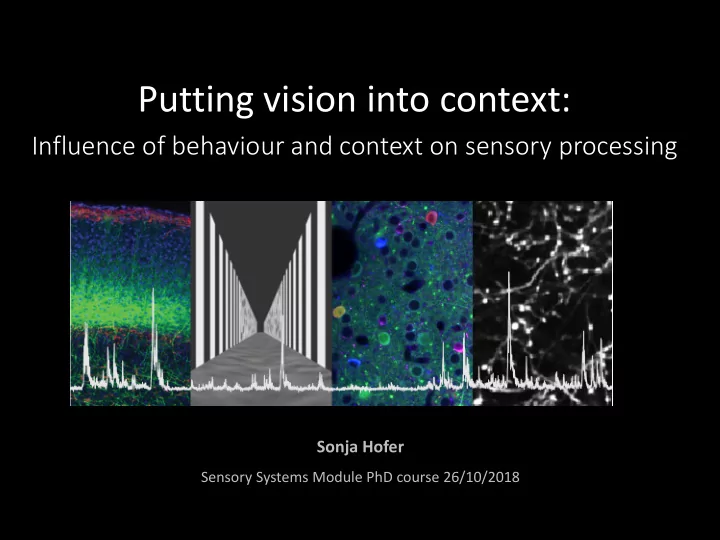
Putting vision into context: Influence of behaviour and context on - - PowerPoint PPT Presentation
Putting vision into context: Influence of behaviour and context on sensory processing Sonja Hofer Sensory Systems Module PhD course 26/10/2018 Visual system Primary visual Lateral geniculate cortex nucleus V1 The same stimulus can be
Sonja Hofer
Sensory Systems Module PhD course 26/10/2018
Primary visual cortex V1
Lateral geniculate nucleus
Visual information Contextual influences
Eye
Top-down cortical inputs
Eye
dLGN
V1
Higher visual areas Association areas
Pulvinar
Cortex Thalamus
Superior colliculus
Neuromodulation Higher-order thalamic inputs
V1 V2 V4 Buffalo et al 2009
Curve-tracing task Roelfsema et al 1998
Attention or reward expectation?
Adapted curve-tracing task Stănişor et al, 2013
Relative reward value
Normalized response
V1
Neuronal signals in V1 related to reward timing (or motor signals?)
Flash to left or right eye: Shuler & Bear, 2006 Shubykin et al, 2013
Reward zone
Approach
Approach corridor Grating corridors Vertical: rewarded
(drop of soya milk)
Angled (40°): non-rewarded
Visual discrimination task in virtual reality
Adil Khan
Head-fixed mouse on a cylinder, running through a virtual corridor (only half of virtual reality visible)
Implantation of a chronic cranial window:
Holtmaat et al., 2009
GCaMP6-expressing neurons in visual cortex (V1)
Trained mouse performing the task Neurons in visual cortex expressing GCaMP6 Eye position
Example cell response to grating corridors:
100 50 100 50
Trials Trials Trials rewarded grating (vertical) Trials non-rewarded grating (angled)
2 4
2 4 Time (s) Time (s) Vertical grating Angled grating
Average response (ΔF/F)
Grating onset
Average response
10 s 50% ΔF/F
2 1
ΔF/F
Cell 1
Vertical grating Angled grating
Day 1 Day 2 Day 5 Day 6
1 ΔF/F
Cell 2 Cell 3 Cell 4
0.2 ΔF/F 0.5 ΔF/F 1 ΔF/F
Neuronal population performance Neuronal population discrimination
2 3 4 5 6 7 8
Session
Time (s)
0.5 1 0.1 0.2 0.3 0.4 0.5 0.6 1 1 2 3 4 5 6 7 8 9
1 2 3 4 5
Mouse M2 Session
Session
Time (s)
0.5 1 0.1 0.2 0.3 0.4 0.5 0.6 0.7 0.8 1 2 3 4 5 6 7 8 9
Time (s)
1 2 3 4 5 6 7 8 9 10
1 2 3
Mouse M5 Session
0.5 1 0.2 0.4 0.6 0.8 1 1.2 1.4 1 2 3 4 5 6 7 8 9 10
Session
1 2 3 4 5 6 7 8 1 2 3
Mouse M7
Behavioural discrimination (d’)
Session
Behavioural performance
Poort, Khan et al., Neuron 2015
0.5 1 0.1 0.2 0.3 0.4 0.5 0.6 0.7 0.8 0.9
Time (s)
Population selectivity
0.8 to 1.7 (N=8) 1.7 to 2.7 (N=26) 2.7 to 3.6 (N=17) 3.6 to 4.5 (N=15)
Behavioural performance (d-prime)
Population performance
The visual cortex gets better at distinguishing the two task- relevant stimuli, tightly correlated with behavioural performance
Poort, Khan et al., Neuron 2015
Learning may increase the salience of task-relevant visual information to better inform behavioural decisions
Learning
Run up Odour1
Irrelevant Grating (vert or ang)
Odour2
Irrelevant Grating (vert or ang)
Run up
Vertical grating Angled grating
Mice switch between a visual and an olfactory task (the same visual stimuli are shown but ignored)
0.5 1
0.2 0.4 0.6 0.8 1.0
Population selectivity
Olfactory blocks (N=11) Visual blocks (N=11 sessions)
Time (s)
Population discriminability
Neurons in V1 are more selective when visual stimuli are relevant
Poort, Khan et al., Neuron 2015
Visual stimulus relevant Visual stimulus irrelevant
Task-dependent changes in auditory cortex receptive fields
Fritz et al, 2003
STRF: spectrotemporal response field Average change in response field passive listening vs during task
Sensory response properties are not fixed but reflect behavioural demands!
Electrophysiological recordings in primary visual cortex in head-fixed, running mice
Niell & Styker, 2010
Visual responses in V1 are increased during locomotion
Lee at al., 2014
MLR: mesencephalic locomotor region
Pakan at al., 2016
Complex networks!! -> Modelling
Del Molino at al., 2017 Fu at al., 2014
Erisken at al., 2014 Activity in visual cortex excitatory cells: modulated in the dark and carry detailed running speed information Saleem at al., 2013
Anterior cingulate cortex (+ secondary motor cortex)?
Origin of motor signals?
Leinweber at al., 2017
Origin of motor signals?
100 µm
LGN
axons
Pulvinar
axons Eye
LGN
Lateral geniculate nucleus
V1
Primary visual cortex
Higher visual areas Association areas
(Lateral posterior nucleus LP)
Cortex Thalamus
Superior colliculus
Thalamus?
1 mm
AM PM
V1
AL LM
Intrinsic signal imaging to determine position of visual areas
LP axons in V1
100 μm
Expression of calcium indicator in pulvinar or LGN
10 μm
1 2
20 s 2 ΔF/F
1 2
Two-photon imaging of thalamic projections in V1
Lateral posterior nucleus LP
In vivo two-photon calcium imaging of thalamic axons and boutons in layer 1 of V1
15 µm
Speed 5x
virtual corridor
visual flow
Visuo-motor ‘task’
5 ΔF/F 10 s 20 cm/s
Visual Flow Speed (VF) ΔF/F
VF dLGN dLGN
30 1 30 1 20
LP
1
Visual flow speed (cm/sec) Response strength dLGN
30 1 30 1 30 1
Running speed (cm/sec) LP LP ΔF/F RS
10 s
Running Speed (RS)
20 cm/s 5 ΔF/F
Proportion of highly informative boutons (%) Running speed Visual flow
10 15 5
dLGN Pulvinar
Roth, Dahmen, Muir et al., Nature Neurosciene 2016
Motor signals seem to dominate neuronal activity across the cortical surface
Musall at al., bioRxiv 2018
Widefield calcium imaging of cortical activity during a very simple spatial discrimination task
Visual information Contextual influences
Eye
Visual information
Eye
During eye or head movements: Motor system Visual information
Eye
Information about own body’s movement Difference calculator Motor command Prediction
Visual feedback Efference copy Predicted visual feedback
Kant, Helmholtz,…Friston, Clark, Mumford
Keller et al., 2012
Experimental evidence for predictive coding in cortical circuits A subset of neurons in V1 shows strong mismatch (prediction error) responses Mismatch responses are dependent on experience
Attinger et al., 2017
Potential circuit for mismatch computation in visual cortex
Mismatch response in V1 is weaker when ACC is silenced Attinger et al., 2017
ACC
Muscimol in Anterior Cingulate Cortex (ACC)
Leinweber et al., 2017
Potential circuit for mismatch computation in visual cortex
Optogenetic manipulation of SOM neurons alters mismatch response
(consistent with the model but no proof)
Attinger et al., 2017 Somatostatin (SOM) neurons are most strongly driven by visual flow
ACC SOM
Spatial prediction and prediction error signals in visual cortex
Some V1 neurons become selective to spatial location
Fiser et al., 2016
Some V1 start firing in expectation
Spatial prediction and prediction error signals in visual cortex
Strong response in V1 when an expected visual stimulus is omitted
Fiser et al., 2016