Disclosures Disclosures placebo controlled, double-blind, Phase III - - PowerPoint PPT Presentation

disclosures disclosures
SMART_READER_LITE
LIVE PREVIEW

Disclosures Disclosures placebo controlled, double-blind, Phase III - - PowerPoint PPT Presentation

Efficacy and safety of siponimod in secondary Efficacy and safety of siponimod in secondary progressive multiple sclerosis - Results of the progressive multiple sclerosis - Results of the Disclosures Disclosures placebo controlled,


slide-1
SLIDE 1

1

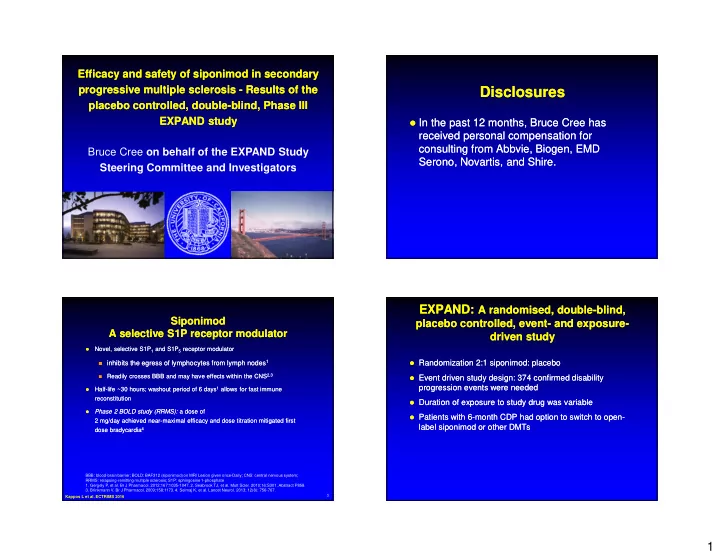
Efficacy and safety of siponimod in secondary progressive multiple sclerosis - Results of the placebo controlled, double-blind, Phase III EXPAND study Efficacy and safety of siponimod in secondary progressive multiple sclerosis - Results of the placebo controlled, double-blind, Phase III EXPAND study Bruce Cree on behalf of the EXPAND Study Steering Committee and Investigators

Disclosures Disclosures

In the past 12 months, Bruce Cree has

received personal compensation for consulting from Abbvie, Biogen, EMD Serono, Novartis, and Shire.

In the past 12 months, Bruce Cree has

received personal compensation for consulting from Abbvie, Biogen, EMD Serono, Novartis, and Shire. Siponimod A selective S1P receptor modulator Siponimod A selective S1P receptor modulator

  • Novel, selective S1P1 and S1P5 receptor modulator

inhibits the egress of lymphocytes from lymph nodes1

  • Readily crosses BBB and may have effects within the CNS2,3
  • Half-life ~30 hours; washout period of 6 days1 allows for fast immune

reconstitution

  • Phase 2 BOLD study (RRMS): a dose of

2 mg/day achieved near-maximal efficacy and dose titration mitigated first dose bradycardia4

  • Novel, selective S1P1 and S1P5 receptor modulator

inhibits the egress of lymphocytes from lymph nodes1

  • Readily crosses BBB and may have effects within the CNS2,3
  • Half-life ~30 hours; washout period of 6 days1 allows for fast immune

reconstitution

  • Phase 2 BOLD study (RRMS): a dose of

2 mg/day achieved near-maximal efficacy and dose titration mitigated first dose bradycardia4

BBB: blood-brain barrier; BOLD: BAF312 (siponimod) on MRI Lesion given once-Daily; CNS: central nervous system; RRMS: relapsing-remitting multiple sclerosis; S1P: sphingosine 1-phosphate

  • 1. Gergely P, et al. Br J Pharmacol. 2012;167:1035-1047. 2. Seabrook TJ, et al. Mult Scler. 2010;16:S301. Abstract P858.
  • 3. Brinkmann V. Br J Pharmacol. 2009;158:1173. 4. Selmaj K, et al. Lancet Neurol. 2013; 12(8): 756-767.

3 Kappos L et al. ECTRIMS 2016

EXPAND: A randomised, double-blind,

placebo controlled, event- and exposure- driven study

EXPAND: A randomised, double-blind,

placebo controlled, event- and exposure- driven study

Randomization 2:1 siponimod: placebo Event driven study design: 374 confirmed disability

progression events were needed

Duration of exposure to study drug was variable Patients with 6-month CDP had option to switch to open-

label siponimod or other DMTs

Randomization 2:1 siponimod: placebo Event driven study design: 374 confirmed disability

progression events were needed

Duration of exposure to study drug was variable Patients with 6-month CDP had option to switch to open-

label siponimod or other DMTs

slide-2
SLIDE 2

2

Key inclusion and exclusion criteria Key inclusion and exclusion criteria

  • Age: 18–60 years old
  • Prior history of relapsing-remitting MS
  • Secondary progressive course of MS (SPMS), defined by a progressive

increase in disability (of at least 6 months duration) in the absence of relapses or independent of relapses

  • EDSS score of 3.0–6.5
  • Evidence for EDSS progression in the 2 years prior to study of 1 point or

more in patients with a screening EDSS score of less than 6.0 ─ ≥0.5 points for patients with EDSS ≥6.0 at screening

  • Standard exclusion criteria
  • Defined washout periods or exclusion criteria for other MS medications

Key exclusion criteria Key inclusion criteria

5 Kappos L et al. ECTRIMS 2016

Primary and secondary endpoints Primary and secondary endpoints

  • Time to 3-month Confirmed Disease Progression (CDP), assessed by

EDSS*1 Efficacy is reported as a hazard ratio, which quantifies risk reduction under siponimod treatment relative to placebo

  • Key secondary endpoints

─ Time to 3-month confirmed worsening of at least 20% from baseline in the Timed 25-foot walk test (T25FW) ─ Change from baseline in T2 lesion volume

  • Other secondary endpoints

─ 6-month CDP, assessed by EDSS*1 ─ Annualised relapse rate ─ Change from baseline in brain volume ─ others (analysis ongoing)

  • Safety and tolerability

Primary endpoint

6

Secondary endpoints

Kappos L et al. ECTRIMS 2016

Patient Disposition Patient Disposition

1651 subjects randomized 1100 siponimod

82% completed double blind period

546 placebo

78% completed double blind period

Actual median time in double blind period was 18

months

Actual total double blind study duration was 37

months

1651 subjects randomized 1100 siponimod

82% completed double blind period

546 placebo

78% completed double blind period

Actual median time in double blind period was 18

months

Actual total double blind study duration was 37

months

Demographics and baseline characteristics Demographics and baseline characteristics

All randomised set. Data represented as mean (SD), unless otherwise specified *Number and percentage of patients with missing screening or baseline observations not displayed

8

Siponimod N=1105 Placebo N=546 Age, years 48.0 (7.8) 48.1 (7.9) Age, n (%) 18-40 188 (17.0) 103 (18.9) >41 917 (83.0) 443 (81.1) Duration of MS since first symptom, years 17.12 (8.39) 16.23 (8.23) Time since conversion to SPMS, years 3.85 (3.61) 3.56 (3.28) EDSS Mean (SD) 5.43 (1.08) 5.41 (1.03) Median (Min-Max) 6.0 (2.0-7.0) 6.0 (2.5-7.0) Number of relapses in last 2 years prior to screening, n (%)* 712 (64.4) 343 (62.8) ≥1 390 (35.3) 202 (37.0) Number of Gd+ T1 lesions, n (%)* 833 (75.4) 415 (76.0) ≥1 237 (21.4) 114 (20.9)

Kappos L et al. ECTRIMS 2016

slide-3
SLIDE 3

3

Primary Efficacy Primary Efficacy

21% relative reduction in 3 month confirmed

disability progression, p=0.129

26% relative reduction in 6 month confirmed

disability progression, p=0.007

Consistent effect across subgroups: prior

relapses in last 2 years, gad enhancement at baseline scan, age, baseline EDSS, disease duration

21% relative reduction in 3 month confirmed

disability progression, p=0.129

26% relative reduction in 6 month confirmed

disability progression, p=0.007

Consistent effect across subgroups: prior

relapses in last 2 years, gad enhancement at baseline scan, age, baseline EDSS, disease duration

Secondary endpoints and AE Secondary endpoints and AE

No significant impact on worsening of T25FW 79% relative reduction in T2 lesion volume

compared to placebo (p<0.0001)

55% relative reduction in relapse rate compared

to placebo (p<0.0001)

23% relative reduction in brain volume loss

compared to placebo (p=0.0002)

Favorable safety profile without new safety

signals distinct from those associated with fingolimod

No significant impact on worsening of T25FW 79% relative reduction in T2 lesion volume

compared to placebo (p<0.0001)

55% relative reduction in relapse rate compared

to placebo (p<0.0001)

23% relative reduction in brain volume loss

compared to placebo (p=0.0002)

Favorable safety profile without new safety

signals distinct from those associated with fingolimod

10 Kappos L et al. ECTRIMS 2016

Conclusions Conclusions

Siponimod reduces the risk of disability

progression in patients with secondary progressive MS in a large international clinical trial

Siponimod’s was well tolerated with a risk

profile similar to that of the established treatment, fingolimod, and without new, distinct safety signals

Siponimod reduces the risk of disability

progression in patients with secondary progressive MS in a large international clinical trial

Siponimod’s was well tolerated with a risk

profile similar to that of the established treatment, fingolimod, and without new, distinct safety signals

Acknowledgements (1/2) Acknowledgements (1/2)

12 Data Monitoring Committee Easton Donald (Chair) Calandra Thierry DiMarco John Kesselring Juerg Laupacis Andreas Temkin Nancy Weinshenker Brian Zarbin Marco Study Steering Committee Kappos Ludwig (Chair) Bar-Or Amit Cree Bruce Fox Robert Giovannoni Gavin Gold Ralf Vermersch Patrick Argentina Correale Jorge Deri Norma H. Patrucco Liliana Piedrabuena Raul Rey Roberto Sinay Vladimiro Australia Barnett Michael Butzkueven Helmut Hodgkinson Suzanne Macdonell Richard Schwartz Raymond Austria Leutmezer Fritz Maida Eva-Maria Weber Joerg R. Belgium Decoo Danny Dubois Benedicte Guillaume Daniel Laureys Guy Pandolfo Massimo Vanopdenbosch Ludo Willekens Barbara Wijmeersch Bart Van Bulgaria Grigorova Olga Kaprelyan Ara Milanov Ivan Shotekov Penko Tarnev Ivaylo Canada Antel Jack P. Bhan Virender Blevins Gregg Brunet Donald Duquette Pierre Freedman Mark Grandmaison Francois Lee Liesly Vorobeychik Galina Yeung Michael China Cui Liying Huang Dehui Huang Yining Li Hongzeng Lu Jiahong Xu Xianhao Yang Yi N. Zhang Meini Zhou Hongyu Czech Republic Liskova Petra Skoda Ondrej Stourac Pavel Ticha Veronika Vachova Marta Estonia Gross-Paju Katrin Toomsoo Toomas France Brochet Bruno Camu William Castelnovo Giovani de Seze Jérôme Debouverie Marc Defer Gilles Edan Gilles Papeix Caroline Pelletier Jean Vermersch Patrick Wiertlewski Sandrine Germany Becker Veit U. Bergh Florian Then Bergmann Arnfin Berthele Achim Boehringer Matthias Boerner Thomas Bracknies Vera Braune Stefan Buttmann Mathias Emrich Peter J. Faiss Juergen Gehring Klaus Haas Judith Harmjanz Arndt Heidenreich Fedor R. Hoffmann Olaf M. Hofmann Werner E. Koehler Juergen Kornhuber Anselm Lassek Christoph Lensch Eckart Linker Ralf A. Maeurer Mathias Oschmann Patrick Polzer Udo Rauer Sebastian Reifschneider Gerd Schlegel Eugen Schmidt Stephan Scholz Erich Schwab Matthias Siever Arno Sigel Karl-Otto Stangel Martin Strassburger-Krogias Katrin Strauss Erik Then Bergh Florian Tiel-Wilck Klaus Tumani Hayrettin Walter Silke Weissert Robert Wiendl Heinz Wildemann Brigitte Zettl Uwe Ziemssen Tjalf Greece Grigoriadis Nikolaos Mastorodimos Vasileios Tavernarakis Antonios Hungary Dioszeghy Peter Imre Piroska Jakab Gabor Kovacs Krisztina Koves Agnes Matyas Klotild Pozsegovits Krisztian Rozsa Csilla Satori Maria Simo Magdolna Valikovics Attila Ireland Hardiman Orla Tubridy Niall Israel Achiron Anat Karussis Dimitrios Italy Brescia Morra Vincenzo Comi Giancarlo Francia Ada Galgani Simonetta Grimaldi Luigi Maria Edoardo Marfia Girolama Alessandra Mirabella Massimiliano Nocentini Ugo Scarpini Elio Angelo Uccelli Antonio Japan Baba Masayuki Kaida Kenichi Kimura Takashi Mizuno Masanori Mori Masahiro Nakahara Jin Nakatsuji Yuji Nohara Chiyoko Nomura Kyoichi Saida Takahiko Yamamura Takashi

We thank all participating patients and investigators for their dedication and contribution to this study

slide-4
SLIDE 4

4

Acknowledgements (2/2) Acknowledgements (2/2)

13 Shimizu Yuko Latvia Kalnina Jolanta Karelis Guntis Millers Andrejs Lithuania Kizlaitiene Rasa Malciene Lina Rastenyte Daiva Netherlands Fermont Jiske Hengstman G.J.D. Hupperts Raymond Schrijver H.M. van Oosten B.W. Visser L.H. Poland Bonek Robert Brola Waldemar Czlonkowska Anna Jasinska Elzbieta Kozubski Wojciech Maciejowski Maciej Rusek Stanislaw Selmaj Krzysztof Portugal Cerqueira Joao Cunha Luis de Sa Joao Martins da Silva Ana Salgado Antonio Vasco Romania Bajenaru Ovidiu Balasa Rodica Bejinariu Mihaela Buraga Ioan Hancu Anca Simu Mihaela Ticmeanu Marina Russia Boyko Alexey N. Evdoshenko Evgeny P. Fedyanin Alexander S. Khabirov Farit A. Magzhanov Rim V. Odinak Miroslav M. Sazonov Denis V. Shchukin Ivan A. Stolyarov Igor D. Slovakia (Slovak Republic) Brozman Miroslav Cimprichova Andrea Donath Vladimir Hancinova Viera Klimova Eleonora Krastev Georgi Kurca Egon Turcani Peter Spain Casanova Estruch Bonaventura Coret Ferrer Francisco Escartin Siquier Antonio Fernandez Sanchez Victoria Eugenia Garcia Merino Juan Antonio Izquierdo Ayuso Guillermo Martinez Rodriguez Jose Martinez Yelamos Sergio Meca Lallana Jose Montalban Xavier Olascoaga Urtaza Francisco Javier Oreja-Guevara Celia Ramo Tello Cristina Rodriguez Antiguedad Alfredo Sweden Fink Katharina Lycke Jan Olsson Tomas Switzerland Achtnichts Lutz Derfuss Tobias Lutterotti Andreas Gobbi Claudio Mueller Stefanie Pless Misha Schluep Myriam Turkey Agan Kadriye Akman-Demir Gulsen Balci Belgin Petek Boz Cavit Efendi Husnu Siva Aksel Terzi Murat United Kingdom Cottrell David A. Craner Matthew Duddy Martin Ford Helen Nicholas Richard Nikfekr Esmaeil Overell James Rog David Sharrack Basil Turner Ben United States Allen Alison B. Apperson Michelle Bass Ann Bernitsas Evanthia Bowen James D. Bowling Allen Burnett Margaret Cahill Jonathan Calkwood Jonathan C. Cascione Mark Cohan Stanley Conway Jill Cooper Joanna A. Corboy John Costell Brian Coyle Patricia K. Dihenia Bhupesh Elias Stanton Ford Corey Frishberg Benjamin Gitt Jeffrey Goldstick Lawrence P. Gross Jeffrey Gudesblatt Mark Herring Mark Honeycutt William D. Hua Le H. Huang DeRen Katz Amos Khatri Bhupendra Kister Ilya Komatineni Aparna Mao-Draayer Yang Markowitz Clyde Miller Aaron E. Montoya Liliana Newsome Scott Pachner Andrew Robertson Derrick Rowe Vernon Rubin Susan Sanders Kalina Scott James Shafer Stuart Solomon Andrew Stefoski Dusan Steingo Brian Stuve Olaf Tullman Mark J. Weiss Sara Zacharias Alan Zelkowitz Marvin

We thank all participating patients and investigators for their dedication and contribution to this study

Adjudication Committee Polman Chris Uitdehaag Bernard