Digital Bridge Governance Principles Transparency: Stakeholders will - - PowerPoint PPT Presentation

digital bridge governance principles
SMART_READER_LITE
LIVE PREVIEW

Digital Bridge Governance Principles Transparency: Stakeholders will - - PowerPoint PPT Presentation

Digital Bridge Governance Principles Transparency: Stakeholders will have Utility: The governance body will prioritize visibility into the governance bodys work use of existing information technology and opportunities to provide


slide-1
SLIDE 1
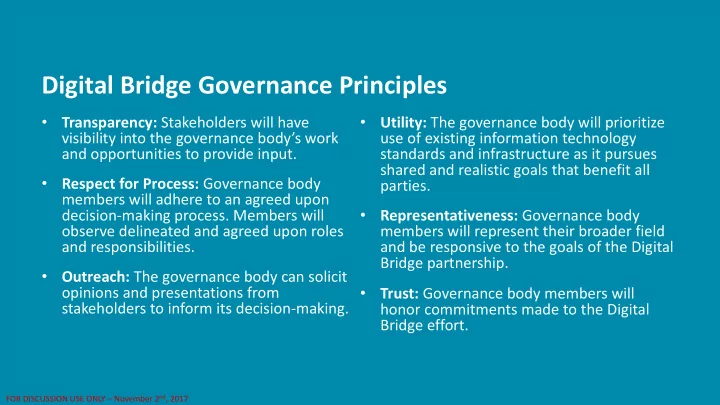
  • Transparency: Stakeholders will have

visibility into the governance body’s work and opportunities to provide input.

  • Respect for Process: Governance body

members will adhere to an agreed upon decision-making process. Members will

  • bserve delineated and agreed upon roles

and responsibilities.

  • Outreach: The governance body can solicit
  • pinions and presentations from

stakeholders to inform its decision-making.

  • Utility: The governance body will prioritize

use of existing information technology standards and infrastructure as it pursues shared and realistic goals that benefit all parties.

  • Representativeness: Governance body

members will represent their broader field and be responsive to the goals of the Digital Bridge partnership.

  • Trust: Governance body members will

honor commitments made to the Digital Bridge effort.

Digital Bridge Governance Principles

FOR DISCUSSION USE ONLY – November 2nd, 2017

slide-2
SLIDE 2

Digital Bridge Strategic Roadmap

Milestones & Critical Activities

By-laws approved by Governance Body Operating model approved by governance body Reporting on five conditions Governance by-laws drafted Operating model self- sustaining Governance Body changes implemented Identify funders Recommend long-term funding modal Implement new funding model Establish communications advisory group Digital Bridge communications plan-V2 Establish Digital Bridge success stories Operating model implemented Marketing materials for funders Evaluate funding model Stand up technical

  • perations

workgroup Wave 1 – Test implementation complete Wave 2 – Test implementation complete Wave 1 – Production Wave 2 - Production

PHASE III (2017) PHASE IV (2018-2019) PHASE V (2020-2021) PHASE VI (2022-2023)

Jun Nov Jan Aug Dec Jan Nov Dec Jan Jan Apr Aug Concept of Operations developed Reportability Response (RR) Published Template for eCR legal agreements eCR legal agreement templates developed Develop long term legal strategy Legal agreement templates developed for new use cases Legal agreement templates developed for subsequent use cases Use case criteria agreed upon Governance

  • dy approves

use case 2 Use case 2 launched 7 sites up and running Funding Model 100% in effect Digital Bridge recruitment strategies & marketing Infrastructure for new use cases

Complexity Low High

Governance body approves use case 3 Begin Technical Architecture Evaluation Develop and recommend long term technical architecture Use case 3 launched Implement long term technical architecture Governance body approves long term technical architecture

Legend

Operations Communications Funding Technical Infrastructure Legal Users & Use Cases Critical Path Other Milestones

*** General Notes: (1) Complexity is used as a rough proxy for the needed resources and effort to complete a milestone, (2) Overall timeline and milestones are subject to change depending on project dependencies.

Wave 1 legal agreements signed Wave 2 legal agreements signed

FOR DISCUSSION USE ONLY – November 2nd, 2017

slide-3
SLIDE 3

Thank you for your feedback

1. “Update on status of initial implementation sites.” 2. “Legal and project plans for both wave 1 and 2.” 3. “Implementations and 2018 plan.” 4. “How do we get to where we are building trust and solving problems?” 5. “How much can we realistically take on given we have not yet seen more than a few eCR sites, none

  • perational at this time. Are we moving too fast?”

6. “The next use case.”

Opportunities to address requested November topics will be provided during today’s meeting where indicated below:

slide-4
SLIDE 4

Governance Body Meeting

Thursday, November 2, 2017 12:00 – 1:30 PM ET This meeting will be recorded for note taking purposes only

FOR DISCUSSION USE ONLY – November 2nd, 2017

slide-5
SLIDE 5

FOR DISCUSSION USE ONLY – November 2nd, 2017

slide-6
SLIDE 6

Meeting Agenda

Time Agenda Item 12:00 PM Call to Order – John Lumpkin 12:03 PM Agenda Review and Approval – John Lumpkin 12:10 PM eCR Implementation Progress

  • Laura Conn, Kirsten Hagemann, Rob Brown

12:45 PM Scalability Issue Brief

  • Jim Jellison

1:05 PM Strategy Workgroup Update

  • Mary Ann Cooney and Richard Paskach
  • Alana Cheeks-Lomax

1:25 PM Digital Bridge Communications – Jessica Cook 1:28 PM Review decisions and major actions – Charlie Ishikawa 1:30 PM Adjournment – John Lumpkin

Purpose:

The purpose of this meeting is to work toward a common vision for exchanging actionable information between public health and health care.

Objectives:

By the end of this meeting, the governance body will have 1. Identified and discussed the status and future plans for the initial eCR implementation sites, 2. Discussed strategic questions and concerns over making final decisions related to an operating model and future use case, and 3. Provided comments and suggestions to improve the accuracy and completeness of a draft scalability issue brief

Materials:

1. PMO Work Plan: eCR Scalability Assessment 2. Scalability Issue Brief – Version 1 3. eCR Implementation activity status report 4. Meeting slides

FOR DISCUSSION USE ONLY – November 2nd, 2017

slide-7
SLIDE 7

eCR Implementation

Laura Conn and Kirsten Hagemann (Taskforce Co-Chairs), Rob Brown

FOR DISCUSSION USE ONLY – November 2nd, 2017

slide-8
SLIDE 8

Updated Implementation Timeline (DRAFT)

Mar 2017 – Sept 2017 Oct 2017 Nov 2017 Dec 2017 Jan 2018 Feb 2018 Mar 2018 Apr 2018

Site Selection

Planning RCKMS & AIMS - Development & Test

Performance Testing (Iterative) RCKMS Training Complete Integration Testing (AIMS & RCKMS Together) DB DB Site e #1 #1 AIMS & RCKMS Onboarding Test Package (Scenarios, Narratives, and Test Data) Legal Agreements

Complete In Progress Not Started

FOR DISCUSSION USE ONLY – November 2nd, 2017 Engagement With Implementation Sites

DB DB Site e #1 #1 End-to-End Testing (eICR & RR) RR Constructor Development Si Site #1 Production DB DB Site e #n #n (TBD) D) Onboarding & End-to-End Testing RR Standard Publication

slide-9
SLIDE 9

eCR Implementation Risks and Issues

# Risk Impact Mitigation

1 Third party security assessment will not occur before initial implementations are in production Medium On eCR roadmap for 2018/2019. 2 Legal agreements and data use agreements beyond initial implementation (risk for both implementation and strategy workgroups) High The legal and regulatory workgroup is working on creating legal and data use agreements for the initial implementations, and an eCR scalability assessment will occur for future implementations. 3 Reportability response (RR) standard changing between balloting and November publication Medium HL7 RR ballot reconciliation process is complete. RR discussions scheduled with sites to address surfacing questions. RR publication expected by December 2017. 4 Technical partners CSTE and APHL may have funding and sustainability shortfalls for FY18 High CSTE (RCKMS team) has mitigated their contract gap in the short term and is actively looking into longer term solutions. APHL has expressed concerns about limited resources and funding for eCR.

# Issue Impact Mitigation

1 Cerner implementation for eICR 1.1 support is delayed due to competing priorities Medium PMO presented the Cerner and Intermountain implementation brief vetted by the eCR implementation taskforce to the governance body at the October

  • meeting. Cerner and Intermountain have also identified a resource and should

have the solution production ready by end of 2017. 2 An increase in the complexity and thoroughness of the test scenarios will cause a delay in the creation of the test eICRs High Continuing to monitor the status of the test package with CDC and CSTE to be completed end of November. CDC and CSTE walked through a test scenario, test narrative and test eICR for the implementation sites at the monthly all site meeting. FOR DISCUSSION USE ONLY – November 2nd, 2017

slide-10
SLIDE 10

Site Status in Preparation for Onboarding and Testing

Implementation Sites Vendor/HIE Activities Provider Activities Public Health Activities Provider/HIE & PH Connectivity with AIMS Additional Notes

Kansas Cerner and Intermountain development work for Utah can be leveraged for Kansas. For public health (PH), the activity remaining is the ability to receive a reportability response (RR). Successful AIMS connectivity test with PH. Discussions with provider connectivity beginning. Michigan N/A For PH, the activities remaining are the ability to receive eICR 1.1 and ability to receive RR. Initial connectivity testing underway between AIMS and MiHIN. Utah Cerner and Intermountain (IMH) obtained resource to get them production ready by end of 2017. PH is ready; their activities are

  • complete. Successful AIMS connectivity test with PH. IMH connectivity

being established. California Epic’s software updates are released. Working through provider

  • concerns. PH is making progress.

Houston Epic’s software updates are released. Provider and PH are making

  • progress. AIMS is working with provider and PH on direct transport.

Massachusetts Epic’s software updates are released. Provider and PH are making

  • progress. For PH, the activities remaining are test and production

environment setup and the ability to receive RR. New York Epic’s software updates are released. Working through provider

  • concerns. PH is making progress.

Complete – 100% In Progress – 50% Not Started – 0%

FOR DISCUSSION USE ONLY – November 2nd, 2017

slide-11
SLIDE 11

eCR Scalability Assessment – Issue Brief Ver. 1

Jim Jellison

FOR DISCUSSION USE ONLY – November 2nd, 2017

slide-12
SLIDE 12

Objectives

  • Review governance directive to conduct assessment
  • Review current eCR approach and legal analysis
  • Describe assessment process and role of governance body and workgroups
  • Gather initial feedback on scalability issues and potential modifications

FOR DISCUSSION USE ONLY – November 2nd, 2017

slide-13
SLIDE 13

eCR Scalability Assessment

  • Objective: Identify possible modifications to the current Digital Bridge electronic case

reporting (eCR) approach that may improve scalability from legal and regulatory perspective.

  • Motion passed on Oct. 5 Digital Bridge governance body meeting:
  • “The Digital Bridge governance body states that a key design objective for any future eCR

approach is to improve the scalability of the eCR solution through modifications to the current DB eCR approach, and directs the PMO to immediately begin work to identify possibilities.”

  • This issue brief summarizes scalability issues and describes approach for identifying

possible modifications and facilitating governance body’s prioritization of modification

  • ptions.

FOR DISCUSSION USE ONLY – November 2nd, 2017

slide-14
SLIDE 14

Scalability vs. Extensibility

  • Scalability
  • In scope for this assessment
  • Pertains to growth of eCR solution to adopters nationwide for surveillance and

control of reportable conditions

  • Extensibility
  • Out of scope for this assessment
  • Pertains to addition of functionality associated with new use case or information

exchange scenario beyond surveillance and control of reportable conditions

  • Will be addressed later

FOR DISCUSSION USE ONLY – November 2nd, 2017

slide-15
SLIDE 15

Current eCR Approach

  • Developed by Digital Bridge partners and approved by the governance body in
  • Jan. 2017.

secondary case adjudication logic primary case adjudication logic FOR DISCUSSION USE ONLY – November 2nd, 2017

slide-16
SLIDE 16

Summary of Legal Analysis

  • Initial implementers of eCR will implement the current DB eCR approach with APHL (as

the decision support intermediary) acting as a business associate of providers or HIEs sending case reports.

  • Managing a multitude of business associate agreements (BAAs) with various providers

implementing eCR impedes the scalability of eCR.

  • Positioning APHL’s decision support intermediary as an agent of public health authority

mitigates scalability barriers associated with BAAs.

  • Shifting more case adjudication capabilities (i.e., trigger codes, RCKMS) to the provider

increases feasibility of APHL’s decision support intermediary to act as an agent of public health authority.

FOR DISCUSSION USE ONLY – November 2nd, 2017

slide-17
SLIDE 17

eCR Scalability Assessment Timeline

Process Highlights

  • Early opportunity for technical,

legal, and strategic experts/stakeholder to provide feedback, and input

  • Governance body controls issue

brief development

  • PMO carries majority of work to

maintain project focus on implementation

  • In-person meeting (Jan. 2018)

will be an opportunity for governance body to prioritize potential modifications and determine next steps

  • Governance body discussions:

Monthly meetings (Nov. 2, Dec. 7, Jan. 4); In-person meeting (Jan. 24-25)

FOR DISCUSSION USE ONLY – November 2nd, 2017

slide-18
SLIDE 18

Scalability Issues Summary

*Potential modifications to be examined and assessed via workgroup discussions in November 2017.

Current eCR Approach Scalability Issue(s) Potential Modification(s)* 1.

DSI acts as BA of Provider or HIE sending case report High administrative costs associated with DSI managing (potentially) thousands of BAAs DSI acts as agent of public health authority receiving case reports

2.

Two levels of case adjudication logic:

  • primary logic that is nationally

consistent and implemented in Provider’s EHR (i.e., “trigger codes”, “RCTC”)

  • secondary logic that is jurisdiction-

specific and implemented in DSI (i.e., “RCKMS”) HIPAA risks associated with Provider reporting non-reportable conditions to DSI DSI distributes both primary and secondary case adjudication logic Provider sends de-identified case report to DSI for secondary case adjudication, then sends identified case report as indicated by adjudication

3.

Emphasis on primary case adjudication and case report construction at point of care (i.e., in EHR) Some potential implementers may be motivated to implement case adjudication and case report construction in an HIE (or similar) environment Case adjudication (primary or secondary) and case report construction is implementable in EHRs or HIEs (or environments accessible to EHRs and HIEs)

FOR DISCUSSION USE ONLY – November 2nd, 2017

slide-19
SLIDE 19

Implementation Task Force Members

Next implementation task force meeting: Wed. Nov. 8, 4PM ET

FIRST NAME LAST NAME SECTOR AFFILIATION ROLE Laura Conn Public Health CDC Co-Chair Kirsten Hagemann Vendor Cerner Co-Chair Richard Hornaday Vendor Allscripts Primary Dari Shirazi Public Health APHL Primary Bryant Karras Public Health ASTHO Primary Jim Collins Public Health CSTE Primary Christopher Alban Vendor Epic Primary Richard Paskach Health Care HealthPartners Primary Geoff Caplea Vendor Allscripts Alternate Srinath Remala Public Health CDC Alternate Monica Coley Vendor Cerner Alternate Gillian Haney Public Health CSTE Alternate James Doyle Vendor Epic Alternate John Loonsk Public Health APHL Alternate

FOR DISCUSSION USE ONLY – November 2nd, 2017

slide-20
SLIDE 20

Legal and Regulatory Workgroup Members

Next legal and regulatory workgroup meeting: Wed. Nov. 8, 10AM ET

FOR DISCUSSION USE ONLY – November 2nd, 2017

slide-21
SLIDE 21

Strategy Workgroup Members

Next strategy workgroup meeting (tentative): Mon. Nov. 13, 1PM ET

FIRST NAME LAST NAME SECTOR AFFILIATION ROLE

Mary Ann Cooney Public Health ASTHO Chair Richard Paskach Health Care HealthPartners Chair Richard Hornaday Vendor Allscripts Primary Patina Zarcone Public Health APHL Primary Charles Shepard Public Health CDC Primary Bob Harmon Vendor Cerner Primary James Doyle Vendor EPIC Primary Walter Suarez Health Care Kaiser Permanente Primary Oscar Alleyne Public Health NACCHO Primary Mike Klompas Health Care Partners Healthcare Primary Vivian Singletary Other PHII Primary Geoff Caplea Vendor Allscripts Alternate Troy Willitt Public Health APHL Alternate Bryant Karras Public Health ASTHO Alternate Susan Mosier Public Health ASTHO Alternate Jason Bonander Public Health CDC Alternate Kirsten Hagemann Vendor Cerner Alternate Meredith Lichtenstein Public Health CSTE Alternate Christopher Alban Vendor EPIC Alternate Art Davidson Public Health NACCHO Alternate Tim Carney Public Health ASTHO Alternate

FOR DISCUSSION USE ONLY – November 2nd, 2017

slide-22
SLIDE 22

Strategy Workgroup Update

Mary Ann Cooney, Richard Paskach, and Alana Cheeks-Lomax

FOR DISCUSSION USE ONLY – November 2nd, 2017

slide-23
SLIDE 23

Strategy Workgroup Overview

  • The strategy workgroup has been working through

the draft sustainability plan

  • The workgroup has developed suggestions and

potential approaches on several topics:

  • Organizational structure
  • Governance model
  • Membership and participation
  • Business model
  • Scaling and sustainability of individual use cases
  • While these suggestions are in progress, questions

and concerns remain

  • The workgroup has voiced concerns about the

decision-making timeline as well as developing concrete recommendations without significant feedback from the governance body

  • These concerns are particularly strong with

regards to

  • The operating model and the future governance

structure,

  • Selecting the next use case,
  • Digital Bridge’s need to focus on eCR to inform the

future of Digital Bridge (making decisions for things further in the future), and

  • The need for more information on the initial

implementations to inform complete and effective suggestions and recommendations for the operating model, organizational structure, etc.

Current State Challenges

FOR DISCUSSION USE ONLY – November 2nd, 2017

slide-24
SLIDE 24

Proposed Next Steps

  • Host final workgroup meetings as deemed necessary until January in-person

meeting

  • Submit sustainability plan and solicit feedback from the governance body over

the next two months

  • Share initial feedback with workgroup members
  • Prepare presentation for January in-person governance body meeting
  • Discuss pertinent topics from the sustainability plan based on feedback
  • Facilitate discussion on next steps post meeting

FOR DISCUSSION USE ONLY – November 2nd, 2017

slide-25
SLIDE 25

Digital Bridge Communications

Jessica Cook

FOR DISCUSSION USE ONLY – November 2nd, 2017

slide-26
SLIDE 26
  • 5,300 sessions in the past year. Bounce

rate is low.

  • Top visited page: resources.
  • Events and newsletters have driven the

most activity to the site.

FOR DISCUSSION USE ONLY – November 2nd, 2017

slide-27
SLIDE 27

Upcoming Events

  • APHA Annual Meeting, Atlanta
  • Panel 4306 –Strengthening Public Health Survey Data and Communications in Technology
  • November 7, 8:30 –10 a.m. with Joel Hartsell (Utah Department of Health)
  • AMIA Annual Symposium, Washington, D.C.
  • Panel S109– Advancing Electronic Case Reporting (eCR) to Enable Public Health Disease

Control and Emergency Response: Getting into the Technical Weeds!

  • November 8, 8:30 a.m. – 10 a.m.
  • Panelists: Catherine Staes (University of Utah), John Loonsk (CGI Federal), Noam Arzt

(HLN Consulting), Kathy Turner (Idaho Division of Public Health), and Patina Zarcone (APHL)

  • HIMSS18 Conference and Expo, Las Vegas
  • Session –Population Health Information Exchange Over a Digital Bridge
  • March 8, 1–2 p.m.
  • Speakers: Jim Jellison (PHII), Jeff Livesay (MiHIN)

FOR DISCUSSION USE ONLY – November 2nd, 2017

slide-28
SLIDE 28

Review | Decisions & Actions

Charlie Ishikawa

FOR DISCUSSION USE ONLY – November 2nd, 2017

slide-29
SLIDE 29

NEXT MEETING Thursday, December 7th @ 12:00 – 1:30 PM EDT FOLLOW-UP ACTIONS Send your in-Person meeting expectations to PMO

FOR DISCUSSION USE ONLY – November 2nd, 2017