Digital Bridge Governance Principles Transparency: Stakeholders will - - PowerPoint PPT Presentation

digital bridge governance principles
SMART_READER_LITE
LIVE PREVIEW

Digital Bridge Governance Principles Transparency: Stakeholders will - - PowerPoint PPT Presentation

Digital Bridge Governance Principles Transparency: Stakeholders will have Utility: The governance body will prioritize visibility into the governance bodys work use of existing information technology and opportunities to provide


slide-1
SLIDE 1
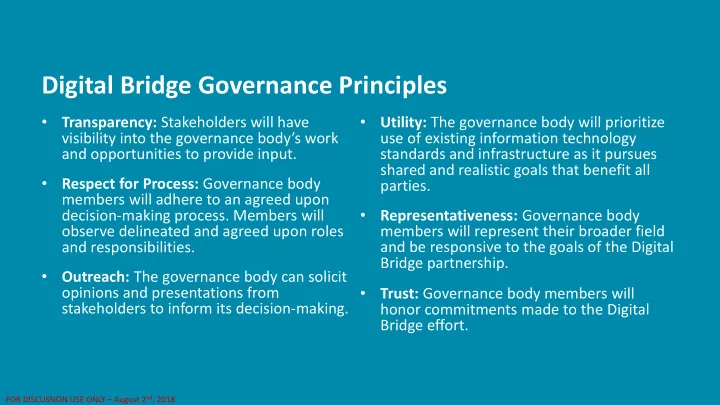
  • Transparency: Stakeholders will have

visibility into the governance body’s work and opportunities to provide input.

  • Respect for Process: Governance body

members will adhere to an agreed upon decision-making process. Members will

  • bserve delineated and agreed upon roles

and responsibilities.

  • Outreach: The governance body can solicit
  • pinions and presentations from

stakeholders to inform its decision-making.

  • Utility: The governance body will prioritize

use of existing information technology standards and infrastructure as it pursues shared and realistic goals that benefit all parties.

  • Representativeness: Governance body

members will represent their broader field and be responsive to the goals of the Digital Bridge partnership.

  • Trust: Governance body members will

honor commitments made to the Digital Bridge effort.

Digital Bridge Governance Principles

FOR DISCUSSION USE ONLY – August 2nd, 2018

slide-2
SLIDE 2

Governance Body Meeting

Thursday, August 2nd, 2018 12:00 – 1:00 PM ET This meeting will be recorded for note-taking purposes only

FOR DISCUSSION USE ONLY – August 2nd, 2018

slide-3
SLIDE 3

FOR DISCUSSION USE ONLY – August 2nd, 2018

slide-4
SLIDE 4

Meeting Agenda

Time Agenda Item 12:00 PM Call to Order 12:04 PM Agenda review and approval 12:05 PM Consent Agenda

1. HHS CTO ex officio seat on Digital Bridge governance 2. Governance plan objectives 3. Workgroup updates

12:10 PM eCR implementation update 12:25 PM Action: eCR transition planning 12:45 PM Discussion: Increasing health care representation and engagement in Digital Bridge 12:55 PM Informational: Coordinating vendor marketing and public health outreach to health care for eCR remaining Announcements – Charlie Ishikawa 1:00 PM Adjournment – John Lumpkin

Purpose:

The purpose of this meeting is to work toward a common vision for exchanging actionable information between public health and health care.

Consent Agenda

  • 1. HHS CTO ex officio seat on Digital Bridge

governance

  • 2. Governance plan objectives
  • 3. Workgroup updates

Risk Log

  • Implementation progress update

For Action

  • Governance memo: eCR transition planning

For Discussion

  • Increasing health care representation and engagement in

Digital Bridge

  • Coordinating vendor marketing and public health outreach

to health care for eCR FOR DISCUSSION USE ONLY – August 2nd, 2018

slide-5
SLIDE 5

Consent Agenda | June 2018

John Lumpkin (Chair)

FOR DISCUSSION USE ONLY – August 2nd, 2018

slide-6
SLIDE 6

Governance Meeting Consent Agenda

Protocol

1. Pre-meeting:

a. Chair places items that are believed to be non-controversial or routine b. Items should be received with sufficient review time

2. Start of meeting:

a. Chair asks if any member wishes to move an item into regular discussion b. All items left on the consent agenda are documented as approved by governance body c. Any item removed will be discussed during the meeting

August 2018 Consent Agenda Items

1. Governance objectives 2. HHS CTO ex officio governance body seat 3. Workgroup updates: a. eCR Implementation Workgroup b. Evaluation Committee c. Pilot Participation Workgroup

FOR DISCUSSION USE ONLY – August 2nd, 2018

slide-7
SLIDE 7

Consent Agenda

eCR demonstration and evaluation

1. Oversee eCR implementation and funding assurance 2. Determine how Digital Bridge will support nationwide eCR adoption and sustainability following the eCR pilot and evaluation

Governance organization and operation

1. Improve meeting efficiency, effectiveness and engagement 2. Assess and recharge workgroups to meet present initiative needs 3. Confirm governance body representation with founding organizations 4. Increase representation with health care providers 5. Revise charter to suit current initiative needs

Transition planning

1. Decide future information exchange use case selection criteria 2. Identify and prioritize potential new use cases for incubation 3. Identify potential organizational home(s) or operating entities for Digital Bridge 4. Identify potential sustainable funding models 5. Begin transition of Digital Bridge to a new business model

Item 1: Governance Objectives

  • Statements describing what

the PMO is working to accomplish for Digital Bridge governance.

  • Overseen by the governance

chair.

  • Subject to change at the

direction of the Digital Bridge governance body.

FOR DISCUSSION USE ONLY – August 2nd, 2018

slide-8
SLIDE 8

Consent Agenda

Item 2: HHS CTO ex officio seat Invite the Chief Technology Officer of the U.S. Department of Health and Human Services (HHS CTO) to participate in Digital Bridge governance as an ex officio. Leading reasons are:

i. Continue Jim Daniel’s engagement ii. Extend Digital Bridge reach and broaden federal participation

Item 3: Workgroup Updates See following pages for each workgroup: a. eCR Implementation Workgroup b. Evaluation Committee c. Pilot Participation Workgroup

FOR DISCUSSION USE ONLY – August 2nd, 2018

slide-9
SLIDE 9

Update: Pilot Participation Workgroup

Organization Name Designation Representing APHL Troy Willitt Chair Public Health Houston Methodist* TBD Member Participant MiHIN* TBD Member Participant Cerner* TBD Member EHR Vendor Epic* TBD Member EHR Vendor Houston Health Department* TBD Member Public Health Authority Utah Department of Health* TBD Member Public Health Authority

  • Troy Willitt, APHL general counsel, will serve as

chair

  • See table (left) for recommended membership
  • rganizations
  • Workgroup will convene remotely for one to two

kick-off calls in early fall once membership is finalized

  • Additional workgroup meetings will be

determined as needed

  • All communication will occur via Basecamp

*If there are no objectives to these recommendations, the chair and PMO steward will solicit individual members from each of the listed

  • rganizations. Each organization will have an opportunity to appoint either an implementation or legal contact, whichever they see most fit.

FOR DISCUSSION USE ONLY – August 2nd, 2018

slide-10
SLIDE 10

Update: Evaluation Committee

  • Committee reconvened and is chaired by Jeff

Engel of CSTE.

  • Committee will advise the development of the

evaluation instruments and identify activities related to or overlapping with implementation.

  • Reconvened on July 25, 2018
  • Increase in health care representation
  • Selection of co-chair
  • Goldie MacDonald, CDC
  • Committee is reviewing documentation

and tools

  • Key informant consent document
  • Data submission guidance document
  • Key informant interview guides
  • Next meeting: August 8

FOR DISCUSSION USE ONLY – August 2nd, 2018

slide-11
SLIDE 11

Update: eCR Implementation Workgroup

  • The governance body approved the workgroup

charge via email in July 2018

  • Laura Conn of CDC and Kirsten Hagemann of Cerner

will continue to chair the workgroup

  • Workgroup recruitment is underway; first meeting

planned for August 2018

  • The workgroup will focus on reviewing and

discussing technical implementation issues with initial implementation sites and will also interface with the Evaluation and Pilot Participation workgroups for any information or guidance they need

  • Two sites are currently in end-to-end testing: Utah

and Houston

  • Utah testing summary:
  • One successful end-to-end workflow testing; two test cases currently
  • being tested
  • Seventeen defects identified (three resolved)
  • To resolve defects and account for Utah PTO, testing was on pause 7/18-

7/30

  • Challenges uncovered in testing at Utah
  • Generation of new test patients was more time and resource intensive

than anticipated

  • Timing of how eICRs are generated within the EHR to minimize

duplicate eICRs may need to be revisited

  • Site engagement and preparation for

implementation continues

  • Most active sites include California, New York, Michigan and Kansas
  • For detailed status of each site and timelines,

please see appendices

FOR DISCUSSION USE ONLY – August 2nd, 2018

slide-12
SLIDE 12

Risk Log: eCR Implementation Update

Laura Conn (eCR Implementation Taskforce Co-Chair), Rob Brown (Digital Bridge PMO)

FOR DISCUSSION USE ONLY – August 2nd, 2018

slide-13
SLIDE 13

Utah End-to-End Testing

Testing Process

  • Utah officially began end-to-end testing on July 11
  • Initial testing has been managed through a

combination of stand-up calls and live working sessions to test initial cases

  • Intermountain has tailored test cases to accommodate

the idiosyncratic demographic characteristics of existing test patients and specifics of how fields/codes are used in the Cerner testing environment

Challenges

  • Designated test scenarios were revised to address

Intermountain-specific scenarios

  • Generation of new test patients was more time and

resource intensive than originally anticipated due to patients needing to be in the SunQuest Lab system and Cerner Millennium for proper workflow. Intermountain has been adjusting existing test patients to trigger eICRs with similar requests

  • Intermountain's testing does not exactly cover the test

cases defined initially, but necessary aspects of these scenarios are incorporated

Test Summary

  • One successful end-to-end workflow testing; two test cases currently being tested
  • Seventeen defects identified (three resolved)
  • Wide variety of defects impacting the Intermountain eICR (i.e., abnormal indicator, nullFlavor used in

medication section)

  • To resolve defects and account for Utah PTO, testing was on pause 7/18-7/30

FOR DISCUSSION USE ONLY – August 2nd, 2018

slide-14
SLIDE 14

Implementation Workgroup Update

  • Charge officially approved
  • First workgroup meeting will be in August
  • Membership still being defined
slide-15
SLIDE 15

Jan 2018 Feb 2018 Mar 2018 Apr 2018 May 2018 June 2018 July 2018 Aug 2018 Sept 2018 Oct 2018 Nov 2018 Dec 2018

Utah Site Production

Digital Bridge eCR Implementation Timeline - 2018 DRAFT

California Site Production Michigan Site Production Kansas Site Production New York City Site Production

RR Development & Testing Complete Production Environment Onboarding Environment

AIMS & RCKMS Milestones Utah Site Connectivity/Onboarding/Testing California Site Connectivity/Onboarding/Testing Michigan Site Connectivity/Onboarding/Testing New York City Site Connectivity/Onboarding/Testing Kansas Site Connectivity/Onboarding/Testing

Cerner corporate eICR product complete Today 8/2 FOR DISCUSSION USE ONLY – August 2nd, 2018

Houston E2E Testing Houston Site Production

(CDC managed eCR implementation)

slide-16
SLIDE 16

Jan 2019 Feb 2019 Mar 2019 Apr 2019 May 2019 June 2019 July 2019 Aug 2019 Sept 2019 Oct 2019 Nov 2019 Dec 2019

Digital Bridge eCR Implementation Timeline - 2019 DRAFT

Massachusetts Site Connectivity/Onboarding/Testing Massachusetts Site Production New York State Site Production New York State Site Connectivity/Onboarding/Testing Potential Interested Implementation Sites:

  • Delaware
  • Illinois
  • Iowa
  • Kentucky
  • Maryland
  • Minnesota
  • North Carolina
  • North Dakota
  • Pennsylvania
  • Tennessee
  • Wisconsin

FOR DISCUSSION USE ONLY – August 2nd, 2018

THIS LIST IS GROWING AND SOME SEPARATE GROUPS ARE FORMING TO DEFINE APPROACHES BECAUSE THEY FEEL EXCLUDED FROM DIGITAL BRIDGE

slide-17
SLIDE 17

Action: eCR Transition Planning

John Lumpkin (Chair)

FOR DISCUSSION USE ONLY – August 2nd, 2018

slide-18
SLIDE 18

Issue

Several decisions need to be made soon to ensure a smooth transition from piloting and evaluating eCR to their next focus. The decisions are as follows: 1. TRANSITION FROM PILOT - Beyond piloting and evaluating eCR, what will Digital Bridge do for nationwide eCR adoption and to assure eCR sustainability? 2. NEXT USE CASE - What will the initiative do to further bi-directional exchange in the health IT ecosystem? 3. ORGANIZATION - What is the most effective and efficient way to structure and support the Digital Bridge partnership for member priorities and interests in 2019 - 2020? For unanimous agreement on these decisions, the process should (a) ensure input from the full membership in a way that is accessible and sensitive to their limited time, and (b) utilize or account for all prior Digital Bridge strategic and sustainability work.

FOR DISCUSSION USE ONLY – August 2nd, 2018

slide-19
SLIDE 19

Action: Select eCR Transition Planning Process

slide-20
SLIDE 20

Discussion: Increasing health care representation and engagement in Digital Bridge

John Lumpkin (Chair)

FOR DISCUSSION USE ONLY – August 2nd, 2018

slide-21
SLIDE 21

Discussion: Increasing health care representation and engagement in Digital Bridge

Background There’s an acknowledgement that greater representation would help ensure an approach that health care professionals value and that we can communicate that value successfully/influentially. How and when to push for greater representation is a decision the governance body should make together. Discussion 1. When: Before or after pilot success? 2. How: Invite systems already engaged (implementation site systems like Intermountain

  • r Houston Methodist), or engage new health care

systems?

  • Option 1: Engage new health care systems in

governance body

  • Option 2: Engage implementing health care systems

in governance body FOR DISCUSSION USE ONLY – August 2nd, 2018

slide-22
SLIDE 22

Informational: Coordinating vendor marketing and public health outreach to healthcare for eCR

John Lumpkin (Chair, Digital Bridge governance body)

FOR DISCUSSION USE ONLY – August 2nd, 2018

slide-23
SLIDE 23

Informational: Coordinating vendor marketing and public health

  • utreach to health care for eCR

Sample questions PHA might ask of vendors:

1. What is their nomenclature for this “product”? Is it an eCR module/upgrade/package? 2. Is there a brief description of how eCR works for their system? 3. How do they plan to deploy this module within their system? Is it as easy as flipping a switch or is this a system reboot? 4. What is their general outreach strategy to market this product? Are they reaching out already? What is their approach? 5. Are all of their local affiliates aware of this product? Can a provider call a general customer service number to speak with someone who knows what eCR is?

  • Staff from a state public health

agency are curious if it would be possible to exchange information with vendors about product marketing (see example questions)

  • This may help PHAs form, or

advance, data trading partnerships with health care providers and systems, because issues regarding cost and technical feasibility are frequently discussed as barriers

  • r facilitators for health care to

acquire and implement a new messaging technology.

FOR DISCUSSION USE ONLY – August 2nd, 2018

slide-24
SLIDE 24

Announcements

Charlie Ishikawa

FOR DISCUSSION USE ONLY – August 2nd, 2018

slide-25
SLIDE 25

NEXT MEETING Thursday, September 6th, 2018, 12:00 – 1:00 PM EDT Action Items …

FOR DISCUSSION USE ONLY – August 2nd, 2018