Digital Bridge Governance Principles Transparency: Stakeholders - - PowerPoint PPT Presentation

digital bridge governance principles
SMART_READER_LITE
LIVE PREVIEW

Digital Bridge Governance Principles Transparency: Stakeholders - - PowerPoint PPT Presentation

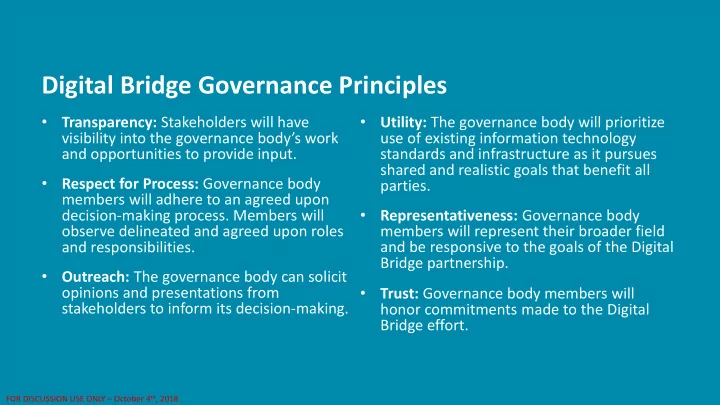
Digital Bridge Governance Principles Transparency: Stakeholders will have Utility: The governance body will prioritize visibility into the governance bodys work use of existing information technology and opportunities to provide


slide-1
SLIDE 1
  • Transparency: Stakeholders will have

visibility into the governance body’s work and opportunities to provide input.

  • Respect for Process: Governance body

members will adhere to an agreed upon decision-making process. Members will

  • bserve delineated and agreed upon roles

and responsibilities.

  • Outreach: The governance body can solicit
  • pinions and presentations from

stakeholders to inform its decision-making.

  • Utility: The governance body will prioritize

use of existing information technology standards and infrastructure as it pursues shared and realistic goals that benefit all parties.

  • Representativeness: Governance body

members will represent their broader field and be responsive to the goals of the Digital Bridge partnership.

  • Trust: Governance body members will

honor commitments made to the Digital Bridge effort.

Digital Bridge Governance Principles

FOR DISCUSSION USE ONLY – October 4th, 2018

slide-2
SLIDE 2

Governance Body Meeting

Thursday, October 4th, 2018 12:00 – 1:00 PM ET This meeting will be recorded for note-taking purposes only

FOR DISCUSSION USE ONLY – October 4th, 2018

slide-3
SLIDE 3

FOR DISCUSSION USE ONLY – October 4th, 2018

slide-4
SLIDE 4

Meeting Agenda

Time Agenda Item 12:00 PM Call to Order 12:03 PM Agenda review and approval 12:05 PM Consent Agenda 12:10 PM Risk Log

  • Reportable conditions – Jeff Engel (CSTE)
  • eCR Implementation progress – Laura Conn

12:35 PM Discussions

  • Difficulty of BAA approach – Troy Willitt (APHL)

12:50 PM Announcements – Charlie Ishikawa 1:00 PM Adjournment – John Lumpkin

Purpose:

The purpose of this meeting is to work toward a common vision for exchanging actionable information between public health and health care.

Consent Agenda

  • Workgroup updates
  • FAQs update

Risk Log

  • Implementation progress update

For Action

  • None

For Discussion

  • Difficulty of BAA approach

FOR DISCUSSION USE ONLY – October 4th, 2018

slide-5
SLIDE 5

Consent Agenda | October 2018

John Lumpkin (Chair)

FOR DISCUSSION USE ONLY – October 4th, 2018

slide-6
SLIDE 6

Governance Meeting Consent Agenda

Protocol

1. Pre-meeting:

a. Chair places items that are believed to be non-controversial or routine b. Items should be received with sufficient review time

2. Start of meeting:

a. Chair asks if any member wishes to move an item into regular discussion b. All items left on the consent agenda are documented as approved by governance body c. Any item removed will be discussed during the meeting

October 2018 Consent Agenda Items

1. Workgroup updates: a. eCR Implementation Workgroup b. Pilot Participation Workgroup c. Transition Workgroup d. Evaluation Committee 2. Updates to FAQ document a. Includes an answer to the question, “Is there an estimated timeframe for when other sites could potentially onboard with the Digital Bridge eCR approach?”

FOR DISCUSSION USE ONLY – October 4th, 2018

slide-7
SLIDE 7

Risk Log

Reportable Conditions 101 – Jeff Engel (CSTE)

FOR DISCUSSION USE ONLY – October 4th, 2018

slide-8
SLIDE 8

eCR Implementation Update

Laura Conn & Monica Coley (eCR Implementation Taskforce Co-Chairs), Rob Brown (Digital Bridge PMO)

FOR DISCUSSION USE ONLY – October 4th, 2018

slide-9
SLIDE 9

Update: eCR Implementation Workgroup

  • Implementation workgroup update:
  • Governance body approved workgroup charter

via email in July 2018

  • Laura Conn (CDC) and Kirsten Hagemann (Cerner)

will continue to chair the workgroup

  • Kirsten will be out on leave starting in

September, and Monica Coley from Cerner will be the temporary co-chair

  • First meeting was held in August 2018
  • Workgroup has reviewed and provided feedback
  • n the Technical Specifications
  • Workgroup is providing feedback and

recommendations on proposed high-level

  • nboarding process
  • Utah testing summary:
  • Three successful end-to-end workflow testing; five test cases being tested

currently

  • 21 Defects Identified (17 Resolved)
  • IMH pushed eICR/ triggering functionality to production without sending

messages through the firewall to AIMS

  • Within one week – 3,000 eICRs generated for 1,800 unique patients for five

pilot conditions

  • Challenges uncovered in testing with Utah
  • Generation of new test patients was more time- and resource-intensive than
  • riginally anticipated
  • Timing of how eICRs are generated within the EHR to minimize duplicate eICRs is

being revisited

  • Intermountain test environments and interfaces have been up and down,

preventing testing and creation of some test patients

  • Houston testing summary:
  • Able to trigger on Problem List – SNOMED
  • SNOMED translated to ICD-10 when diagnosis is not triggered
  • Challenges uncovered in testing with Houston
  • Epic product does not trigger from diagnosis fields, diagnosis trigger codes are

being triggered out of problem list

  • Using production environment for testing
  • Surescripts HISP/Epic issue with patient data in wrapper of returned Reportability

Response has not allowed processing of RR that is received at HM

  • Site engagement and preparation for implementation continues
  • Most active sites include California, NY, Michigan, Kansas
  • For detailed status of each site and timelines, please see appendices

Consent Agenda | Digital Bridge Governance Meeting | For Discussion Only 9 FOR DISCUSSION USE ONLY – October 4th, 2018

slide-10
SLIDE 10

Jan 2018 Feb 2018 Mar 2018 Apr 2018 May 2018 June 2018 July 2018 Aug 2018 Sept 2018 Oct 2018 Nov 2018 Dec 2018

Utah Site Production

Digital Bridge eCR Implementation Timeline - 2018 DRAFT

California Site Production Michigan Site Production

RR Development & Testing Complete Production Environment Onboarding Environment

AIMS & RCKMS Milestones Utah Site Connectivity/Onboarding/Testing California Site Connectivity/Onboarding/Testing Michigan Site Connectivity/Onboarding/Testing New York City Site Connectivity/Onboarding/T esting Kansas Site Connectivity/Onboarding/T esting

Cerner corporate eICR product complete Today 10/4 FOR DISCUSSION USE ONLY – October 4th, 2018

Houston E2E Testing Houston Site Production

(CDC managed eCR implementation)

slide-11
SLIDE 11

Jan 2019 Feb 2019 Mar 2019 Apr 2019 May 2019 June 2019 July 2019 Aug 2019 Sept 2019 Oct 2019 Nov 2019 Dec 2019

Digital Bridge eCR Implementation Timeline - 2019 DRAFT

New York State Site Production New York State Site Connectivity/Onboarding/Testing Potential Interested Implementation Sites:

  • Delaware
  • Illinois
  • Iowa
  • Kentucky
  • Maryland
  • Minnesota
  • North Carolina
  • North Dakota
  • Ohio
  • Pennsylvania
  • South Dakota
  • Tennessee
  • Wisconsin

FOR DISCUSSION USE ONLY – October 4th, 2018

Anticipate discussion of how eCR onboarding will be opened up as part of eCR transition

New York City Site Production Kansas Site Production New York City Site Connectivity/ Onboarding/ Testing Kansas Site Connectivity/ Onboarding/ Testing

slide-12
SLIDE 12

California Parkinson’s Registry Update

Benson Chang (Digital Bridge PMO)

FOR DISCUSSION USE ONLY – October 4th, 2018

slide-13
SLIDE 13

California Parkinson’s Registry Use Case Update

Background

  • In July, California Department of Health (CDPH) made it known that they were

interested in potentially using Digital Bridge to collect required reporting for the statewide Parkinson’s Registry

  • Electronic reporting for Parkinson’s is mandated by statute by January 2019,

although clarifications by CDPH indicate providers have until March 2019

  • PMO directed to perform additional investigation and requirements scoping with

DSI partners in August 2018, initial discovery session held August 29, 2018

slide-14
SLIDE 14

California Parkinson’s Registry Use Case Update

Accomplishments this month

  • Follow up requirements and scoping discussions held on September 12, 21, and 24
  • Attendees included CDPH, DSI leads (CDC, APHL, CSTE), and PMO
  • UC Davis and Epic involved in discussions; 9/24 discussion held to clarify Epic plans for software development

necessary

  • General conclusions from meetings:
  • Some concerns mitigated – CDPH willing to issue waivers to providers who are planning to implement reporting this

way (does not need to be done by January 2019)

  • More discovery may be needed before a complete picture of risks and sustainability can be presented and the

governance body makes a decision

  • Concerns:
  • Legal agreements may need to be signed regardless for reporting to be done this way
  • DSI team is concerned about scalability of connections to more CA providers and understanding how CDPH will

route and onboard each new provider in addition to general unknowns and the possibility of cannibalizing resources from other Digital Bridge site implementations

  • Epic needs to make changes to their software to trigger case reports off of diagnosis instead of just problem list

to support this use case. The updates will need to be retrofitted to a variety of previous Epic versions to support the needs of the California Epic users. Epic is currently going through its estimation and release planning process and cannot give a firm commitment to a release timeline, although they believe tentatively it will be in January

  • 2019. Epic agreed to meet with the PMO again to confirm a release schedule in mid-October.
slide-15
SLIDE 15

California Parkinson’s Registry Use Case Update

Next steps

  • Confirm with Epic timeline of software modifications and release schedule by

mid-October 2018

  • Convene follow-up meetings as necessary
  • Present proposal to governance body for action in November 2018
slide-16
SLIDE 16

Discussion: Experiences of implementing a business associate framework

Troy Willitt, APHL

FOR DISCUSSION USE ONLY – October 4th, 2018

slide-17
SLIDE 17

eCR Using a Business Associate Framework

FOR DISCUSSION USE ONLY – October 4th, 2018

slide-18
SLIDE 18

Structure of Legal Agreement

Pilot Participation Agreement

  • Agreement between pilot health care provider
  • r HIE (a participant) and APHL
  • Provides legal framework for pilot sites to

enable transmission of protected health information to APHL, and, if elected, for APHL to transmit those data to public health authorities in accordance with applicable law

  • n participant’s behalf
  • Makes explicit that pilot project only includes

a subset of all reportable conditions

Business Associate Agreement

  • Formatted as an addendum to the Pilot

Participation Agreement

  • Accounts for requirements as defined by

HIPAA (e.g., permitted uses and disclosures, additional obligations of APHL, breach reporting, ownership of information)

FOR DISCUSSION USE ONLY – October 4th, 2018

slide-19
SLIDE 19

Lessons Learned to Date

  • Challenges in negotiating the liability limit with the first three pilot participants
  • Implications for APHL’s annual cybersecurity insurance coverage
  • Remaining pilot sites are eager to review and sign the pilot participation

agreement

  • Logistics of getting every provider/HIE onboarded
  • Additional exploration needed if AIMS/ RCKMS to be used to facilitate

Parkinson’s disease reporting in California, beginning with UC Davis

FOR DISCUSSION USE ONLY – October 4th, 2018

slide-20
SLIDE 20

Announcements

Jim Jellison, Jelisa Lowe and Charlie Ishikawa

FOR DISCUSSION USE ONLY – October 4th, 2018

slide-21
SLIDE 21

ONC Request for Information

  • ONC has issued an RFI for the 21st Century Cures Act EHR Reporting Program
  • The request: help develop EHR reporting program criteria and processes that are required by the

Cures Act

  • Deadline: Wednesday, October 17, 2018 at 5:00PM ET
  • Relevance to Digital Bridge:
  • The Cures Act requires the EHR Reporting Program's criteria to address five categories (security,

interoperability, usability and user-centered design, and conformance to certification testing)

  • Other suggested categories include accessing and exchanging data held by federal, state, and local

agencies

  • Decision: Should the Digital Bridge governance body submit official comments?
  • If yes, the PMO suggests
  • One governance body representative guide the PMO in drafting before an asynchronous vote
  • Keep response brief and high level
  • Emphasize goal of bi-directional information exchange between health care and public health
  • Encourage a conceptualization of "reporting to clinical registries" that encompasses eCR and public health

surveillance

  • Applaud ONC's support for modern, API-based approaches for interoperability

21

slide-22
SLIDE 22

Communications

  • Upcoming events
  • Johns Hopkins University panel – October

26, 2018

  • Connecting Healthcare and Public Health

through a Digital Bridge

  • AMIA 2018 Annual Symposium –

November 5, 2018

  • Informatics Challenges, Solutions and

Opportunities for Public Health Electronic Case Reporting

  • 2019 ISDS Annual Conference
  • Abstract submitted, awaiting response
  • Upcoming abstract deadlines
  • 2019 Health Datapalooza
  • Abstract deadline: October 22, 2018

FOR DISCUSSION USE ONLY – October 4th, 2018

slide-23
SLIDE 23

NEXT MEETING Thursday, November 1st, 2018, 12:00 – 1:00 PM EDT Action Items …

FOR DISCUSSION USE ONLY – October 4th, 2018