
SLIDE 1
.
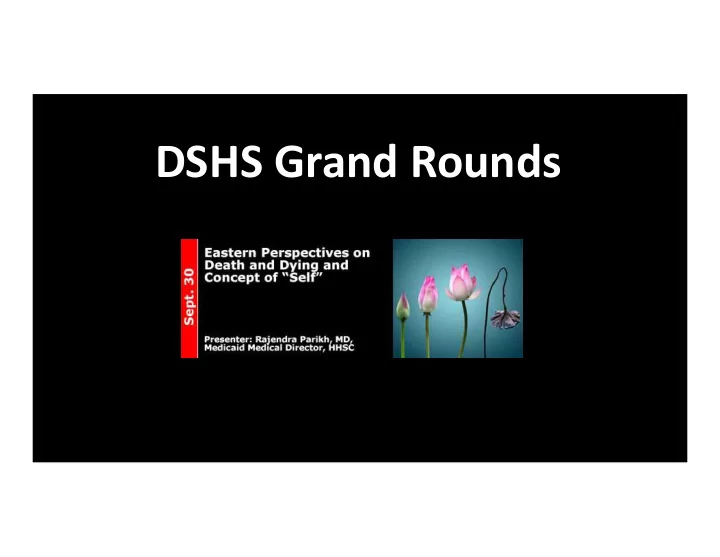
DSHS Grand Rounds . Logistics Registration for free continuing - - PowerPoint PPT Presentation
DSHS Grand Rounds . Logistics Registration for free continuing education (CE) hours or certificate of attendance through TRAIN at: https://tx.train.org Streamlined registration for individuals not requesting CE hours or a certificate of attendance
.
2
Registration for free continuing education (CE) hours or certificate of attendance through TRAIN at: https://tx.train.org Streamlined registration for individuals not requesting CE hours
For registration questions, please contact Laura Wells, MPH at CE.Service@dshs.state.tx.us
3
Slides and recorded webinar available at: http://www.dshs.state.tx.us/grandrounds Questions? There will be a question and answer period at the end of the presentation. Remote sites can send in questions throughout the presentation by using the GoToWebinar chat box or email GrandRounds@dshs.state.tx.us. For those in the auditorium, please come to the microphone to ask your question. For technical difficulties, please contact: GoToWebinar 1‐800‐263‐6317(toll free) or 1‐805‐617‐7000
4
Requirement of Learner Participants requesting continuing education contact hours or a certificate of attendance must register in TRAIN, attend the entire session, and complete the online evaluation within two weeks of the presentation. Commercial Support This educational activity received no commercial support. Disclosure of Financial Conflict of Interest The speakers and planning committee have no relevant financial relationships to disclose. Off Label Use There will be no discussion of off‐label use during this presentation. Non‐Endorsement Statement Accredited status does not imply endorsement by Department of State Health Services ‐ Continuing Education Services, Texas Medical Association, or American Nurses Credentialing Center of any commercial products displayed in conjunction with an activity.
5
Additional Readings
For more information, please e-mail the DSHS Medical and Research Library (Library@dshs.state.tx.us)
Being Mortal: Medicine and What Matters in the End by Atul Gawande Advaita Vedanta: An Introduction by Arvind Sharma Complete Works of Swami Vivekananda by Swami Vivekananda How We Die: Reflections of Life's Final Chapter by Sherwin B. Nuland The Heart of the Buddha's Teaching: Transforming Suffering into Peace, Joy, and Liberation by Thich Nhat Hanh The Essence of Vedanta: The Ancient Wisdom of Indian Philosophy by Brian Hodgkinson A Guide to Hindu Spirituality (Perennial Philosophy) by Arvind Sharma
6
Kirk Cole DSHS Interim Commissioner is pleased to introduce our DSHS Grand Rounds speaker
7
Rajendra C. Parikh, MD, MBA, CPE Medical Director Texas Medicaid and CHIP Division Texas Health & Human Services Commission
8
9
10
Foundational Beliefs based on:
Socio Economic, Cultural factors influencing
Providers and Members of Society
Organization of Health Care Delivery Systems
11
Socrates (Plato’s Apology).
12
Death is an enemy and a consequence of a sin. When someone dies, their body goes into the grave and their spirit goes into an afterlife to face judgment. Whoever does not obey the Son shall not see life, but the wrath of God remains on him”. The Bible is clear that one day there will be a bodily resurrection for everyone to either eternal salvation in heaven or eternal condemnation in hell. Mark Driscoll - founding pastor of Mars Hill Church, Seattle.
CNN Debate on concept of Hell
13
“For the wages of sin is death,” (Romans 6:23)
“By one man sin entered the world, and death by sin, and
so death passed upon all men, for that all have sinned” (Romans 5:12).
Eastern view: (Buddha - A Role of a Physician not a Judge)
I am the all devouring death, and also the origin of future beings. I am the beginning, the middle, and the end of all creation.
Lord Krishna in Gita
Science has found that nothing can disappear without trace.
Nature does not know extinction. All it knows is transformation!
Death is not extinguishing the light.
It is putting out the lamp because dawn has come.
Ravindranath Tagore
Death is but changing of our robes to wait in
wedding garments at the Eternal's gate.
Sri Aurobindo
Death is not the end. Death can never be the end.
Death is the road. Life is the traveler. The Soul (!) is the Guide. Sri Chinmoy
15
Where one sees something else, hears something
else, recognizes something else, that is the finite.
That which is finite is mortal and cannot escape
Where one sees nothing else, hears nothing else,
recognizes nothing else, that is the Infinite.
That which is Infinite is Immortal and deathless.
16
Just as a tidal-wave brings together two logs
No one can avoid the common lot of all.
17
Of that which is born, death is sure; Of that which
is dead, birth is sure. Over the unavoidable, therefore you never should grieve.
This indweller in all bodies is ever indestructible.
Therefore you should not ever mourn for any creature.
18
A Temporary Cessation of physical activity. A Necessary Means of recycling the resources and energy. An opportunity for the “Jivatman” to review its programs and
policies.
What is Jivatman? We will come to that!
19
To be considered free in life, we must also be free from the fear
comprehend the laws of Nature. Whenever fear arises, it
What is born will die What has been gathered will be dispersed, What has been accumulated will be exhausted, What has been built up will collapse, And what has been high will be brought low.
20
Death is as impermanent as life itself is. Sanghāta - Everything in this universe is a
Vighāta - Death is an inevitable change or
21
Birth is not a beginning. Death is not an end. There is existence without limitation. Existence without
limitation is space.
There is continuity without a starting point. Continuity
without a starting point is time.
There is birth, there is death, there is issuing forth, there is
entering in.
That through which one passes in and out without seeing its
form, that is the Portal of God.
22
As a caterpillar, having come to the end of one blade of grass, draws itself together and reaches out for the next, so the self, having come to an end of one life and shed all ignorance, gathers its faculties and reaches out from the
Brihadaranyka Upanishad
23
I died as a plant and rose to animal, I died as animal and I was man. Why should I fear death? When was I less by dying?
Jalaluddin Rumi, A Sufi poet
24
The necessity of nature’s final victory was expected and accepted in generations before our own. Doctors were far more willing to recognize the signs of defeat and far less arrogant about denying them. Sherwin Nuland, M.D. (How We Die) There is no escaping from the tragedy of life which is that we are all aging from the day we are born. Death, of course, is not a failure. Death may be an enemy but it is also the natural order of things. Atul Gawande, M.D. Being Mortal: Medicine and What matters in the End.
25
USA is a death denying/defying society where
People vow not to go gently into the good night
(Kalish & Reynolds, 1981)
26
90% of respondents to NHO Gallup survey want to die at
home. 1949 – 50% of deaths in institutions 1958 – 61% of deaths in institutions 1980 – 74% (57% hospitals, 17% nursing homes, 20% home) 2000 – 75% (50% in hospitals, 25% in nursing homes)
27
30 % of Medicare payments in last year of life. 12 % of Medicare spending covers in the last two months. 10 % of Medicare beneficiaries - 70 % of program spending. Differences in medical expenditures vary greatly by gender,
race and income among patients two and three years before they die, those differences narrow or disappear during the last year of life
RAND Health Research 2004.
28
An individual who has sustained either/or
is dead. Dilemma of "purgatory status” - the brain itself can be very badly damaged but the brain stem can still function. People with no "cognitive" powers can continue to breathe, their hearts can pump blood throughout their bodies, and they can maintain sleep-wake cycles for as long as you force nutritional fluids into them intravenously. e.g. Karen Ann Quinlan Question Is consciousness extinguished at death? Is consciousness changing? - Can those changes can be influenced by the circumstances of the dying process?
29
Hindus tested lowest in death anxiety (greatest belief in life
after death) followed by the Muslims, while the Christians showed the highest death anxiety.(One life to live!). Parsuram and Sharma (1992)
A strong negative correlation between death anxiety and belief in afterlife.
That is, as the degree of certainty in afterlife increased, levels of death anxiety decreased. Alvarado, Templer, Bresler, and Thomson-Dobson (1995)
30
Medical Science comes with “technical solutions to human
intractable technical problems for End of Life”.
Science actively promotes increased and Unrealistic
Expectations for a Transitory Version of satisfaction. Spirituality prepares one for a State of Serenity by curbing those Desires and Unrealistic Expectations.
31
Distribution of Medical Graduates by Race/Ethnicity, 2011
TX # US # White 670 10,783 Black 81 1,129 Asian 308 3,767 Hispanic 201 1,336 American Indian and Alaska Native 9 135 Native Hawaiian and Other Pacific Islander 2 49 Other Non-Hispanic 13 33 Foreign 14 292 No Response/Unknown 15 321 Total Graduates 1296 17364
32
Race/Ethnicity Number Percentage
White 519,840 54.5 Black 33,781 3.5 Hispanic 46,507 4.9
Asian 116,412 12.2
American Native/Alaska Native 1,594 .16 Other 13,019 1.3 Unknown 223,071 23.4
Total Physicians by Race/Ethnicity - 2008 (total physicians = 954,224)
Source: Physician Characteristics and Distribution in the US, 2010 Edition. American Medical Association. 33
22% of the current medical students in American medical
schools are of Asian origin.
10% of current students are Indian origin. 7% of the current physicians are from India. Rapidly changing demographics and Multi-Cultural society
(especially physicians).
Economic Hierarchy drives Value systems, Morality
and Ethics!
34
Religious variables - Euthanasia /Physician-assisted suicides, “Do not resuscitate”
control and Abortion. J Gen Intern Med. July,2005.
Physicians are more likely to belong to religious traditions that are under represented
in the United States.
US Women physicians were less likely to be Christian (61% versus 85% of the
general population) Jewish (13% vs. 2.0%), Buddhist (1.4% vs. 0.3%), Hindu (4% vs. 0.4%), Atheist/Agnostic (6% vs. 0.6%).
Physicians of under represented traditions take pains to limit the overt influence of
their religious commitments in recognition of the discordance between their own religions and those of their patients. Social Science & Medicine December 1999
35
It is a careful analysis of the ways in which an individual's
state of mind and motivations can affect his Perceptions, Experiences and Interpretations of Himself and the World.
Ethics is knowing the difference between what you have a
right to do and what is right to do. Potter Stewart
East is east, west is west and twain shell never meet
Rudyard Kipling
36
Philosophy: The discipline comprising logic, ethics, aesthetics, metaphysics
and epistemology.
Metaphysics: A priori speculation upon questions that is unanswerable to
scientific observation, analysis, or experiment.
Ontology: The branch of metaphysics that deals with the nature of being. Epistemology: Studies the nature of knowledge, its presuppositions and
foundations, and its extent and validity.
Axiology: The study of value or goodness, in its widest sense. Theology: Study of the nature of God and the relationship of the human
and divine.
37
Literal Interpretation of Scripture Mainline Churches*
word
Literal Interpretation of Scripture Among Hindus*
*Pew foundation Research, 2008
38
39
40
42
A car cannot run without a driver. Similarly, the body will not work without the presence of the “ATMAN.” The driver develops a deep attachment to and identifies with the car. The soul i.e. Jivatman identifies with the body in the same way. Although the driver is not the vehicle, he will move according to the nature of the car, namely fast, slow, etc. The same driver can get out of one vehicle and drive another. Similarly, the soul leaves one body and enters another.
43
Die on a machine Die in discomfort Be a burden Die in institution
Die not on a ventilator Die in comfort Die with family/friends Die at home
44
Five stages: Elisabeth Kübler-Ross Denial Anger (Karma Theory)! Bargaining Depression Acceptance (Reincarnation)!
45
46
Quality
Utilization
Pain / symptom relief
47
Race, ethnicity and Culture
Socioeconomic class
48
cognitive symptoms Physical symptoms Care giving needs
Economic demands
49
Systematizing, defending, and recommending concepts of right and
wrong behavior.
Three general subject areas
universal truths, the role of reason in ethical judgments.
regulates right and wrong conduct.
abortion, Euthanasia, pain and suffering, dying process, etc.
50
“Advocates of such programs have been demonized. They have been criticized by the Catholic Church in the name of “life,” and vilified by Sarah Palin and Michele Bachmann in the pursuit of cheap political gain…….Anything that looks like an official protocol, or guideline — you’re going to get death-paneled,” “There are lots of reasons to believe you could save money,” …..I just think we can’t do it for the reason of saving money.”
Bioethicist and expert on end-of-life care
51
Logical principle: Karma stands for strict causal necessity between actions and
resulting effects.
Metaphysical principle: it espouses immortality of Atman. Ethical principle: it explains the diversity in destiny of men regarding their birth
and fortunes. (R. K. Garg)
things will happen to you“
52
The moral and physical law of cause and effect by which
each individual creates one's own future destiny.
An interaction (A chain reaction) of actions and reactions. It is a predisposition and not Fatalism. It can be “influenced” but not be fundamentally altered*.
53
Three kinds:
Sanchita (Accumulated) Prarabdha (Fruit-bearing) Kriyamana (Current)
All Kriyamana karmas become Sanchita karma upon completion of act. Three elements:
The thought, which conceives the action The will, which finds the means of accomplishment. The union of thought and will, which brings the action to fruition.
A natural, impersonal law of moral cause and effect and has no connection with the idea of a supreme power that decrees punishment or forgiveness of sins*.
54
The theory of Newton states that “every action produces an equal
and opposite reaction.”
“Sum of person's actions in one of his successive states of existence, viewed as
deciding his fate for the next.” (Oxford Dictionary).
It is “a volitional action that is undertaken deliberately or
knowingly.”
Every time we think or do something, we create a cause, which in
time will bear its corresponding effects. And this cyclical cause and effect generates the concepts of birth/death and reincarnation.
55
Just as the “Self” advances through childhood, youth and old age in its physical body, so it advances to another body after death. The wise person is not confused by this change called death. Just as the body casts off worn out clothes and puts on new ones, so the infinite, immortal self casts off worn out bodies and enters into new ones. Lord Krishna in Gita
56
I am of the nature to age, I have not gone beyond ageing. I am of the nature to sicken, I have not gone beyond sickness. I am subjected to my own karma, I am not free from karmic effects. I am of the nature to die, I have not gone beyond dying. All that is mine, beloved and pleasing, will change, will become
56
58
60
Inability to perform normal bodily purification. Death appears imminent or life's pleasures are nil. The decision is publicly declared. The action is made under community regulation.
61
A spiritual purification - A holy fast unto death, rids the soul of negative karma and brings about death with dignity and dispassion. Promote detachment - Not an act of suicide - Recommended only for a few spiritually fit persons and under strict supervision, usually in a public forum, with the approval of the family and spiritual superiors. People who die in this "death of the wise" (Pandita-marana) are considered to be only a few births removed from final liberation from the painful cycle of death and rebirth.
62
Abstention from food - Death through renunciation (Sannyasana marana) Death through meditation (Samaadhi marana). Ensure that there are no signs of bad death (feces, vomit, or urine). "When a wise man, in whatever way, comes to know that the apportioned space of his life draws towards its end, he should in the meantime quickly learn the method of dying a religious death."
63
Fasting to death: An acceptable way for a Hindu to end life in certain
When it is the right time for this life to end – (this body has served its purpose
and become a burden).
A Gradual process, giving ample time for the patient to prepare himself in a
thoughtful manner and (those around him) for his death.
Feelings of serenity and fulfillment of desires vs. suicide is associated with
feelings of despair.
64
A Hindu Perspective
By helping to end a painful life a person is performing a good deed and
so fulfilling their moral obligations. Counter point
By helping to end a life, even one filled with suffering, a person is
disturbing the timing of the cycle of death and rebirth.
Those involved in the euthanasia will take on the remaining karma of
the patient.
Use of a temporary life-support machine as part of healing is
acceptable but keeping a person artificially alive on a life-support machines disturbs his/her Karmic consequences.
65
Active Euthanasia: Causing death directly by some active means
(administration of a lethal injection). Passive Euthanasia: Allowing "nature to take its course” even though the means to intervene are available. Allowing death to occur or causing death to occur by Removal or refusal of life-sustaining treatment, A Point of controversy: Any chance of healing or rehabilitation, treatment becomes a painful invasion making the last days before death a nightmare of suffering. Role of living wills and medical proxy legislation, physician assisted suicide, legalize euthanasia or mercy killing
66
Buddhism teaches that the very attempt to avoid suffering creates ever more suffering….Death is not the end, suffering does not cease thereupon, but continues until the karma that created the suffering has played itself out Philip Kapleau Roshi The Buddhist masters speak of the need to die consciously with as lucid, un-blurred, and serene a mental mastery as possible. Keeping pain under control without clouding the dying person's consciousness is the first prerequisite. Sogyal Rinpoche (The Tibetan Book of Living and Dying) If a dying person has any chance of having positive, virtuous thoughts, it is important— and there is a purpose—for them to live even just a few minutes longer. If there is no such chance for positive thoughts …….then there seems to be no point. Dalai Lama
67
68
Ravindranath Tagore (Poet, philosopher, first Hindu Nobel laureate)
69
A part of the unfolding of karma. A consequence of past inappropriate action
(mental, verbal or physical) that occurred in either
A natural consequence of the moral laws of the
universe in response to past negative behavior and not a punishment.
70
Famous case of Karen Quinlan/Schivo and Western Dilemma.
Bhishma in Mahabharata (voluntary withdrawal of intake acceptable to
societal beliefs).
Hinduism states that natural death helps to lead towards Moksha
(Salvation) or liberation from birth-death cycle.
71
Accepts death as part of a cosmic cycle or order of things. Terminal illness with time for preparation is preferred to a sudden death. The state of the mind at the time of death influences their rebirth. Physical pain may be attributed to harmful actions carried during their own
For the elderly, many medical interventions available may be viewed as “futile” because aging process seen as natural. A an elderly terminally ill patient’s detachment from treatment decisions or withdrawal into spiritual preparation should not be mistaken for depression. Lack of acceptance of life-threatening disease by loved ones, may cause dying person to become “attached” and increase spiritual distress.
72
Hinduism embraces a diversity of traditions.
Life is a transition between the previous one and the next one. Karma explains inequity and suffering in this life and affects the next life. A good death is timely, in the right place, conscious and prepared, with the mind on God. A bad death is untimely, violent, and unprepared. Religious grounds exists for voluntary euthanasia for spiritually advanced
after death. Involuntary euthanasia may be justified to prevent extreme suffering.*
73
74
75
He who dies begins to live. Birth and death are merely doors of
Swami Shivananda
76
Take me away from the Unreality (of the bondage of the Phenomenal World), but lead me towards the Reality (of the Eternal Self). Take me away from the Darkness (of Ignorance) and lead me towards the Light (of Spiritual Knowledge). Take me away from the (Fear of) Death (due to the bondage of the Mortal World) and lead me towards the state of deathlessness (i.e. Knowledge of the Immortal Self beyond Death).
77
Neither am I bound by Death and its Fear, nor by the rules
Neither do I have Father and Mother, nor do I have Birth. I am the Ever Pure Blissful Consciousness. I am Shiva, I am Shiva, The Ever Pure Blissful Consciousness.
Shankaracharya
78
No weapon can cleave him; Nor the fire burn him, No waters can make him wet, Nor the wind dry him up. Un-cleavable is he; He is not burnt; Nor be wetted And neither be dried; Eternal, all-pervading, stable and immovable is he from
everlasting time.
79
Never is he (Atman) born, nor does he die at any
time, he has never been brought into being, nor shall come hereafter; unborn, eternal, permanent and ancient (primeval). When the body is slain, he is not slain.
Truly there never was a time when I was not, nor
you, nor these Lords of men, nor in the future a time when we shall cease to be.
80
81
Who AM I? What is Bondage? What is Jivatman /Atman Relationship? Who Dies? Who/How/What Survives?
82
From the earliest times, the scriptures condemn the practice,
except when the mother's life is in danger. An act against Rita (Natural order) and ahimsa.
The fetus is a living, conscious person, needing and deserving
protection (a Rig Vedic hymn for protection of the fetus).
The Kaushitaki Upanishad describes abortion as equivalent
to killing one's parents.
The Atharva Veda lists the fetus slayer among the greatest
sinners.
(Hinduism's Online Lexicon)
83
The soul in the womb not a new soul. It contemplates its previous births. The purpose of life is to make progress toward
liberation from rebirth.
Abortion condemned as it obstructs this unfolding
84
Transmigration of consciousness occurs at
A minority tradition as in Hindu embryology
85
Absolutist: Bad karma is incurred from any act of murder,
regardless of justifications.
Utilitarian: Can be a compassionate act with positive karmic
consequences, taking into account factors such as the health of the fetus or mother, the population crisis, and the readiness of the parents to raise a child.
Virtue-oriented: The attitude and motivations of the pregnant
woman and her collaborators would determine the ethics of an
contraception would be more karmically significant than an abortion necessitated in spite of contraception.
86
Remote sites can send in questions by typing in the GoToWebinar chat box or email GrandRounds@dshs.state.tx.us. For those in the auditorium, please come to the microphone to ask your question.
87
Emilie Attwell Becker, M.D. Mental Health Medical Director Texas Medicaid and Chip Program Texas Health & Human Services Commission
88
DSHS Grand Rounds Spring Semester 2016
Wednesday, April 6, 2016 Wednesday, April 13, 2016 Wednesday, April 20, 2016 Wednesday, April 27, 2016 Wednesday, May 4, 2016 Wednesday, May 11, 2016 Wednesday, May 18, 2016