DSHS Grand Rounds Presenter: Donald Dudley, MD, UT Health Science - - PowerPoint PPT Presentation

dshs grand rounds presenter donald dudley md ut health
SMART_READER_LITE
LIVE PREVIEW

DSHS Grand Rounds Presenter: Donald Dudley, MD, UT Health Science - - PowerPoint PPT Presentation

DSHS Grand Rounds Presenter: Donald Dudley, MD, UT Health Science Center at San Antonio . Logistics Registration for free continuing education (CE) hours or certificate of attendance through TRAIN at: https://tx.train.org Streamlined


slide-1
SLIDE 1

.

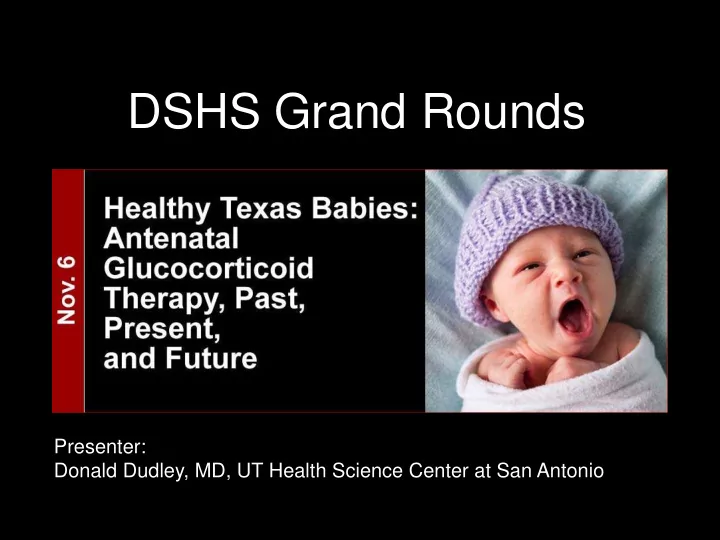
DSHS Grand Rounds

Presenter: Donald Dudley, MD, UT Health Science Center at San Antonio
slide-2
SLIDE 2

Logistics

2

Registration for free continuing education (CE) hours or certificate of attendance through TRAIN at:

https://tx.train.org

Streamlined registration for individuals not requesting CE hours

  • r a certificate of attendance
  • 1. webinar: http://extra.dshs.state.tx.us/grandrounds/webinar-noCE.htm
  • 2. live audience: sign in at the door

For registration questions, please contact Annette Lara, CE.Service@dshs.state.tx.us

slide-3
SLIDE 3

Logistics (cont.)

3

Slides and recorded webinar available at:

http://extra.dshs.state.tx.us/grandrounds

Questions?

There will be a question and answer period at the end of the presentation. Remote sites can send in questions throughout the presentation by using the GoToWebinar chat box or email GrandRounds@dshs.state.tx.us. For those in the auditorium, please come to the microphone to ask your question.

For technical difficulties, please contact:

GoToWebinar 1-800-263-6317(toll free) or 1-805-617-7000

slide-4
SLIDE 4

Disclosure to the Learner

4

Requirement of Learner Participants requesting continuing education contact hours or a certificate of attendance must register in TRAIN, attend the entire session, and complete the

  • nline evaluation within two weeks of the presentation.

Commercial Support This educational activity received no commercial support. Disclosure of Financial Conflict of Interest The speakers and planning committee have no relevant financial relationships to disclose. Non-Endorsement Statement Accredited status does not imply endorsement by Department of State Health Services - Continuing Education Services, Texas Medical Association, or American Nurses Credentialing Center of any commercial products displayed in conjunction with an activity.

slide-5
SLIDE 5

5

David Lakey, MD

DSHS Commissioner is pleased to introduce today’s DSHS Grand Rounds speakers

slide-6
SLIDE 6

Healthy Texas Babies: Antenatal Glucocorticoid Therapy, Past, Present, and Future

Donald J. Dudley, M.D.

Division of Maternal-Fetal Medicine Department of Obstetrics and Gynecology University of Texas Health Science Center at San Antonio

6

slide-7
SLIDE 7

Learning Objectives

Participants will be able to: 1. Describe the past investigations that led to the discovery and early use of antenatal steroid therapy to prevent complications of preterm birth. 2. Analyze the indications, contraindications, and current recommendations regarding the use of antenatal steroid therapy to prevent the complications of preterm birth. 3. Recognize the gaps in knowledge regarding the use of antenatal steroid therapy and where future investigations should be focused to improve outcomes for preterm babies.

7

slide-8
SLIDE 8

8

slide-9
SLIDE 9

Why Antenatal Steroid Therapy? The Past

9

slide-10
SLIDE 10

Liggins and Howie

10

slide-11
SLIDE 11

Results from Liggins and Howie

11

slide-12
SLIDE 12

12

slide-13
SLIDE 13

13

slide-14
SLIDE 14

P=0.05 Multicenter Prospective Randomized Trial of Dexamethasone in Women At Risk for Preterm Birth (overall N=661 women/ 720 infants)

14

slide-15
SLIDE 15

15

slide-16
SLIDE 16

16

slide-17
SLIDE 17

Use Antenatal Steroids in African American Women with Singleton Girl Babies Between 30-34 Weeks Gestation

17

slide-18
SLIDE 18

18

slide-19
SLIDE 19

19

slide-20
SLIDE 20

20

slide-21
SLIDE 21

Prophylactic Corticosteroids for Preterm Birth

  • Crowley P, Cochrane Database 2000;2:CD000065
  • Steroid Therapy for Fetal Lung Maturation:

– Reduces Mortality, RDS, & IVH – Across Gestational Ages, Not Limited by Gender or Race – Greatest after 24 Hours, <24 Hours May Improve Outcome

21

slide-22
SLIDE 22

22

slide-23
SLIDE 23

Prophylactic Corticosteroids for Preterm Birth

  • Crowley P, Cochrane Database 2000;2:CD000065

– ßmethasone or Dexamethasone – No Evidence to Support or Condemn the Use of Repeated Doses of Steroids who Remain Undelivered after One Week – More Data Needed: Preeclampsia, Twins, Diabetes – Updated in 2004: No Changes, Not Enough Data Regarding Weekly vs. Single Course of Steroids

23

slide-24
SLIDE 24

24

slide-25
SLIDE 25

Multiple Courses of Steroids

  • Brocklehurst, et al, BJOG 1999;106:977

– Surveyed 279 OB Units in the UK – 75% Response Rate – 98% Used Repeated Courses – Over 80% Use Repeated Courses in the Setting

  • f PTL or PPROM

25

slide-26
SLIDE 26

Repeated Antenatal Corticosteroids: Size at Birth and Subsequent Development

  • French et al, AJOG 1999;180:114

– Observational Study of 477 Singletons Born at <33 Weeks GA – Dose Response on BW: 3+, 122 grams Smaller – Dose Response on HC: 3+, 1.02 cm Smaller – No Benefit to Repeated Courses

26

slide-27
SLIDE 27

Multiple Courses of Antenatal Corticosteroids and Outcome of Premature Neonates

  • Banks, et al, AJOG 1999;181:709

– Secondary Analysis of TRH Trial, n=710 – Three Groups: 1, 2, or ≥ 3 Courses – No Differences in Incidence of RDS, IVH – If ≥ 2 Courses, Lower BW (by 39 gm) – If ≥ 3 Courses, Increased Death Risk (OR 2.8) – If ≥ 3 Courses, Prolonged Adrenal Suppression

27

slide-28
SLIDE 28

Neonatal Sepsis and Death After Multiple Courses of Antenatal Betamethasone Therapy

  • Vermillion, et al, AJOG 2000;183:810

– “Nonconcurrent Prospective Analysis” of Single vs. Multiple Courses – N=267 Single Course, N=186 Multiple Course – Multiple Courses Significantly Associated with Neonatal Sepsis (OR=5), Chorioamnionitis (OR=9.96), Endometritis (OR=3.6), and Neonatal Death (OR=2.92)

28

slide-29
SLIDE 29

Problems with Studies of Single

  • vs. Multiple Courses of Steroids
  • Most are Retrospective
  • Insufficient Power
  • Inappropriate Grouping (is 3 courses the same as 6

courses?)

  • Inappropriate Outcome Measures
  • Inappropriate Study Groups

29

slide-30
SLIDE 30

Single vs. Weekly Courses of Antenatal Corticosteroids for Women at Risk of Preterm Delivery

  • Guinn, et al, JAMA 2001;286:1581
  • Randomized, Prospective, Controlled Trial (n=246 single

course vs n=256 multiple course)

  • Preterm Birth Risk based on:

– Preterm Labor n=270 – PPROM n=120 – Maternal Illness n=79 – Fetal Jeopardy n=33 – Multiple Gestation n=73

30

slide-31
SLIDE 31

Single vs. Weekly Courses of Antenatal Corticosteroids for Women at Risk of Preterm Delivery

  • Weekly Courses: 2 in 88, 3 in 55, 4 in 34, 5

in 20, and ≥6 in 48

  • Results:

– No Differences in GA at Delivery – No Differences in BW – No Differences in Head Circumference – No Differences in Composite Outcomes (22.5% vs. 28%)

31

slide-32
SLIDE 32

NIH Consensus Development Conference on Antenatal Corticosteroids: Repeat Courses

  • O & G, 2001;98:144

– Single Course of Antenatal Steroids is Unequivocally Beneficial – Not Enough Data to Comment on Repeated Courses – Repeat Courses, including Rescue Therapy, Should be Reserved for Patients Enrolled in Clinical Trials

32

slide-33
SLIDE 33
  • Wapner, et al: MFMU Network
  • Randomized 495 Women: 252 Repeated Courses,

243 Placebo

  • All Women at Risk for Spontaneous Preterm Birth

(Previa, Abruption)

  • Primary Outcome: Composite of RDS, IVH, PVL,

Chronic Lung Disease, Death

  • Secondary Outcome: BW, HC

33

slide-34
SLIDE 34

MFMU Network Study on Repeated vs. Single Course

  • 64% Received ≥ 4 Courses
  • No Difference: Time to Delivery (47

Days), PPROM, PTD, GDM, Chorioamnionitis, Endometritis

  • No Difference in Primary Outcome: 8%

Repeat vs. 9% Single

  • Repeat: Less Need for Vent Support,

Surfactant Use

34

slide-35
SLIDE 35

35

slide-36
SLIDE 36

MFMU Network Study on Repeated vs. Single Course

  • Subset Analysis: < 32 Weeks (n=60 vs. n=

52)

  • Near Significant Decrease in Primary

Outcome: 23% vs. 39%

  • Much Less Pulmonary Complications
  • Lower Incidence of Infectious Morbidity

36

slide-37
SLIDE 37
  • Women Given Antenatal Steroids at 23-31

Weeks and Remained Pregnant for One Week were then Randomized to Weekly Doses until 34 Weeks or Delivery (Steroids vs Placebo)

  • N= 248 ACS Infants vs. 238 Control Infants

37

slide-38
SLIDE 38

38

slide-39
SLIDE 39

Steroid Placebo Increased Risk for CP with ≥ 4 Courses

39

slide-40
SLIDE 40

40

slide-41
SLIDE 41

41

slide-42
SLIDE 42

42

slide-43
SLIDE 43

43

slide-44
SLIDE 44

Antenatal Steroid Therapy: Where are We Now? The Present

44

slide-45
SLIDE 45

Effects of Antenatal Steroids

  • Induction of fetal type II alveolar cells to make surfactant

proteins A, B, C, D

  • Increases activity of antioxidant enzymes that may protect

neonatal lungs from oxidant damage

  • Facilitates clearance of lung fluid from alveolar spaces
  • Increases alveolar volume, lung compliance, reduces

protein leak, enhances response to exogenous surfactant

45

slide-46
SLIDE 46

Current Recommendations

  • Antenatal Glucocorticoids Should be

Administered to Women from 24 to 34 Weeks Gestation who are At Risk for Preterm Birth Prior to 34 Weeks

  • ß-methasone 12 mg IM 24 hours Apart

(Two Doses)

  • Dexamethasone 6 mg q 12 hours IM for 4

Doses

46

slide-47
SLIDE 47

Indications for Antenatal Steroid Therapy

  • Preterm Labor/Preterm Premature Rupture of the

Membranes

  • Hypertensive Diseases of Pregnancy
  • Blood Group Isoimmunization
  • Placental Abnormalities (Previa/Accreta)
  • Other Conditions: Twins, Intrauterine Growth

Restriction

But Remember Barney and His One Bullet….

47

slide-48
SLIDE 48

Weekly vs. Single Courses: “Rescue” Dosing?

  • Peaceman, et al, The interval between a single course of

antenatal steroids and delivery and its association to neonatal outcomes. AJOG 2005;193:1165

  • N=197, half delivered within 7 days, half delivered after 7

days

  • <7 Days: Lower RDS (62% vs. 81%)
  • No Difference: Surfactant Rx, Ventilation, NEC, IVH, O2

Dependence, Mortality

  • Refutes Concept of Decreasing Efficacy, Question the

Need for Rescue Dosing

48

slide-49
SLIDE 49
  • Randomized Trial: 223 in the Rescue

Group, 214 in the Placebo group

  • 14 days after Initial Course
  • Composite Neonatal Outcome
  • 55% in Each Group Delivered < 34 Weeks
  • 24-25 Days from Randomization to

Delivery

49

slide-50
SLIDE 50

50

slide-51
SLIDE 51

Rescue Courses Improved Outcome if Delivery Occurs 2-7 Days After Administration

51

slide-52
SLIDE 52

A Relative Contraindication to Antenatal Steroids Has Been Maternal Intrauterine Infection

52

slide-53
SLIDE 53

53

slide-54
SLIDE 54

54

slide-55
SLIDE 55

Intrauterine Infection is Not a Contraindication For Antenatal Steroid Therapy

55

slide-56
SLIDE 56

The Future Where Do We Go From Here?

56

slide-57
SLIDE 57

Questions That Remain

  • Which is the Best Steroid?

– ß-Methasone Acetate – ß-Methasone Sodium Phosphate – Dexamethasone Phosphate

  • What is the Correct Dose?

– Powerful Drugs, Less Dose may be Just as Efficacious

  • What is the Correct Schedule? Is Rescue Dosing Justified?

What about Incomplete Courses?

  • What is the Best Route?
  • What about in Pregnant Women between 34-37 Weeks?

What About Less than 24 Weeks?

  • Long Term Outcome Data in the Children?

57

slide-58
SLIDE 58

Which is Better: ß-Methasone or Dexamethasone?

58

slide-59
SLIDE 59

Antenatal Glucocorticoid Treatment and Cystic Periventricular Leukomalacia in Very Premature Infants

  • Baud, et al, NEJM 1999;341:1190

– Retrospective Cohort Study of 3 Groups:

  • ß-Methasone n=361
  • Dexamethasone n=165
  • No Steroid n=357

– Cystic PVL Found in 4.4% if ß-Methasone, 11% if Dexamethasone, and 8.4% if No Steroid – Dexamethasone does not Protect vs. PVL

59

slide-60
SLIDE 60

Two-year Infant Neurodevelopmental Outcome After Single or Multiple Antenatal Courses of Corticosteroids to Prevent Complications of Prematurity

  • Spinillo, et al. AJOG 2004;191:217.
  • Sample Size:

– ß-Methasone: N=138 (37 Multiple) – Dexamethasone: N=63 (33 Multiple)

  • Increased Risk for PVL with Increased # Courses (26% 1,

44% >2)

  • Increased Risk for Neuro Abnormalities with Increased #

Courses (18% 1, 35% > 2)

  • Increased Risk for PVL (OR 3.21) and Neuro

Abnormalities (OR 3.63) with Dexamethasone

60

slide-61
SLIDE 61

ß-Methasone is Better than Dexamethasone

  • Less Risk for PVL & Neurodevelopmental

Abnormalities

  • Animal Studies: Better Development
  • Only ß-Methasone Reduces Risk of

Neonatal Mortality

61

slide-62
SLIDE 62

62

slide-63
SLIDE 63

The Barker Hypothesis

63

slide-64
SLIDE 64

No Obvious Adverse Effects on Pulmonary Function at Age 30

64

slide-65
SLIDE 65

No Obvious Long Term Effects on Psychological Functioning or Cognitive Ability at Age 30

65

slide-66
SLIDE 66

No Obvious Adverse Effects on BP or Lipids at Age 30, But These Results Do Not Really Answer the Real Question….. What Happens at Age 60?

66

slide-67
SLIDE 67

Maternal Fetal Medicine Units Network (MFMU)

67

slide-68
SLIDE 68

MAIN ISSUE NOW: CORRECT USAGE

  • How Come All Women Who Should Get

Antenatal Steroid Therapy Do Not Receive It?

  • What Can We Do to Address This?

68

slide-69
SLIDE 69

Several Hospitals in New York

69

slide-70
SLIDE 70

70

slide-71
SLIDE 71

Use in Canada

71

slide-72
SLIDE 72

Still Seems to Be Confusion on When to Give Steroids

72

slide-73
SLIDE 73

73

slide-74
SLIDE 74

Appropriate Use of Antenatal Steroids Can Decrease Neonatal Mortality in Low Resource Countries

74

slide-75
SLIDE 75

DALY=Cost per disability- adjusted life year

Why Antenatal Steroids Are Important!

75

slide-76
SLIDE 76

March of Dimes Big 5

76

slide-77
SLIDE 77

Summary

  • One Course of Antenatal Steroids is Standard of Care for

Women with Threatened Preterm Birth Whatever the Reason

  • If You Don’t Give Steroids in a Preterm Situation, You

Need a Good Reason Why Not – Maternal Infection? – Imminent Delivery?

  • If You Give More than One Course, You Need a Good

Reason to Do So – Rescue Course is Probably OK in Specific Circumstances

  • So the Next Question is….

77

slide-78
SLIDE 78

78

slide-79
SLIDE 79

dudleyd@uthscsa.edu

  • Office Phone: (210) 567-5035
  • Cell Phone: (210) 287-6102

79

slide-80
SLIDE 80

Questions and Answers

Remote sites can send in questions by typing in the GoToWebinar chat box or email GrandRounds@dshs.state.tx.us. For those in the auditorium, please come to the microphone to ask your question.

80

Evelyn Delgado, Assistant Commissioner Division for Family and Community Health Services Texas Department of State Health Services

slide-81
SLIDE 81

Our Next Grand Rounds Presentation

Presenters: Frank Patterson, Emergency Management Coordinator for City of Waco/McLennan County; Kelly Craine, Public Information Officer, Waco- McLennan County Public Health District; Dana Lafayette, LPC, LP-S, LCDC, Heart of Texas MHMR

81