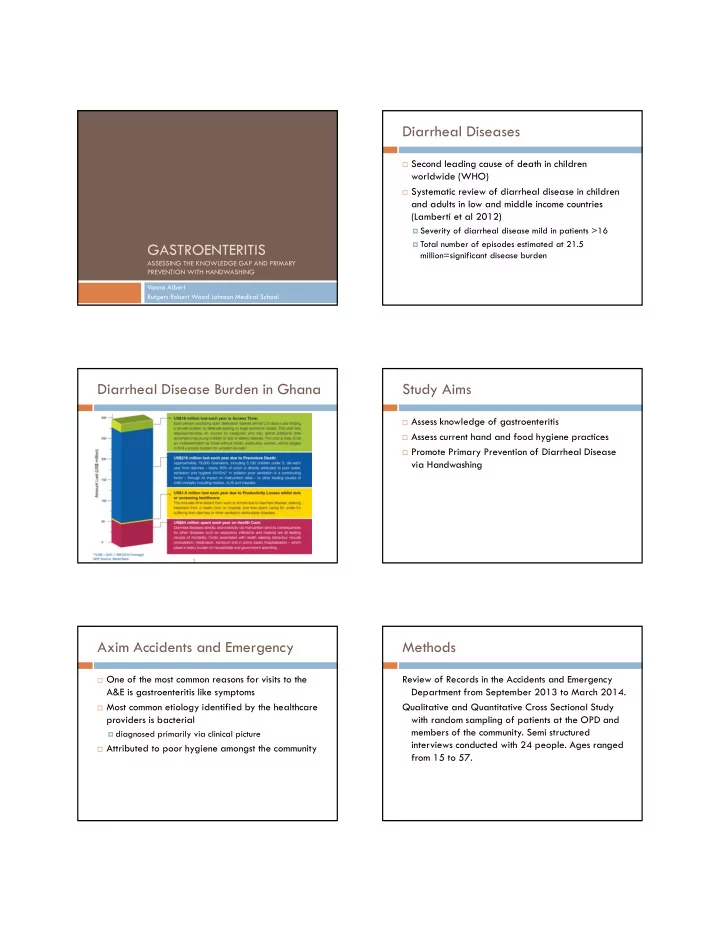
Diarrheal Diseases Second leading cause of death in children - - PDF document

diarrheal diseases
SMART_READER_LITE
LIVE PREVIEW

Diarrheal Diseases Second leading cause of death in children - - PDF document

Diarrheal Diseases Second leading cause of death in children worldwide (WHO) Systematic review of diarrheal disease in children and adults in low and middle income countries (Lamberti et al 2012) Severity of diarrheal disease mild in


slide-1
SLIDE 1

GASTROENTERITIS

ASSESSING THE KNOWLEDGE GAP AND PRIMARY PREVENTION WITH HANDWASHING Vanna Albert Rutgers Robert Wood Johnson Medical School

Diarrheal Diseases

 Second leading cause of death in children

worldwide (WHO)

 Systematic review of diarrheal disease in children

and adults in low and middle income countries (Lamberti et al 2012)

 Severity of diarrheal disease mild in patients >16  Total number of episodes estimated at 21.5

million=significant disease burden

Diarrheal Disease Burden in Ghana Study Aims

 Assess knowledge of gastroenteritis  Assess current hand and food hygiene practices  Promote Primary Prevention of Diarrheal Disease

via Handwashing

Axim Accidents and Emergency

 One of the most common reasons for visits to the

A&E is gastroenteritis like symptoms

 Most common etiology identified by the healthcare

providers is bacterial

 diagnosed primarily via clinical picture  Attributed to poor hygiene amongst the community

Methods

Review of Records in the Accidents and Emergency Department from September 2013 to March 2014. Qualitative and Quantitative Cross Sectional Study with random sampling of patients at the OPD and members of the community. Semi structured interviews conducted with 24 people. Ages ranged from 15 to 57.

slide-2
SLIDE 2

Question Guide

 Is there soap in the home?  Is there a place where water and soap are readily

available?

 Has anyone in your home had diarrhea in the last 3

months?

 Describe your practice of handwashing  How do you access water?  Define diarrhea  What comes to mind when you hear the words vomiting,

abdominal pain, nausea, diarrhea and how would you react?

Gastroenteritis at AGH: Accidents and Emergency

Month Number of Gastroenteritis Cases September 2013 36 October 2013 44 November 2013 28 December 2013 23 January 2014 22 February 2014 17 March 2014 38 Second Most Common Diagnoses in A&E within 7 months

Results

 A&E Records Review  14% of A&E visits for gastroenteritis admitted to

wards

Age Range Percentage <5 years old 2.4% 5-12 years old 6.25% >12 years old 91%

Gastroenteritis Management Quantitative Analysis Qualitative Analysis

 Hand Hygiene  Food and Cooking Hygiene  Perception of Diarrhea  Understanding/Perception of Gastroenteritis like

scenario

slide-3
SLIDE 3

Results

Describe your practice of handwashing Soap and water 15 Soap, sponge, and water 1 Wet hands with clean water, pour liquid soap, then rub palms together, wash in between fingers, then rinse 2 Take soap, rub in palms, rinse in water 6

Results Results Intervention

 Community Education on Proper Handwashing and safe

cooking practices

 Introduction of Tippy Tap  Based upon Uganda school study  Intervention schools in Uganda received a tippy tap with an

educational program,

 Rise in handwashing at school and after using the bathroom  Percentage of students reporting no stomach pain increased from

7% to 80%

 The headmasters at two primary schools and one junior high

school in Axim approached about demonstration of proper handwashing

TIPPY TAP

 Simple hand washing device  Tools: Bamboo or wood, gallon/jug, rope, soap  Cost effectiveness  Construction cost equivalent to US$2 + market cost of

soap vs Veronica Bucket US$18

 Useful in water scarce areas-- 40-50 ml of water

dispensed on average for each hand wash

TIPPY TAP

slide-4
SLIDE 4

Community Outreach

Responses to Community Intervention

 “If I’m on the street and hungry and would like to

buy food where there isn’t water or soap available, what should I do?”

 “The food vendor may only serve dishes with one

plate and utensil that is reused for other customers”

 “Can I drink sea water if I don’t have salt or sugar

to make ORS at home?”

 “We are treated badly when we go to the hospital

and are not encouraged to do so.”

Limitations

 Study sample size not adequate for assessment of

quantitative questions

 Interpreter Bias  Wording of Questions  Knowledge of rotavirus vaccine not assessed

Recommendations

 Implement promotion of tippy tap promotion as part of the

preexisting Ghana Health and Education Initiative Handwashing with Soap Program in schools

 Promote and supervise student construction of tippy taps at

school

 Assign students maintenance duties i.e. refill water jug,

replenish soap

 Strategic placement of tippy taps within the community as a

potential class project: place near washrooms, food vendors, sea side

 Expand educational programs of hand washing into the

community with pictorial, instructional diagrams on use of tippy tap and proper hand washing techniques

Acknowledgments

 I’d like to thank Dr. Hagan for his support in my

research endeavors at Axim Government Hospital. I thank Dr. Eben Badoe for his guidance in developing my research question and design & analysis of this qualitative study. I am appreciative

  • f GE/NMF collaboration with Dr. Buckle, Dr. Dyer,

and Ja’net Carter for the opportunity to participate in public health research and a rich clinical experience in Ghana.

QUESTIONS