Developments in Particle Therapy using Nuclear Science and - - PowerPoint PPT Presentation

developments in particle therapy using nuclear science
SMART_READER_LITE
LIVE PREVIEW

Developments in Particle Therapy using Nuclear Science and - - PowerPoint PPT Presentation

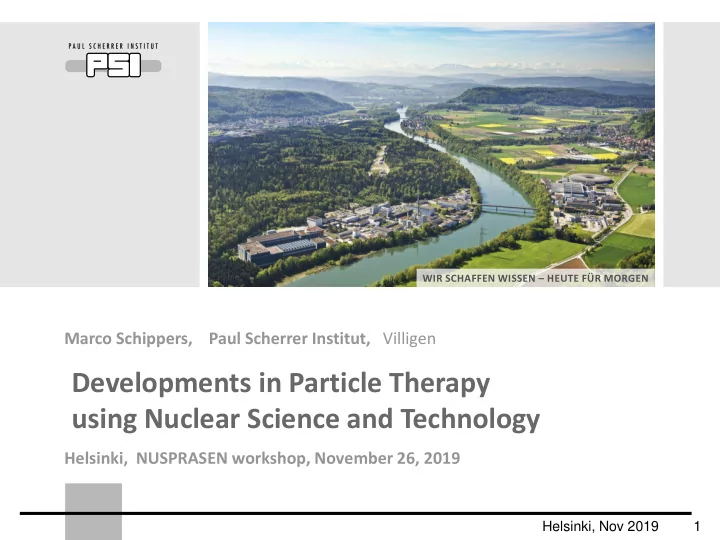
WIR SCHAFFEN WISSEN HEUTE FR MORGEN Marco Schippers, Paul Scherrer Institut, Villigen Developments in Particle Therapy using Nuclear Science and Technology Helsinki, NUSPRASEN workshop, November 26, 2019 Helsinki, Nov 2019 1


slide-1
SLIDE 1

WIR SCHAFFEN WISSEN – HEUTE FÜR MORGEN

Helsinki, Nov 2019 1

Developments in Particle Therapy using Nuclear Science and Technology

Marco Schippers, Paul Scherrer Institut, Villigen Helsinki, NUSPRASEN workshop, November 26, 2019
slide-2
SLIDE 2

NUSPRASEN-workshop Marco Schippers, PSI Helsinki, Nov 2019 2

  • Proton Therapy
  • Recent developments in dose delivery and p.th.-accelerators
  • Current major topics of research:

Treatment when organs are moving High intensity Proton range determination

3.3.2

OUTLINE

slide-3
SLIDE 3

NUSPRASEN-workshop Marco Schippers, PSI Helsinki, Nov 2019 3

X-rays

lung

heart

Spinal cord

Protons

lung

heart

Spinal cord

pictures: Medaustron

Proton beams

from 3 directions

X-ray beams

from 7 directions

Why Particle therapy?

slide-4
SLIDE 4

NUSPRASEN-workshop Marco Schippers, PSI Helsinki, Nov 2019 4

Proton therapy facility

accelerator

IBA

slide-5
SLIDE 5

NUSPRASEN-workshop Marco Schippers, PSI Helsinki, Nov 2019 5

Accelerators for Proton therapy

Cyclotron Synchrotron

slide-6
SLIDE 6

NUSPRASEN-workshop Marco Schippers, PSI Helsinki, Nov 2019 6

Recent Developments in dose delivery and accelerators

slide-7
SLIDE 7

NUSPRASEN-workshop Marco Schippers, PSI Helsinki, Nov 2019 7

Dose delivery techniques

Collimator Scatter syst.

Scatter technique: From nucl physics lab: Pencil Beam Scanning

slide-8
SLIDE 8

NUSPRASEN-workshop Marco Schippers, PSI Helsinki, Nov 2019 8

compact “Gantry-1” at PSI (1996)

4 m

Eros Pedroni

scanning proton pencil beam

slide-9
SLIDE 9

NUSPRASEN-workshop Marco Schippers, PSI Helsinki, Nov 2019 9

Typical Gantry ~1996…

Schär Engineering - Munich

Roberts Proton Therapy Center Philladelphia

10-12 m

slide-10
SLIDE 10

NUSPRASEN-workshop Marco Schippers, PSI Helsinki, Nov 2019 10

ProNova Toshiba, NIRS

NEW: gantries with SC magnets

slide-11
SLIDE 11

NUSPRASEN-workshop Marco Schippers, PSI Helsinki, Nov 2019 11

Proton SC Gantry (PSI)

Energy acceptance = ± 30%

 NO Magnetic Field change for tumors 15-30 cm

NEW: optics in SC gantry design

slide-12
SLIDE 12

NUSPRASEN-workshop Marco Schippers, PSI Helsinki, Nov 2019 12

Kicker

Vary depth: adjust beam energy

Degrader unit

All following magnets: 1% field change (5mm) in 50-80 ms (PSI) Steerer Q Q Q

graphite multi-wedge degrader  238-70 MeV

250 250 MeV Cyc yclotron

E- change ges with Cyclot

  • tron
  • n

Gaphite  Boron Carbide Less scattering less losses at low E

recent development:

slide-13
SLIDE 13

NUSPRASEN-workshop Marco Schippers, PSI Helsinki, Nov 2019 13

#

Energy is set per spill

1 spill: several spills

recent development: Energy adjustable during extraction

NIRS: Y. Iwata et al., MOPEA008, Proc. IPAC’10

E-change ges with Synchrot

  • tron
  • n

Vary depth: adjust beam energy

slide-14
SLIDE 14

NUSPRASEN-workshop Marco Schippers, PSI Helsinki, Nov 2019 14

cyclotrons in proton therapy

IBA (1996) , SHI Isochronous Cyclotron Varian (2005) Isochronous Cyclotron IBA (2018) Synchrocyclotron MEVION (2013) Synchrocyclotron

Pulsed beam: Limits speed in dose delivery

slide-15
SLIDE 15

NUSPRASEN-workshop Marco Schippers, PSI Helsinki, Nov 2019 15

AVO, ADAM: A. Degiovanni et al. 2016

In Production: Linac 230 MeV

Spin-off from TERA and CERN: Coupled Cavity Linac 230 MeV

E-change by: switching on/off power of cavity units

slide-16
SLIDE 16

NUSPRASEN-workshop Marco Schippers, PSI Helsinki, Nov 2019 16

Laser driven proton accelerator

thin foil, doped with hydrogen Laser light

  • +
  • +
  • +
  • -
  • -
  • +

++ + + + ++ + ++ + + +

Laser light creates plasma and pushes electrons out

Electric field from electrons pulls protons out of foil O OO O O O OO O OO O O O

  • now used:

6x10¹⁷ W/mm2 Pulsed at low rate

protons

C.M. Ma, Laser Physics, 2006, Vol. 16, No. 4, pp. 639

But: more research needed for:

  • 100x more power (for Ep)
  • MUCH higher pulse rate
  • better energy spectrum
slide-17
SLIDE 17

NUSPRASEN-workshop Marco Schippers, PSI Helsinki, Nov 2019 17

Current major topics of research

Treatment with moving organs High intensity + verification Range determination

slide-18
SLIDE 18

NUSPRASEN-workshop Marco Schippers, PSI Helsinki, Nov 2019 18

Possible solutions:

  • Gating
  • Adaptive scanning

(tumor tracking)

  • Fast (+ rescanning)
  • rgan / tumor motion

Organ motion

slide-19
SLIDE 19

NUSPRASEN-workshop Marco Schippers, PSI Helsinki, Nov 2019 19

Fast pencil beam scanning

0 time (ms) 10 intensity

  • Cont. scanning “TV” mode

kHz-Intensity modulation

7 s for a 1 liter volume.

slide-20
SLIDE 20

NUSPRASEN-workshop Marco Schippers, PSI Helsinki, Nov 2019 20

High intensity:

  • Reduces motion problems
  • FLASH irradiation: 0.03 Gy/s  40 Gy/s

To be modified:

  • Source / accelerator / beam transport
  • How to verify?

Current major topics of research

slide-21
SLIDE 21

NUSPRASEN-workshop Marco Schippers, PSI Helsinki, Nov 2019 21

21

CCD camera proton pencil beams Light emitting Screen

  • r ….gas scintillation

with a GEM beam delivery system

scanning beam monitor

Sjirk Boon (1996),

Advantages of gas scintillation: No quenching at low E Very fast (s)

Enrica Seravalli (2003)

slide-22
SLIDE 22

NUSPRASEN-workshop Marco Schippers, PSI Helsinki, Nov 2019 22

Particle range in tissue

Current major topics of research

Particle beams are sensitive to

  • CT Hounsfield number  Stopping Power accuracy
  • Organ motion
  • Change of patient’s anatomy

 Uncertainty in range in patients ~3% ….. but impossible to measure range directly  Various methods are in development

slide-23
SLIDE 23

NUSPRASEN-workshop Marco Schippers, PSI Helsinki, Nov 2019 23

Proton range in tissue

CT images: based on X- ray interaction.  Calibration to stopping power is needed  Range error from CT calibr ~1% CT - Hounsfield nr

Effect of: CT

protons: Range 2 cm less X-rays: Dose drops 11%

Effect of: 3 cm bone

slide-24
SLIDE 24

NUSPRASEN-workshop Marco Schippers, PSI Helsinki, Nov 2019 24

Protons create activation in tissue

11C 13N

Paans and Schippers, IEEE 40(1993)1041

Range measurements

CURRENT STATUS:

  • Need to know tissue constituents and predict PET signal
  • Compare measured signal with prediction
  •  accuracy ~3mm
  • but new developments are coming……

 Measure PET Activity!  3D activ.image Dose

slide-25
SLIDE 25

NUSPRASEN-workshop Marco Schippers, PSI Helsinki, Nov 2019 25

Range measurements

e.g.: Verburg et al., PMB 60(2015)1019

CURRENT STATUS:

  • Dependent on E selection
  • Know tissue constituents
  • Accuracy of range change: ~1mm

prompt  patient

slide-26
SLIDE 26

NUSPRASEN-workshop Marco Schippers, PSI Helsinki, Nov 2019 26

U.Scheider and E.Pedroni

  • Med. Phys. 22(1994), 353

Residual range  E-loss = Integrated stopping power along track

Proton radiography Range measurements

CURRENT STATUS:

  • Range accuracy: ~1%
  • Proton CT:  3D stopping power

Mumot et al, PMB (2010).

slide-27
SLIDE 27

NUSPRASEN-workshop Marco Schippers, PSI Helsinki, Nov 2019 27

  • Lower price (50%)

 (SC) Magnets + Acc.

  • Faster (x …100)

 Acc. + Nucl techn.

  • Motion detect., imaging

 Nucl. Techn.

  • Range detection

 Nucl. Techn.

What developments are needed and where can Nuclear Technology contribute?

Conclusions

But take care when implementing new developments:

  • Do not propose a solution looking for a problem
  • Proven idea  clinic takes 10-20 years
  • Long term (>20 yr) commitment: service / upgrades…
slide-28
SLIDE 28

Thank you for your attention

slide-29
SLIDE 29

NUSPRASEN-workshop Marco Schippers, PSI Helsinki, Nov 2019 29