Developing an experimental fishery on Vanderkloof Dam The - - PowerPoint PPT Presentation

developing an experimental fishery on vanderkloof dam the
SMART_READER_LITE
LIVE PREVIEW

Developing an experimental fishery on Vanderkloof Dam The - - PowerPoint PPT Presentation

Developing an experimental fishery on Vanderkloof Dam The importance of inland fisheries in Africa Annual harvest of 1.5 million tons Inland fisheries contributes 54% of total fish production For 1/3 of African countries, inland


slide-1
SLIDE 1

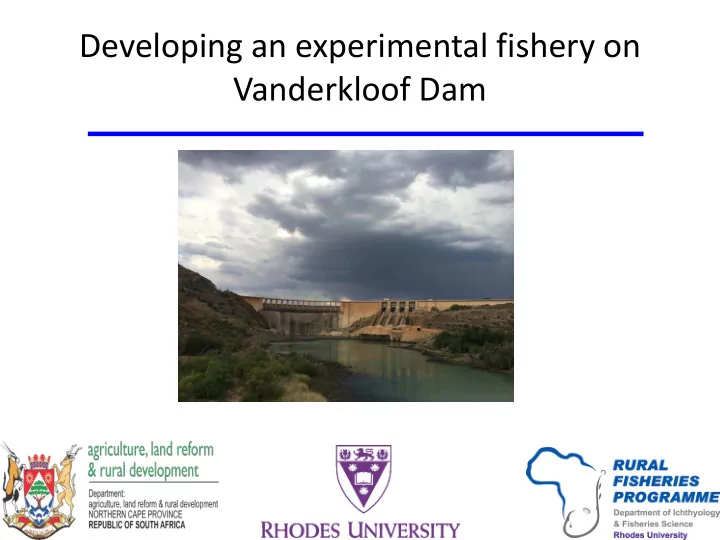
Developing an experimental fishery on Vanderkloof Dam

slide-2
SLIDE 2

The importance of inland fisheries in Africa

  • Annual harvest of 1.5

million tons

  • Inland fisheries contributes

54% of total fish production

  • For 1/3 of African

countries, inland fisheries contributes 90% of fish production

slide-3
SLIDE 3

Case study: Malawi’s fishery

  • Annual production of 50 000 tons

per annum

  • Primary sector employs 65 000
  • Secondary sector employs

350 000

  • 90% of fishers are artisanal
slide-4
SLIDE 4

Why are our dams un-fished?

Dam in SA Lake Malawi

slide-5
SLIDE 5

In the beginning

  • There are over 3500 dams in

SA

  • Dams primarily for human

and agriculture

  • Fish stocked by Nature

Conservation primarily for recreational anglers

  • In many instances rural

communities access to dams was restricted

slide-6
SLIDE 6

Rural communities have recentrly recognised fishing

slide-7
SLIDE 7

Overall Economic Impact R18,8 Billion

  • Deep Sea

R6,8 bill

  • Surf/Shore

R2,5 bill

  • Light Boat

R285 mill

  • Fresh Water Bank

R3,9 bill

  • Fly-fishing

R3,5 bill

  • Artificial Lure

R267 mill

  • Bass

R1,2 bill

  • Carp

R260 mil

  • Match Angling R22 mill
  • Underwater

R52 mill

But how much

  • f this economy

filters down to the rural economy?

slide-8
SLIDE 8

Fishery potential of SA dams

  • Most dams in SA have

been stocked with fish.

  • Dams are largely un-

fished

  • Most dams in rural areas,

therefore significant potential for improving rural livelihoods and economic development

slide-9
SLIDE 9

Water SA Vol 33 No 4 July 2007

Results of a fishery survey in NW Province

slide-10
SLIDE 10

Fishery research on Vanderkloof Dam

  • Alanson et al (1983) established that there was

potential for a 150 – 250 t fishery

  • Tomasson et al (1985) “Exploitation of yellowfish

might lead to better use of resources”… “a commercial fishery should not be seen as a threat, but rather as a benefit to recreational fisheries since it could be used to promote good angling.”

  • 2013 Rhodes University survey of dam
slide-11
SLIDE 11

Survey in 2013

slide-12
SLIDE 12

Petrusville Keurtjieskloof Fishery base

slide-13
SLIDE 13

Set up a small scale community based fishery

  • The idea was to empower

fishers in Vanderkloof and Petrusville to become small scale fishers

  • From the onset the project

supported the existence of the recreational sector

  • The dam is big enough for

both sectors

slide-14
SLIDE 14

Marketing

  • Local marketing – setting up a

spaza shop

  • Processing
  • When fishery is developed

selling to government markets

slide-15
SLIDE 15

The campaign

slide-16
SLIDE 16

Is the largemouth yellowfish endangered?

slide-17
SLIDE 17

Images from, A Complete Guide to the Freshwater Fishes of Southern Africa. Paul Skelton

slide-18
SLIDE 18
slide-19
SLIDE 19
  • L. kimberleyensis has successfully colonised a number of man-made dams, among these are

Gariep and Van Der Kloof Dams on the Orange River and the Vaal and Bloemhof Dams on the Vaal River. They are however not common in these dams.

TECHNICAL REPORT ON THE STATE OF YELLOWFISHES IN SOUTH AFRICA

  • 2007. BY THE YELLOWFISH WORKING GROUP. WRC REPORT No KV 212/08

Labeobarbus kimberleyensis is vulnerable to angling pressure for several

  • reasons. Firstly, it is not as plentiful as L. aeneus and seems to have more

specific habitat requirements (the home range is mainstream rivers)

slide-20
SLIDE 20
slide-21
SLIDE 21

TECHNICAL REPORT ON THE STATE OF YELLOWFISHES IN SOUTH AFRICA

  • 2007. BY THE YELLOWFISH WORKING GROUP. WRC REPORT No KV 212/08
  • Water abstraction and pollution from both

industrial effluent and urban run-off, are threats that may have catastrophic effects

  • n L. kimberleyensis populations in the

future if the right measures are not taken to curb the source of this pollution.

slide-22
SLIDE 22
slide-23
SLIDE 23

Recap

The campaign The facts Largemouth are endangered Under IUCN they are classed as near threatened Dam is a last sanctuary for the largemouth Main habitat is in the rivers The fishery is a threat to the largemouth populations Water abstraction from the rivers & pollutions are the main threats

slide-24
SLIDE 24

Developing an experimental fishery

An experimental fishery allows for modifications to be made to the fishery should there be need

slide-25
SLIDE 25

Step 1: Fishery Management Plan Team

slide-26
SLIDE 26

Developing a Fishery Management Plan (FMP)

The primary objectives of the FMP is to work out the details / operations of the fishery:

  • 1. Selection of the fishers
  • 2. Fishing methods (mesh sizes, number of nets,

catches…)

  • 3. Fishing zones
  • 4. Managing the fishery (record keeping)
  • 5. Value chain / marketing
slide-27
SLIDE 27

From experimental to small scale fishery (SSF)

The transition

  • After 2-4 years the transition from experimental

to SSF will be made.

  • This will be guided by the results of the

experimental fishery

slide-28
SLIDE 28

Multi-user fishery: learning from the marine environment

  • In the marine

environment, the commercial, small scale, and recreational fisheries co-exist

  • Each sector has its

regulations as to what it can catch, the quantity and time.

slide-29
SLIDE 29
slide-30
SLIDE 30
slide-31
SLIDE 31

FAQ

Question Answer Is the fishery sustainable? It will start as an experimental fishery and the results will guide us Is the populations of the largemouth yellowfish in danger? The main populations of the fish is in the rivers & the results of the experimental fishery will guide us Is an EIA required In effect the experimental fishery is the EIA Will there be conflict between the users of the dam? Possibly: however this should not stop the

  • fishery. The role of gov is to manage this

process Is the proposed experimental fishery serve the greater good of the community? Yes Do we support the recreational fishery and plan to address their issues? Yes Do we believe that both sectors can co-exist? Yes Is there need for further research Yes, hence the experimental fishery