
- pg. 1
www.NewDownrigger.com
Deepwater Release
Releases only when a fish strikes.
Downrigger is An item often used when trolling in deep water, a downrigger is great when it works, but is not without
- flaws. Luckily, NewDownrigger has come up with the Deepwater Release, an enhancer for downriggers with multiple
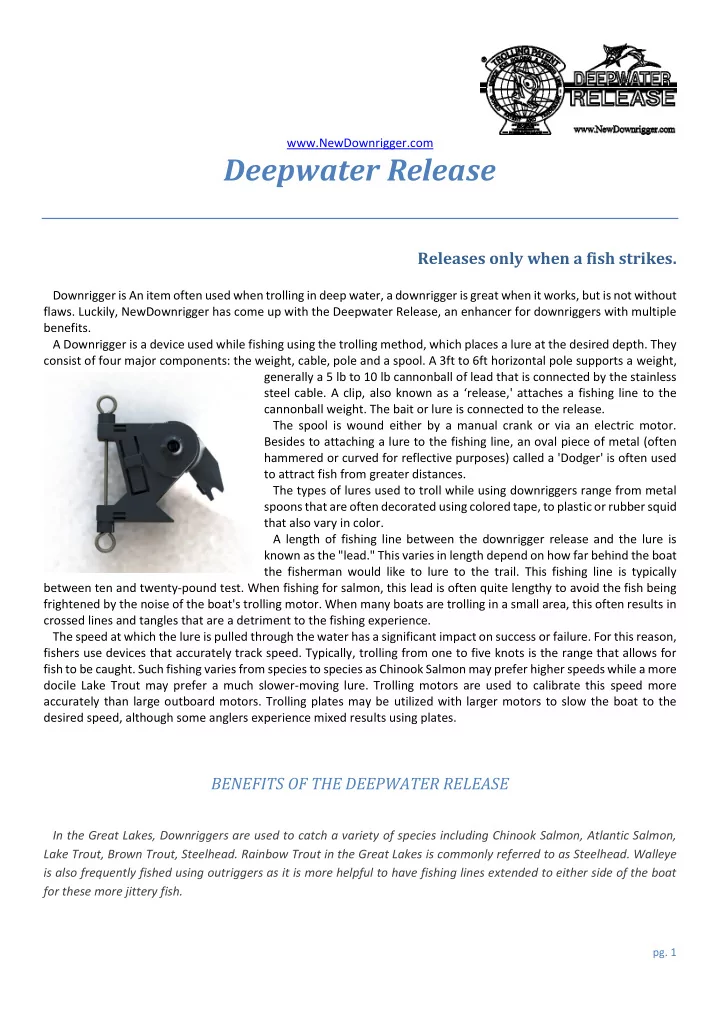
benefits. A Downrigger is a device used while fishing using the trolling method, which places a lure at the desired depth. They consist of four major components: the weight, cable, pole and a spool. A 3ft to 6ft horizontal pole supports a weight, generally a 5 lb to 10 lb cannonball of lead that is connected by the stainless steel cable. A clip, also known as a ‘release,' attaches a fishing line to the cannonball weight. The bait or lure is connected to the release. The spool is wound either by a manual crank or via an electric motor. Besides to attaching a lure to the fishing line, an oval piece of metal (often hammered or curved for reflective purposes) called a 'Dodger' is often used to attract fish from greater distances. The types of lures used to troll while using downriggers range from metal spoons that are often decorated using colored tape, to plastic or rubber squid that also vary in color. A length of fishing line between the downrigger release and the lure is known as the "lead." This varies in length depend on how far behind the boat the fisherman would like to lure to the trail. This fishing line is typically between ten and twenty-pound test. When fishing for salmon, this lead is often quite lengthy to avoid the fish being frightened by the noise of the boat's trolling motor. When many boats are trolling in a small area, this often results in crossed lines and tangles that are a detriment to the fishing experience. The speed at which the lure is pulled through the water has a significant impact on success or failure. For this reason, fishers use devices that accurately track speed. Typically, trolling from one to five knots is the range that allows for fish to be caught. Such fishing varies from species to species as Chinook Salmon may prefer higher speeds while a more docile Lake Trout may prefer a much slower-moving lure. Trolling motors are used to calibrate this speed more accurately than large outboard motors. Trolling plates may be utilized with larger motors to slow the boat to the desired speed, although some anglers experience mixed results using plates.
BENEFITS OF THE DEEPWATER RELEASE
In the Great Lakes, Downriggers are used to catch a variety of species including Chinook Salmon, Atlantic Salmon, Lake Trout, Brown Trout, Steelhead. Rainbow Trout in the Great Lakes is commonly referred to as Steelhead. Walleye is also frequently fished using outriggers as it is more helpful to have fishing lines extended to either side of the boat for these more jittery fish.