Developing a negotiation strategy Goals of this session: Answer the - - PowerPoint PPT Presentation

developing a negotiation strategy goals of this session
SMART_READER_LITE
LIVE PREVIEW

Developing a negotiation strategy Goals of this session: Answer the - - PowerPoint PPT Presentation

Developing a negotiation strategy Goals of this session: Answer the most Which items for faculty positions common questions asked by faculty can I negotiate candidates when they get their first offer for? Location: Boston, MA


slide-1
SLIDE 1

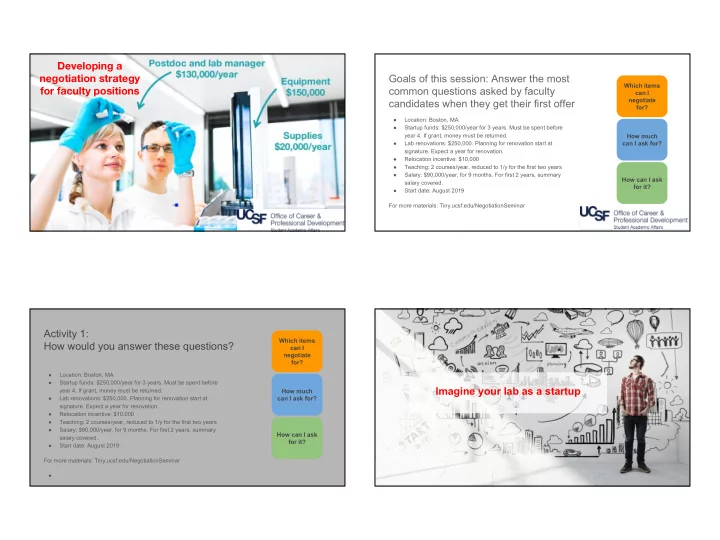
Developing a negotiation strategy for faculty positions Goals of this session: Answer the most common questions asked by faculty candidates when they get their first offer

  • Location: Boston, MA
  • Startup funds: $250,000/year for 3 years. Must be spent before

year 4. If grant, money must be returned.

  • Lab renovations: $250,000. Planning for renovation start at
  • signature. Expect a year for renovation.
  • Relocation incentive: $10,000
  • Teaching: 2 courses/year, reduced to 1/y for the first two years
  • Salary: $90,000/year, for 9 months. For first 2 years, summary

salary covered.

  • Start date: August 2019

For more materials: Tiny.ucsf.edu/NegotiationSeminar Which items can I negotiate for? How much can I ask for? How can I ask for it?

Activity 1: How would you answer these questions?

  • Location: Boston, MA
  • Startup funds: $250,000/year for 3 years. Must be spent before

year 4. If grant, money must be returned.

  • Lab renovations: $250,000. Planning for renovation start at
  • signature. Expect a year for renovation.
  • Relocation incentive: $10,000
  • Teaching: 2 courses/year, reduced to 1/y for the first two years
  • Salary: $90,000/year, for 9 months. For first 2 years, summary

salary covered.

  • Start date: August 2019

For more materials: Tiny.ucsf.edu/NegotiationSeminar

  • Which items

can I negotiate for? How much can I ask for? How can I ask for it?

Imagine your lab as a startup

slide-2
SLIDE 2

Reframing the faculty job application process

INSTITUTION INVESTOR & INCUBATOR JOB/CHALK TALK PITCH RESEARCH PLAN BUSINESS PLAN JOB OFFER DEAL

Backward Design Your Negotiation

What level of productivity does the INSTITUTION expect from you after they invest in you? What do YOU need to attain this level of productivity? If you do not get some of the items on that list, how does this impact YOUR long-term productivity at this institution? Example: One R01 grant by Y3, another large grant by Y5 Several papers, including in high-impact journals 1 technician for the first 3 years, Access to a confocal microscope 20 h/wk 1 graduate students and 1 postdoc within 2 years A job for my spouse with equivalent salary No technician: no one to set-up lab and train graduate students while you write grants

The chair is your ally in the negotiation process

Can advocate for you Can find creative solutions to your problems

The chair is your ally in the negotiation process

Can advocate for you Can find creative solutions to your problems

The chair is your ally in the negotiation process

Can advocate for you Can find creative solutions to your problems

The chair is your ally in the negotiation process

They need to know what problem you are trying to solve to help you attain your goal

slide-3
SLIDE 3

The chair is your ally in the negotiation process

Can advocate for you Can find creative solutions to your problems

The chair is your ally in the negotiation process

“I need to buy a $500K equipment for my experiments in Y1, but the budget is of $250K a year. If I do not buy this equipment in the first year, I will lose 1 year of work and will not be able to get my first R01 in Y3. Can you suggest any solutions for this problem?”

So, when speaking with the chair, focus on your needs.

  • Be clear: what are they?
  • Justify: in terms of productivity

and well-being

  • Prioritize: you won’t get

everything you want

  • Be flexible: focus on solutions

How to ask for what you need

I don’t want to seem greedy

Put your request into the context

  • f your productivity

I don’t want to sound unreasonable

Stay focused on solving the problem, be flexible with the solution

I feel uncomfortable even asking to negotiate

Ask the Chair how THEY want to proceed with the negotiation (by phone, email?)

I don’t want to make the wrong decision

This phase of the negotiation is an information collection phase, not a decision making phase. Take a pause in the negotiation when you need it.

Most commons concerns when it comes to negotiating

“The first item I’d like to discuss is the salary. Considering my level of experience, and with the cost of living in the Boston area, I am wondering if there is any flexibility in the startup salary.” “My spouse, who is also a researcher, is going to need to find employment in the area. He is a scientist at Gladstone and would need an equivalent-level position in the Boston area. He is open to academic and industry positions. Do you have any suggestions on how to help us find a satisfying position for him?” “There are 4 items I would like to discuss with you: the salary, the situation of my spouse, and two items in the startup budget. What would be the best way to discuss these with you - email or phone?” “Thank you so much for taking the time to walk me through the details of how salaries and startup budgets are calculated. I am really excited about the idea of continuing this discussion. This is a lot of new information, so I would like to take some time to think about this and pick up the discussion later. Can we schedule some time to talk later? Maybe we can find a time that works for both of us via email.”

slide-4
SLIDE 4

Institution indicates interest and asks for your budget Chair calls to discuss the verbal offer on the phone Ask for what you need Express enthusiasm Don’t tip your hand Ask for the letter Chair sends

  • ffer letter

Express enthusiasm Decide whether you want this position Prioritize your asks You begin negotiating Express enthusiasm. Give overview of what you want to discuss (how many items). Ask HOW they want to negotiate (via email or phone) Negotiate first

  • item. Explain why

you need it You need to think about what you’ve learned. Thanks. Indicate need for pause. Summarize action items (by phone and email). Express enthusiasm. Indicate a timeline for following-up. You finish negotiating. Express enthusiasm. Negotiate other items. Explain why you need them. Repeat process pause/negotiation if needed. You ask for a revised letter Recognize and appreciate the efforts.

Information collection phase NOT decision making phase

Activity 2: How would you answer these questions? Think/write for 3

  • minutes. Share for 3 minutes each.
  • Be clear: what are they?
  • Justify: in terms of productivity and

well-being

  • Prioritize: you won’t get everything

you want

  • Be flexible: focus on solutions

Prioritize: Which 3 items do you need to negotiate to reach the productivity needed? Be clear: What will you ask for specifically (i.e. I would like $X of startup). Justify: For each of these items, what will happen if you don’t get it? Be flexible: What other creative solutions could you suggest to meet your needs?

What are your most important concerns when it comes to negotiating? Socrative.com Choose “student login” Room “OCPD”

Activity 3: From your list of necessary items, choose the

  • ne you are the least comfortable negotiating for, and

write your request down, then practice saying it to your partner.