
12/6/12 ¡ 1 ¡
NFS
Don Porter CSE 506
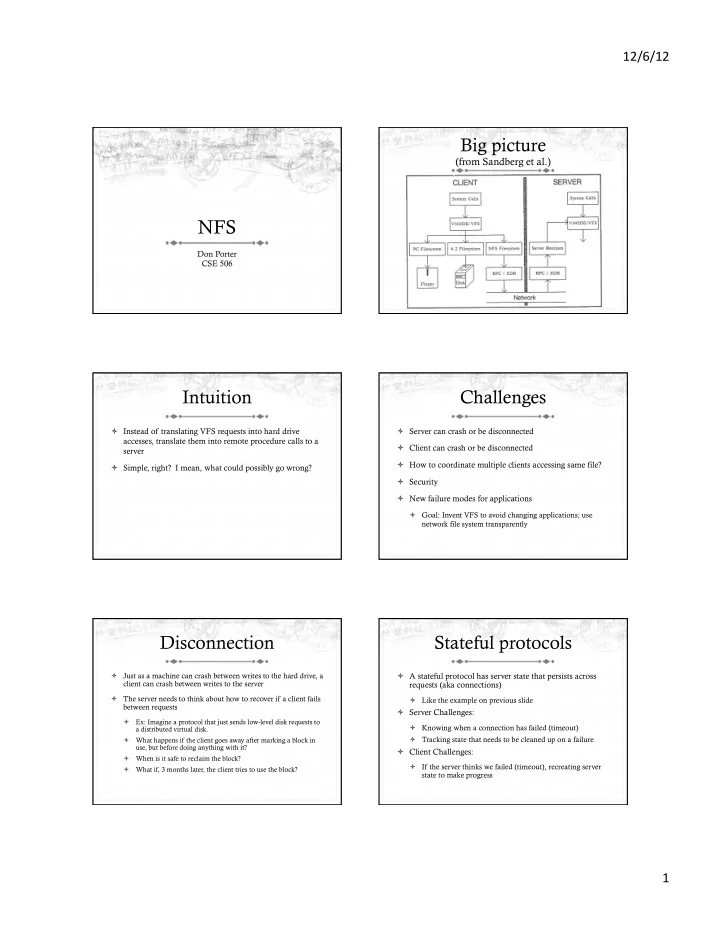
Big picture
(from Sandberg et al.)
J
together as the !handle for a rue. The inode generation number is necessary because the server may hand out an !handle with an inode number of a file that is later removed and the inode
- reused. When the original fhandle comes
back, the server must be able to tell that this inode number now refers to a different rile. The generation number has to be incremented every time the inode is freed. Client Side The client side provides the transparent interlace to the NFS. To make transparent access to remote rues work we had to use a method of locating remote files that does not change the structure of path names. Some UNIX based remote rue access schemes use host:path to name remote files. This does not allow real transparent access since existing programs that parse pathnames have to be modified. Rather than doing a "late binding" of rile address, we decided to do the hostname lookup and rile address binding once per rllesystem by allowing the client to attach a remote ruesystem to a directory using the mount program. This method has the advantage that the client only has to deal with hostnames
- nce, at mount time. It also allows the server
to limit access to filesystems by checking client credentials. The disadvantage is that remote files are not available to the client until a mount is done. Transparent access to different types
- f rllesystems
mounted
- n a single machine is provided
by a new rllesystems interlace in the kernel. Each "filesystem type" supports two sets
- f operations:
the Virtual Fllesystem (VFS) interface dermes the procedures that operate
- n the filesystem
as a whole; and the Virtual Node (vnode) interface dermes the procedures that operate on an individual rue within that filesystem type. Figure 1 is a schematic diagram of the filesystem interface and how the NFS uses it. ~
Figure 1
The Fllesystem Interface The VFS interface is implemented using a structure that contains the operations that can be done
- n a whole fllesystem. Ukewise. the vnode interface is a structure that contains the operations
that can be done
- n a node (rIle or directory) within a fllesystem. There is one VFS structure
per
Intuition
ò Instead of translating VFS requests into hard drive accesses, translate them into remote procedure calls to a server ò Simple, right? I mean, what could possibly go wrong?
Challenges
ò Server can crash or be disconnected ò Client can crash or be disconnected ò How to coordinate multiple clients accessing same file? ò Security ò New failure modes for applications
ò Goal: Invent VFS to avoid changing applications; use network file system transparently
Disconnection
ò Just as a machine can crash between writes to the hard drive, a client can crash between writes to the server ò The server needs to think about how to recover if a client fails between requests
ò Ex: Imagine a protocol that just sends low-level disk requests to a distributed virtual disk. ò What happens if the client goes away after marking a block in use, but before doing anything with it? ò When is it safe to reclaim the block? ò What if, 3 months later, the client tries to use the block?
Stateful protocols
ò A stateful protocol has server state that persists across requests (aka connections)
ò Like the example on previous slide
ò Server Challenges:
ò Knowing when a connection has failed (timeout) ò Tracking state that needs to be cleaned up on a failure
ò Client Challenges:
ò If the server thinks we failed (timeout), recreating server state to make progress