Designing a Pipelined Processor Computer System Architecture Go - - PowerPoint PPT Presentation

designing a pipelined processor computer system
SMART_READER_LITE
LIVE PREVIEW

Designing a Pipelined Processor Computer System Architecture Go - - PowerPoint PPT Presentation

Designing a Pipelined Processor Computer System Architecture Go back and examine your datapath Pipelining Part II and control diagram associated resources with states ensure that flows do not conflict, or Chalermek Intanagonwiwat


slide-1
SLIDE 1

1

Computer System Architecture Pipelining Part II

Chalermek Intanagonwiwat

Slides courtesy of David Patterson

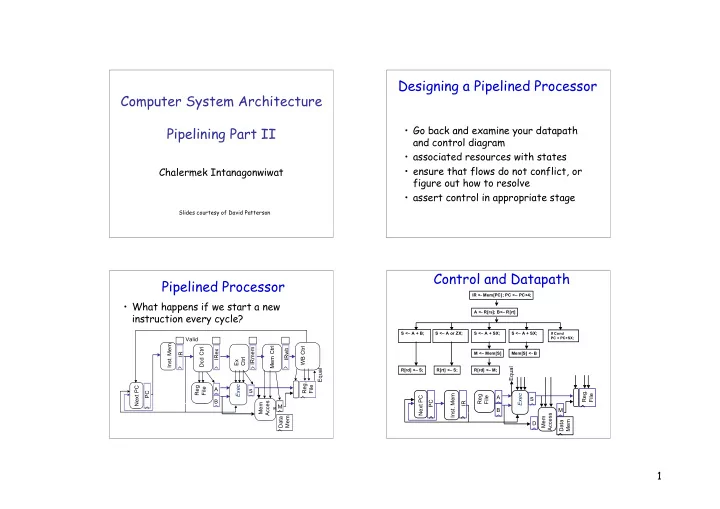
Designing a Pipelined Processor

  • Go back and examine your datapath

and control diagram

  • associated resources with states
  • ensure that flows do not conflict, or

figure out how to resolve

  • assert control in appropriate stage

Pipelined Processor

  • What happens if we start a new

instruction every cycle?

Exec Reg. File Mem Acces s Data Mem A B S M Reg File Equal PC Next PC IR

  • Inst. Mem

Valid IRex Dcd Ctrl IRmem Ex Ctrl IRwb Mem Ctrl WB Ctrl

Control and Datapath

Exec Reg. File Mem Access Data Mem A B S Reg File

IR <- Mem[PC]; PC <– PC+4; A <- R[rs]; B<– R[rt] S <– A + B; R[rd] <– S; S <– A + SX; M <– Mem[S] R[rd] <– M; S <– A or ZX; R[rt] <– S; S <– A + SX; Mem[S] <- B

If Cond PC < PC+SX;

Equal PC Next PC IR

  • Inst. Mem

D M

slide-2
SLIDE 2

2

Pipelining the Load Instruction

  • The five independent functional units in the pipeline datapath

are: – Instruction Memory for the Ifetch stage – Register File’s Read ports (bus A and busB) for the Reg/Dec stage – ALU for the Exec stage – Data Memory for the Mem stage – Register File’s Write port (bus W) for the Wr stage

Clock Cycle 1 Cycle 2 Cycle 3 Cycle 4 Cycle 5 Cycle 6 Cycle 7 Ifetch Reg/Dec Exec Mem Wr 1st lw Ifetch Reg/Dec Exec Mem Wr 2nd lw Ifetch Reg/Dec Exec Mem Wr 3rd lw

The Four Stages of R-type

  • Ifetch: Instruction Fetch

– Fetch the instruction from the Instruction Memory

  • Reg/Dec: Registers Fetch and Instruction Decode
  • Exec:

– ALU operates on the two register operands – Update PC

  • Wr: Write the ALU output back to the register file

Cycle 1 Cycle 2 Cycle 3 Cycle 4 Ifetch Reg/Dec Exec Wr R-type

Pipelining the R-type and Load Instruction

  • We have pipeline conflict or structural hazard:

– Two instructions try to write to the register file at the same time! – Only one write port

Clock Cycle 1 Cycle 2 Cycle 3 Cycle 4 Cycle 5 Cycle 6 Cycle 7 Cycle 8 Cycle 9 Ifetch Reg/Dec Exec Wr R-type Ifetch Reg/Dec Exec Wr R-type Ifetch Reg/Dec Exec Mem Wr Load Ifetch Reg/Dec Exec Wr R-type Ifetch Reg/Dec Exec Wr R-type Ops! We have a problem!

Important Observation

  • Each functional unit can only be used
  • nce per instruction
  • Each functional unit must be used at the

same stage for all instructions:

– Load uses Register File’s Write Port during its 5th stage – R-type uses Register File’s Write Port during its 4th stage

Ifetch Reg/De c Exec Mem Wr Load 1 2 3 4 5 Ifetch Reg/Dec Exec Wr R-type 1 2 3 4

° 2 ways to solve this pipeline hazard.

slide-3
SLIDE 3

3

Solution 1: Insert “Bubble” into the Pipeline

  • Insert a “bubble” into the pipeline to prevent 2 writes

at the same cycle – The control logic can be complex. – Lose instruction fetch and issue opportunity.

  • No instruction is started in Cycle 6!

Clock Cycle 1 Cycle 2 Cycle 3 Cycle 4 Cycle 5 Cycle 6 Cycle 7 Cycle 8 Cycle 9 Ifetch Reg/Dec Exec Wr R-type Ifetch Reg/Dec Exec Ifetch Reg/Dec Exec Mem Wr Load Ifetch Reg/Dec Exec Wr R-type Ifetch Reg/Dec Exec Wr R-type Pipeline Bubble Ifetch Reg/Dec Exec Wr

Solution 2: Delay R-type’s Write by One Cycle

  • Delay R-type’s register write by one

cycle:

– Now R-type instructions also use Reg File’s write port at Stage 5 – Mem stage is a NOOP stage: nothing is being done.

Ifetch Reg/Dec Exec Wr R-type Mem 1 2 3 4 5

Solution 2: Delay R-type’s Write by One Cycle (cont.)

Clock Cycle 1 Cycle 2 Cycle 3 Cycle 4 Cycle 5 Cycle 6 Cycle 7 Cycle 8 Cycle 9 Ifetch Reg/Dec Mem Wr R-type Ifetch Reg/Dec Mem Wr R-type Ifetch Reg/Dec Exec Mem Wr Load Ifetch Reg/Dec Mem Wr R-type Ifetch Reg/Dec Mem Wr R-type Exec Exec Exec Exec

Modified Control & Datapath

IR <- Mem[PC]; PC <– PC+4; A <- R[rs]; B<– R[rt] S <– A + B; R[rd] <– M; S <– A + SX; M <– Mem[S] R[rd] <– M; S <– A or ZX; R[rt] <– M; S <– A + SX; Mem[S] <- B

if Cond PC < PC+SX;

M <– S

Exec Reg. File Mem Access Data Mem A B S Reg File Equal PC Next PC IR

  • Inst. Mem

D M

M <– S

slide-4
SLIDE 4

4

The Four Stages of Store

  • Ifetch: Instruction Fetch

– Fetch the instruction from the Instruction Memory

  • Reg/Dec: Registers Fetch and

Instruction Decode

  • Exec: Calculate the memory address
  • Mem: Write the data into the Data

Memory

Cycle 1 Cycle 2 Cycle 3 Cycle 4 Ifetch Reg/Dec Exec Mem Store Wr

The Three Stages of Beq

  • Ifetch: Instruction Fetch

– Fetch the instruction from the Instruction Memory

  • Reg/Dec:

– Registers Fetch and Instruction Decode

  • Exec:

– compares the two register operand, – select correct branch target address – latch into PC

Cycle 1 Cycle 2 Cycle 3 Cycle 4 Ifetch Reg/Dec Exec Mem Beq Wr

Control Diagram

IR <- Mem[PC]; PC < PC+4; A <- R[rs]; B<– R[rt] S <– A + B; R[rd] <– S; S <– A + SX; M <– Mem[S] R[rd] <– M; S <– A or ZX; R[rt] <– S; S <– A + SX; Mem[S] <- B

If Cond PC < PC+SX;

Exec Reg. File Mem Access Data Mem A B S Reg File Equal PC Next PC IR

  • Inst. Mem

D

M <– S M <– S

M

Datapath + Data Stationary Control

Exec Reg. File Mem Access Data Mem A B S Reg File PC Next PC IR

  • Inst. Mem

D Decode Mem Ctrl WB Ctrl M rs rt

  • p

rs rt

fun im ex me wb rw v me wb rw v wb rw v

slide-5
SLIDE 5

5

Let’s Try it Out

10 lw r1, r2(35) 14 addI r2, r2, 3 20 sub r3, r4, r5 24 beq r6, r7, 100 30

  • ri

r8, r9, 17 34 add r10, r11, r12 100 and r13, r14, 15

Address is in octal

Start: Fetch 10

Exec Reg. File Mem Access Data Mem A B S Reg File PC Next PC IR

  • Inst. Mem

D Decode Mem Ctrl WB Ctrl M rs rt im

10 lw r1, r2(35) 14 addI r2, r2, 3 20 sub r3, r4, r5 24 beq r6, r7, 100 30

  • ri

r8, r9, 17 34 add r10, r11,r12 100 and r13, r14, 15

n n n n 10

Fetch 14, Decode 10

Exec Reg. File Mem Access Data Mem A B S Reg File PC Next PC IR

  • Inst. Mem

D Decode Mem Ctrl WB Ctrl M 2 rt im

10 lw r1, r2(35) 14 addI r2, r2, 3 20 sub r3, r4, r5 24 beq r6, r7, 100 30

  • ri

r8, r9, 17 34 add r10, r11,r12 100 and r13, r14, 15

n n n 14

lw r1, r2(35)

Fetch 20, Decode 14, Exec 10

Exec Reg. File Mem Access Data Mem r2 B S Reg File PC Next PC IR

  • Inst. Mem

D Decode Mem Ctrl WB Ctrl M 2 rt 35

10 lw r1, r2(35) 14 addI r2, r2, 3 20 sub r3, r4, r5 24 beq r6, r7, 100 30

  • ri

r8, r9, 17 34 add r10, r11,r12 100 and r13, r14, 15

n n 20

lw r1 addI r2, r2, 3

slide-6
SLIDE 6

6

Fetch 24, Decode 20, Exec 14, Mem 10

Exec Reg. File Mem Access Data Mem r2 B r2+35 Reg File PC Next PC IR

  • Inst. Mem

D Decode Mem Ctrl WB Ctrl M 4 5 3

10 lw r1, r2(35) 14 addI r2, r2, 3 20 sub r3, r4, r5 24 beq r6, r7, 100 30

  • ri

r8, r9, 17 34 add r10, r11,r12 100 and r13, r14, 15

n 24

lw r1 sub r3, r4, r5 addI r2, r2, 3

Fetch 30, Dcd 24, Ex 20, Mem 14, WB 10

Exec Reg. File Mem Access Data Mem r4 r5 r2+3 Reg File PC Next PC IR

  • Inst. Mem

D Decode Mem Ctrl WB Ctrl M[r2+35] 6 7

10 lw r1, r2(35) 14 addI r2, r2, 3 20 sub r3, r4, r5 24 beq r6, r7, 100 30

  • ri

r8, r9, 17 34 add r10, r11,r12 100 and r13, r14, 15

30

lw r1 beq r6, r7 100 addI r2 sub r3

Fetch 34, Dcd 30, Ex 24, Mem 20, WB 14

Exec Reg. File Mem Access Data Mem r6 r7 r2+3 Reg File PC Next PC IR

  • Inst. Mem

D Decode Mem Ctrl WB Ctrl r1=M[r2+35] 9 xx

10 lw r1, r2(35) 14 addI r2, r2, 3 20 sub r3, r4, r5 24 beq r6, r7, 100 30

  • ri

r8, r9, 17 34 add r10, r11,r12 100 and r13, r14, 15

34

beq addI r2 sub r3

r4-r5

100

  • ri r8, r9 17

Fetch 100, Dcd 34, Ex 30, Mem 24, WB 20

Exec Reg. File Mem Access Data Mem r9 x Reg File PC Next PC IR

  • Inst. Mem

D Decode Mem Ctrl WB Ctrl r1=M[r2+35] 11 12

10 lw r1, r2(35) 14 addI r2, r2, 3 20 sub r3, r4, r5 24 beq r6, r7, 100 30

  • ri

r8, r9, 17 34 add r10, r11, r12 100 and r13, r14, 15

100

beq r2 = r2+3 sub r3

r4-r5

17

  • ri r8

xxx

add r10, r11, r12

  • oops, we should have only one delayed instruction
slide-7
SLIDE 7

7 Fetch 104, Dcd 100, Ex 34, Mem 30, WB 24

Exec Reg. File Mem Access Data Mem r11 r12 Reg File PC Next PC IR

  • Inst. Mem

D Decode Mem Ctrl WB Ctrl r1=M[r2+35] 14 15

10 lw r1, r2(35) 14 addI r2, r2, 3 20 sub r3, r4, r5 24 beq r6, r7, 100 30

  • ri

r8, r9, 17 34 add r10, r11, r12 100 and r13, r14, 15

104

beq r2 = r2+3 r3 = r4-r5 xx

  • ri r8

xxx

add r10 and r13, r14, r15

n

Squash the extra instruction in the branch shadow!

r9 | 17

Fetch 108, Dcd 104, Ex 100, Mem 34, WB 30

Exec Reg. File Mem Access Data Mem r14 r15 Reg File PC Next PC IR

  • Inst. Mem

D Decode Mem Ctrl WB Ctrl r1=M[r2+35]

10 lw r1, r2(35) 14 addI r2, r2, 3 20 sub r3, r4, r5 24 beq r6, r7, 100 30

  • ri

r8, r9, 17 34 add r10, r11, r12 100 and r13, r14, 15

108

r2 = r2+3 r3 = r4-r5 xx

  • ri r8

add r10 and r13

n

Squash the extra instruction in the branch shadow!

r9 | 17 r11+r12

Fetch 112, Dcd 108, Ex 104, Mem 100, WB 34

Squash the extra instruction in the branch shadow!

Exec Reg. File Mem Access Data Mem Reg File PC Next PC IR

  • Inst. Mem

D Decode Mem Ctrl WB Ctrl r1=M[r2+35]

10 lw r1, r2(35) 14 addI r2, r2, 3 20 sub r3, r4, r5 24 beq r6, r7, 100 30

  • ri

r8, r9, 17 34 add r10, r11, r12 100 and r13, r14, 15

112

r2 = r2+3 r3 = r4-r5 r8 = r9 | 17 add r10 and r13

n r11+r12 NO WB NO Ovflow r14 & R15

Summary: Pipelining

  • What makes it easy

– all instructions are the same length – just a few instruction formats – memory operands appear only in loads and stores

  • What makes it hard?

– structural hazards: suppose we had only

  • ne memory

– control hazards: need to worry about branch instructions – data hazards: an instruction depends on a previous instruction

slide-8
SLIDE 8

8

Summary: Pipelining (cont.)

  • We’ll build a simple pipeline and look at

these issues

  • We’ll talk about modern processors and

what really makes it hard:

– exception handling – trying to improve performance with out-of-

  • rder execution, etc.

Summary

  • Pipelining is a fundamental concept

– multiple steps using distinct resources

  • Utilize capabilities of the Datapath by

pipelined instruction processing

– start next instruction while working on the current one – limited by length of longest stage (plus fill/flush) – detect and resolve hazards