Chapter 6: Designing a Pipelined CPU What are our resources? 1 - - PowerPoint PPT Presentation

chapter 6 designing a pipelined cpu
SMART_READER_LITE
LIVE PREVIEW

Chapter 6: Designing a Pipelined CPU What are our resources? 1 - - PowerPoint PPT Presentation

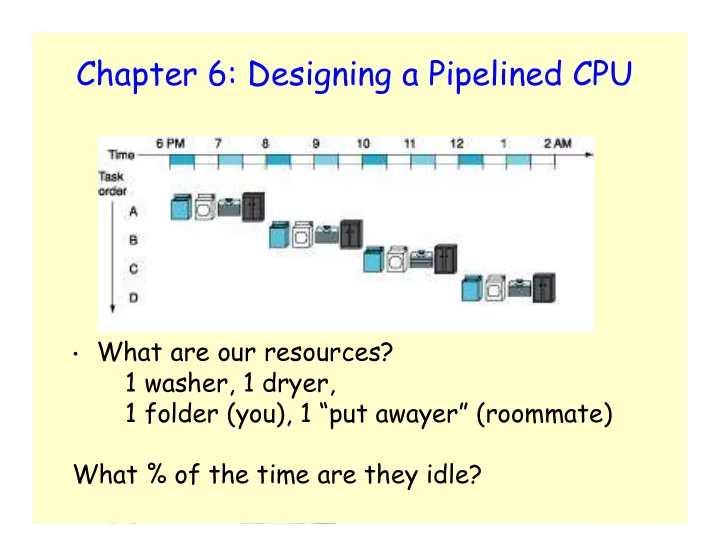
Chapter 6: Designing a Pipelined CPU What are our resources? 1 washer, 1 dryer, 1 folder (you), 1 put awayer (roommate) What % of the time are they idle? 1 2 Chapter 6: Designing a Pipelined CPU Chapter 6: Designing a Pipelined CPU


slide-1
SLIDE 1

1

Chapter 6: Designing a Pipelined CPU

  • What are our resources?

1 washer, 1 dryer, 1 folder (you), 1 “put awayer” (roommate) What % of the time are they idle?

slide-2
SLIDE 2

2

Chapter 6: Designing a Pipelined CPU

slide-3
SLIDE 3

3

Chapter 6: Designing a Pipelined CPU

What % of the time are resources idle?

  • steady-state
  • ramp up
  • ramp down
slide-4
SLIDE 4

4

Chapter 6: Designing a Pipelined CPU

What is our roommate takes off? What happens to the pipeline?

slide-5
SLIDE 5

5

Chapter 6: Designing a Pipelined CPU

What if our roommate is gone? What happens to the pipeline?

Massive Laundry Pile

slide-6
SLIDE 6

6

Chapter 6: Designing a Pipelined CPU

What if our roommate is gone? What happens to the pipeline?

Massive Laundry Pile

slide-7
SLIDE 7

7

Chapter 6: Designing a Pipelined CPU

No Laundry Pile

Scheduling work later reduces “laundry pile”

slide-8
SLIDE 8

8

Chapter 6: Designing a Pipelined CPU

Scheduling work later reduces “laundry pile”

slide-9
SLIDE 9

9

Execution in a Pipelined Datapath

CC1 CC2 CC3 CC4 CC5 CC6 CC7 CC8 CC9

lw lw lw lw lw

steady state IF ID EX MEM WB IM Reg ALU DM Reg IF ID EX MEM WB IM Reg ALU DM Reg IF ID EX MEM WB IM Reg ALU DM Reg IF ID EX MEM WB IM Reg ALU DM Reg IF ID EX MEM WB IM Reg ALU DM Reg

TIME

slide-10
SLIDE 10

10

Instruction Latencies and Throughput

Multiple Cycle CPU Pipelined CPU

Cycle 1 Cycle 2 Cycle 3 Cycle 4 Cycle 5 Cycle 6 Cycle 7 Cycle 8 IF Dec EX Mem WB Load IF Dec EX Mem WB Load IF Dec EX Mem WB Load IF Dec EX Mem WB Load Cycle 1 Cycle 2 Cycle 3 Cycle 4 Cycle 5 IF Dec EX Mem WB Load

Single-Cycle CPU

IF Dec EX Mem WB Load IF Dec EX Mem WB Cycle 6 Cycle 7 Cycle 8 Cycle 9Cycle 10 IF Dec EX Mem WB Cycle 1 Cycle 2

Latency: Throughput: Latency: Throughput: Latency: Throughput:

Load Load

slide-11
SLIDE 11

11

Self Check!

  • If my single cycle CPU has a cycle time of

14ns and my multicycle CPU has a cycle time

  • f 3ns and my pipelined CPU has a cycle time
  • f 3ns, what is the relative performance of

my machines?

  • What kind of answer would you provide?
  • What kind of information do you need to know?

ET = IC * CPI * CT What differs across machines? CT and CPI Single: CT = 14ns, CPI = 1 Multi: CT = 3ns CPI=??? NEED DYN INST LOAD INFO PIPELINED: CT = 3ns CPI = ?? WHAT IS IT? ALWAYS 5?

slide-12
SLIDE 12

12

Pipelining Advantages

  • Higher maximum throughput
  • Higher utilization of CPU resources
  • But, more hardware needed, perhaps

complex control

before, a simple FSM could guide execution

  • f one instruction at a time

but, now if we implemented the FSM, it would need to control 5 instructions simultaneously!

slide-13
SLIDE 13

13

Mixed Instructions in the Pipeline

CC1 CC2 CC3 CC4 CC5 CC6

lw add

IF Dec EX Mem WB IF Dec EX WB

Cycle # What’s wrong with this?

slide-14
SLIDE 14

14

To avoid structural hazard, schedule resource usage homogeneously

CC1 CC2 CC3 CC4 CC5 CC6

lw add

IF Dec EX Mem WB IF Dec EX WB

Cycle #

Mem

slide-15
SLIDE 15

15

Pipeline Principles

  • All instructions that share a pipeline must

have the same stages in the same order.

  • therefore, add does nothing during Mem stage
  • sw does nothing during WB stage
  • All intermediate values must be latched each

cycle.

  • There is no functional block reuse
  • example: we need 2 adders and ALU (like in single-

cycle)

IM Reg ALU DM Reg IF ID EX MEM WB

slide-16
SLIDE 16

16

Pipelined Datapath

Instruction Fetch Instruction Decode/ Register Fetch Execute/ Address Calculation Memory Access Write Back

Instruction memory Address 4 32

Add Add result

Shift left 2 IF/ID EX/MEM MEM/WB M u x 1

Add

PC Write data M u x 1 Registers Read data 1 Read data 2 Read register 1 Read register 2 16 Sign extend Write register Write data Read data 1

ALU result

M u x

ALU Zero

ID/EX Data memory Address

Is this more similar to multicycle or single cycle datapath?