On Fair Selection in the Presence of Implicit Variance Emelianov, - - PowerPoint PPT Presentation

on fair selection in the presence of implicit variance
SMART_READER_LITE
LIVE PREVIEW

On Fair Selection in the Presence of Implicit Variance Emelianov, - - PowerPoint PPT Presentation

On Fair Selection in the Presence of Implicit Variance Emelianov, Gast, Gummadi, Loiseau (EC 2020) Various fairness mechanisms have been proposed to mitigate discrimination Rooney rule: select at least one from underrepresented group


slide-1
SLIDE 1

On Fair Selection in the Presence of Implicit Variance

Emelianov, Gast, Gummadi, Loiseau (EC 2020)

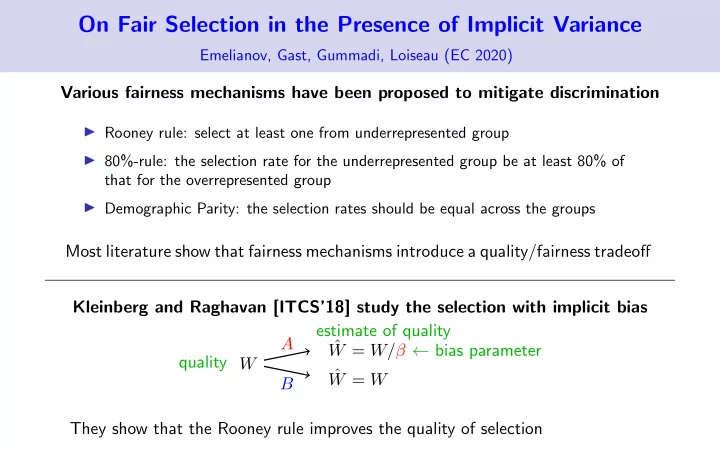
Various fairness mechanisms have been proposed to mitigate discrimination

◮ Rooney rule: select at least one from underrepresented group ◮ 80%-rule: the selection rate for the underrepresented group be at least 80% of that for the overrepresented group ◮ Demographic Parity: the selection rates should be equal across the groups

Most literature show that fairness mechanisms introduce a quality/fairness tradeoff Kleinberg and Raghavan [ITCS’18] study the selection with implicit bias W quality estimate of quality ˆ W = W/β ← bias parameter ˆ W = W A B They show that the Rooney rule improves the quality of selection

slide-2
SLIDE 2

Selection with Implicit Variance

Our Model W

quality estimate of quality

ˆ W = W + ε · σA ˆ W = W + ε · σB A B Selection Problem Setup n candidates nA + nB select αn

budget

xAnA + xBnB ˆ Wi We consider two natural selection algorithms W ∼ N(µ, σ2) ˆ WA ˆ WB ˆ WA ˆ WB

xA xB

ˆ w φ ˆ

W

Group-Oblivious: select best irrespective of their group W ∼ N(µ, σ2) ˆ WA ˆ WB

xA xB

ˆ w φ ˆ

W

Group-Fair: select best from each group (xA ≥ γxB and xB ≥ γxA)

slide-3
SLIDE 3

Our main result is that fairness mechanisms improve the quality

Theorem Assume that the quality distribution is group-independent W ∼ N(µ, σ2). For any α and γ < 1: Ud.p. > Uγ-fair ≥ Ug.obl. Proof Sketch ˆ WA ˆ WB

xA > xB

ˆ w

Group-Oblivious

ˆ WA ˆ WB

xA = xB

ˆ w

Demographic Parity

ˆ WA ˆ WB

xA < xB

ˆ w

Bayesian-Optimal

slide-4
SLIDE 4

We also study the cases when our assumptions are not valid

Non-Gaussian Quality Distribution

1 1.2 1.4 1.6 1.8 2 1 2 3

Pareto(1,3)

W pdf

0.2 0.4 0.6 0.8 1 5 10

α1 Ud.p. − Ug.obl., % Two-Stage Selection n select α1n

budget at 1st stage

select α2n

budget at 2nd stage 0.5 1 2 4

Ud.p. 1 − Ug.obl. 1 Ug.obl. 1

, %

α1

0.5 1 2 4

α1 = α2

Ud.p. 2 − Ug.obl. 2 Ug.obl. 2

, %

α1

ˆ Wi

1 stage

Wi

2 stage