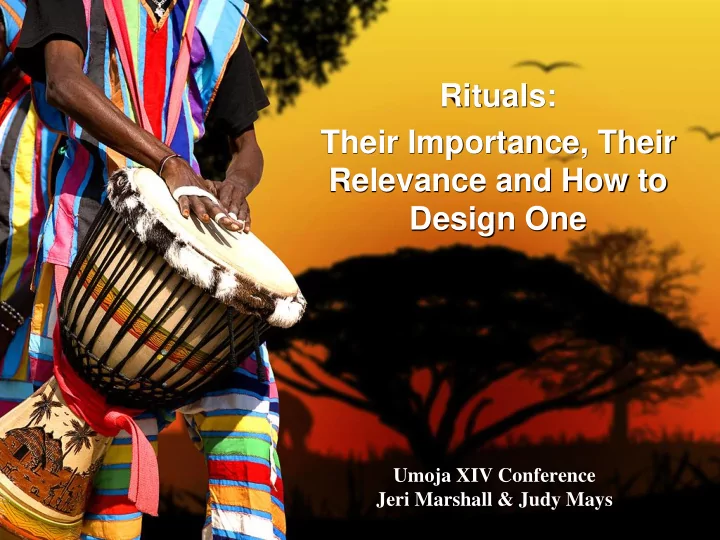
Design One Umoja XIV Conference Jeri Marshall & Judy Mays The - - PowerPoint PPT Presentation

design one
SMART_READER_LITE
LIVE PREVIEW

Design One Umoja XIV Conference Jeri Marshall & Judy Mays The - - PowerPoint PPT Presentation

Rituals: Their Importance, Their Relevance and How to Design One Umoja XIV Conference Jeri Marshall & Judy Mays The Collective is Greater than the I African philosophical tradition, unlike western philosophical systems, does


slide-1
SLIDE 1

Umoja XIV Conference Jeri Marshall & Judy Mays

Rituals: Their Importance, Their Relevance and How to Design One

slide-2
SLIDE 2

The Collective is Greater than the “I”

“…African philosophical tradition, unlike western philosophical systems, does not place emphasis

  • n the ‘individual’ or ‘individuality’...It

recognizes that only in terms of one’s people does the ‘individual’ become conscious of

  • ne’s duties and responsibilities toward himself

and the collective self or tribe… Africans believe that whatever happens to the ‘individual’ self, the ‘I,” also happens to the corporate body, the ‘we,’ and vice versa.”

From: The Healing Wisdom of Africa: Finding Life Purpose Through Nature, Ritual, and Community by Malidoma Patrice Somè (1998)

slide-3
SLIDE 3

Why we need ritual…

“Deep connection rather than competition is the quality most essential to human nature; we were never meant to live a life of isolation and self-serving survival. Human beings need partnership just to survive; we experience the greatest stress and the most serious illnesses when we are isolated from

  • thers and from a sense of connection.”

McTaggart (2011)

slide-4
SLIDE 4

Importance of Community

“The truth is that one doesn’t lose one’s self as a result

  • f being part of a community. On the contrary,

being in community leads to a healthy sense of belonging, greater generosity, better distribution of resources, and a greater awareness of the needs of the many…being part of a strong community strengthens one’s individuality by supporting the expression and enjoyment of one’s unique gifts and talents.” From: The Healing Wisdom of Africa: Finding Life Purpose Through Nature, Ritual, and Community by Malidoma Patrice Somè (1998)

slide-5
SLIDE 5

Why ritual?

“…the latest evidence from many disciplines— from neuroscience and biology to quantum physics—suggests that nature’s most basic drive is not competition, as classic evolutionary theory maintains, but wholeness…all living beings, including human beings, have been hardwired to seek connection above virtually any other impulse.” From: Connecting Through the Space Between Us: The Bond, by Lynne McTaggart (2011).

slide-6
SLIDE 6

What our West African brothers and sisters say about ritual…

  • Ritual is seen as a way of healing one’s spirit.
  • Ritual connects people to their ancestors and

to others in their community.

  • Ritual builds community through allowing a

conscious feeling of connection among members of a community.

  • Ritual allows us to connect with the self, the

community, and the natural forces around us.

  • Rituals can also acknowledge people and

their unique talents gifts and abilities.

slide-7
SLIDE 7

West African Ritual Process & Elements

West African rituals have several parts: 1) Symbolic bathing or cleansing 2) Initial prayer/invocation – state intention and invite ancestral spirits to oversee and help guide what is to take place in the ritual 3) Creating a sacred space by gathering needed elements – see handout

slide-8
SLIDE 8

West African Ritual Process & Elements (cont’d)

4) Healing phase – those gathered have the

  • pportunity to speak out loud based on the

intention of the ritual (in West Africa, singing, dancing and drumming accompanies this phase) 5) Closing prayer – thank the ancestors for whatever they have allowed to occur in the ritual space and release them

slide-9
SLIDE 9

Ritual Elements:

  • Fir

ire – Fire represents our connection to the ancestral world and candles or even an ancient mask are the symbols used to represent fire. The fire element can be used to help people stay connected to their purpose, to have clear vision

  • r to burn away undesirable things.
  • Wat

ater – Water represents peace and togetherness; a vase or other container can be used to hold water. The water element is used to help bring focus; it represents peace, harmony and reconciliation.

slide-10
SLIDE 10

Ritual Elements con’t

  • Earth

rth – The earth element represents our sense of identity as well as our capacity to support and nurture

  • ne another. A bowl of fruit or soil can be used to

symbolize the earth element. The earth element is used to help heal emotional wounds and to create a greater sense of belonging and self-worth in all forms

  • f relationships.
  • Mi

Mineral neral – Mineral element represents memory and bones or stones are used to symbolize this element. The mineral element is used to help us to remember

  • ur purpose and it also helps us to communicate and

understand what others are saying.

slide-11
SLIDE 11

Ritual Elements con’t

  • Nat

atur ure – The nature element represents our ability to be our true selves. This element can be symbolized by a small potted plant, a flower or a

  • twig. The nature element helps in dealing with

major life changes and life-threatening situations. This is the element most often combined with the other principal elements because its focus is change and transformation.

slide-12
SLIDE 12

Adapting Ritual for the Umoja Classroom/Community

Umoja classroom/community rituals are designed to:

  • Build community
  • Bring everyone to the point of focus and

center us in that space

  • Help students express themselves
  • Help students heal and make spiritual

transformations

slide-13
SLIDE 13

Building Community in the Umoja Classroom

Instructor’s awareness:

  • Trust the uncomfortable moments.
  • Reverance the sacredness of the moment.
  • Healing comes in the moments of catharsis.
slide-14
SLIDE 14

Examples of Umoja Classroom/Community Rituals

  • Akwaaba (Welcome)
  • Remembrance Ceremony
  • Affirmations
  • Meditations
  • Call and Response
  • Dance
  • Songs (those that touch or enliven the spirit)
  • Naming Ceremony
slide-15
SLIDE 15

Designing a Ritual for your Umoja Program

Chose an occasion. What is the intent? Which elements will you use? How will you create a sacred space? How will you engage the participants?

slide-16
SLIDE 16