Design a and Assessment o of a Collabor orative 3 3D Interactio - - PowerPoint PPT Presentation

design a and assessment o of a collabor orative 3 3d
SMART_READER_LITE
LIVE PREVIEW

Design a and Assessment o of a Collabor orative 3 3D Interactio - - PowerPoint PPT Presentation

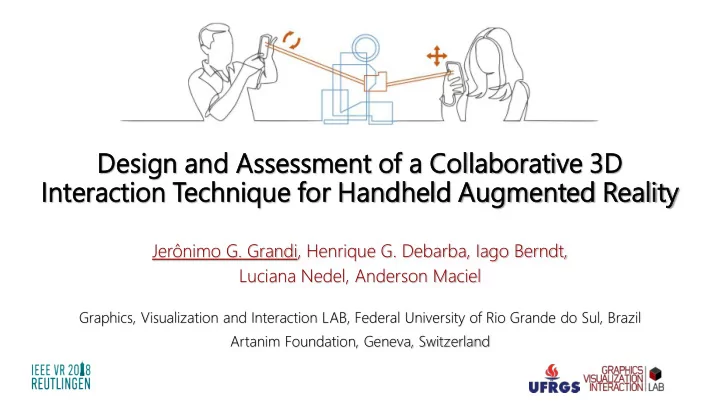
Design a and Assessment o of a Collabor orative 3 3D Interactio ion Techniq hnique f for H Handhe held ld A Augment nted R Realit lity Jernimo G. Grandi, Henrique G. Debarba, Iago Berndt, Luciana Nedel, Anderson Maciel Graphics,


slide-1
SLIDE 1

Design a and Assessment o

  • f a Collabor
  • rative 3

3D Interactio ion Techniq hnique f for H Handhe held ld A Augment nted R Realit lity

Jerônimo G. Grandi, Henrique G. Debarba, Iago Berndt, Luciana Nedel, Anderson Maciel

Graphics, Visualization and Interaction LAB, Federal University of Rio Grande do Sul, Brazil Artanim Foundation, Geneva, Switzerland

slide-2
SLIDE 2

Augmented Reality Interfaces

2

Google ARCore Microsoft Hololens

Head-mounted See-through

Pixelasm

Mapped Projections Handheld Devices

slide-3
SLIDE 3

Handheld Augmented Reality

3

Google ARCore

Handheld Devices 3D Interaction

Mossel et al., 2013 Marzo et al., 2014

Visualization

Grandi et al., 2014 López et al., 2016

2D Interaction

Boring et al., 2010 Bergé et al. 2014

slide-4
SLIDE 4

Handheld Augmented Reality - Characteristics

4 3D Interaction

Mossel et al., 2013 Marzo et al., 2014

  • Interaction is mapped from the device’s

2D screen to 3D transformations

  • AR allows for position based interaction
slide-5
SLIDE 5

Handheld Augmented Reality - Problems

5 3D Interaction

Mossel et al., 2013 Marzo et al., 2014

  • Still a complex task

› Many DoFs › Virtual objects are intangible

  • Exausting if necessary to interact with

several objects

  • Single-user interaction
slide-6
SLIDE 6

6

Collaboration for 3D Spatial Manipulations

Divide and Conquer Join and Solve

slide-7
SLIDE 7

Simultaneous Manipulations of 3D Objects

7

Aguerreche et al. 2010

TUI DOF Separation

Pinho et al. 2008 Duval et al. 2006

Mean Average

Grandi et al. 2017

Summed Contributions

slide-8
SLIDE 8

Simultaneous Manipulations of 3D Objects

8

Grandi et al. 2017

Summed Contributions

slide-9
SLIDE 9

and of a Collaborative 3D Interaction Technique for Handheld Augmented Reality

9

De Design Asse ssessm ssment

slide-10
SLIDE 10

10

The Interface for Collaborative Object Manipulation

slide-11
SLIDE 11

11

Des esign Assessment

  • Hybrid Interaction: T
  • uch Gestures and

Movements

  • Shared space
  • Simultaneous manipulation
  • UI elements
  • Interface assessment

› Is our technique suitable for manipulation tasks in AR environments?

  • Collaborative assessement

› What strategies emerge when users are free to make their own task

  • rganization?
slide-12
SLIDE 12

12

3D Manipulation Using Handheld Devices for AR Environments

slide-13
SLIDE 13

Selection

13

slide-14
SLIDE 14

Touch Translation

14

slide-15
SLIDE 15

Touch Rotation

15

slide-16
SLIDE 16

Touch Scale

16

slide-17
SLIDE 17

Device Movements

17

slide-18
SLIDE 18

Hybrid: Touch + Movements

18

slide-19
SLIDE 19

Interface Evaluation

Is our technique suitable for manipulation tasks in AR environments?

19

slide-20
SLIDE 20

Interface Evaluation - Hypotheses

  • H1

H1- Hybr brid t tec echniq ique e will be the faste test and will have the lo lowes est er error r rate.

  • H2

H2- Hybr brid d will have a tim ime a e adv dvantage over the Touch and Movements

  • H3

H3- Physical effo l effort required by the Dev evic ice m e movem emen ents technique may introduce more re e erro ror r during precise positioning

20

slide-21
SLIDE 21

21

Interface Evaluation

Evaluation Details

Touch Gestures Device Movements Hybrid

Dependent Variables Independent Variables

Time Accuracy

slide-22
SLIDE 22

22

Interface Evaluation

Evaluation Details

Touch Gestures Device Movements Combined

Dependent Variables Independent Variables

Time Accuracy

Task Subjects

x 20

  • repeated measures
  • within-subject
  • 8 trials per condition
  • Participants had to

confirm to finish the docking

Setup & Protocol

  • volunteers
  • 14 male
  • 6 female
slide-23
SLIDE 23

Results - Performance

23 ** *** Participants had to confirm to finish the docking 1.15cm and 8◦ H2- Hybr brid will have a time a e advan antag age e over the Touch and Movements

The picture can't be displayed.
slide-24
SLIDE 24

Results - Error reduction by time for position and rotation

24 H1- Combi bined t d techniqu que will be the fastest st and will have the lowest e err rror ra rate.

The picture can't be displayed.
slide-25
SLIDE 25

Results - Workload

25

** ** ** **

H3- Phys ysical e effort required by the Devi vice m move vements technique may introduce more e error during precise positioning

slide-26
SLIDE 26

Collaborative 3D Manipulation

26

slide-27
SLIDE 27

Interface Elements

27

slide-28
SLIDE 28

Simultaneous Manipulations of 3D Objects

28

Grandi et al. 2017

Summed Contributions

slide-29
SLIDE 29

What strategies emerge when users are free to make their own task

  • rganization?

Collaborative Evaluation

29

How the performance changes accordingly to the strategy adopted?

slide-30
SLIDE 30

Interface Evaluation - Hypotheses

  • H4

H4- Two strategies will emerge: Indep epen enden ent I Inter eractio ion and Shared I Inter eractio ion

  • H5

H5- Users will tend to reo eorganiz nize e them emselv lves d dep epend endin ing o

  • n the t

task`s difficult ulty

  • H6

H6- Sha hared int interaction approach will have better time performance compared with Independent Interaction.

30

slide-31
SLIDE 31

31

User Study – Main Hypothesis

Independent Variables

Low Occlusion Moderate Occlusion High Occlusion

Dependent Variables

Total Time User Maniputation Time

slide-32
SLIDE 32

Assessment Conditions

32 User 1 View User 2 View

slide-33
SLIDE 33

33

User Study – Main Hyphotesis

Dependent Variables Independent Variables

Total Time Low Occlusion Moderate Occlusion High Occlusion

Evaluation Details Task x15 Subjects

User Maniputation Time

Hybrid Manipulation

Protocol

  • repeated measures
  • within-subject
  • 8 trials per condition
  • 1.15cm and 8

degrees finishes the dock

  • volunteers
  • 17 male
  • 13 female
slide-34
SLIDE 34

Results – Pair Performance

34

slide-35
SLIDE 35

H4 H4- Two strateg egies w will appea ear: I : Indep epend endent ent I Inter eraction n and S Shared ed Inter eraction. n.

Results – Pair Strategies

35 Groups

H6 H6- Shared ed i inter eracti tion n approach will have better er t time e perform rmance compared with Independent Interaction.

The picture can't be displayed.

H5 H5- Users will tend to organize t themselves d depending

  • n

n the he t task`s d difficulty.

Pairs s stick w with t thei eir s strategy i indep epen enden ent o

  • n the

e occlusion

slide-36
SLIDE 36

Results Summary

  • Handheld devices are po

powerfu ful tools for 3D collaborative tasks in AR

36

slide-37
SLIDE 37

Results Summary

  • Handheld devices are po

powerfu ful tools for 3D collaborative tasks in AR

  • The Hybrid t

d techniqu ique e achieves the best performance

37

slide-38
SLIDE 38

Results Summary

  • Handheld devices are po

powerfu ful tools for 3D collaborative tasks in AR

  • The Hybrid t

d techniqu ique e achieves the best performance

  • Two s

strateg egies ies were adopted

38 Groups

slide-39
SLIDE 39

Results Summary

  • Handheld devices are po

powerfu ful tools for 3D collaborative tasks in AR

  • The Hybrid t

d techniqu ique e achieves the best performance

  • Two s

strateg egies ies were adopted

  • Both strategies performed in similar

time

39 Groups

slide-40
SLIDE 40

Applications

40 Assembly tasks Data Exploration Serious Games

Medtech Boston CNN T ech VisNEST CAVE2™ Ford ESI Group

slide-41
SLIDE 41

Future Work

  • Add more subjects in the scene
  • Control the labor division
  • Remote locations
  • Explore other immersion scenarios

41

slide-42
SLIDE 42

Design and Evaluation of a Handheld-based 3D User Interface for Collaborative Object Manipulation

Jerônimo G. Grandi, Henrique G. Debarba, Iago Berndt, Luciana Nedel, Anderson Maciel

Handheld devices are power erful ul tools for 3D collaborative tasks in AR The Hybri rid d technique achieved the bes est p per erformanc nce Indep epen enden ent I Inter eraction and Shared I Inter eractio ion were the strategies adopted by pairs Performan ance ce during pair work is not r rel elated ed to the strat ategy adopted

jggrandi@inf.ufrgs.br

Graphics, Visualization and Interaction LAB, UFRGS, Brazil Artanim Foundation, Geneva, Switzerland