Desi sign prin inciples A A DO DOMAIN IN ON ONTOLOGY It will - - PowerPoint PPT Presentation

desi sign prin inciples
SMART_READER_LITE
LIVE PREVIEW

Desi sign prin inciples A A DO DOMAIN IN ON ONTOLOGY It will - - PowerPoint PPT Presentation

Desi sign prin inciples A A DO DOMAIN IN ON ONTOLOGY It will cover the whole domain of archival description. When implementing it, no need to borrow any class or property from other existing ontologies. Will not reuse classes and


slide-1
SLIDE 1

Desi sign prin inciples

 A

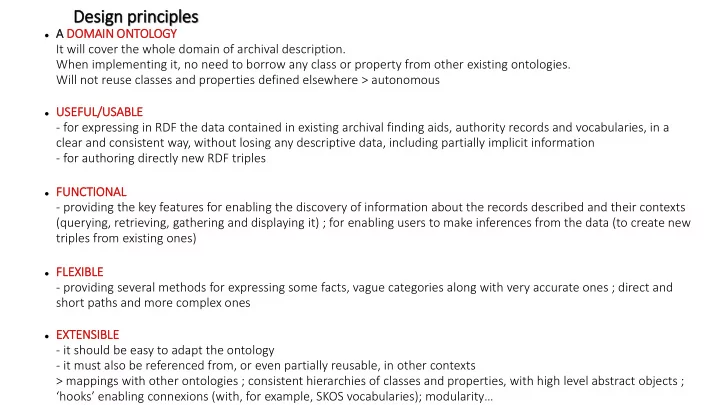
A DO DOMAIN IN ON ONTOLOGY It will cover the whole domain of archival description. When implementing it, no need to borrow any class or property from other existing ontologies. Will not reuse classes and properties defined elsewhere > autonomous

 USE

USEFUL/USABLE

  • for expressing in RDF the data contained in existing archival finding aids, authority records and vocabularies, in a

clear and consistent way, without losing any descriptive data, including partially implicit information

  • for authoring directly new RDF triples

 FUN

FUNCT CTIONAL

  • providing the key features for enabling the discovery of information about the records described and their contexts

(querying, retrieving, gathering and displaying it) ; for enabling users to make inferences from the data (to create new triples from existing ones)

 FLE

FLEXIBLE

  • providing several methods for expressing some facts, vague categories along with very accurate ones ; direct and

short paths and more complex ones

 EX

EXTENSIBLE

  • it should be easy to adapt the ontology
  • it must also be referenced from, or even partially reusable, in other contexts

> mappings with other ontologies ; consistent hierarchies of classes and properties, with high level abstract objects ; ‘hooks’ enabling connexions (with, for example, SKOS vocabularies); modularity…

slide-2
SLIDE 2

How We We Build ild RIC IC-O: Prin inciples

MAPPINGS (FOR A BETTER INTEGRATION OF OUR DATA TO LINKED DATA) The archival domain is linked to (or part of) many other ones. It is very important that our concepts (classes or properties) be compared with, and when appliable, aligned, with concepts defined in other ontologies:

  • ontologies for other domains of cultural heritage:
  • CIDOC-CRM (www.cidoc-crm.org/official_release_cidoc.html)
  • FRBRoo (http://www.cidoc-crm.org/frbr_inro.html)
  • ontologies for describing entities or events somewhat close or linked to the archival one:
  • The PROV Ontology (PROV-O) (http://www.w3.org/TR/prov-o/)
  • The Organization ontology (http://www.w3.org/TR/vocab-org/)
  • Open Archives Initiative-Object Reuse and Exchange (OAI-ORE)

(https://www.openarchives.org/ore/)

  • generic, widely used, ontologies:
  • FOAF (Friend of a Friend) (http://xmlns.com/foaf/spec/)
  • Dublin Core Metadata Initiative Terms (dcterms)

(http://dublincore.org/documents/dcmi-terms/)

  • LODE: An ontology for Linking Open Descriptions of Events

(http://linkedevents.org/ontology/)

slide-3
SLIDE 3

The ontology file iles

  • Created using Protégé software

(see https://protege.stanford.edu/)

  • Stored in a Git repository
  • For now, two files:
  • the main one contains everything

… apart from a vocabulary (using SKOS/RDF) for record set types

  • Namespace URI:

http://www.ica.org/standards/RiC/o ntology#

  • Documentation in English (some

information on the ontology itself; labels for classes and properties; definitions) is a work in progress

3

slide-4
SLIDE 4

The on

  • ntolo

logy file files as as th they wil ill probably ly be be se seen (when rele leased) by a a human reader

4

slide-5
SLIDE 5

A Part artia ial l

  • verv

ervie iew of

  • f the

the Curr urrent t Statu tus

  • f
  • f the

the Ontology

slide-6
SLIDE 6

Some issues on which we have worked or are working

  • The upper level of the hierarchies of classes and properties
  • Modelling both a high-level and practical representation of agents
  • Modelling names and name parts
  • Providing ways for categorizing things, using external SKOS vocabularies if wanted
  • An accurate hierarchy of n-ary relations
  • Representing sequences within record sets
  • Naming conventions
  • etc.

6

slide-7
SLIDE 7

A A sp specif ific ic par art

  • f
  • f RiC

RiC-O: : th the system of

  • f

n-ary rela lations

7

slide-8
SLIDE 8

Testi ting th the ontology now! A proof f of f concept t in in France

  • An ongoing project (will be finished by the end of 2017)
  • Tasks:

Converting to RDF three archival metadata sets (EAD 2002 finding aids and EAC-CPF authority records) coming from three institutions, interlinking and graphically displaying the RDF triples

  • The reference model used is the current version of RiC-O

RDF triples : high level of accuracy, a lot of (though not all) RIC-O components used > Using RiC-O for processing existing metadata is possible ☺

  • Once the project is finished, we will:
  • publish online the web application allowing to query and display the resulting graph;
  • release the scripts written for converting the metadata files
  • prepare and publish a detailed report on the targets, methods and results, including discussing

lessons and perspectives

8

slide-9
SLIDE 9

From one EAC-CPF file describing one person

… to several different interconnected RDF resources of different kinds

9

slide-10
SLIDE 10

From one EAC-CPF file describing one person

… to several dif ifferent in interconnected RDF resources

  • f dif

ifferent kin kinds

10

slide-11
SLIDE 11

11

slide-12
SLIDE 12

A A screenshot from the current versio ion of the prototype in interface

12

slide-13
SLIDE 13

Other proje jects that will ill probably soon use RiC iC-O

  • At least for aligning their ontology with RiC-O
  • The Swiss Federal Archives (and other institutions) project

A second phase after a proof of concept (see http://www.alod.ch/)

  • The SAEM (Système d’Archivage Électronique Mutualisé) of the

Département de la Gironde, the city of Bordeaux et Bordeaux métropole (France)

  • And most probably for using directly the whole ontology (or a part of

it), the SNAC Cooperative (http://snaccooperative.org/)

13

slide-14
SLIDE 14

Thank You!

14