Im Imag age-ba base sed BR d BRDF de F desi sign Guide Image - - PowerPoint PPT Presentation

im imag age ba base sed br d brdf de f desi sign
SMART_READER_LITE
LIVE PREVIEW

Im Imag age-ba base sed BR d BRDF de F desi sign Guide Image - - PowerPoint PPT Presentation

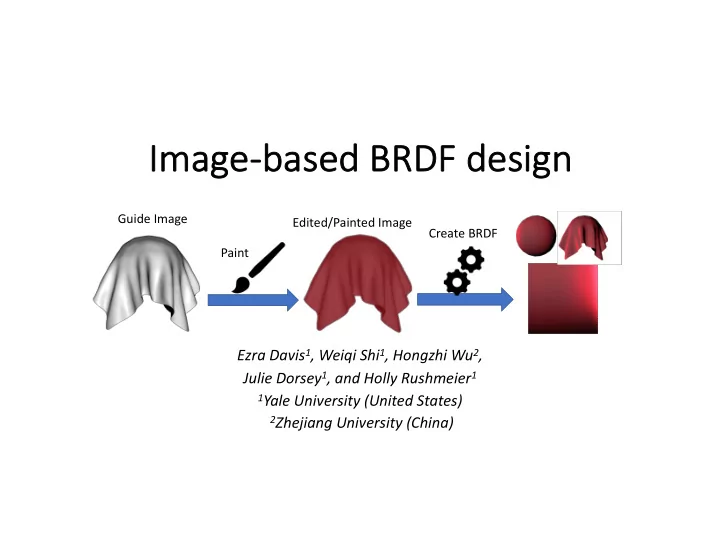
Im Imag age-ba base sed BR d BRDF de F desi sign Guide Image Edited/Painted Image Create BRDF Paint Ezra Davis 1 , Weiqi Shi 1 , Hongzhi Wu 2 , Julie Dorsey 1 , and Holly Rushmeier 1 1 Yale University (United States) 2 Zhejiang University


slide-1
SLIDE 1

Im Imag age-ba base sed BR d BRDF de F desi sign

Ezra Davis1, Weiqi Shi1, Hongzhi Wu2, Julie Dorsey1, and Holly Rushmeier1

1Yale University (United States) 2Zhejiang University (China)

Paint Create BRDF Guide Image Edited/Painted Image

slide-2
SLIDE 2

Problem Definition

  • Artists/Designers need to specify materials for rendering

digital scenes or creating new physical products. We consider the subproblem of specifying bidirectional reflectance distribution functions (BRDFs).

Physical – Product Design [2] Virtual – Games/Film [1]

slide-3
SLIDE 3

Problem Definition: Conventional methods

  • Conventional methods often do not provide much

control for the artist

  • Can be limited by being defined by fixed analytic

functions to control features such as highlights

slide-4
SLIDE 4

Problem Definition: Conventional methods Things you can’t model with simple approach:

[3] [4]

slide-5
SLIDE 5

Problem Definition: Measured BRDFs

  • Richer varieties of materials can be

captured from physical materials

  • Takes time to measure
  • Requires physical samples
  • Hard to edit by artists

Measured materials in the MERL database [5]

slide-6
SLIDE 6

Problem Definition: Our Approach

Paint Create BRDF Guide Image Edited/Painted Image

slide-7
SLIDE 7

Background: Current Design Systems

slide-8
SLIDE 8

[6] [7]

Can be powerful and general, but extraordinarily complex and indirect!

Background: Current Design Systems

slide-9
SLIDE 9

Previous Work: Gaussian Material Synthesis

  • Uses Disney’s “Principled” shader
  • Navigate parameter variations by

example

  • Gaussian Material Synthesis Zsolnai-Feher et al. ACM

TOG 2018

slide-10
SLIDE 10

Previous Work: BRDF-Shop

  • Paint highlights onto BRDF
  • BRDF-Shop: creating physically correct

bidirectional reflectance distribution functions, Colbert et al. Computer Graphics and Applications, 2006

slide-11
SLIDE 11
  • Use a painted sphere to shade an
  • bject by its normals
  • The Lit Sphere: A Model for Capturing NPR Shading

from Art, Sloan et al., Graphics Interface, 2001

Previous Work: The Lit Sphere

slide-12
SLIDE 12

Our image-based BRDF design system

Paint Calculate Guide Painted Sparse BRDF Calculate

Dense BRDF

slide-13
SLIDE 13

Our image-based BRDF design system

slide-14
SLIDE 14

Our System: Select object

  • Allows design in context for the user
  • Allows associating normal/light/view

direction for calculations

(Or Custom)

slide-15
SLIDE 15

Our System: Set light position

  • Light direction
  • Allows associating normal/light/view

direction for calculations

slide-16
SLIDE 16

Our System: Download guide image

  • Provide an image that can be

imported to any image editor

slide-17
SLIDE 17

Our System: Paint image

Any type of editing allowed:

  • Paint on image
  • Paint on an image layer
  • Adjust contrast
  • Set colors in different

ranges.

slide-18
SLIDE 18

Our System: Upload painted image

slide-19
SLIDE 19

BRDF format

Incident Theta Reflected Theta Incident Phi Reflected Phi

Theta Phi Normal

slide-20
SLIDE 20

Sparse BRDF Reconstruction

Create Sparse BRDF Reconstruct from same angle

slide-21
SLIDE 21

Sparse BRDF Reconstruction

Create Sparse BRDF

Reconstruct from different angle

slide-22
SLIDE 22

Dense BRDF reconstruction

Sparse BRDF Dense BRDF PCA Reconstruction

slide-23
SLIDE 23

Dense BRDF Reconstruction

  • Our method based on Nielsen et
  • al. paper for reconstructing

measured BRDFs from few samples

On Optimal, Minimal BRDF Sampling for Reflectance

  • Acquisition. Nielsen et al., Siggraph Asia 2015
slide-24
SLIDE 24

User Experiences

  • All of the people that used the

interface would be willing to use this method (though one artist preferred traditional parametric BRDF creation)

  • Some users like resulting image more

than their painting

slide-25
SLIDE 25

Limitations

No textures (Spatially Varying BRDFs)

Limited by BRDF tables in database

slide-26
SLIDE 26

Future work

  • Use larger database of measured

BRDFs

  • Alternate reconstruction

methods

  • Use natural images instead of

just painted ones

slide-27
SLIDE 27

Future work

  • How to present lighting

direction?

  • How is high dynamic range input

(e.g. specular highlights)

  • btained from a low dynamic

range image?

  • What other refinements and

feedback should we offer? (e.g. “blurring” the BRDF)

slide-28
SLIDE 28

Image-based BRDF design

slide-29
SLIDE 29

Questions and Comments

slide-30
SLIDE 30

Image sources

  • [1] https://all3dp.com/1/best-20-3d-animation-software/
  • [2] Photo-realistic Rendering of Metallic Car Paint from Image-Based
  • Measurements. Rump et al., Eurographics 2008
  • [3] https://jsouguan.en.made-in-china.com/product/fjdmsYwSkTcv/China-

Magic-Color-Interference-Powder-Violet-Iridescent-Pearl-Pigment-for- Paint.html

  • [4] https://www.trurofabrics.com/shot-silk-taffeta-fabric-purple-
  • range.html
  • [5] A data-driven reflectance model. Matusik et al., Siggraph 2003
  • [6] https://lesterbanks.com/2013/12/cinema-4d-creating-node-based-

materials-and-shaders-using-cmnodes/

  • [7] http://www.design-corps.co.uk/tag/slate-material-editor/
slide-31
SLIDE 31

BRDF format

Incident Theta Reflected Theta Incident Phi Reflected Phi

Theta Phi Normal

slide-32
SLIDE 32