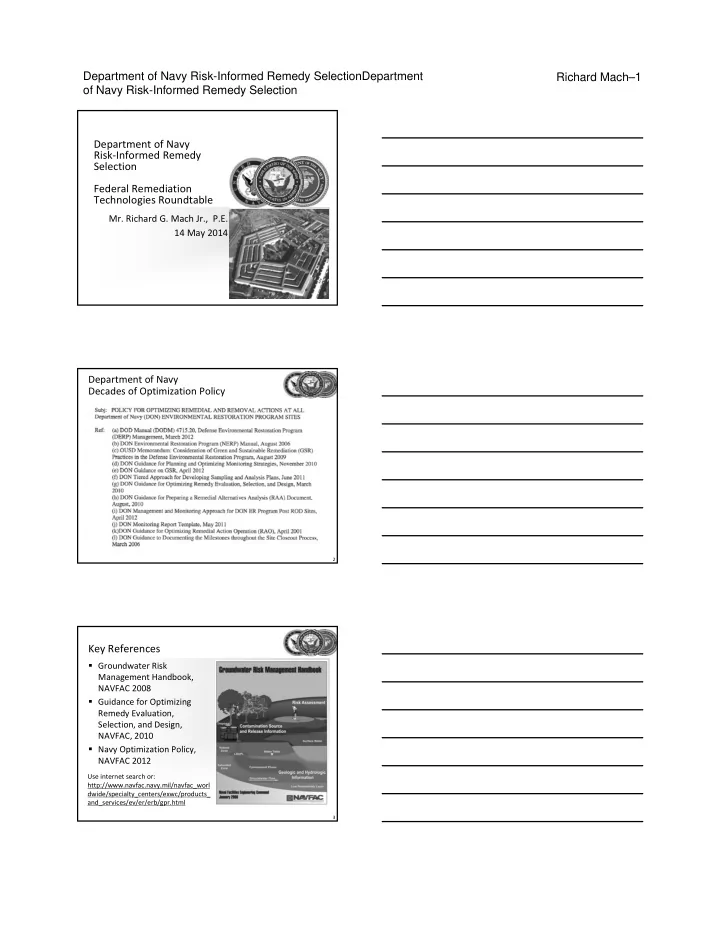
SLIDE 2 Department of Navy Risk-Informed Remedy SelectionDepartment
- f Navy Risk-Informed Remedy Selection
Richard Mach–2
Site Evaluation / CSM
- Focus on GW useability and complete exposure pathways
Risk Management
- Plume Management Zones, Point of Compliance
Remediation Strategies
- Treatment Trains, Active vs. Passive, Containment , MNA as
polishing technology
Optimization / Sustainability New Tools
- Mass flux
- Plume stability/MNA software
Navy’s Toolbox Approach
4
Typical Alternative Approaches to Groundwater Remediation
- Groundwater plume management
Some states allow for plume management zones,
alternate groundwater classification, alternate concentration limits (risk‐based)
Containment systems (focus on plume migration control
through pumping or permeable barriers)
- Treatment + MNA over long time frames
Treat source/hot spots to extent practicable followed by
MNA (often with extend timeframes) and/or other passive remediation technologies
Land‐use controls to manage potential exposure during
remediation
5
Performance Objectives and Exit Strategies
Select remediation approach to achieve objectives Define clear end‐point
Need to be developed and clearly defined Functional objectives should be specific, measurable,
attainable, relevant, and time‐bound (SMART)
When time to stop, modify, or change technology “Asymptote” and “$/kg removed” important
Identify appropriate times to transition to other components of the treatment train
6
$/KG $/KG Conc. Conc.