Nuclear Metals, Inc. Superfund Site, Concord, MA Overview of the - - PowerPoint PPT Presentation

nuclear metals inc superfund site concord ma overview of
SMART_READER_LITE
LIVE PREVIEW

Nuclear Metals, Inc. Superfund Site, Concord, MA Overview of the - - PowerPoint PPT Presentation

Nuclear Metals, Inc. Superfund Site, Concord, MA Overview of the Site Remedy 1 Outline Site Background / Regulatory History Remedy Framework RD/RA Process and Schedule Post-Remedy Considerations, Effect of Institutional Controls


slide-1
SLIDE 1

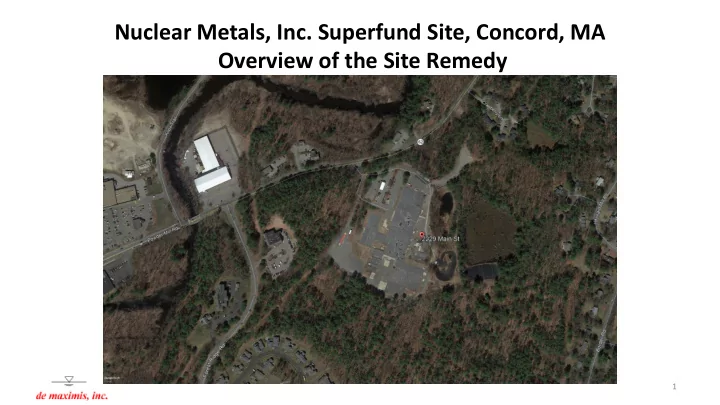
Nuclear Metals, Inc. Superfund Site, Concord, MA Overview of the Site Remedy

1
slide-2
SLIDE 2

Outline

  • Site Background / Regulatory History
  • Remedy Framework
  • RD/RA Process and Schedule
  • Post-Remedy Considerations, Effect of Institutional Controls on

Reuse Scenarios

  • Components of the NMI Remedy

➢ Sitewide Soils & Sediments ➢ Holding Basin Physical Containment ➢ In-Situ Sequestration of Depleted and Natural Uranium ➢ Hydraulic Containment and Ex-Situ Treatment of 1,4-dioxane and VOCs ➢ 1,4-dioxane and VOCs in Bedrock Groundwater

  • November 2019 Groundwater Sampling Event

2

slide-3
SLIDE 3

Site History

1959 – 1972: Conducted research and development with specialty metals (Be, Zr, Y, Hf, Pt, Mo, Nb, W, Ta, Ti, Th, Depleted Uranium (DU), U, and cermets) 1972 – 2003: Large scale production of DU “penetrators,” DU armor and counterweights, and Thoriated Tungsten rods 2003 – 2011: Produced Beryllium/Be-Cu/Be-Al and Ti alloys, and Spherical Metal Powders (Al, Ti, Ni)

Regulatory History / Actions

1980 – 2001: Investigations by NMI / Starmet as required by MassDEP and MADPH-RCP June 2001: Site listed by EPA on “National Priorities List” 2002 – 2003: EPA removal actions (covered Holding Basin and Old Landfill Area) 2003 – 2015: Remedial Investigation / Risk Assessment / Feasibility Study 2005 – 2006: MassDEP removes drums and DU metal from buildings with US Army funding 2008: EPA removal action (flammable and combustible materials from buildings) 2015: EPA issues Record of Decision (ROD) setting forth site remedy 2011 – 2016: Removal action to empty buildings contents and demolish buildings 2016 – present: Removal action to hydraulically contain and treat impacted groundwater migrating to Acton production wells

3

slide-4
SLIDE 4

Site Features

(August 1984 photo)

Cooling Water Pond

Sphagnum Bog Old Landfill Area

“Sweepings” Piles

Holding Basin

North

GW Flow

Towards Assabet River ~500 feet NW

150 feet

Rt 62

4

slide-5
SLIDE 5

Regulatory Framework for Upcoming Remedy

  • Remedial work needed at the NMI Site was selected and documented in the USEPA’s

2015 “Record of Decision” or “ROD”. ➢ The ROD specifies the actions needed to address unacceptable risks to human health and the environment posed by site-related contaminants in soil, sediment, and groundwater, as wells as the cleanup levels for the remedy to achieve. The ROD cleanup levels assume the potential for future residential use of the site.

  • On December 6, 2019, the Massachusetts Federal Court entered the Consent Decree

(CD) and Statement of Work (SOW) that will require the funding and performance of the work required by the ROD. ➢ This work is termed the “Remedial Design / Remedial Action” or “RD/RA”. ➢ The CD generally addresses the legal aspects (including funding of the work), and the SOW describes the technical requirements for the RD/RA.

  • The USEPA will oversee the work, with input from the MassDEP.

5

slide-6
SLIDE 6

Components of the NMI Remedy

The NMI remedy will be implemented as five parallel projects, each addressing a different aspect of the work required by the ROD and CD. The five projects include:

  • 1. Excavation and off-site disposal of contaminated soil and sediment, building

foundations and sub-slab soil, and restoration of affected areas;

  • 2. In-situ Sequestration (ISS) of depleted uranium (DU) in the Holding Basin (HB) soils,
  • f DU in overburden groundwater, and of natural uranium in bedrock groundwater;
  • 3. Containment of the Holding Basin soils with a low-permeability vertical wall and

horizontal sub-grade cover;

  • 4. Hydraulic containment (pumping) and ex-situ treatment of VOCs and 1,4-dioxane in

groundwater (already initiated under the Groundwater Removal Action); and,

  • 5. 1,4-dioxane and VOCs in bedrock groundwater (bedrock starts ~100’ below ground
  • surface. The need for this project was identified during the Removal Action.

6

slide-7
SLIDE 7

RD Project Team

7

EPA Chris Smith Remedial Project Manager MassDEP Garry Waldeck Project Manager de maximis, inc. - General Contractor Bruce Thompson - Project Coordinator Jessie McCusker - Site-Wide Soils and Sediments and Holding Basin Containment Amy Hoffman – ISS and Sitewide Monitoring Nathan Hunt – HCTS O&M and1,4-D in Bedrock Geosyntec Consultants Carl Elder, Ph.D., P.E. – Overall PM ISS and 1,4-D in Bedrock Dave Adilman, P.G. – Task Manager Haley & Aldrich, Inc. Mark Kelley, P.E. – Overall PM Site-Wide Soils and Sediments Mark Kelley, P.E. – Task Manager Holding Basin Containment Tim Crowl, P.E. – Task Manager ddms, inc. Heidi Gaedy Database Website, GIS, Project Portal Polly Newbold Data Validation O&M, Inc. Nicolas Carabillo HCTS O&M PM AECOM Andy Schukta EPA Oversight Contractor Community Groups Town of Concord Reuse Cmte 2229 Main St Cmte CREW Green Acton Laboratories Alpha Analytical GEL Drilling TBD DDES, Inc. Matt Norton, CIH, CSP Radiation Safety Officer

slide-8
SLIDE 8

The RD/RA Process

Superfund site remedies all use the same framework, defined by a series of reports, which will include: ▪ Remedial Design Work Plan (RDWP). The RDWP overviews the project goals and requirements, and describes the Pre-Design Investigations (PDIs) and Treatability Studies (TS) needed to conduct the design. ▪ PDIs and TS are then performed and reported. EPA approval that PDIs and TS are sufficient trigger the start of the Remedial Design (RD). ▪ The RD is a step-wise process. It will progressively detail and refine the design and associated plans. RD steps include: ▪ Preliminary or “Conceptual” (30%) Design ▪ Intermediate (60%) Design (can be bypassed with EPA’s approval) ▪ Pre-Final (95%) Design ▪ Final (100%) Design ▪ The Remedial Action will then be implemented according to the Final Design, and documented in a “Construction Completion Report.”

8

slide-9
SLIDE 9

Timing for Major Deliverables

  • RDWP due 60 days after the later of EPA approval of

Supervising Contractor or first funding of RD/RA Trust.

  • 30% RD due 90 days after EPA approves PDI Report (and for

ISS, TS Report)

  • 60% RD (we expect to skip this deliverable)
  • 95% RD due 60 days after receipt of EPA comments on 30% RD.
  • 100% RD due 14 days after receipt of EPA comments on 95%

RD.

  • Remedial Action Work Plan due 90 days after EPA

authorization to proceed.

9

slide-10
SLIDE 10

Conceptual RD/RA Schedule

Process Step Duration (includes preparation, Agency review, and revision) Notes

RDWP ~6 - 9 months PDIs and TS ~6 – 18 months Longest duration is for ISS TS. Preliminary Design ~6 months Pre-Final Design ~6 months Final Design ~3 months Remedial Action ~1 – 3 years Longest duration is for site-wide soil and sediment excavation

Totals – through end of RA* ~4.25 – 6.5 years

* This is a best case schedule projection.

10

slide-11
SLIDE 11

Remedial Design Work Plan (RDWP)

The RDWP summarizes pertinent Site information, and identifies and describes:

  • the scopes and procedures for various pre-design investigations,
  • the anticipated RD process, and
  • the various RD-related deliverables and schedule.

The RDWP will include appendices to describe a variety of studies to support the design, including: – Site-wide Soils and Sediment PDI WP (Appendix A) – ISS PDI WP (Appendix B) – HB Containment PDI WP (Appendix C) – 1,4-dioxane and VOCs in Bedrock Groundwater PDI WP (Appendix D) – ISS Treatability Study Work Plan (TSWP) (Appendix E)

11

slide-12
SLIDE 12

RDWP – “Supporting Deliverables”

The RDWP will include the following supporting deliverables needed to manage the Site and to implement the PDIs and TS:

  • Post-Removal Site Control (PRSC) Plan pursuant to the Building

NTCRA - Appendix F.

  • Health and Safety Plan (HASP) – Appendix G
  • Emergency Response Plan (ERP) – Appendix H
  • Sampling and Analysis Plan

– Field Sampling Plan (FSP) – Appendix I – Quality Assurance Project Plan (QAPP) – Appendix J

  • Sitewide Monitoring Plan (SWMP) – Appendix K
  • Community Relations Support Plan (CRSP) – Appendix L

12

slide-13
SLIDE 13

Community Involvement in the RD/RA Process

  • The RDWP will include a “Community Relations Support Plan”

(CRSP).

  • The CRSP will name Bruce Thompson of de maximis, inc. as

the Community Involvement Coordinator.

  • All major deliverables (e.g., RDWP, PDI Reports, RDs) will be

shared with community groups after EPA performs initial quality review.

  • Design team (de maximis, Haley & Aldrich, Geosyntec), EPA,

and MassDEP representatives will meet with community groups to discuss comments on major deliverables. Expect separate meetings for each PDI WP.

13

slide-14
SLIDE 14

Post-Remedy Considerations

  • The site will become available for reuse after acquisition of the

property by Concord and completion of the remedial projects.

  • If a reuse will involve construction of new buildings over an area
  • f VOCs in groundwater, an evaluation of the potential for vapor

intrusion will be conducted. Mitigation will be provided, if needed.

  • Some limits on future use, called “institutional controls” (deed

restrictions) will need to be enacted on the property. These are detailed on the next slide.

  • Monitoring of groundwater and maintenance of the Holding

Basin and groundwater pump and treat system will continue into the foreseeable future.

14

slide-15
SLIDE 15

Effects of Institutional Controls on Reuse Scenarios

The CD requires certain institutional controls. These will include prohibitions on: ➢ Excavating where contamination above cleanup levels may exist at depths > 10’ below ground surface (Areas A-1 & D) ➢Construction on or excavation into the capped HB area (Area B) ➢ Use of impacted groundwater (until such time as cleanup levels are met) (Areas A, B, & D). ➢Disturbance of groundwater monitoring wells (Site- wide – if needed, wells could be converted to flush mount, so would not obstruct traffic) ➢In addition, long-term easements will needed to provide for access to perform maintenance and monitoring.

15

slide-16
SLIDE 16

Sitewide Soils and Sediment

  • Excavate ~82,500 yards3 of soils and sediments, generally located at the

Cooling Water Pond, South-west edge of Bog, “saddle” between pond and bog, Old Landfill Area, “Sweepings Piles” area, Courtyard Area, North-east Drain Outfall, Building slabs, surrounding pavement, and impacted sub-slab and pavement soil.

  • Confirm excavation has met cleanup levels. If not, continue excavation. (Note

– maximum excavation depth will be to 10’ below ground surface – which allows for construction of future foundations and utilities).

  • Backfill excavations with clean soil.
  • Transport and dispose of excavated materials at off-site location.
  • Restore site and monitor vegetation planted during restoration.

16

slide-17
SLIDE 17

Soil / Sediment Remediation Areas

Estimated Volume* ~82,500 cubic yards

*Note – this is starting point, final scope dependent on PDI and confirmatory sampling during RA.

17

slide-18
SLIDE 18

Sitewide Soils and Sediment – Pre-Design Investigation

Five PDIs will be performed to further characterize the limits of soil and sediment excavation, and to refine the means and methods of construction for the site wide soil and sediment remedy. PDIs include:

  • 1. soil and sediment sampling focused on refining the design,
  • 2. Sub-slab soil sampling;
  • 3. Cooling Pond SW-GW and Gabion Wall Evaluation;
  • 4. On-site Borrow Source Evaluation; and,
  • 5. Survey for depleted uranium (DU) fragments.

18

slide-19
SLIDE 19

In-situ Sequestration (ISS)

  • ISS will involve mixing or injecting a phosphate reagent into

the soil that changes DU or U into a stable, non-leachable

  • mineral. “Treatability Studies” will be used to identify

reagents and prove their efficacy. ISS will be used:

– beneath the Holding Basin, where the highest concentrations of DU are present, – to treat DU in overburden groundwater, and – may be used for U in bedrock groundwater (if needed).

  • Contaminant concentrations in groundwater will be monitored

to assess treatment effectiveness.

19

slide-20
SLIDE 20

Conceptual ISS Locations (Plan as of 2015 ROD) U in Bedrock DU in Overburden

Extent of Overburden or Bedrock Groundwater Exceeding Safe Drinking Water Level

DU in HB

20

slide-21
SLIDE 21

In-situ Sequestration (ISS) – Pre-Design Investigation and Treatability Studies

Four PDIs – will include: 1. Site-Wide Groundwater Sampling 2. Injection Pilot Testing in Saturated OB 3. Bedrock Pumping and Rebound for U 4. ISS Pilot Testing in BR groundwater dependent on results of PDI 3 TS will include:

  • Batch and column laboratory tests to assess the effectiveness of several

possible stabilizing agents (e.g., solid versus aqueous amendments) for DU in the HB, DU in overburden groundwater, and if needed, for U in bedrock

  • groundwater. Testing will use site soil and groundwater and will consider

the various geochemical regimes and geologic conditions expected at the site (e.g., aerobic versus anaerobic, and overburden versus bedrock).

21

slide-22
SLIDE 22
  • Install vertical containment wall around HB and low-permeability below grade

cap, then backfill to bring basin up to grade. ➢Perform hydraulic containment (groundwater pumping) if needed during construction to minimize potential for worsening DU migration. ➢Design objectives include 90-99% reduction in mobility or concentrations through ISS treatment and physical containment. This aspect of remedy will be designed to last a minimum of 200 years.

  • Install asphalt cover. Design will assume future use as parking.
  • Perform long-term O&M (maintenance of cap, monitoring of HB).

➢ Design and implementation of ISS of Holding Basin soils will be closely coordinated with the construction of the vertical containment wall and cap.

22

Holding Basin Physical Containment

slide-23
SLIDE 23

Holding Basin Physical Containment

23

Holding Basin

slide-24
SLIDE 24

Holding Basin Physical Containment – Pre-Design Investigation

Five PDIs will be performed to: 1. define the subsurface conditions along the alignment of the Holding Basin containment wall; 2. collect data for the seismic analysis for the wall design; 3. collect data for determining the mix design for the wall construction including both the slurry mix and concrete mix design; 4. collect data to refine the cap design for the holding basin footprint and for slope stability analysis for slurry wall excavation; and, 5. perform seepage analysis to evaluate the hydraulic properties of the containment wall and to evaluate the necessary depth of the wall to meet the design objectives for the overall remedy of the ISS and containment wall system.

24

slide-25
SLIDE 25

Ex-situ Treatment of VOCs and 1,4-dioxane in Groundwater

25

de maximis, inc. Project Manager – Nathan Hunt

  • Initiated prior to RD/RA to control migration of contaminated groundwater

towards Acton’s production wells. Consists of hydraulic containment (pumping), treating that water, and then discharging it to the Assabet River. Treatment system located on Knox Trail in Acton ➢ Temporary system started in May 2017 to expedite containment pending design and construction of final treatment system. ➢ Final treatment system started in May 2019, uses UV oxidation to destroy contaminants.

  • System operation to continue until groundwater cleanup levels are attained.
slide-26
SLIDE 26

Overburden 1,4-Dioxane Plume (September 2019)

26

Estimated Capture Zone for EW-1 at 19.6 gpm

EW-1

slide-27
SLIDE 27

1,4-Dioxane and VOCs in Bedrock

  • Monitoring during groundwater removal action identified an

area of 1,4-dioxane and VOCs in bedrock groundwater above the ROD cleanup levels.

  • This groundwater would not be effectively remediated by the

current pump and treat system.

  • Further investigation necessary as part of the RD process to

support design and implementation of a remedial approach.

27

slide-28
SLIDE 28

1,4-Dioxane and VOCs in Bedrock

  • Two PDIs will include:
  • 1. Installation of additional monitoring wells, and
  • 2. pumping and rebound testing for 1,4-dioxane.

28

slide-29
SLIDE 29

Bedrock PDIs U and 1,4- Dioxane

29