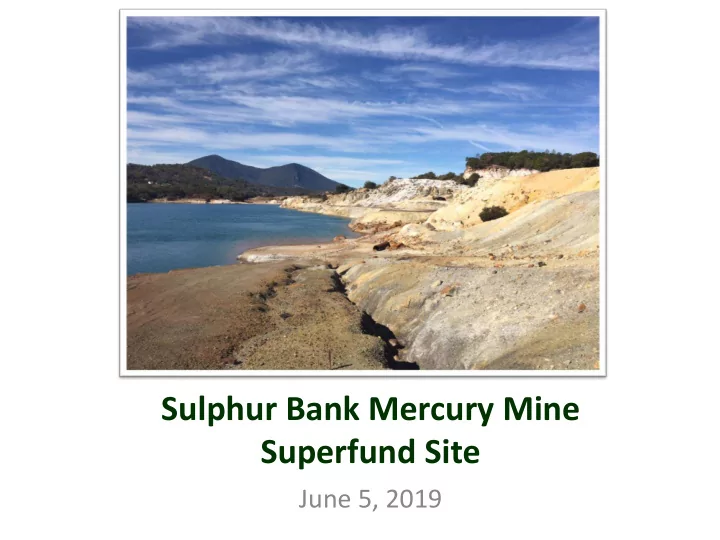
Sulphur Bank Mercury Mine Superfund Site June 5, 2019 Presentation - - PowerPoint PPT Presentation
Sulphur Bank Mercury Mine Superfund Site June 5, 2019 Presentation Overview Introduction of EPA Staff Site Overview Superfund Process EPA Actions to-date at SBMM Site Impacts on Clear Lake Water Quality Next steps
Presentation Overview
- Introduction of EPA Staff
- Site Overview
- Superfund Process
- EPA Actions to-date at
SBMM
- Site Impacts on Clear
Lake Water Quality
- Next steps
- Discussion
Key EPA Team Members
Carter Jessop, Project Manager Kelly Manheimer, Section Chief Alejandro Díaz, Community Involvement Coordinator Margot Perez-Sullivan, EPA Office
- f Public Affairs
John Lucero, E2 Consulting Engineers
Site Overview
Sulphur Bank Mercury Mine
- Operated on and off 1865 to
1957
- Produced 7 million pounds of mercury
- Added to
the Superfund list in 1990
- Fish consumption advisory for Clear Lake
Principle Site Contaminants:
- Mercury and arsenic in soils
- Mercury in sediment and fish
tissue
Located on Oaks Arm of Clear Lake, south of Clearlake Oaks, adjacent to the Elem Indian Colony
Major Mine Site Features
Source Areas – Waste Rock Piles – Ores Piles – Tailings Pile – Disturbed and Native Rock – Northwest Pit – Mining Facilities/Buildings Herman Impoundment (HI) Waste Rock Dam (WRD) Off-Site Residential Soils – Elem Indian Colony – BIA 120 – Sulphur Bank Mine Road neighborhood
5
Site Overview
Terrestrial Mine Site and Residential Soils Operable Unit 1 Lake Sediments and North Wetlands Operable Unit 2
Superfund Process
- Comprehensive Environmental
Response and Compensation Act (CERCLA) - “Superfund”
- Established in 1980
- EPA performs cleanups
performed under two authorities:
– Removal Process – discrete action, usually < $2 million – Remedial Process – more complex, higher cost
6/6/2019 U.S. Environmental Protection Agency 7
1 2 3 4 5 6 7 8 9
OU-1 OU-2
Preliminary Assessment / Site Inspection Placement on the National Priorities List (NPL) Remedial Investigation (RI) Feasibility Study (FS) Proposed Plan (PP) Record of Decision (ROD) Remedial Design (RD) Remedial Action (RA) Long-Term Operations & Maintenance (O&M) Community involvement and planning for a site’s future reuse are integral parts of the entire process.
Early actions to protect human health
The Remedial Process
Actions to Reduce Exposure
Human Health
– Site Controls (Fencing) – Removal of soils, replacement of homes and infrastructure on EIC (1997,1998,2006) – Geothermal well closures (2000-2001) – Removal of soils from Sulphur Bank Mine Road residential area (2008) – Pomo Road cleanup (2010)
Clear Lake
– Stabilization of Waste Rock Dam (1992) – Stormwater Diversion/Pipeline (1999-2000) – Sediment test caps in Clear Lake (2012-2016)
Water Quality
SBMM Impacts on Clear Lake Water Quality
4 pathways SBMM contaminants to enter Clear Lake
- 1. Direct placement during
mining operations
- 2. Erosion of mine waste, usually
stormwater or direct sloughing
- f unstable areas
- 3. Overflow of Herman
Impoundment
- 4. Mine-impacted groundwater
discharges into the lake, primarily HI water moving through the WRD
Conceptual Site Model
Revised Site Understanding
Changes in Herman Impoundment water quality
- Stormwater divisions and drought led to improved water quality in
Herman Impoundment – pH from around 3 to nearly 5
- Capping the exposed mine waste at the site would further:
- Reduce acid rock drainage
- Reduce hydraulic head pushing water through WRD
- Reduce contaminant loading into Clear Lake
- Once waste is capped, HI water chemistry modeled to move toward
background groundwater quality
OU-1 Focused Feasibility Study
The Focused FS brings together all of the information gathered about OU-1 of the SBMM Site and compares remedial alternatives
- Draft-Final Focus Feasibility Study complete
- Incorporating input from CA Department of Toxic Substances
Control, Central Valley Waterboard, and Elem Tribe
- 3 new alternatives proposed by Elem Tribe - screening of these
alternatives now complete
- Finalization of FFS will allow next steps toward Proposed Plan
for OU-1 cleanup
13
Water Quality Part 2
- Mercury binds to soil and sediment
- Clear Lake water contains low/safe levels of mercury
- Methylation of mercury makes it available for biological uptake
- Primary pathway for exposure – methylmercury in fish
- Poor correlation between sediment concentrations and fish
tissue concentrations - additional study needed
Fish Consumption Advisory
CA OEHHA Fish Advisory, Updated August 2018
6/6/2019 U.S. Environmental Protection Agency
Remedial Investigation OU-2
Additional Study Needed
- Data collection since 1980
- EPA sponsored work by UC Davis, USGS, others
- No firm answers on effect of remedial action alternatives
- Proposed USGS partnership
- Coordination with Blue Ribbon Committee sampling work
16
Other Ongoing Work
Site-wide Human Health Risk Assessment
- Sampling in coordination with Elem cultural practices
- Looking at exposure pathways and rates specific to tribes
- Considering traditional foods
Waste Rock Dam Flux Monitoring
- Better quantify total Hg moving
through the WRD
Background Soils Investigation
- What would levels of contaminants
be were it not for SBMM mine?
Stormwater BMP Repairs
- Scheduled for fall 2019
18
Non-Time Critical Removal Action
Northwest Waste Rock Pile
- Adjacent to and partially in
North Wetlands, Elem lands
- Placement into NW Pit
- Consistent with final remedy
- Reduces risk to public and
environment
- Engineering Evaluation/Cost
Analysis pending – late 2019
- Public meeting before
finalization
6/6/2019 U.S. Environmental Protection Agency
Tribal Consultation
Government-to-government consultation
- Meaningful communication and coordination between EPA and tribal official
- Invite open dialog with all interested Lake County Tribes
Coordination with Elem Tribe
- Working with the Elem Environmental
Department since 1990
- Superfund Cooperative Agreement to facilitate
Elem involvement
- Feedback throughout FFS process
- Regular communication and coordination on field
work, site plans and document development
- Input on outreach and education
- Tribal monitors