SLIDE 1
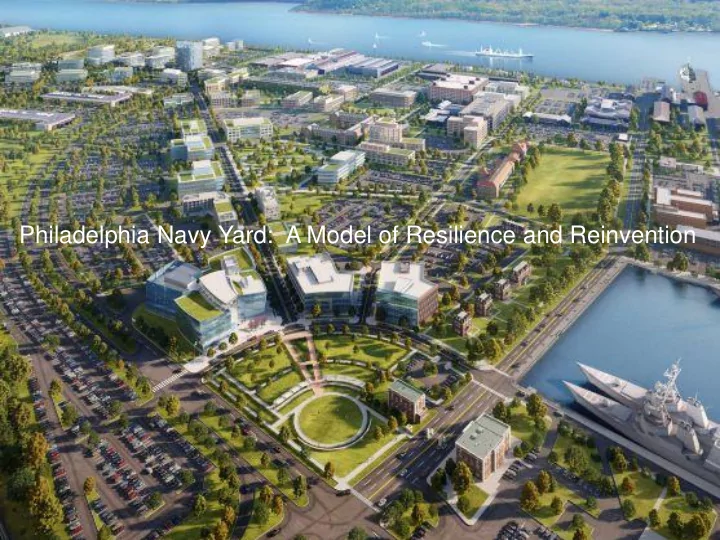
Philadelphia Navy Yard: A Model of Resilience and Reinvention
SLIDE 2
The Continental Navy is founded in Philadelphia in 1777
SLIDE 3
Naval Act of 1794 creates U.S. Navy shipyard in Philadelphia
Located on Delaware River adjacent to central city
SLIDE 4
Shipyard enlarges and moves in 1876 to remote League Island at the foot of Broad Street in South Philadelphia
Original home on Front Street New home at League Island
SLIDE 5
U.S. Navy Base and shipyard operate for 120 years, through 1996, at League Island site
SLIDE 6
Industry at the Navy Yard is an economic engine for Philadelphia which is known as the “Workshop of the World”
SLIDE 7
At its peak in WW II, the Navy Yard employed 58,000 people
In its 200 year history, the Navy Yard built 119 ships.
SLIDE 8
Many well-known visitors were welcomed at the Navy Yard
President Franklin Roosevelt Judy Garland
SLIDE 9
Base closures of 1991 include Philadelphia Navy Yard – results are devastating for Philadelphia and region
More than 18,000 direct and indirect jobs lost Annual loss of over $180 million in direct income Annual loss of $56 million in state and local government revenues Lay-offs resulted in a one-time unemployment cost of $42 million
SLIDE 10
How to recover: City officials, experts and students engaged in planning and visioning exercises to identify possible reuse
SLIDE 11
Reviving the Navy Yard required coordinated leadership of government at all levels along with private investors
SLIDE 12
Potential enhanced by an ideal location in the city and region
Centralized location for regional workforce of more than 3 million employees Access to: Major highways International airport Center City University City Intercity rail terminal Sports complex
SLIDE 13
Master Plan 2004, updated 2013, by RAM Stern Associates
SLIDE 14 20 years later: Improved infrastructure and a vibrant campus
employees
Navy activities
million SF occupied
private investment
publicly funded infrastructure improvements
SLIDE 15
Campus provides activities and amenities for employees
SLIDE 16 The Navy Yard is an historic preservation success story
Over 30 buildings have been historically
preserved buildings are used as office space.
SLIDE 17
Urban Outfitters world headquarters relocates to the Navy Yard
SLIDE 18
Renovates abandoned Navy buildings, employs 2,200 people
SLIDE 19
Reuse of key abandoned dry docks helps build new industries
Aker Shipyard manufacturers US merchant shipping vessels
SLIDE 20
Exploiting unique assets: dry docks for industry and recreation
Urban Outfitters campus Aker shipyard
SLIDE 21
Glaxo SmithKline builds double LEED Platinum offices
Navy Yard provides opportunity for more sustainable, flexible work environment than typical downtown high rise building
SLIDE 22 Tasty Baking Company, largest LEED Silver bakery in the world
Former Tasty
inefficient multi-story building New, high-efficiency plant moves to 24 hour
SLIDE 23
LEED certified hotel opens in January 2014, second scheduled
Increase in business drives need for hospitality services
SLIDE 24
Energy Efficiency in Buildings (EEB) hub established in 2010
Consortium of universities and private companies, with federal support, explore ideas for energy efficiency in buildings
SLIDE 25
New high-technology companies are clustering on the campus
Research and industrial facilities for biotech and manufacturing are in construction: Adaptimmune, Axalta and Wuxi Apptec
SLIDE 26
New infrastructure: storm-water management, solar cells and an unregulated micro-grid for electricity
SLIDE 27
Central Green Park opens in 2015 creating a new public place
SLIDE 28
Preparing for the future – more density, better public space
SLIDE 29
Green space is key to sustainability and long-term resilience
SLIDE 30
Good plan and patience will complete the Navy Yard over time
SLIDE 31 Projected economic impact at completion is substantial
- 30,000 employees
- 1,500 residential units
- +15 million SF
- $4 billion of investment
- $11 billion of local and state impact annually
- $275 million of state and local tax revenue annually
- Compelling alternative to further-out suburbs
- Not a substitute for downtown which has 200,000
employees
SLIDE 32 Key elements for resilience of the Navy Yard
- A good mix of preservation and innovation, re-use and
re-invention
- Strong public sponsorship around planning,
infrastructure and a long-term vision
- Strong private sponsorship that invests – resources,
credibility and brand identity – to establish market fundamentals
- Economic and tax incentives to attract capital
- A public-private partnership that provides stewardship
and a vehicle for implementation
- Commitment to sustainable buildings
SLIDE 33
Philadelphia thanks the Organization of World Heritage Cities