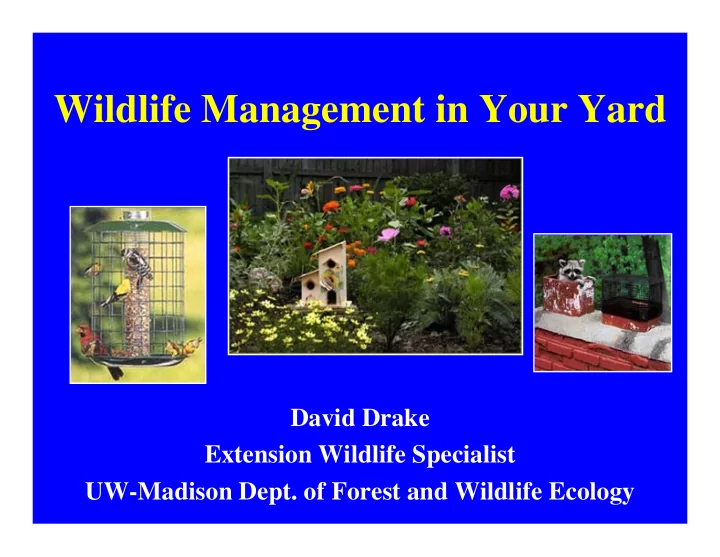
Wildlife Management in Your Yard David Drake Extension Wildlife - - PowerPoint PPT Presentation

wildlife management in your yard
SMART_READER_LITE
LIVE PREVIEW

Wildlife Management in Your Yard David Drake Extension Wildlife - - PowerPoint PPT Presentation

Wildlife Management in Your Yard David Drake Extension Wildlife Specialist UW-Madison Dept. of Forest and Wildlife Ecology 5.6 million residents (2010) 68% reside in urban/suburban areas 143,000 new homes built since 2000


slide-1
SLIDE 1

Wildlife Management in Your Yard

David Drake Extension Wildlife Specialist UW-Madison Dept. of Forest and Wildlife Ecology

slide-2
SLIDE 2
slide-3
SLIDE 3
  • 5.6 million residents

(2010)

  • 68% reside in

urban/suburban areas

  • 143,000 new homes

built since 2000

slide-4
SLIDE 4

Wisconsin’s Vertebrate Wildlife

  • 408 avian species
  • 71 mammal species
  • 36 reptiles
  • 21 snake sp.
  • 11 turtle sp.
  • 4 lizard sp.
  • 19 amphibians
  • 12 frog sp.
  • 7 salamander sp.
slide-5
SLIDE 5

Backyard Wildlife

  • Nocturnal (and diurnal)
  • Fragmented habitats
  • Adaptable
  • Opportunistic
slide-6
SLIDE 6

Cast of Characters (aka Winners)

slide-7
SLIDE 7

Cast of Characters

slide-8
SLIDE 8

Losers

slide-9
SLIDE 9

Habitat

  • Food
  • Water
  • Shelter
  • Space
slide-10
SLIDE 10

Food

slide-11
SLIDE 11

Food

slide-12
SLIDE 12

Habitat

  • Food
  • Water
  • Shelter
  • Space
slide-13
SLIDE 13

Habitat

  • Food
  • Water
  • Shelter
  • Space
slide-14
SLIDE 14

Habitat

  • Food
  • Water
  • Shelter
  • Space

Forbs & Shrubs Young woodlands Mature woodlands Grasses

TIME >>>>>>>>>>>>>>>>>>>>>>>>>>>>>>>>>>>>>>>>>>>>>>>>>>>>

slide-15
SLIDE 15

Habitat Diversity = Wildlife Diversity

slide-16
SLIDE 16

Habitat Quality & Quantity

  • Amount of turf
  • Snags
  • Brush piles
slide-17
SLIDE 17

Habitat Arrangement

  • Percent of open space
  • Size and shape of open space
  • Fragmentation and edge
slide-18
SLIDE 18

Additional Space Considerations

  • Neighbor cooperation
  • Regional and landscape context
slide-19
SLIDE 19

Wildlife Corridors

  • Travel
  • Habitat
  • Refuge
slide-20
SLIDE 20

Wildlife Management Plan

  • Identify objectives
  • Habitat assessment
  • Implement management plan
  • Evaluate plan
slide-21
SLIDE 21

Landscaping Tips

  • Develop a plan
  • Budget and timeline
  • Go native!
  • Consider all 4 seasons
slide-22
SLIDE 22

Examples of Native Plants

Trees

  • Black and Pin Cherry – summer
  • American Mountain Ash – fall
  • Hackberry – winter
  • Eastern Red Cedar – winter
  • Hawthorn – winter
  • Oaks – nut trees

Shrubs

  • Serviceberry – early summer
  • Chokecherry – early summer
  • Blackberries – midsummer
  • Raspberries – midsummer
  • American Elderberry – midsummer
  • Dogwood - fall
  • Sumac - winter
slide-23
SLIDE 23

Landscaping Tips

  • Conifers
  • Nut and acorn

producing plants

  • Grasses and legumes
  • Nectar-producing

plants

slide-24
SLIDE 24

Landscaping Tips

  • Summer-fruiting

plants

  • Fall-fruiting plants
  • Winter-fruiting plants
  • Vines
slide-25
SLIDE 25

Citizen Science

  • www.birds.cornell.edu/pfw
  • www.audubon.org/bird/citizen/index.htm
  • www.wisnatmap.org
slide-26
SLIDE 26

Additional Resources

  • wildlife.wisc.edu
  • dnr.state.wi.us
  • Landscaping for Wildlife by Carrol

Henderson (MN DNR)

  • Wisconsin’s Native Plant Society

(http://wisplants.uwsp.edu/BCW/)

slide-27
SLIDE 27
slide-28
SLIDE 28
slide-29
SLIDE 29
slide-30
SLIDE 30
slide-31
SLIDE 31
slide-32
SLIDE 32
slide-33
SLIDE 33
slide-34
SLIDE 34
slide-35
SLIDE 35
slide-36
SLIDE 36
slide-37
SLIDE 37
slide-38
SLIDE 38
slide-39
SLIDE 39
slide-40
SLIDE 40
slide-41
SLIDE 41